


Automotive wire is a broad term. A 12 V vehicle harness, a battery lead, and an electric vehicle high-voltage circuit do not use one interchangeable cable. For a low-voltage harness, the useful starting point is the circuit, the wire’s construction, its route through the vehicle, and the connector at each end.
This guide explains where common primary-wire types fit, how to compare GXL and TXL, and when moisture control needs attention. It also shows what to ask a supplier before specifying a wire. The dimensions below are a worked example from TEBAOFLEX’s published GXL/TXL construction, not universal dimensions for every manufacturer’s wire.
What is automotive wire?
Automotive wire is an insulated conductor used in vehicle electrical systems. For low-voltage harness circuits such as lighting and controls, the relevant subset is automotive primary wire, usually stranded for routing. The label alone does not specify conductor size, insulation material, temperature rating, voltage rating, or moisture protection; check the particular wire specification.
In North American specifications, SAE J1128 covers low-voltage primary cable for surface vehicles with nominal system voltages up to 60 V DC or 25 V AC. Its scope describes limited exposure to fluids and physical abuse. A reference to the standard is a starting point for checking a construction, not evidence that every wire sold as “automotive” is suitable for every location in a vehicle.
Which automotive wire type belongs in which circuit?
The circuit sets the first boundary. Automotive primary wire serves low-voltage harness runs; battery cable, data cable, and high-voltage traction cable meet different needs. Within primary wire, insulation material and wall thickness affect routing space, temperature rating, and connector-seal fit. Select the wire category for the circuit before comparing color or AWG.
Common labels are GPT, a PVC-insulated general-purpose construction, and the crosslinked-polyethylene GXL, TXL, and SXL families. TXL is the thin-wall member of the latter group. Check the supplier drawing for actual dimensions and ratings; Southwire’s GXL/TXL/SXL specification illustrates the distinction. GPT is also documented in its separate manufacturer specification.
| Application question | Wire category to investigate | What to verify before choosing |
|---|---|---|
| Is this an ordinary low-voltage harness circuit? | Automotive primary wire, including specified GXL or TXL constructions | Voltage, temperature, conductor size, insulation, route, connector seal |
| Is this a battery or starter lead? | Battery cable specified for that duty | Current, temperature, flexing, terminal, and the applicable battery-cable specification |
| Is this CAN or another OEM-specified data/noise-sensitive circuit? | The specified data-cable construction; twisted, paired, or shielded only when required | Impedance, shielding if specified, termination, and OEM drawing |
| Is this an EV traction or other high-voltage circuit? | A dedicated high-voltage automotive cable | Voltage class, insulation system, shielding, routing, and OEM/ISO requirements |
Do not use the marketing label “automotive grade” as a substitute for a drawing or datasheet. A wire can be appropriate for one circuit and wrong for another.
GXL vs TXL automotive wire: what actually changes?
GXL and TXL are low-voltage, crosslinked-insulation primary-wire constructions. TXL is the thinner-wall choice when harness space and mass matter; GXL gives a thicker insulation wall for a comparable conductor. That does not make one universally better. Compare the same conductor size, then check the nominal finished diameter against the harness route and the connector’s approved insulation-diameter range.
The following nominal AWG 16 example comes from the TEBAOFLEX water-blocked GXL/TXL wire data. These numbers describe the listed constructions, not a tolerance or an industry-wide specification.
| Published nominal property | TXL AWG 16 | AWG 12 ≈ 2.9 مم²، وAWG 14 ≈ 1.9 مم²، وAWG 16 ≈ 1.2 مم². |
|---|---|---|
| Copper strand construction | 19 × 0.287 mm | 19 × 0.287 mm |
| قطر الموصل | about 1.43 mm | about 1.43 mm |
| جدار عازل | about 0.58 mm | about 0.41 mm |
| Finished outside diameter | about 2.59 mm | about 2.25 mm |
| الوزن التقريبي | 19.5 kg/km | 17.7 kg/km |
| Listed maximum conductor resistance at 20 °C | 14.03 Ω/km | 14.03 Ω/km |
In this like-for-like example, the copper construction and stated 20 °C resistance are the same. The main published difference is the insulation envelope: TXL is approximately 0.34 mm smaller in outside diameter and 1.8 kg/km lighter. A change in finished diameter can affect a grommet, connector seal, abrasion protection, and bundle fill, so obtain the approved drawing and tolerances before release. The current published TEBAOFLEX table lists GXL AWG 12 and 16 و TXL AWG 14 and 16; ask before assuming another combination is offered.
Does TXL’s thinner wall mean it has less copper?
No. A thinner TXL insulation wall does not inherently reduce conductor copper. In the TEBAOFLEX AWG 16 example, GXL and TXL both use a nominal 19 × 0.287 mm copper construction and list the same maximum resistance at 20 °C. Their finished diameters differ because the specified insulation walls differ. Compare the actual datasheets.
Why can water travel along a stranded automotive wire?
Water can enter at a stripped end, splice, or compromised termination and move through spaces between strands. That lengthwise path can carry moisture beyond the visibly wet point. The risk depends on the termination, exposure, route, and construction; intact outer insulation alone does not prove the conductor is sealed at its ends.
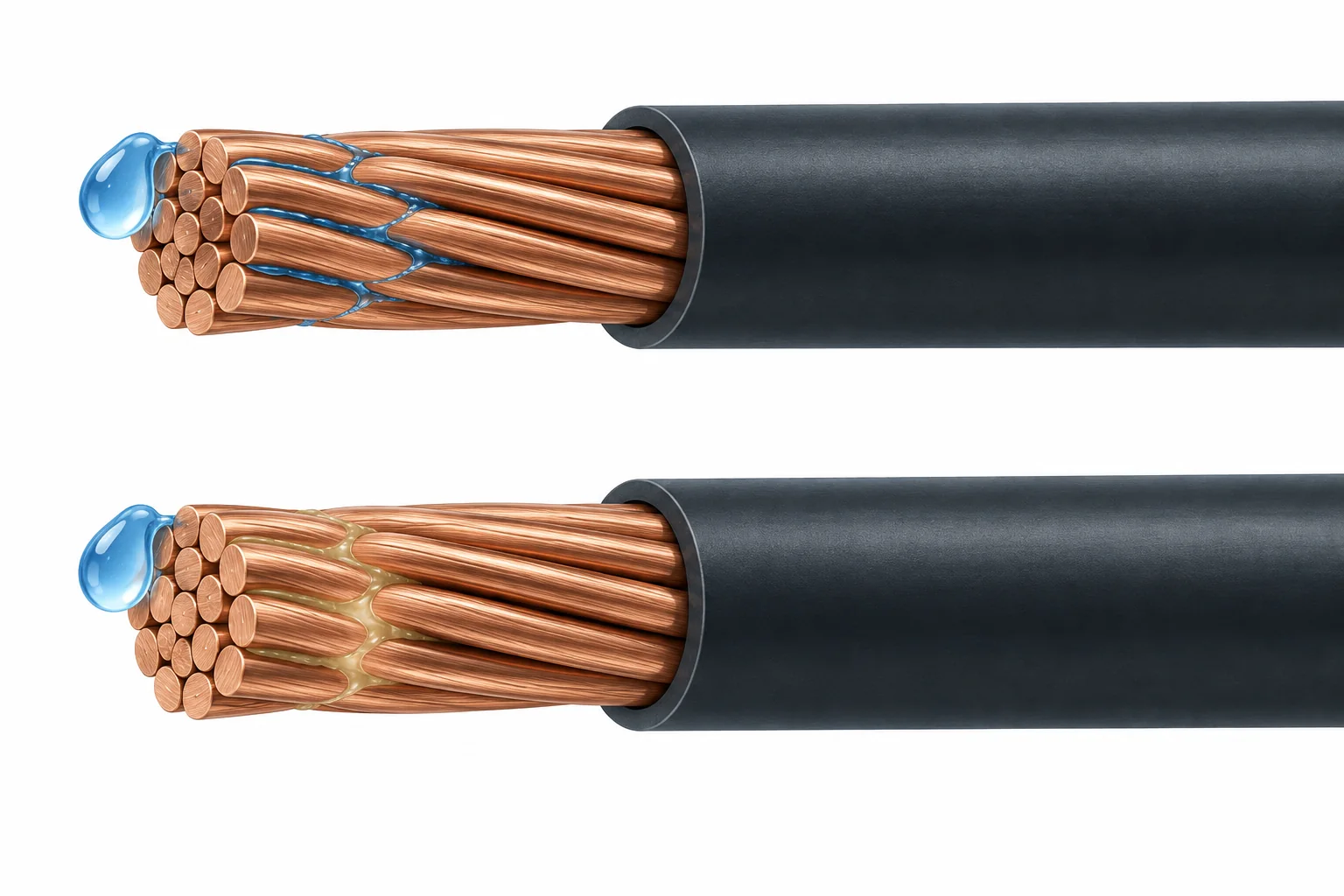
TE Connectivity’s splice-sealing guide describes a separate capillary path between individual wires at a splice. The illustration above instead explains the potential path among strands inside one conductor—the path addressed by TEBAOFLEX’s inter-strand material. Both routes show why “Is the connector waterproof?” is too narrow a question, but they should not be treated as the same test or sealing claim.
Does a sealed connector make the entire wire waterproof?
No. A connector seal protects one interface when the connector, wire diameter, seal, assembly, and test conditions match its design. It does not repair damaged insulation or block water entering at another cut end or splice. Check the full path, including exposed ends and junctions, and follow the connector manufacturer’s sealing instructions.
When should a buyer consider water-blocked automotive wire?
Consider water-blocked automotive wire when a route or termination creates a credible risk of water traveling lengthwise through stranded copper—for example, a splash-zone interface or separated connection points. Inter-strand material addresses that migration path. The complete assembly still needs suitable connector sealing, insulation protection, routing, and validation for its actual exposure.
TEBAOFLEX’s anti-capillary GXL/TXL construction lists a stranded copper conductor, a silicone-based inter-strand water-blocking material, and irradiated XLPE insulation. Its published ratings are 60 V DC / 25 V AC and −40 °C to +125 °C. Those are construction and rating statements from the product page; they do not establish a universal ingress-protection rating for an assembled harness.
What gauge automotive wire should you choose?
Choose conductor size from the circuit’s continuous and transient current, route length, permissible voltage drop, ambient temperature, bundling, and protection device. The connector and terminal must also accept that conductor and insulation diameter. A single “amps per AWG” table cannot account for all these variables, so use the OEM circuit requirement and a documented electrical/thermal calculation for the installation.
For a voltage-drop sense check, the published TEBAOFLEX AWG 16 maximum resistance of 14.03 Ω/km at 20 °C would give approximately 0.42 V at 5 A over a 3 m one-way run with a 6 m copper round trip: 5 × 0.006 km × 14.03 Ω/km. That is about 3.5% of a nominal 12 V supply before connectors, elevated conductor temperature, and other losses. This arithmetic is an illustration, not an AWG 16 ampacity recommendation.
How many amps can 12-gauge automotive wire handle?
There is no safe universal ampere number for “12-gauge automotive wire.” Allowable current depends on the specific wire’s insulation and temperature rating, ambient heat, bundle size, duty cycle, route length, terminals, and fuse or breaker. Use the wire and connector datasheets with the OEM’s circuit limits; verify voltage drop and temperature rise in the intended installation before choosing AWG 12.
Can low-voltage GXL or TXL replace an EV high-voltage cable?
No. The GXL/TXL product here is specified for 60 V DC / 25 V AC low-voltage service. EV high-voltage circuits need a cable validated for their voltage class and system requirements, including insulation, routing, and screening where specified. Similar color or the word “automotive” does not make the two constructions interchangeable.
For a different class of construction, see TEBAOFLEX’s ISO 19642 XLFE high-voltage cable و FHL2G powertrain cable; choose against the actual vehicle specification.
ال ISO 19642-5 scope is high-voltage single-core copper cable, distinct from the low-voltage primary-cable scope. Neither a similar color nor the word “automotive” makes two constructions interchangeable.
What should an OEM or harness buyer put in an automotive-wire RFQ?
An effective RFQ identifies the circuit and the drawing requirements, not just a wire name. Give the supplier enough information to confirm a suitable construction and to flag where a proposed substitute changes harness fit or validation. For GXL/TXL primary wire, ask for the following items in one controlled specification:
- Circuit and standard: nominal voltage, applicable OEM drawing and standard revision, operating temperature, and exposure conditions.
- الموصل: AWG or mm², copper strand construction, resistance requirement, and color or stripe marking.
- Insulation and fit: GXL or TXL choice, material, nominal wall and finished OD, OD tolerances, bend/routing constraints, and the mating seal/terminal range.
- Moisture strategy: where water could enter, whether lengthwise conductor water blocking is required, how ends and splices are sealed, and the assembly-level validation method.
- Supply evidence: approved drawing, dimensional and electrical test requirements, sample length, packaging, traceability, and requested quantity.
If water migration is one of the risks, ask the supplier to state the intended test method and acceptance criterion rather than relying on the phrase “waterproof wire.” If you are comparing GXL and TXL for the same harness, request matched AWG samples and check finished OD against the connector seal before freezing the drawing. Send the circuit details and drawing to TEBAOFLEX for a GXL/TXL construction review.
Common buying questions
Is automotive primary wire the same as battery cable?
No. Primary wire serves low-voltage vehicle circuits, while battery cable is selected for high-current battery and starter duties with its own construction and specification. A shared voltage system does not make the wires interchangeable. Check the current, terminal, temperature, routing, and relevant battery-cable standard for the actual connection.
Does “SAE J1128” on a listing prove every performance claim?
No. SAE J1128 describes a primary-cable scope and requirements, but a listing or marketing phrase alone does not document the exact construction, edition, independent approval, or performance in an assembled harness. Ask for the manufacturer’s drawing, the claimed standard edition, test evidence relevant to the application, and any OEM-specific requirements.
Which matters more for a connector seal: AWG or outside diameter?
Both matter for different reasons. AWG helps define the conductor and electrical fit with the terminal; the wire’s finished outside diameter must fit the connector seal’s approved range. Two AWG 16 constructions can have the same copper size and different insulation diameters, as the GXL/TXL example shows. Verify both against the connector supplier’s documentation.