


SO cord is a flexible, multi-conductor power cord used for industrial equipment leads, portable tools and other suitable power connections. The exact SO type designation identifies an extra-hard-usage cord with an oil-resistant outer jacket. Buyers also use “SO cord” informally for SOOW, so the full printed designation matters.
A request for “SO cord” identifies a family of needs, but it does not yet identify a cable size, conductor count or complete set of environmental ratings. The useful information is on the jacket, reel label and matching datasheet.
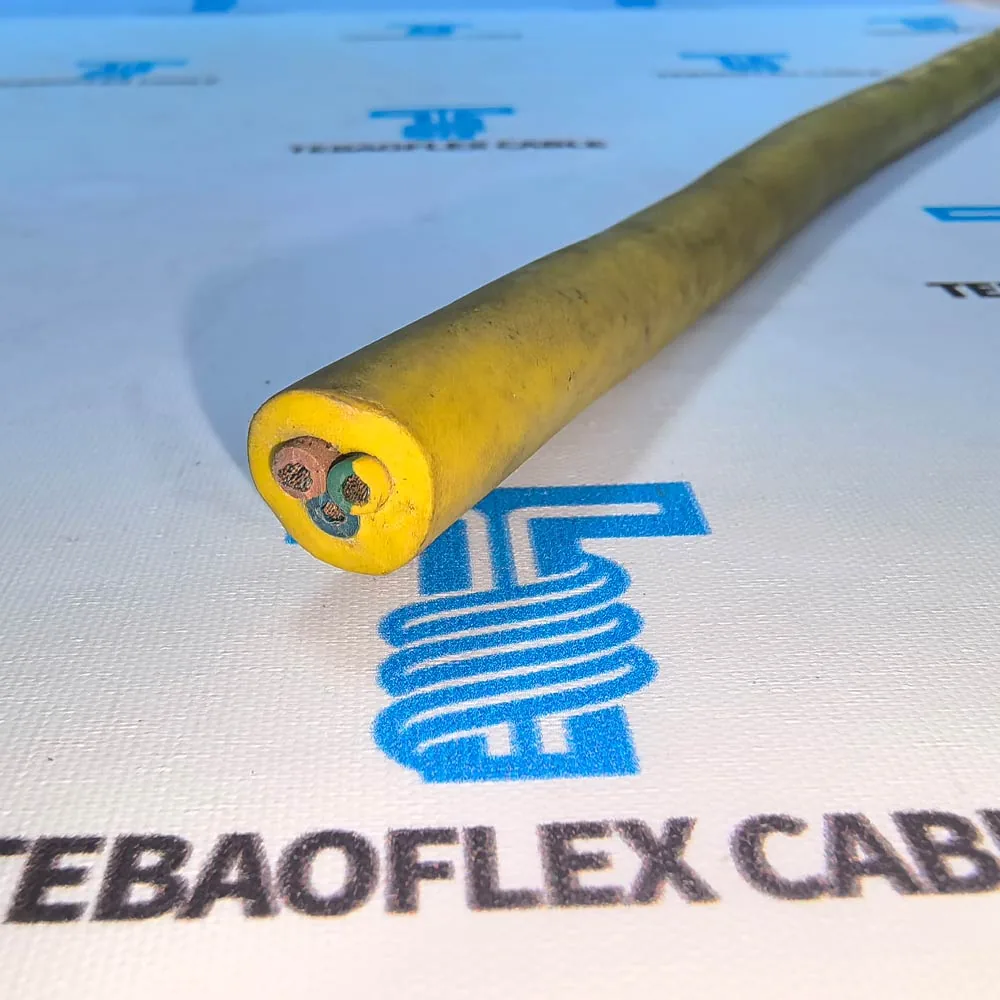
A cut end helps identify how conductors, insulation and jacket fit together. Appearance alone cannot establish an electrical or environmental rating.
What does SO cord stand for?
SO is commonly expanded as “service, oil-resistant.” More precisely, UL identifies S as extra-hard-usage flexible cord and a single O as an oil-resistant jacket. The designation describes the cord’s type; it does not specify its conductor size, number of cores or current capacity.
This distinction matters when reading similar names. An additional O extends the oil-resistance designation to the conductor insulation, while a final W identifies wet-location suitability and sunlight resistance. Those letters have specific meanings in UL’s Wire and Cable Application Guide; they are not optional spelling variations.
Type SO is a 600 V portable-cord designation in Prysmian’s cord designation reference. A voltage rating is an insulation-system limit, not a statement that the connected equipment must operate at that voltage.
Is SO cord the same as SOOW?
SO and SOOW are different type designations, although suppliers and buyers sometimes use “SO cord” as shorthand when discussing SOOW. A purchase description should therefore preserve the complete marking. A cable marked SO must not be assumed to have properties represented by the additional O and W in SOOW.
When the question becomes which cord type to specify, use the SOOW, SJOOW and SEOOW comparison. That guide covers the differences between the types; the identification steps below help establish what the cable in front of you actually is.
Recognizing the construction
A typical portable power cord groups individually insulated stranded conductors inside one outer jacket. The sample above shows the three structural elements to look for:
- Stranded conductor: many copper strands form each electrical conductor.
- Individual insulation: a separate insulating layer surrounds each conductor.
- Powłoka zewnętrzna: the common covering encloses the insulated conductors. Some constructions also include fillers or separators.
The insulation and jacket do different jobs, which is why an oil-resistance designation can apply to one or both. Exact compounds are product-specific. For example, Southwire’s published 12 AWG, three-conductor SOOW construction lists stranded copper, EPDM insulation and a CPE jacket. That example is not a material specification for every cord called “SO.”
Appearance is useful for spotting damage and understanding construction, but not for assigning ratings. Black and yellow jackets are both used on commercial portable cords. A readable type marking and traceable product record are stronger evidence than color or apparent thickness.
How to read an SO cord marking
Read a portable-cord marking in separate parts: the cord type, conductor size, conductor count, voltage rating and any additional ratings or identification. Keep those fields separate when recording the cable. The example below explains the shorthand; actual manufacturers may print the same information in a different order.
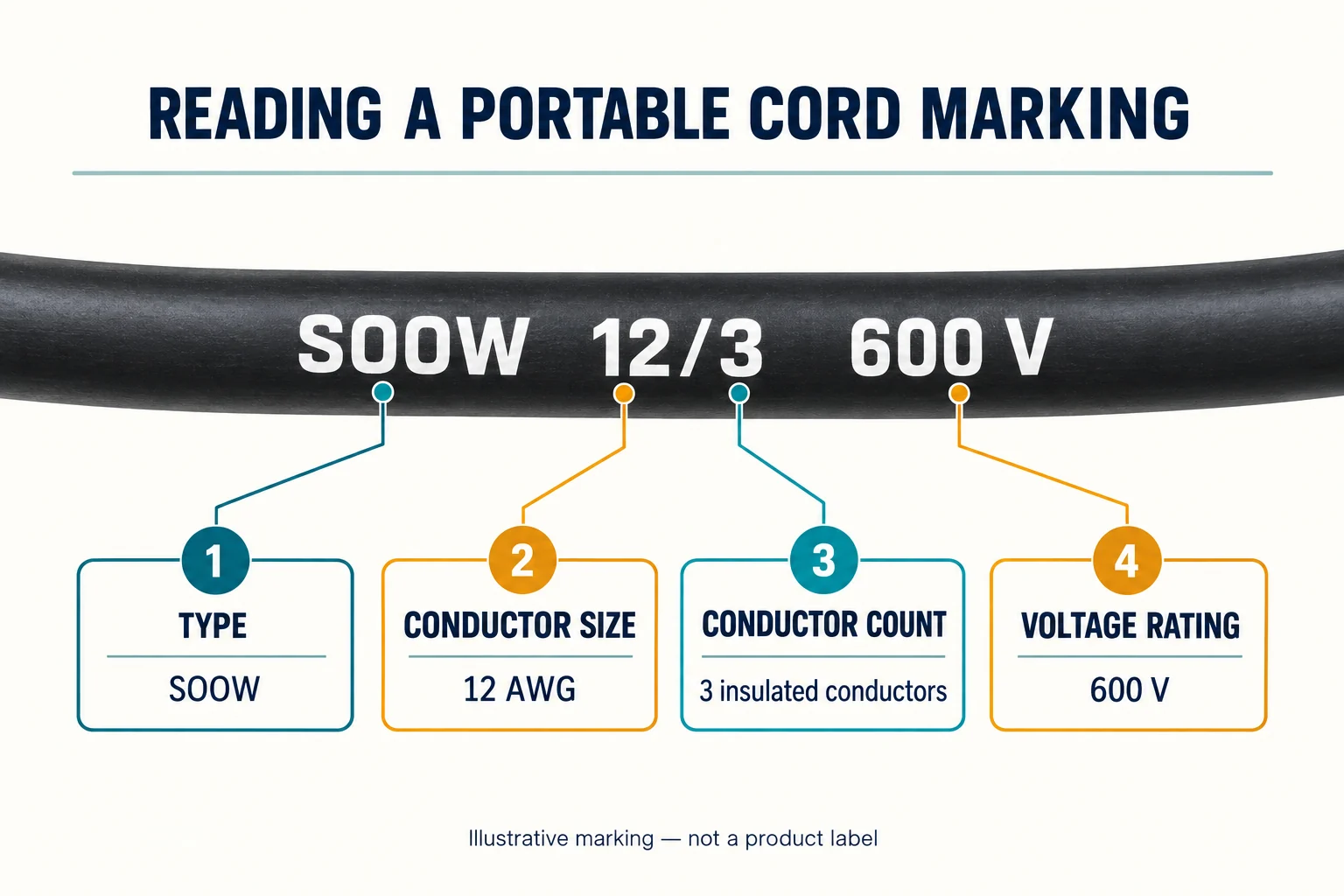
- Read the full type: SOOW. Record all the letters. Do not shorten SOOW to SO when checking a specification or requesting a replacement.
- Read the conductor size: 12 AWG. In the example, 12 describes the conductor’s American Wire Gauge size. It is not the cord’s outside diameter, an amp rating or the number of strands.
- Read the conductor count: 3. Here, 12/3 describes three insulated 12 AWG conductors. The count includes an insulated equipment-grounding conductor when one is part of that construction; it does not mean three phases or three current-carrying conductors.
- Read the voltage rating: 600 V. Keep this separate from the supply voltage and from the ratings of plugs, connectors and equipment.
A manufacturer may print 3C 12 AWG rather than 12/3. Alpha Wire’s 1937/3 specification, for example, identifies three 12 AWG conductors, lists black, white and green insulation, and specifies a legend containing the type and voltage. Its documented construction illustrates why a grounding conductor can be included in the total count.
The same reading method applies to a description such as 10/3 SO cord: establish the complete cord type, then verify that the product record identifies three 10 AWG conductors. The shorthand alone is not enough to determine allowable current or conductor functions in an existing installation.
Continue around the jacket to find the temperature marking, manufacturer identification and other printed information. Match the entire record to the datasheet and reel label. For certification checks, UL’s verification guidance directs users to the certification identification on the reel or container and the corresponding Product iQ record; a familiar-looking surface mark is not the whole check.
What is SO cord used for?
SO-type portable cord is used for appropriate equipment power connections where flexibility is needed. Documented SOOW applications include industrial machinery leads, portable tools, battery chargers, portable lighting and power extensions. The exact cord and completed connection must suit the load, environment and permitted installation method.
These examples describe the kinds of jobs portable cord can serve, not blanket approval for every installation:
| Situation | What to establish |
|---|---|
| Portable tool or maintenance equipment | Equipment instructions, load current, grounding arrangement and connector ratings. |
| Industrial machinery connection | Permitted connection method, movement, strain relief and exposure to oil or physical damage. |
| Temporary lighting or distribution | Supply voltage, loaded conductor count, run length and protection for the route. |
| Outdoor portable equipment | Appropriate outdoor/wet ratings for both cable and connectors, plus actual exposure conditions. |
Check the limits behind the label
Is SO cord outdoor rated?
Plain Type SO should not be assumed to be outdoor-rated. In UL’s designation system, a final W identifies wet-location suitability and sunlight resistance. Outdoor use still requires the cable, connectors and installation to suit the location. Check the full designation and documentation, not jacket color.
Wet-location suitability does not specify an immersion depth or duration. Prysmian permits immersion for certain SOOW constructions when properly sealed and terminated. Check the actual cable and termination requirements for submerged service.
Can SO cord replace building wiring or be buried?
SO cord is not a general substitute for building wiring, and its name does not establish direct-burial suitability. Installation permission depends on the cord’s evaluated use and the applicable wiring rules. An outdoor rating alone does not answer whether a cable may be concealed, routed through a building or placed underground.
In U.S. general-industry workplaces, OSHA 1910.305(g) sets permitted uses, restrictions and strain-relief requirements. Apply the relevant local rules and equipment instructions. Some permitted equipment connections can be long-term; “portable cord” does not mean every use must be temporary.
A cord and a completed cord set have different checks
Bulk cord is the cable without complete connection hardware. A cord set adds an attachment plug and connector. Check their ratings, terminations, grounding continuity and strain relief as well as the cable. A 600 V cable does not make an attached connector 600 V rated.
UL 817 addresses cord sets and power-supply cords; the cable’s own marking does not certify the finished assembly.
Oil resistance also has limits. Describe the actual fluid, temperature and exposure before selecting a construction. The guide to oil-resistance ratings and service conditions explains that wider specification question; its PR I/PR II discussion is separate from decoding the O letters in a portable-cord designation.
Record the cable before requesting a replacement
A useful replacement inquiry starts with a readable identity and a clear description of the job. Collect:
- A photograph of the complete jacket legend and reel or packaging label.
- Dany full cord type, AWG size and conductor count.
- The equipment’s supply voltage, load current and required length.
- Dany environment and movement: indoors/outdoors, wet exposure, oil, temperature and handling.
- Dany connection requirements: plug/connector information, grounding and applicable approval requirements.
If the cable has already been identified as SOOW, the SOOW portable-cord specification page is the next place to compare the required construction. For an unclear marking or an incomplete drawing, send the label photograph and application details for review. Record what is visible and flag what is missing rather than filling the gaps with an assumed rating.