









Braided cables are not automatically better than rubber cables for industrial service. A braid may protect a motor lead, reinforce a moving cable or form an electrical screen; rubber may provide the insulation, the outer sheath, or both. Choose the complete construction for the equipment and operating duty.
The distinction matters when comparing a large single-core motor lead with a multicore power cable or a crane reeling cable. These products can all contain rubber, yet use very different layer arrangements. A visible weave is not enough to establish suitability for heat, dragging, oil exposure or repeated movement.
Industrial braid and rubber layers
An industrial braid is a woven layer whose material, position and purpose must be identified. “Braided” alone does not tell a buyer whether the layer is an outer covering, internal reinforcement or an electrical screen.
| Construction feature | What it describes | What to confirm before selecting it |
|---|---|---|
| Exposed nonmetallic braid | An outer covering, such as an aramid braid over a motor lead’s insulation | Fibre material, treatment, installation environment and permitted mechanical exposure |
| Internal reinforcing braid | A strengthening layer within the cable’s sheath system | Position, specified mechanical function and suitability for the actual movement |
| Metallic screen braid | A conductive screening layer | Screen material, termination arrangement and the equipment’s EMC requirements |
| Kauçuk yalıtım | The electrical insulation around a conductor | Compound, rated voltage and temperature conditions |
| Rubber outer sheath | The exterior jacket of a finished cable | Compound and documented environmental and mechanical performance |
Rubber and braid are therefore not competing names for the same component. The scope of IEC 60245-4:2026 includes rubber-insulated braided cords alongside specified rubber- or elastomer-sheathed cords and flexible cables, at rated voltages up to and including 450/750 V. That published scope does not establish compliance or suitability for an arbitrary industrial construction.
Outer braid on large industrial motor leads
An outer braid is useful when it forms part of the specified motor-lead construction and matches the equipment’s installation conditions. It should be assessed together with the insulation beneath it, rather than treated as an alternative to that insulation.
TEBAOFLEX'ler UL 3410 aramid örgülü motor bağlantı teli provides a large-section example. Its published construction uses stranded tin-coated copper, extruded silicone rubber insulation and a finished polyaramid outer braid. The current product table lists 250, 350, 500 and 750 kcmil configurations at 200°C and 600 V. These are the stated product configurations, not ratings to transfer to every braided cable.
The silicone rubber is the insulation layer; the aramid braid is a separate outer layer. Replacing either with a different material changes the construction and needs an application review. Quoting only “braided motor wire” leaves the conductor size, insulation, braid and electrical requirements unresolved.

For equipment wiring, confirm the connection space, routing, temperature at the cable, termination method and exposure to rubbing or fluids. An exposed braid should not be assumed to provide a sealed outer sheath, immersion suitability or permission for continuous dragging. Those requirements need explicit documentation for the selected cable.
Rubber-sheathed industrial power cables
A rubber-sheathed power cable is a relevant starting point when the requirement is a complete flexible power cable with an exterior elastomer jacket. The particular compound, voltage class and permitted operating conditions still decide whether it fits the installation.
TEBAOFLEX'ler H07RN-F ağır hizmet tipi esnek kauçuk kablo is a separate product route for portable equipment, industrial machinery and temporary power connections. Its published reference construction identifies flexible copper conductors, EI4 rubber insulation and an EM2 elastomer sheath, with a rated voltage of 450/750 V. Confirm the ordered size and construction against the project specification.
A multicore rubber power cable also differs from a single-core motor lead in its circuit arrangement. Core count, protective-conductor requirements, cable diameter, termination space and the installation method must all match. A similar conductor area does not make the two products interchangeable.
The H07RN-F page expressly separates general flexible power service from submersible, continuous-reeling and high-torsion applications. Do not extend a general “flexible cable” description into a moving-machine rating that has not been established.
Can a rubber reeling cable also contain a braid?
Yes. A rubber reeling cable can contain an internal reinforcing braid between sheath layers. In that arrangement, the outer rubber sheath and the reinforcement perform different roles within the same finished cable.
İlgili NTSCGEWOU / (N)TSCGEWÖU vinç tambur kablosu endüstriyel bir örnektir. Yayınlanan yapısı ekranlı bir EPR yalıtım sistemi, bir iç kılıf, kılıf katmanları arasında yüksek çekme dayanımlı burulma önleyici örgü ve sentetik kauçuk dış kılıfı birleştirir. Bu ürün hareketli ekipmanlardaki motorlu kablo tamburları için tasarlanmıştır.
Here, “braided or rubber?” would omit the feature that matters: the cable uses both. The important selection question is whether the complete construction matches the drum, rollers, tension, movement and electrical system.
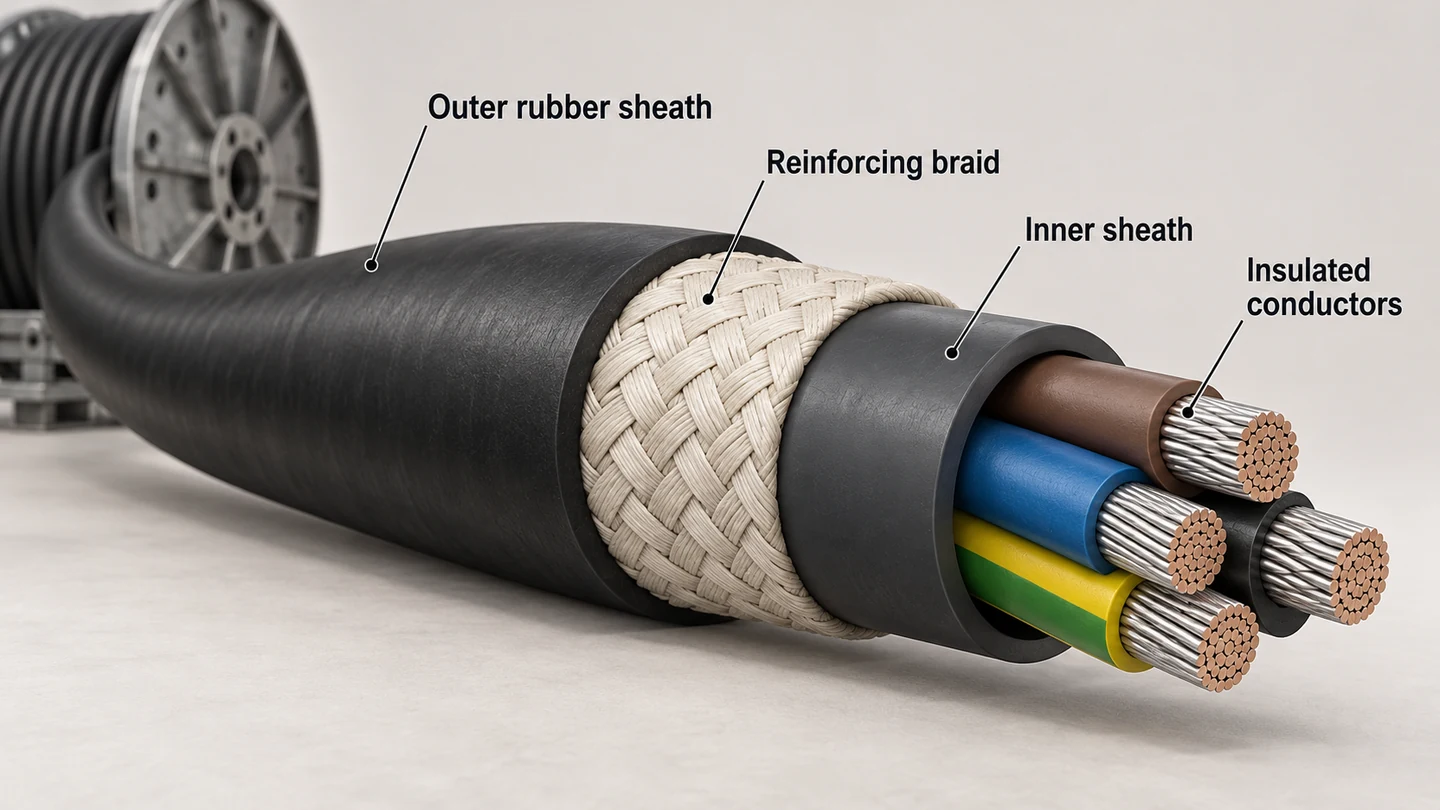
The location of the braid also matters. An exposed outer textile covering and a reinforcement enclosed between rubber sheaths are not the same arrangement. Do not assume that every reinforcement uses the same fibre, or that an internal nonmetallic braid is an electrical screen.
For reeling duty, supply the drum core diameter, pulley sizes, bend path, installed length, travel speed and acceleration. A cable that meets a circuit’s voltage and conductor-size requirements can still be unsuitable for the mechanical route.
Does a metal braided screen make the cable more suitable?
A metal braided screen is relevant when the equipment requires that screening construction. Its presence does not establish the outer sheath’s wear resistance, the cable’s permitted movement or its environmental rating.
Screen selection is a separate decision from choosing an exposed textile cover or a rubber jacket. The spiral sargı ekran ile örgülü ekran kılavuzumuz explains that distinction for industrial cable screens. Specify the screen and its termination requirements alongside the insulation, sheath and mechanical duty.
For a drive or instrumentation connection, confirm the equipment manufacturer’s cable requirements. Choosing a cable because a braid is visible leaves its electrical screening arrangement and installation requirements unresolved.
Which industrial construction fits your application?
Choose the construction that addresses the actual installation, then verify its limits. The following routes serve different requirements; they are not drop-in substitutes for one another.
| Uygulama | Relevant construction to assess | What remains to confirm |
|---|---|---|
| Large single-core motor or equipment lead | Silicone rubber insulation with the specified aramid outer braid | Electrical rating, conductor size, temperature, termination and exposure of the outer braid |
| General flexible industrial power connection | A suitably specified rubber-insulated and rubber-sheathed power cable | Core arrangement, current capacity, environment, bend radius and permitted movement |
| Motorized crane or machinery reel | A cable designed for reeling, with the specified reinforcement and sheath system | Drum and roller geometry, tension, speed, acceleration, torsion and electrical configuration |
| Connection with an electrical screening requirement | A screened construction that matches the equipment specification | Screen material, coverage where specified, termination and the independent mechanical requirements |
No single layer establishes overall durability. For rubbing or dragging, ask for relevant evidence about the finished sheath system. For repeated movement, check the complete cable’s motion conditions. For heat or fluids, use the specified compound and application limits rather than transferring a material’s general reputation to the finished cable.
What information should you include in an industrial cable enquiry?
An industrial cable enquiry should identify both the electrical circuit and the mechanical route. “Braided” or “rubber” is a construction clue, not a complete purchasing specification.
- Electrical duty: rated voltage, conductor material and size, core count, protective conductors and any screen or monitoring requirements.
- Kurulum: equipment connection, fixed wiring, occasional handling, trailing, festoon or continuous reeling.
- Hareket: bend radius, drum and roller dimensions, travel, speed, tension and torsion where applicable.
- Ortam: operating temperature, heat exposure, oil or chemicals, water, sunlight and mechanical contact.
- Supply definition: required designation, construction drawing, dimensions, termination details and project-specific documentation.
Conductor specifications also have a defined scope. IEC 60228:2023 addresses conductor cross-sectional areas, wire construction and resistance requirements. A conductor description alone is not a complete specification for the insulation, sheath system or equipment route.
Send your industrial cable requirements to TEBAOFLEX with the equipment type, voltage, conductor arrangement and operating conditions. That gives the team a basis for assessing a braided motor lead, rubber power cable or reinforced reeling construction against the actual application.