

Project record · Egypt · Steel production
كابل مسطح لدراجة سفر تعمل بتقنية القطع بالأكسجين
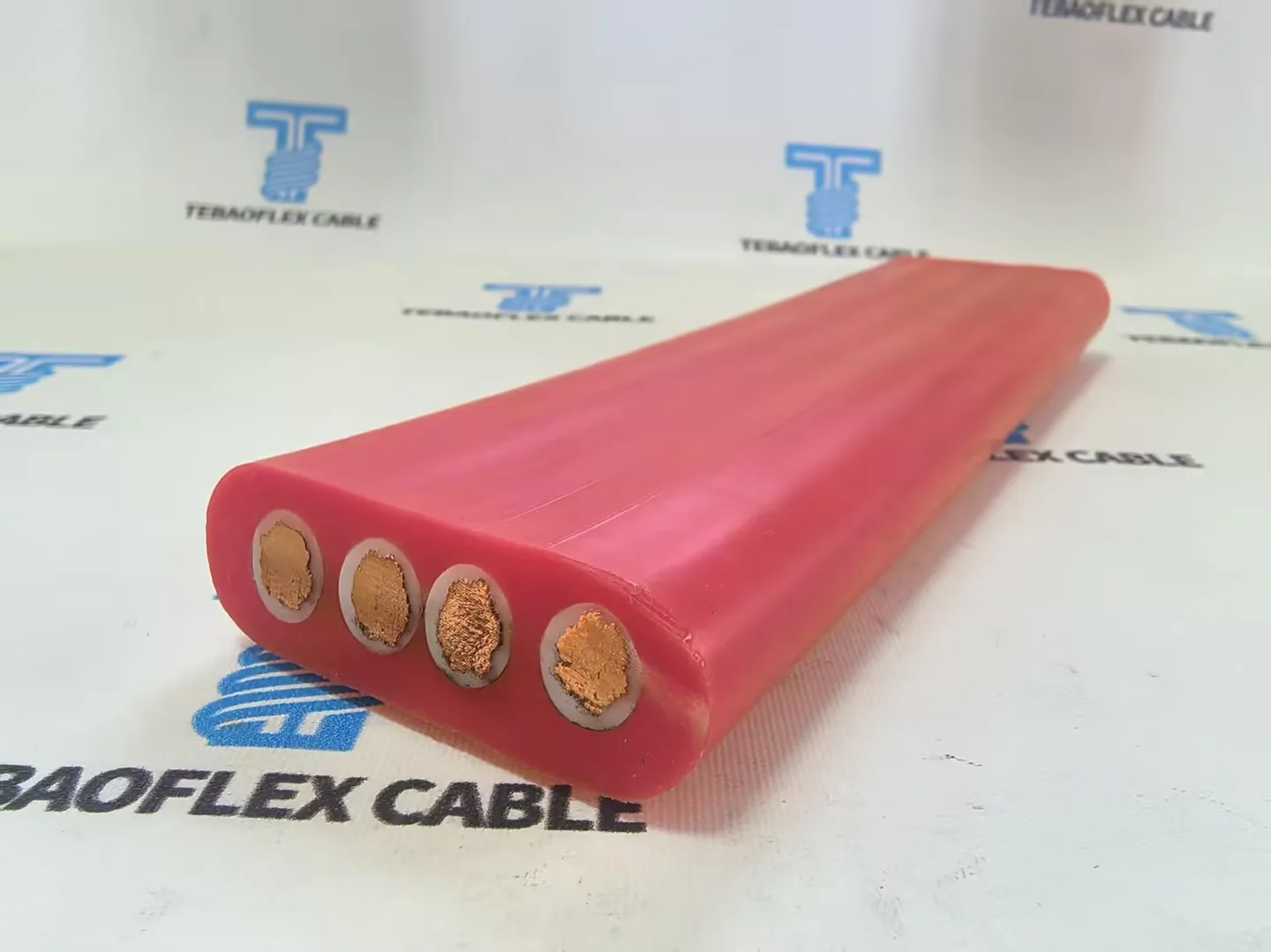
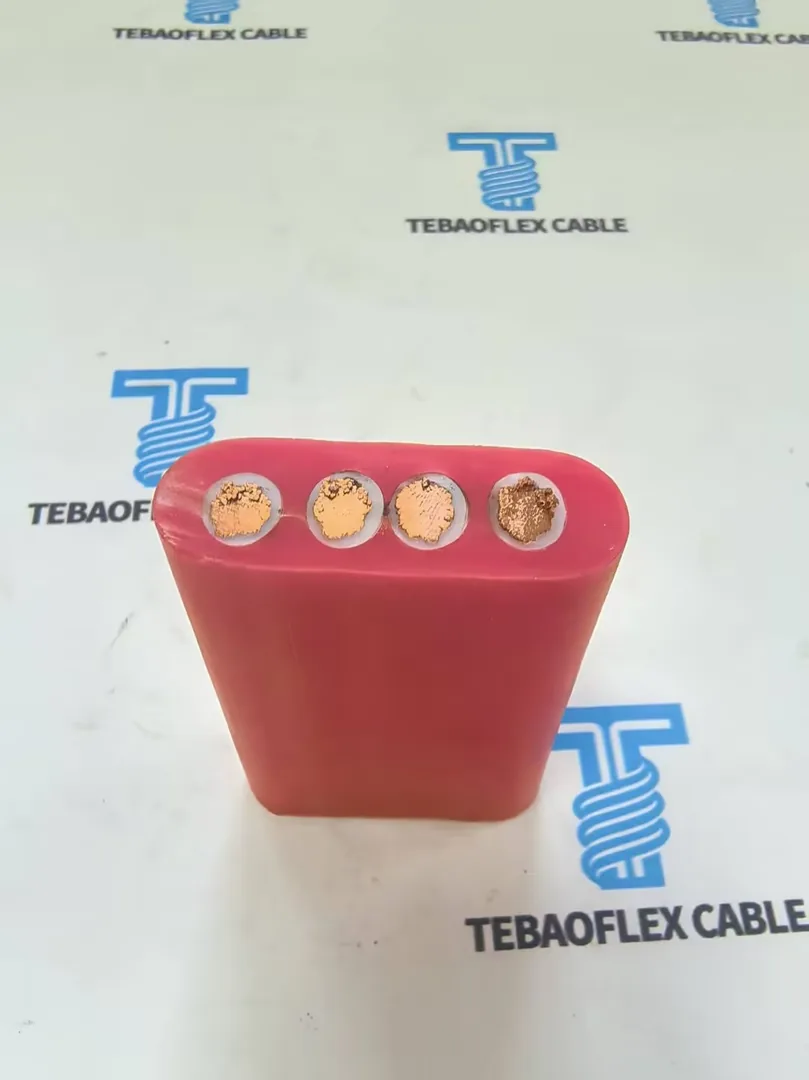
A steel plant application required a multicore power cable for the repeated travel path of an oxy-cutting car. TEBAOFLEX supplied a four-core flat cable for the machine’s moving cable route.
Project record
| Country | مصر |
|---|---|
| Industry | إنتاج الصلب |
| معدات | سيارة قطع الأكسجين |
| حركة | حركة الآلة الدورية |
| التنسيق المقدم | كابل مسطح رباعي النواة |
| أعمال بناء مرئية | Four conductors arranged in a single flat plane, red sheath |
Why a flat construction for a travel cycle
A cutting car does not move once and stop. It runs the same path continuously, so the cable is bent in the same places, in the same direction, thousands of times. A flat construction answers that duty in ways a round cable does not.
It bends in one plane. With the cores side by side, the neutral axis of the bend stays predictable and each conductor sees a consistent strain every cycle. In a round cable the cores are helically stranded, so the same bend loads different conductors differently along the length.
It does not corkscrew. Repeated pulling along a fixed path makes round cables untwist and take a permanent spiral set — what port and mining engineers call corkscrewing. A flat profile has no lay to open up.
It sits flat in a guide or festoon trolley. Flat cable stacks and rides without rolling, which is why flat constructions dominate festoon systems and machine travel guides.
It has a low build height, which helps where the machine route is a shallow channel or a tight guide.
What an oxy-cutting car asks of the cable
Steel-plant cutting machines combine two loads that are individually manageable and jointly difficult: continuous movement و heat. The cable has to stay flexible while operating near its thermal limit, which is the opposite of what most compounds do as they age.
The usual exposures on this kind of route are radiant heat from the workpiece and the cutting head, slag and spark spatter, mill scale abrasion along the guide, and cutting oils or coolants. Standard rubber and PVC compounds are out of scope above roughly 90 °C continuous; silicone rubber covers the 180–200 °C band, and fluoropolymers such as PFA extend to around 250 °C. Silicone is mechanically soft, so where spatter or abrasion is present it needs a glass braid or protective covering.
Which of these actually governs depends on how close the cable route runs to the cutting head — something to be measured on site rather than assumed from a datasheet.
What we review for a similar project
- Machine type and travel length
- Cycles per shift or per day
- Guide type — channel, festoon, drag chain, free
- Minimum bending radius available
- Ambient temperature at the cable route
- Distance from the cutting head
- Spatter and scale exposure
- Oils, coolants or descaling chemicals present
- الجهد المقنن
- Core count and cross-section
- Required standard or approval
- Length per run and total quantity
Related constructions
- NGFLGOEU flat festoon cable 300/500 V
- Festoonflex PUR-HF for cranes and moving equipment
- SiHF-J silicone 180 multi-core
- SiHFC screened silicone 180 °C
- H05GG-F EN 50525-2-21 rubber
- Intemp 250 BS G210 PFA, 250 °C
Browse the full high temperature cables و port and festoon cables ranges, or look up a designation in the cable designation and standard index.
Questions on this application
Can a round cable be used instead of a flat one on a cutting machine travel path?
It can be, but it is the more common source of trouble. A round cable’s cores are helically stranded, so repeated bending along a fixed path tends to open the lay and produce a permanent spiral set. On a guided or festooned route a flat construction keeps the bend in one plane and stacks predictably. Round is the better choice where the cable also has to twist or wind onto a drum.
What temperature class does a steel-plant cutting machine cable need?
It depends on the distance between the cable route and the radiant source, not on the process temperature. Standard rubber and PVC are limited to roughly 90 °C continuous; silicone covers 180–200 °C; PFA reaches around 250 °C. The practical step is to measure the temperature at the cable route under production conditions, not at the cutting head.
Do you publish the full specification of this cable?
Not on this page. The record above lists what the project documentation and photographs confirm. Voltage, cross-section, compound and standard were set for this plant’s conditions, and publishing them as a general recommendation would mislead for a different machine. Send your own duty conditions and we will quote against them.
Discuss a moving-equipment cable →
← Back to all industrial cable application cases