

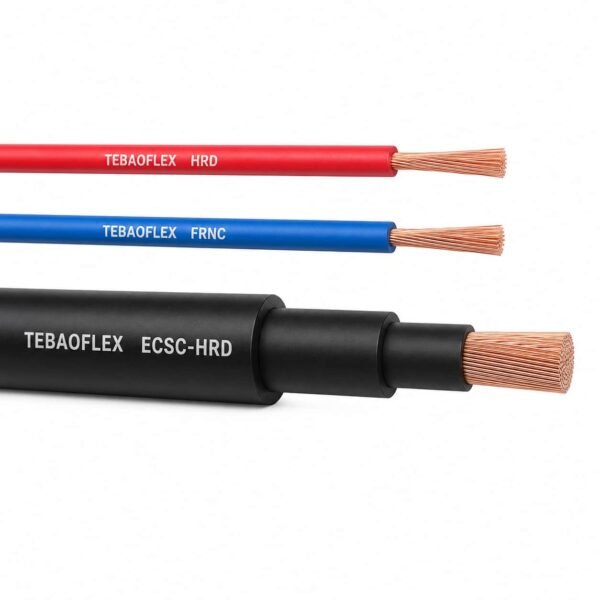
High Strength Silicone Cable 180°C, HRD / FRNC / 1500 V DC
Silicone single cores for the three jobs standard silicone cannot do: mechanical strength, fire performance, and 1,500 V DC.
- HRD: high mechanical strength silicone, 300/500 V, 0.5–6 mm²
- FRNC: halogen-free, low smoke, low corrosivity, vertical flame, 300/500 V, 0.5–2.5 mm²
- ECSC-HRD: insulated و sheathed, 1,000 V AC / 1,500 V DC, 10–630 mm²
- درجة الحرارة: −60 °C to +180 °C (ECSC-HRD from −40 °C)
- الموصل: IEC 60228 class 5 flexible copper; class 2 on request
- Plating: bare, tinned, nickel, silver or pure nickel
- الخيارات: tinned copper braid screen; double insulation; all colours
Tell us which problem you have — mechanical, fire, or voltage — and the cross-section.
Ordinary silicone wire is bought for one reason: it stays flexible and it survives heat. It is also, unmodified, easy to tear, easy to nick, and rated 300/500 V. This page is about the three places that is not enough, and the three compounds that fix them — all in the same −60 °C to +180 °C silicone family, on IEC 60228 class 5 flexible copper.
HRD — mechanical strength. A silicone compounded for tear, abrasion and cut resistance, in 0.5 to 6 mm². For the wire that gets pulled through a machine frame, clamped, and handled by people who are not thinking about it.
FRNC — fire performance. A compound that adds low corrosivity, low smoke density and vertical flame propagation resistance to the halogen-free baseline. For anywhere people have to get out of: rail, marine, tunnels, public buildings.
ECSC-HRD — voltage. Silicone insulation plus a high-strength silicone sheath, rated 1,000 V AC / 1,500 V DC and available from 10 all the way to 630 mm². This is the one standard silicone single-core cannot do, and it is why the build has two layers rather than one.
All three are halogen-free to IEC 60754-1. All three come with the same choice of conductor plating — bare, tinned, nickel, silver or pure nickel — and an optional tinned copper braid screen.
If your application is comfortably inside 300/500 V with no particular mechanical or fire requirement, buy the standard product instead: SiF silicone single core is cheaper and does the same job. Come here when the standard one has already failed, or when the specification says it will.
Tell us which of the three problems you have — mechanical, fire, or voltage — and the cross-section. That is enough to quote.
Three products, one material family. The conductor and the temperature range are shared; what changes is the silicone compound and, in one case, whether there is a second layer of it.
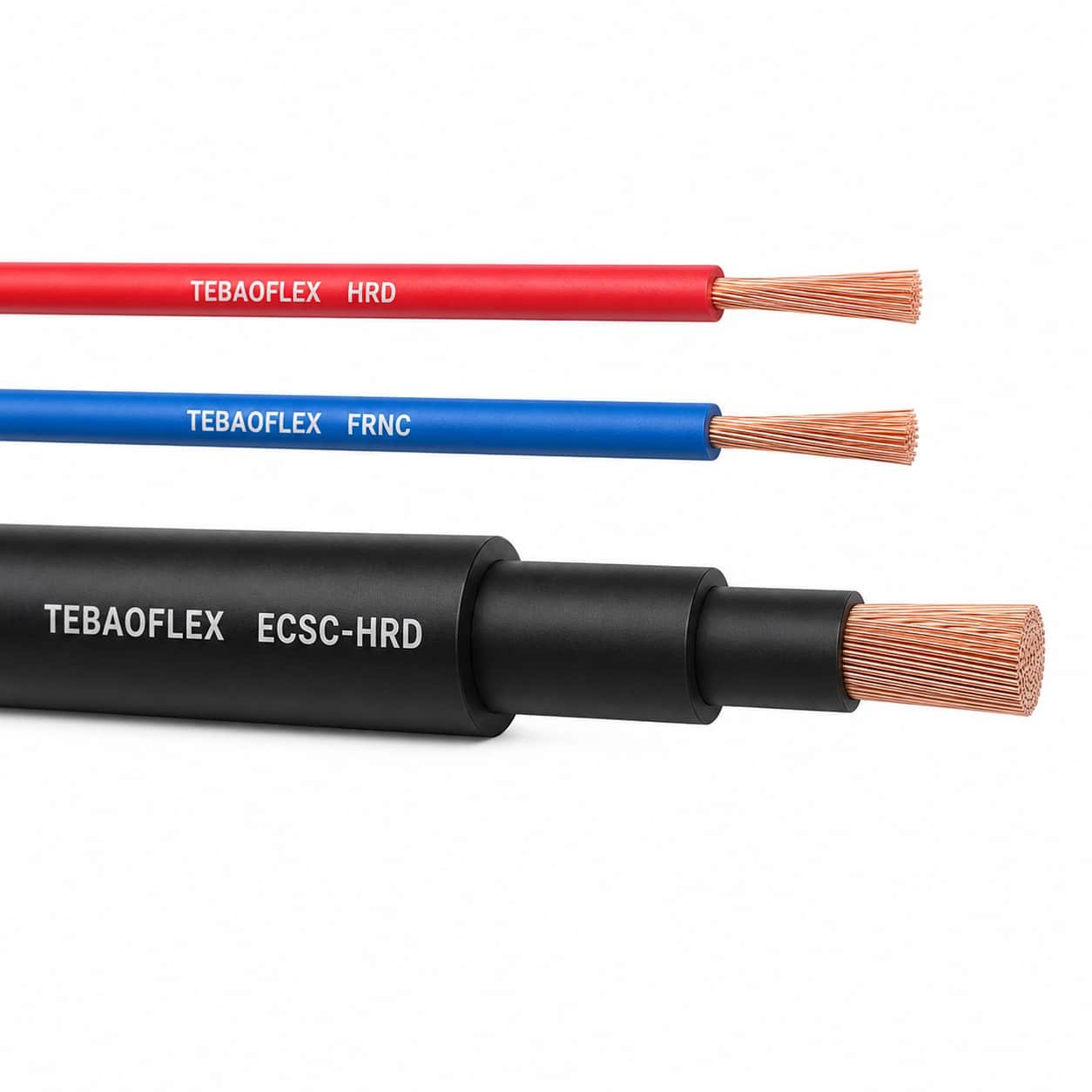
HRD — the compound is the product
- الموصل: flexible copper, IEC 60228 class 5, bare or tin-plated.
- العزل: silicone rubber compounded for high mechanical properties — tear strength, cut-through and abrasion.
Only two elements, and the compound is the whole story. Standard silicone is a soft, high-elongation rubber; it survives heat beautifully and a screwdriver very badly. The HRD compound trades a little of that softness for the toughness that lets the wire be pulled through a frame, clamped, and handled on an assembly line without a nick becoming a fault three years later.
FRNC — the compound is the certificate
- الموصل: the same class 5 flexible copper, bare or tin-plated.
- العزل: silicone rubber compounded for fire performance.
Structurally identical to HRD. Chemically, not at all — and there is physical evidence of that in the dimension tables. A 0.5 mm² HRD wire and a 0.5 mm² FRNC wire have exactly the same 2.1 mm diameter and 0.6 mm wall, and the FRNC one weighs 8.7 kg/km against 7.8. That extra 11 % is mineral filler doing the fire work. Same geometry, different material, and you can see it on the weighbridge.
ECSC-HRD — why 1,000 V needs two layers
- الموصل: flexible tinned copper, class 5.
- العزل: silicone rubber — the dielectric.
- غمد: silicone rubber with high mechanical properties — the armour.
A single-layer silicone core is asked to be a good dielectric and a tough outer surface at once, and a compound cannot be optimised for both. Splitting the job lets the inner layer be chosen purely for dielectric strength and the outer purely for toughness, which is what makes 1,000 V AC / 1,500 V DC and a 3,500 V test voltage achievable in a flexible silicone cable at all. It also survives what the single-layer product will not: acids and bases, mineral oil, and repeated alternate bending.
The plating ladder
All three builds take the same conductor options, and each rung buys something specific:
- Bare copper — the default, best conductivity, cheapest. Oxidises at the cut end over time.
- Tin-plated — solderability and a stable crimp surface. The usual choice, and the one most specifications assume.
- مطلي بالنيكل — for the top of the temperature range and for atmospheres that attack tin.
- مطلي بالفضة — lowest contact resistance and best high-frequency behaviour; avoid where sulfur is present.
- Pure nickel — not a plating at all but a solid nickel conductor, and not described in IEC 60228. For the extreme case. Expect a resistance penalty and tell us the current before choosing it.
Options that change the build
A tinned copper braid screen can be applied over any of the three. Double insulating layers are available on the 300/500 V products where the mechanical duty is severe but the voltage is not. Conductors can be supplied to class 2 stranding instead of class 5 where the run is fixed and cost matters more than flexibility — the diameter and the wall stay the same, only the stranding and the resistance change.
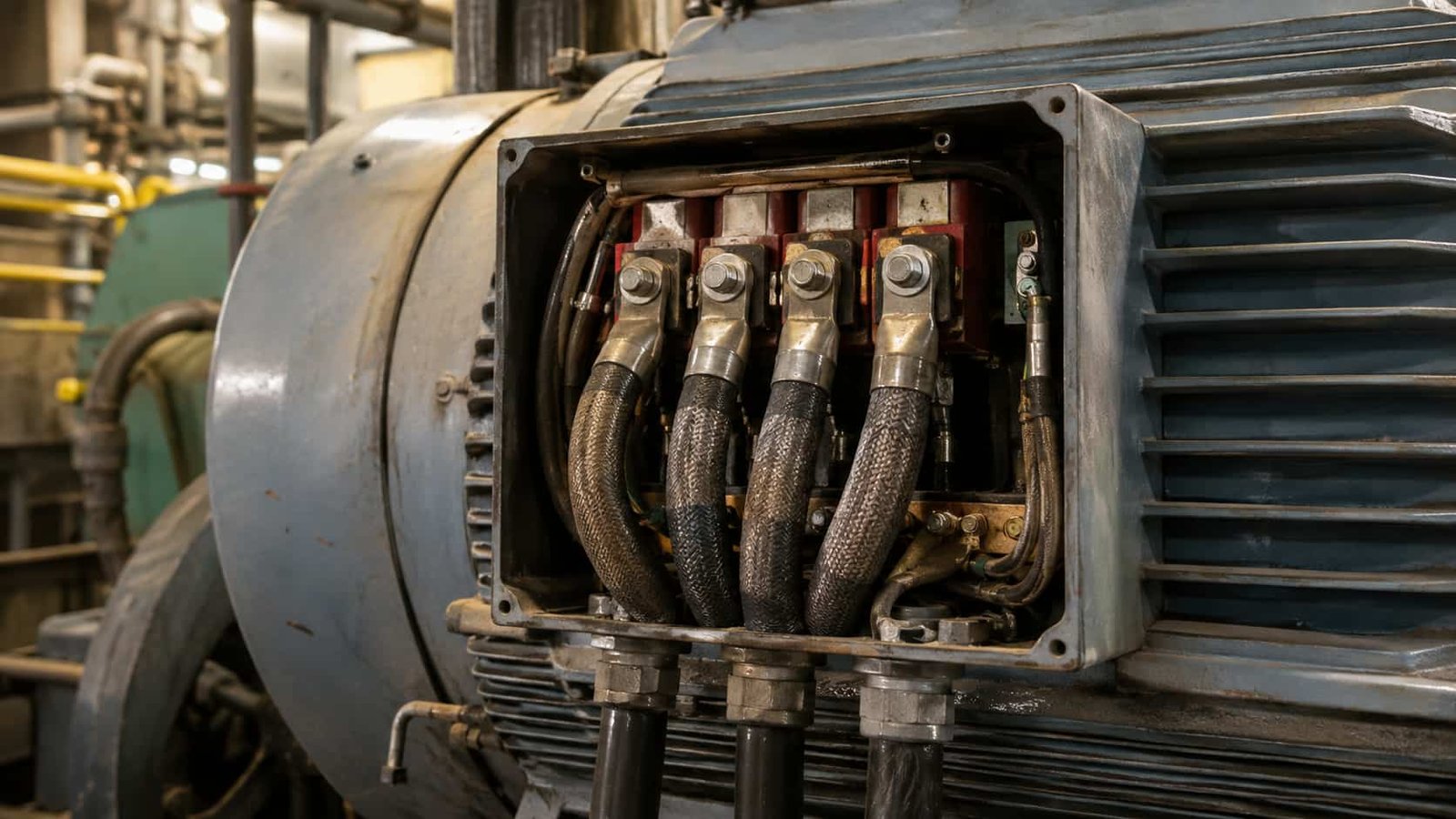
These are all internal wiring and equipment cables, not installation cables. They live inside machines, cabinets and enclosures where the temperature is high, the space is tight, and the person doing the wiring is working fast.
Where each one goes
| طلب | Build | Why |
|---|---|---|
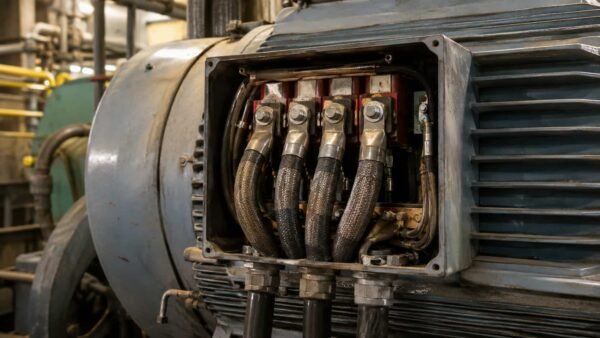
| Rotating machines — motors, alternators, generators, class H insulation systems | HRD, or ECSC-HRD above 500 V | Winding leads are pulled, dressed and clamped; the wire has to survive assembly as well as service |
| Household and commercial heating appliances | HRD | 180 °C with a wire that will not tear during automated assembly |
| Lighting — luminaire and ballast wiring | HRD or FRNC | Heat at the lamp end; fire performance where the fitting is in a public space |
| Industrial cabling in hot atmospheres | HRD | Ovens, dryers, furnaces, foundry equipment |
| Rail, marine, tunnels, public buildings | FRNC | Smoke density and gas corrosivity are what the specification is actually testing |
| Static machines — transformers, inductors, inverters, choppers | ECSC-HRD | 1,000 V AC and a sheath that tolerates impregnation and handling |
| Switchboards and power cabinets | ECSC-HRD | Large cross-sections in tight cabinets; the 5 × D bend radius is the reason it fits |
| Battery energy storage | ECSC-HRD | 1,500 V DC is the rating the DC side of a storage system needs, and silicone gives it in a cable that bends |
Halogen-free, flame retardant and low smoke are three different things
They get written into specifications as if they were one requirement, and they are tested by three separate standards that measure three separate outcomes:
- Halogen-free (IEC 60754-1) asks what the compound is made of — how much halogen acid gas it can release. Both HRD and FRNC pass this.
- Gas corrosivity (IEC 60754-2) asks how corrosive the smoke is — whether the electronics in the room survive the fire even if the building does.
- كثافة الدخان (IEC 61034-2) asks how much you can see through it — the property that decides whether people find the exit.
- انتشار اللهب (IEC 60332-1-2) asks whether the fire travels along the cable to somewhere it was not.
HRD is halogen-free. FRNC is halogen-free and the other three. If your specification names a smoke or corrosivity standard, halogen-free alone does not satisfy it, and a supplier who answers “yes, it is halogen-free” to a smoke-density question has not answered the question.
Choosing between them, in one question each
- Will the wire be handled, pulled or clamped during assembly, or rub against anything in service? If yes, HRD.
- Is there a specification naming smoke, corrosivity or flame propagation — or will people need to evacuate past this cable? If yes, FRNC.
- Is the working voltage above 500 V, or is it a DC bus? If yes, ECSC-HRD, and nothing else on this page will do.
- None of the above? Buy standard SiF silicone single core and spend the difference elsewhere.
What these are not for
- Not fixed installation cables. These are equipment and internal wiring cables. Building installation is a different family of standards.
- Not UL AWM. These are IEC and European standards. If your equipment is certified into North America you want a UL style — see UL silicone hook-up wire.
- Not a drag-chain or reeling cable. Class 5 and good alternate-bending behaviour are not the same as a rated flex life.
- Not a heating element. These carry current somewhere; for wire that converts current into heat see silicone rubber heating wire.
- Not a high-voltage lead. 1,500 V DC is the ceiling here. Above that see كابل سيليكوني عالي الجهد.
The three builds compared
| الخاصية | HRD | FRNC | ECSC-HRD |
|---|---|---|---|
| What it solves | Mechanical strength | Fire performance | الجهد االكهربى |
| الجهد المقنن | 300/500 فولت | 300/500 فولت | 1,000 V AC / 1,500 V DC |
| جهد الاختبار | 2,000 V | 2,000 V | 3,500 V AC |
| نطاق درجة الحرارة | −60 °C to +180 °C | −60 °C to +180 °C | −40 °C to +180 °C |
| Build | Insulated | Insulated | Insulated + sheathed |
| موصل | Class 5, bare or tinned | Class 5, bare or tinned | Class 5, tinned |
| Cross-sections | 0.5 – 6 mm² | 0.5 – 2.5 mm² | 10 – 630 mm² |
| Halogen-free | Yes | Yes | Yes |
| Smoke, corrosivity, flame | — | Yes, all three | Flame and low smoke toxicity |
| بيانات المقاسات والكهرباء المقدمة | All, including two-colour | All, including two-colour | أسود |
| نصف قطر الانحناء | عند الطلب | عند الطلب | 5 × D (EN 50355) |
HRD — insulated wire, class 5 conductor
| Cross-section (mm²) | سماكة جدار العزل (مم) | Max resistance at 20 °C (Ω/km) | Insulation (mm) | Diameter (mm) | GXL AWG 12 |
|---|---|---|---|---|---|
| 0.5 | 16 × 0.20 | 39.0 | 0.6 | 2.1 | 7.8 |
| 0.75 | 24 × 0.20 | 26.0 | 0.6 | 2.4 | 11.0 |
| 1 | 32 × 0.20 | 19.5 | 0.6 | 2.5 | 13.3 |
| 1.5 | 30 × 0.25 | 13.3 | 0.6 | 2.8 | 18.2 |
| 2.5 | 50 × 0.25 | 7.98 | 0.7 | 3.4 | 29.0 |
| 4 | 56 × 0.30 | 4.95 | 0.8 | 4.2 | 45.8 |
| 6 | 84 × 0.30 | 3.30 | 0.8 | 4.8 | 65.5 |
Class 2 stranding is available at the same diameters and walls: 0.5 mm² becomes 7 × 0.30 at 36.0 Ω/km, and 6 mm² becomes 7 × 1.04 at 3.08 Ω/km. Lower resistance, much lower flexibility.
FRNC — insulated wire, class 5 conductor
| Cross-section (mm²) | سماكة جدار العزل (مم) | Max resistance at 20 °C (Ω/km) | Insulation (mm) | Diameter (mm) | GXL AWG 12 |
|---|---|---|---|---|---|
| 0.5 | 16 × 0.20 | 39.0 | 0.6 | 2.1 | 8.7 |
| 0.75 | 24 × 0.20 | 26.0 | 0.6 | 2.4 | 12.0 |
| 1 | 32 × 0.20 | 19.5 | 0.6 | 2.5 | 14.3 |
| 1.5 | 30 × 0.25 | 13.3 | 0.6 | 2.8 | 19.5 |
| 2.5 | 50 × 0.25 | 7.98 | 0.7 | 3.4 | 30.7 |
Compare the two tables. Identical stranding, identical resistance, identical wall, identical diameter — and FRNC is 6 to 11 % heavier at every size. That difference is the fire-performance filler package, and it is the only place on a datasheet where you can actually see that a compound has changed. If someone offers you an “FRNC” silicone whose weights match the standard product exactly, ask what test evidence they have.
ECSC-HRD — insulated and sheathed, 1,000 V AC / 1,500 V DC
| Cross-section (mm²) | Max strand dia. (mm) | Insulation (mm) | Sheath (mm) | Cable diameter (mm) | Max resistance at 20 °C (Ω/km) |
|---|---|---|---|---|---|
| 10 | 0.41 | 1.0 | 1.0 | 8.2 | 1.95 |
| 16 | 0.41 | 1.0 | 1.0 | 9.5 | 1.24 |
| 25 | 0.41 | 1.0 | 1.2 | 11.3 | 0.795 |
| 35 | 0.41 | 1.5 | 1.2 | 13.6 | 0.565 |
| 50 | 0.41 | 1.5 | 1.4 | 15.7 | 0.393 |
| 70 | 0.51 | 1.5 | 1.4 | 17.6 | 0.277 |
| 95 | 0.51 | 1.5 | 1.4 | 19.2 | 0.210 |
| 120 | 0.51 | 2.0 | 1.4 | 21.9 | 0.164 |
| 150 | 0.51 | 2.0 | 1.6 | 24.1 | 0.132 |
| 185 | 0.51 | 2.0 | 1.6 | 25.9 | 0.108 |
| 240 | 0.51 | 2.0 | 1.8 | 28.8 | 0.0817 |
| 300 | 0.51 | 2.7 | 1.9 | 33.4 | 0.0654 |
| 400 | 0.51 | 2.7 | 2.0 | 37.1 | 0.0495 |
| 500 | 0.51 | 2.7 | 2.0 | 40.2 | 0.0391 |
| 630 | 0.51 | 3.0 | 2.2 | 45.4 | 0.0292 |
The bend radius is the headline here. At 5 × D, a 630 mm² cable at 45.4 mm outside diameter turns inside 227 mm. Very little else at that cross-section and that voltage will do it, and in a power cabinet that number decides whether the termination is comfortable or a fight.
Options across all three
| الخيار | What it changes |
|---|---|
| Nickel-plated conductor | Top of the temperature range; atmospheres that attack tin |
| Silver-plated conductor | Lowest contact resistance; avoid where sulfur is present |
| Pure nickel conductor | Extreme temperature. Not described in IEC 60228; expect a resistance penalty |
| Tinned copper braid screen | Outer electrical screening over any of the three builds |
| Double insulating layers | Extra mechanical margin on the 300/500 V products |
| Class 2 conductor | Same dimensions, lower resistance, much lower flexibility |
| Other cross-sections | Outside the tables above — on request |
What each build is tested against
| معيار | What it tests | HRD | FRNC | ECSC-HRD |
|---|---|---|---|---|
| IEC 60228 class 5 | Conductor stranding and resistance for flexible cables | ✓ | ✓ | ✓ |
| IEC 60754-1 / EN 60754-1 | Halogen-free — halogen acid gas released by the compound | ✓ | ✓ | ✓ |
| IEC 60754-2 / EN 60754-2 | Corrosivity and acidity of the gases — whether equipment survives the smoke | — | ✓ | ✓ (low smoke toxicity) |
| IEC 61034-2 / EN 61034-2 | كثافة الدخان — whether people can see the exit | — | ✓ | — |
| IEC 60332-1-2 / EN 60332-1-2 | Vertical flame propagation on a single insulated wire | — | ✓ | ✓ |
| NF C 32-070 test C2 | The French national flame test the same compound is qualified to | — | ✓ | — |
| NF C 15-100-1, AD 7 | External influence class for temporary immersion in water | — | — | ✓ |
| EN 50355 | Railway rolling stock cables — the source of the 5 × D bend radius figure | — | — | ✓ |
Read that table down the FRNC column
The reason FRNC exists as a separate product is that halogen-free is the easiest of these four tests to pass and the least useful on its own. It says what the compound is not made of. It says nothing about how dense the smoke is, how corrosive it is, or whether the fire walks along the cable into the next compartment. A specification for a tunnel, a ship or a station names the other three, and only the FRNC compound is qualified to them.
The same distinction exists on the UL side of the fence, where it is easier to miss: a UL AWM style number fixes the material class, the wall, the temperature and the voltage and says nothing about halogen content or smoke. See UL XLPE and XLPO hook-up wire for the same argument in the North American vocabulary.
Conversely, do not pay for FRNC to satisfy a halogen-free clause. HRD is halogen-free and tougher. Matching the product to the clause that is actually written is worth doing carefully here, because the two look identical in a catalogue and are not remotely the same price.
AD 7 is a quietly useful line
ECSC-HRD is classified AD 7 under NF C 15-100-1, which covers temporary immersion in water. For a cable whose main job is inside motors, transformers and switchboards, that matters more often than it sounds: washdown, condensate in the bottom of a cabinet, and a flooded pit are all things this cable is expected to come back from. It is not a submersible cable and should not be specified as one — but a puddle is not a failure.
What the datasheet does not decide for you
Silicone datasheets in this family are unusually complete on materials and unusually quiet on flex life, because “good resistance to alternate bending” is a qualitative statement, not a cycle count. If your application bends the cable in service — a moving axis, a cable carrier, a door — that is a different specification with a tested cycle life, and it is worth saying so at enquiry rather than reading toughness as flex rating.
ما نحتاجه منكم لتقديم عرض سعر
- Which of the three problems you have: mechanical, fire, or voltage
- Cross-section, or the current and the run length
- Working voltage, AC or DC — this alone decides whether ECSC-HRD is required
- Any named fire standard in your specification (smoke, corrosivity, flame), and the certifying body
- Conductor plating, and whether the ends are soldered or crimped
- Colour, screening, and put-up
شهادة TEBAOFLEX
تحمل شركة Jiangsu TEBAOFLEX Special Cable Co., Ltd شهادة UL UL-US-2449012-0 وشهادة cUL UL-CA-2437036-0، وكلاهما بتاريخ 27 ديسمبر 2024 وفق التقرير E542560-20241225، وشهادة VDE 40060055 dated 28 March 2025. These are company-level certifications. The IEC and EN standards above are type-test regimes rather than certificates — send the build and cross-section you intend to order and we will confirm the test evidence that applies before you commit.
الوثائق المورّدة مع الطلب
- Construction drawing with conductor, plating, wall, sheath and finished dimensions
- Type-test evidence for the fire and material standards claimed for the build
- سجلات الاختبارات الروتينية لدفعة الإنتاج، بما في ذلك اختبار الجهد المطبق
- شهادة مطابقة تشير إلى المعايير المتفق عليها
- Reel and packing list with marking and length detail
لمعرفة نطاق معيار محدد راجع الجهة المصدرة مباشرة — IEC.
خيارات الكابلات ذات الصلة
قارن بين خيارات الكابلات هذه حسب مجموعة الخدمات، والحركة، والحمل، والجهد، ومتطلبات الإرسال.
سلك توصيل سيليكوني 105–250°C، 300–1000 V، أنماط UL AWM
خيار كابل ذي صلة لتطبيق أو وظيفة مختلفة.
عرض المنتج
كابل سيليكوني عالي الجهد 3–60 كيلوفولت، UL 3239 وUL 10475
خيار كابل ذي صلة لتطبيق أو وظيفة مختلفة.
عرض المنتجاطلب توصية بشأن الكابلات وعرض سعر
يرجى إرسال الخدمات المطلوبة، وطول الكابل، والقدرات الميكانيكية، والبيئة، ونوع التوصيلات، والكمية. سيقوم فريقنا بمراجعة الطلب قبل تقديم عرض السعر.
- يرجى تضمين اسم المنتج أو رمز المنتج (SKU) بالإضافة إلى طول الكابل المطلوب وكميته.
- أرفق المواصفات أو الرسم أو ورقة البيانات عند توفرها.