

NSHTOEU 0.6/1kV LHD Mining Reeling Cable
NSHTOEU 0.6/1kV LHD Mining Reeling Cable is a TEBAOFLEX cable for the application and operating conditions identified in the original product record. The figures below reproduce the supplied size data. The kN value is retained as part of each listed construction designation. Confirm the applicable support-element rating, allowable working load, safety factor and termination method in the quotation before final selection. The two 4 x 50 mm² entries are separate constructions with different listed support values, diameter ranges and cable weights. Send the exact size, length, installation duty and documentation requirements for a technical quotation.
NSHTOEU 0.6/1kV LHD Mining Reeling Cable is a TEBAOFLEX cable for the application and operating conditions identified in the original product record. The figures below reproduce the supplied size data. The kN value is retained as part of each listed construction designation. Confirm the applicable support-element rating, allowable working load, safety factor and termination method in the quotation before final selection. The two 4 x 50 mm² entries are separate constructions with different listed support values, diameter ranges and cable weights. They should not be treated as interchangeable solely because the electrical cross-section is the same. Start with the electrical duty. Select the conductor cross-section from the machine load current, motor starting condition, route length and permitted voltage drop. Then check the thermal condition of the actual reel. Cable stored in multiple energized layers generally dissipates heat less effectively than cable laid out in free air, so a current rating taken from an unrelated installation method should not be used without review. Match the mechanical construction. Determine the maximum cable pull at full travel, reel orientation, acceleration, slope, cable hanging length and the method used to anchor the central support. Apply the project safety factor and confirm how the catalogue kN value is defined. The source record places this product in mining & tunneling cables. Before ordering, confirm the exact product variant, conductor or core arrangement, system rating, route conditions, equipment connection and required documentation against the project specification.
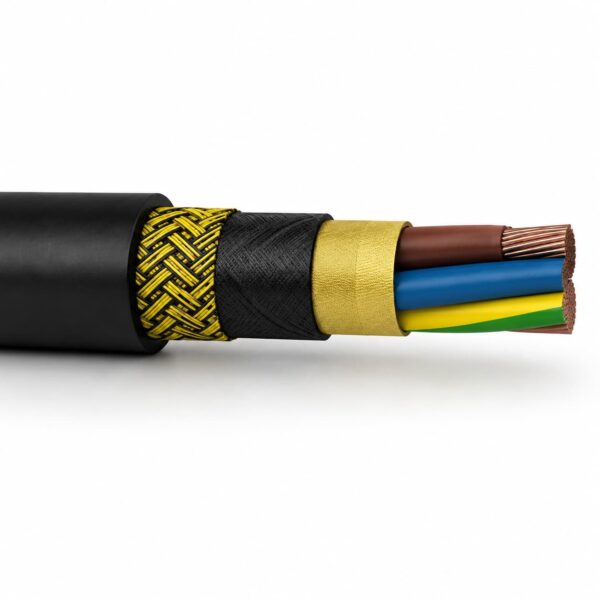
NSHTOEU 0.6/1kV LHD Mining Reeling Cable construction
Cable Construction
- Conductors: Four flexible stranded tinned-copper conductors carry power while accommodating the repeated bending imposed by the LHD reel.
- Core insulation: Each conductor is insulated with EPR compound type 3GI3.
- Central support: An optional support element may be positioned at the cable center according to the required construction and mechanical rating.
- Inner sheath: PCP compound type 5GM5 forms the bedding beneath the reinforcement.
- Anti-torsion reinforcement: A reinforced polyester-thread braid is incorporated in a vulcanized bond between the two sheath layers to manage twisting and stabilize the cable body.
- Outer sheath: PCP compound type 5GM5 completes the cable and provides the surface that runs over the reel and guidance system.
NSHTOEU 0.6/1kV LHD Mining Reeling Cable applications
Applications
- Underground load-haul-dump machines
- Mine scoop loaders with onboard cable reels
- Mono-spiral LHD reel systems
- Cylindrical and multilayer reel arrangements, subject to reel-capacity and thermal checks
- Mobile underground equipment exposed to frequently changing dynamic cable loads
Selection Notes for Buyers
Start with the electrical duty. Select the conductor cross-section from the machine load current, motor starting condition, route length and permitted voltage drop. Then check the thermal condition of the actual reel. Cable stored in multiple energized layers generally dissipates heat less effectively than cable laid out in free air, so a current rating taken from an unrelated installation method should not be used without review.
Match the mechanical construction. Determine the maximum cable pull at full travel, reel orientation, acceleration, slope, cable hanging length and the method used to anchor the central support. Apply the project safety factor and confirm how the catalogue kN value is defined. The optional support element is not automatically present in every construction and should not be assumed from the model name alone.
Check reel fit with the complete diameter range. Use the maximum overall diameter for drum-groove, guide-roller, cable-entry and reel-capacity calculations. Use the minimum value when checking clamping and sealing hardware. For cylindrical reels, also specify the number of stored layers and whether the cable remains energized while wound.
Control installation variables. Confirm the minimum permissible bending radius, reel speed, travel distance, reversing frequency and fleet duty cycle with the offered datasheet. Avoid introducing twist while paying the cable off the shipping drum, align the first guide with the reel and keep the cable path free from sharp edges and crossovers.
Define the mine environment. State water, oil, hydraulic-fluid, abrasion, flame-performance and ambient-temperature requirements in the RFQ. The supplied data confirms the materials and VDE construction reference, but it does not state individual resistance test results or operating limits for these exposures.
Selection checks
Confirm the equipment interface, installation method, route length, movement or flexing duty, environmental exposure, conductor or core requirements and project documentation before final selection.
NSHTOEU 0.6/1kV LHD Mining Reeling Cable specifications
The source-listed technical notes are retained below. Confirm the final size, tolerance, installation basis and ordered configuration before release.
Dimensions and Weight
The figures below reproduce the supplied size data. The kN value is retained as part of each listed construction designation. Confirm the applicable support-element rating, allowable working load, safety factor and termination method in the quotation before final selection.
The two 4 x 50 mm² entries are separate constructions with different listed support values, diameter ranges and cable weights. They should not be treated as interchangeable solely because the electrical cross-section is the same.
Source-listed technical tables
The tables below retain the original product data, including units, ranges and ordering examples.
| Product Type | Low-voltage LHD mining reeling cable |
| Model | NSHTOEU |
| Rated Voltage | 0.6/1 kV |
| Number of Power Cores | 4 |
| Nominal Cross-Section Range | 16-95 mm² in the supplied table |
| Listed Support Variants | 6, 12, 20, 30 and 50 kN, depending on construction |
| Conductor | Flexible stranded tinned copper |
| Insulation | EPR type 3GI3 |
| Support Element | Optional central support element |
| Inner Sheath | PCP type 5GM5 |
| Reinforcement | Polyester anti-torsion braid in a vulcanized bond between inner and outer sheaths |
| Outer Sheath | PCP type 5GM5 |
| Reel Types | Mono-spiral and cylindrical reels |
| Standard | VDE 0250 Part 814 |
| Cores x Nominal Cross-Section | Listed Support Value | Minimum Overall Diameter | Maximum Overall Diameter | Nominal Weight |
|---|---|---|---|---|
| 4 x 16 mm² | 6 kN | 27.5 mm | 31.5 mm | 1500 kg/km |
| 4 x 35 mm² | 12 kN | 37.5 mm | 42.0 mm | 2920 kg/km |
| 4 x 50 mm² | 12 kN | 43.0 mm | 48.0 mm | 3970 kg/km |
| 4 x 50 mm² | 30 kN | 42.0 mm | 44.0 mm | 3660 kg/km |
| 4 x 70 mm² | 20 kN | 47.0 mm | 52.0 mm | 5530 kg/km |
| 4 x 95 mm² | 50 kN | 53.0 mm | 58.0 mm | 6500 kg/km |
Original product attributes
These product attributes are retained as supplied and should be checked against the ordered construction.
| Product Type | LHD mining reeling cable |
|---|---|
| Model | NSHTOEU |
| Voltage Rating | 0.6/1 kV |
| Number of Cores | 4 |
| Nominal Cross-Sections | 16, 35, 50, 70 and 95 mm² |
| Listed Support Values | 6, 12, 20, 30 and 50 kN, construction-dependent |
| Conductor | Flexible stranded tinned copper |
| Insulation | EPR type 3GI3 |
| Support Element | Optional central support element |
| Inner Sheath | PCP type 5GM5 |
| Reinforcement | Polyester anti-torsion braid, vulcanized between sheaths |
| Outer Sheath | PCP type 5GM5 |
| Reel Types | Mono-spiral and cylindrical reels |
| Standard | VDE 0250 Part 814 |
| Application | Underground LHDs and scoop loaders |
NSHTOEU 0.6/1kV LHD Mining Reeling Cable standards and compliance
The following standard references are carried over from the original product record. They identify the source basis and do not replace project-specific certification or inspection requirements.
- Standard VDE 0250 Part 814
- Define the mine environment. State water, oil, hydraulic-fluid, abrasion, flame-performance and ambient-temperature requirements in the RFQ. The supplied data confirms the materials and VDE construction reference, but it does not state individual resistance test results or operating limits for these exposures.
Where a project requires a test report, certificate, marking record or inspection release, include that requirement in the quotation request.
Related cable options
Compare these cable options by service combination, movement, load, voltage and transmission requirement.
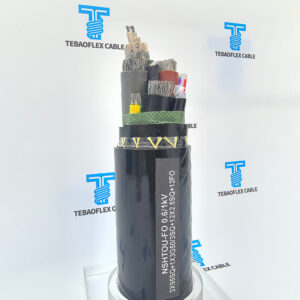
NSHTÖU-J Rubber Reeling Cable 0.6/1 kV for Hoisting and Hauling Equipment
A related cable option for a different application or duty profile.
View product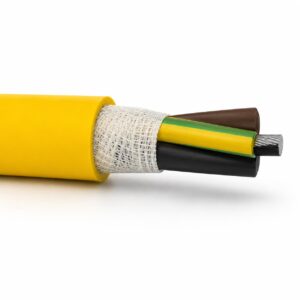
NSHTOU / (N)SHTÖU 0.6/1 kV Low Voltage Reeling Cable
A related cable option for a different application or duty profile.
View productRequest a cable recommendation and quotation
Send the required services, cable length, mechanical duty, environment, termination and quantity. Our team will review the application before quoting.
- Include the product name or SKU plus the required cable length and quantity.
- Attach a specification, drawing or data sheet when available.