


Mining & Tunnelling Cable Guide
Use this mining cable selection guide to define the machine duty, movement pattern, electrical system, protection scheme and operating environment before comparing model names. The right cable is the construction validated for the complete duty – not simply the one with the right voltage on its data sheet.
Machine, route and movement.
Load, voltage and protection.
Cores, screens and reinforcement.
Standard, tests and approval.
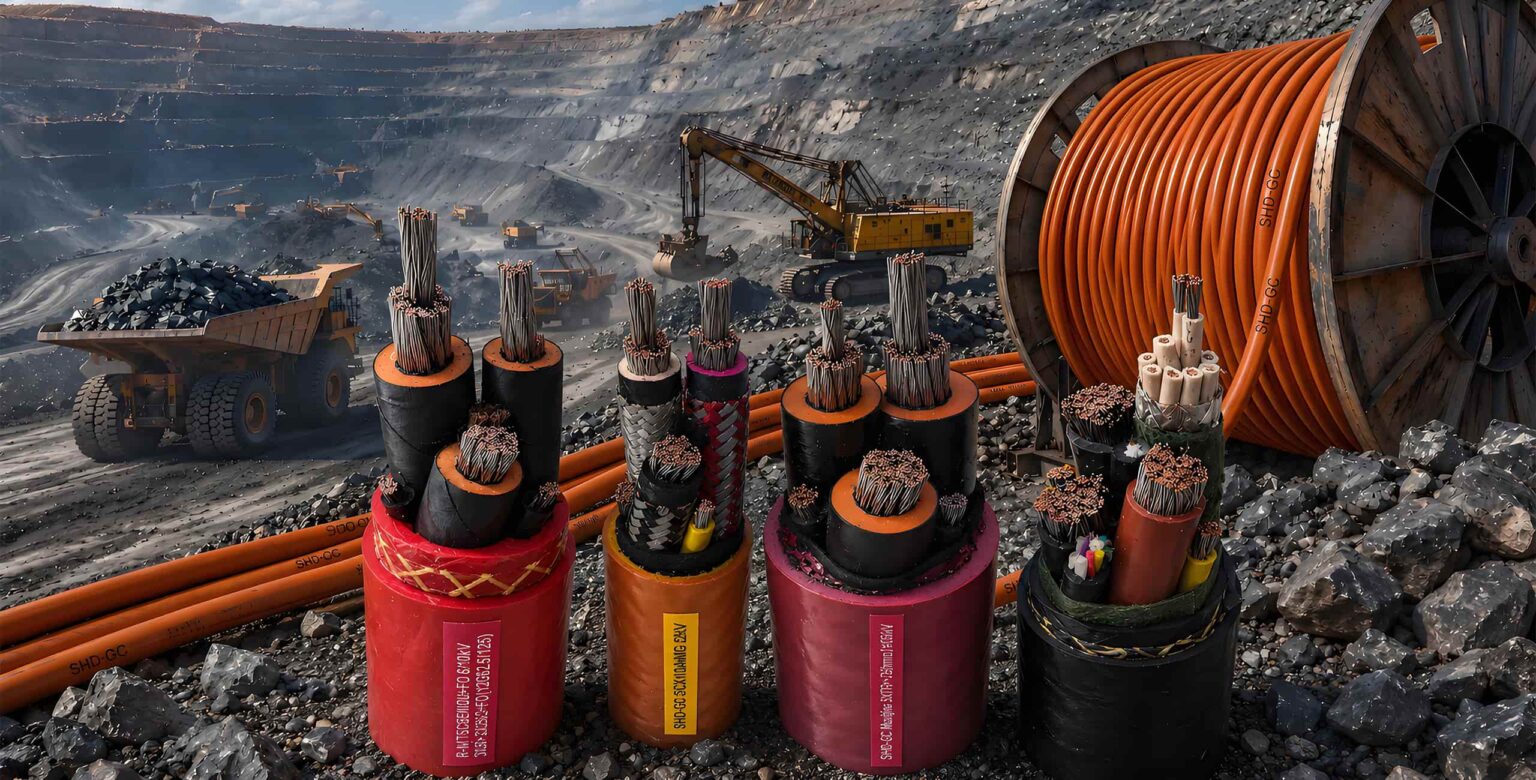
Mining cable selection: the quick answer
Select a mining cable in this order: define the machine and route, classify how the cable moves, calculate the electrical duty, map the protection circuit, specify the complete cable construction, document the mechanical and environmental hazards, confirm the governing standard, and validate the offered design against a written cable schedule.
Voltage is one filter, not the selection method. Two cables can share a voltage class and still have different conductor flexibility, screens, pilots, reinforcement, outer jackets, bend limits and intended movement. Choosing by voltage alone is a little like choosing work boots by size alone: technically relevant, but not enough information about where they are going.
| Observed duty | Start the comparison with | Critical data to confirm |
|---|---|---|
| Stationary or semi-fixed distribution | Feeder or armored power-cable construction | Installation method, voltage, ampacity, fault duty, mechanical protection and termination system |
| Cable dragged or repositioned with mobile equipment | Trailing-cable construction | Drag distance, route surface, pulling load, bend points, grounding and monitoring arrangement |
| Repeated winding on a powered drum | Reeling-cable construction | Drum diameter, layers, speed, tension, acceleration, torsion, reverse bending and fleet geometry |
| Medium-voltage mobile machine | Screened trailing or reeling construction | Rated voltage, insulation level, screens, grounding, ground check, protection coordination and accessories |
| Tender names a regional cable type | The exact named standard and designation | Edition, suffix, core arrangement, tests, marking, approval evidence and deviation schedule |
| Model | Start here when | Do not assume |
|---|---|---|
| NSSHCGEOEU | The mobile machine uses a documented high-tensile guide-pulley or reeling construction. | That a similar NSSHKCGEOEU spelling or any reel geometry is automatically equivalent. |
| (N)SSHCGEWÖU | A 0.6/1 kV mine or tunnel lighting route needs the specified monitoring function. | That the non-V cable is the same as the armoured -V variant. |
| (N)SSHCOEU | A frequency-converter output needs the documented screened rubber cable construction. | That a general mining cable provides the same EMC path. |
| (N)SSHÖU O/J, 3E or 3E + ST | A heavy-duty flexible power route needs the selected earth-screen and control-core arrangement. | That O/J, 3E and 3E + ST are interchangeable suffixes. |
1. Define the machine, circuit and route
Start with the equipment because the cable behaves as part of that machine. Record whether the circuit feeds a loader, drill, cutter, shovel, dragline, pump, conveyor, tunnel boring machine, mobile substation or another load. Then map the supply point, cable route, travel distance, cable length and every guide, roller, sheave, crossing and entry point.
The route often exposes the requirement that a product name hides. A cable that moves 5 m during maintenance has a different duty from one that follows a loader throughout each shift. The same applies to a pump lead held vertically, a dragline cable crossing broken rock and a reeling cable passing through an S-bend.
- Equipment: machine type, rated power, motor or drive type, starting method and operating cycle.
- Route: supply point, travel, vertical sections, crossings, guides, exposure to vehicles and inspection access.
- Existing installation: cable marking, length, terminations, couplers, glands, reel and strain-relief details.
- Service evidence: photographs of the full route, reel, entry points and any repeat damage location.
2. Classify fixed, trailing, reeling and handler duty
A trailing cable is moved with mobile equipment and may contact the ground or pass through a handling system. A reeling cable repeatedly winds onto and off a drum. A feeder cable normally supplies distribution equipment without the same continuous flexing. Where that feeder never moves at all, see armoured and static mining cable for the fixed-route construction. WorkSafe Western Australia treats trailing and reeling as distinct duties and connects them with equipment-specific safety and earth-continuity requirements in applicable systems.
For a reel, provide drum core diameter, flange diameter, usable width, number of layers, fleet angle, line speed, acceleration, pull, direction changes and whether the cable experiences twist or reverse bending. For a trailing route, provide drag distance, surface, tension, crossings and handling method. The drum is not known for negotiating after the cable arrives, so confirm its geometry before ordering.
Use the dedicated mining reeling cable vs trailing cable guide when movement is the first unresolved decision.
3. Calculate voltage, current, ampacity and voltage drop
Confirm the system operating voltage and the cable rated-voltage designation; they are related but not interchangeable. Calculate load current from the equipment data, then evaluate starting or cyclic load, route length, allowable voltage drop, ambient conditions, grouping, installation method and the temperature assumptions used for ampacity.
Single-conductor 2 kV DLO leads on drills, shovels and generator links start from the free-air or raceway base values in the DLO cable ampacity chart, before the ambient, grouping and terminal corrections described in this step.
IEC 60228 defines conductor requirements within its scope, while mining cable standards and manufacturer data add construction and application details. None of those sources replaces the project calculation. A qualified electrical professional should confirm conductor area, protection coordination, fault withstand and voltage drop for the actual circuit.
4. Match screens, grounding and ground-check circuits
Grounding conductors provide the equipment-grounding path. A ground-check conductor is part of a monitoring circuit used to verify ground-circuit continuity in applicable systems. They have different jobs, and a supplier needs the required arrangement rather than a generic request for an earth core.
Medium-voltage constructions may add conductor screens, insulation screens and metallic screens to control electrical stress and support the system fault-current path. The screen design must match the terminations, couplers, grounding method and protection system. For high-voltage continuous mining machines in US underground coal mines, 30 CFR 75.824 addresses short-circuit, overload, ground-fault and undervoltage protection. That rule has a defined jurisdiction; it is not a universal design template.
5. Specify the cable construction as a system
Read the cable from the conductor outward. Fine-stranded copper supports flexing, but conductor design alone does not determine dynamic life. Insulation, screens, fillers, reinforcement, inner sheath, outer jacket, core lay and manufacturing balance all influence how the cable handles electrical stress, bending, tension and torsion.
| Component | Question to answer | Why the answer changes selection |
|---|---|---|
| Power conductors | Material, conductor area, stranding and cyclic-flex requirement? | Affects ampacity, voltage drop, termination and flex-fatigue behavior |
| Insulation | Voltage class, temperature basis, moisture exposure and dynamic duty? | EPR, XLPE and other systems have different construction and movement contexts; material name alone is not suitability |
| Electrical screens | What field-control and grounding arrangement does the circuit require? | Affects electrical stress control, fault path and accessory compatibility |
| Grounding, pilot or ground check | What core arrangement and monitoring circuit are specified? | Affects protection-system compatibility and continuity monitoring |
| Reinforcement and fillers | What tension, torsion, crush and shape-stability duty is present? | Helps control core movement, elongation and deformation |
| Outer jacket | Which abrasion, cut, oil, chemical, water, UV and temperature exposures apply? | CPE, TPU and other jacket families must be evaluated in a complete tested construction |
That jacket row is deliberately short, because compound choice carries enough weight to need its own treatment. See how CPE, TPU and PVC jackets compare on abrasion for the drum-test methods behind those names and the wear patterns that point to which one a route needs.
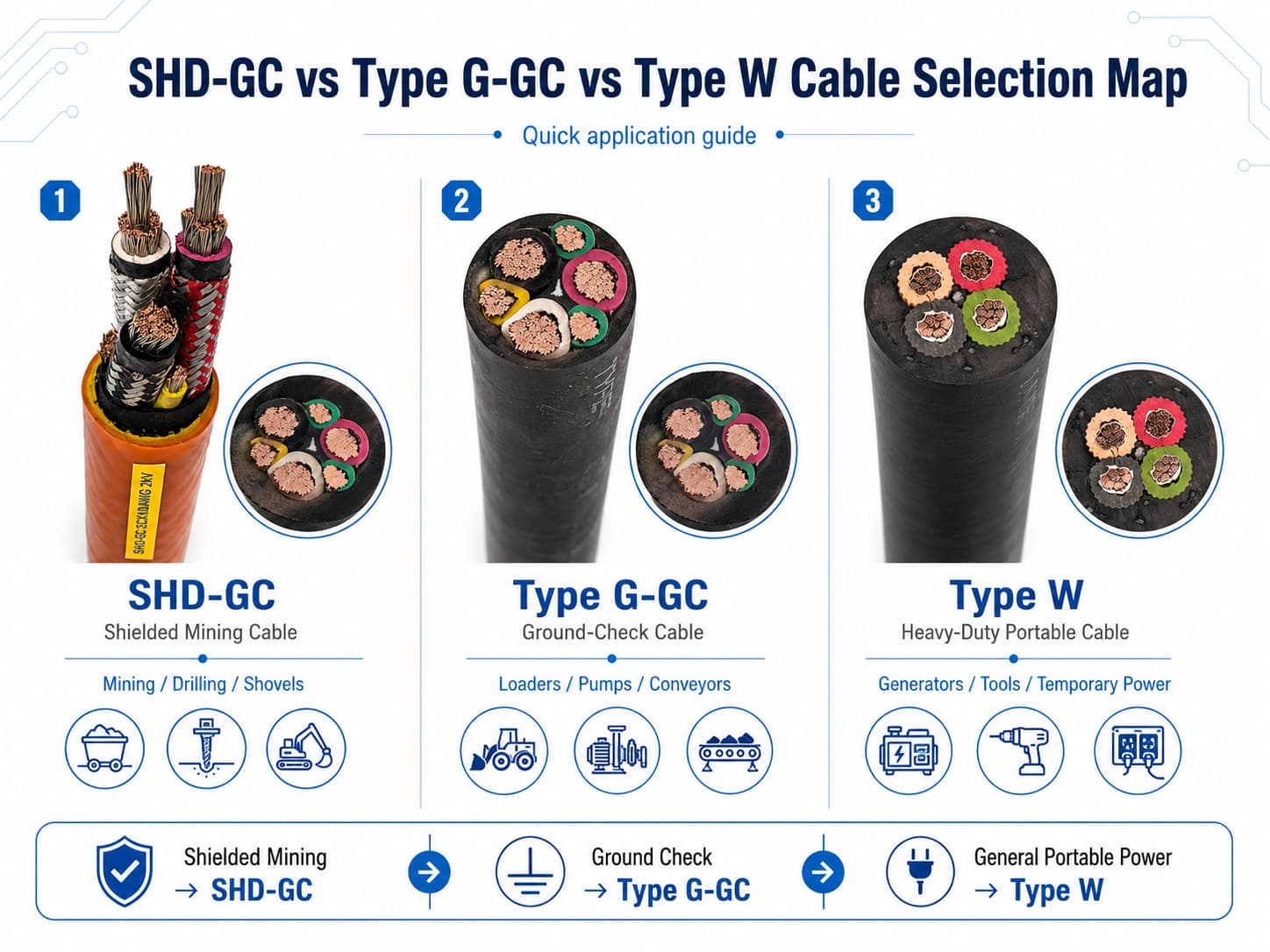
For a broader North American comparison, see the SHD-GC, Type G-GC and Type W mining cable guide. For application planning across different regional families, use the mining and tunnelling cable range only after the duty is defined.
6. Turn route hazards and old damage into specification data
Describe the environment in mechanisms, not adjectives. “Heavy duty” does not tell a cable engineer whether the dominant risk is abrasion over rock, sidewall pressure at a sheave, oil exposure, water ingress, low-temperature flexing, torsion on a reel or heat at a termination.
| Observed condition | Check first | Specification response to evaluate |
|---|---|---|
| Outer jacket cuts or rapid abrasion | Route surface, crossings, guides, pulling method and chemical exposure | Route protection, handling change, jacket system, reinforcement and inspection interval |
| Flattening or crushing | Rollers, sheaves, vehicle crossings, sidewall pressure and reel layering | Cable geometry, mechanical protection, reel control and guide dimensions |
| Corkscrewing or core movement | Torsion, fleet angle, reel alignment, pull and reverse bends | Torsion-balanced construction, reel geometry and operating controls |
| Conductor break near a termination | Strain relief, bend point, vibration, unsupported length and lug installation | Termination design, support, conductor construction and minimum bend limits |
| Heat or discoloration | Load, connection resistance, protection, grouping and ambient conditions | Electrical calculation, termination inspection and protection review |
| Repeated water ingress or splice failure | Damage location, repair method, immersion, sealing and handling | Route control, approved repair boundary, accessory system and replacement criteria |
Record ambient minimum and maximum temperature, water or submersion, mud, oils, fuels, chemicals, sunlight, flame-resistance requirements and inspection access. Photos should show context as well as the close-up; a jacket wound photographed without the guide or crossing that caused it tells only half the story.
7. Confirm the governing standard, jurisdiction and approval evidence
Mining cable names are regional. Type W, G-GC, SHD-GC and MP-GC are familiar North American designations; other markets use AS/NZS, SANS, VDE or project-specific constructions. Similar voltage labels do not make those types equivalent. Any proposed alternative should be compared clause by clause, with deviations approved before manufacture.
ANSI/ICEA S-75-381/NEMA WC 58 covers portable and power-feeder cables for mines and similar applications within its stated scope. Confirm the edition named by the project. In the United States, underground coal trailing-cable requirements are distributed across 30 CFR Part 75, Subpart G and equipment-specific provisions such as 30 CFR 18.35. Metal and nonmetal mines follow a different regulatory path, including 30 CFR Part 57, Subpart K.
If MSHA acceptance or another approval is required, request evidence for the exact offered construction and marking. A family brochure or certificate for a similar cable does not establish approval for the proposed item, and approval does not replace voltage, ampacity, movement, accessory and installation checks.
8. Build an RFQ cable schedule and validate the offer
Put one circuit on each line of the cable schedule. Include the machine, system and cable voltage, load current or conductor area, core arrangement, screen and monitoring functions, route length, required cable length, movement duty, bend or reel data, environment, terminations, governing standard and required documents.
- Electrical: operating and rated voltage, current, starting duty, fault level, protection settings and voltage-drop limit.
- Mechanical: trailing or reeling duty, bend limits, drum geometry, tension, speed, torsion, guides and crossings.
- Construction: conductors, insulation, screens, earth and pilot cores, reinforcement, jacket and cable marking.
- Environment: temperature, water, oil, chemicals, abrasion, UV, flame requirement and mine classification.
- Interfaces: couplers, glands, terminations, reel, strain relief and compatibility drawings.
- Documents: standard and edition, datasheet, cross-section, dimensions and tolerances, test plan, approval evidence, drum schedule and deviations.
Compare offers against the same schedule. Ask each supplier to state assumptions and deviations rather than hiding them in a generic “equivalent” description. The final construction should be validated by the responsible engineer and the manufacturer against the actual duty cycle.
When the schedule is complete, send the mining cable application data for technical quotation review. A quotation route supports selection; it does not replace engineering approval or site compliance review.
Common mining cable selection mistakes
- Starting with a familiar type name: the name may belong to another standard, voltage suffix or movement duty.
- Treating flexibility as reeling suitability: repeated drum cycling adds tension, layering, torsion and reverse-bend questions.
- Choosing a jacket compound in isolation: service performance depends on the full construction, thickness, reinforcement, processing and exposure.
- Confusing grounding and ground check: one provides a grounding path; the other supports continuity monitoring in applicable systems.
- Ignoring accessories: the cable, couplers, terminations, glands, reel and protection system must work together.
- Accepting an undocumented equivalent: require a completed datasheet and deviation schedule tied to the named project requirements.
Inspection and repair remain part of selection
A suitable cable still needs controlled handling, route protection, inspection, electrical testing and documented replacement criteria. WorkSafe and Queensland mining guidance both treat cable management and reeling equipment as part of the system rather than a one-time purchase decision.
This article is not a repair procedure. High-voltage cable work, testing, splicing and repair must follow the applicable de-energization, grounding, isolation and qualified-work requirements. For US underground coal applications, 30 CFR 75.830 and 30 CFR 75.831 provide application-specific repair and electrical-work provisions.
Mining cable selection FAQs
How do I choose the right mining cable?
Define the machine and route, movement duty, voltage and load, protection system, construction, mechanical and environmental hazards, governing standard, accessories and required documents. Then have the proposed construction validated against the complete cable schedule.
What is the difference between trailing, reeling and feeder cable?
A trailing cable moves with mobile equipment and may contact the ground or pass through a handler. A reeling cable repeatedly winds onto a drum and must match the reel mechanics. A feeder cable normally serves distribution duty without the same continuous movement.
Can a flexible industrial cable be used on mobile mining equipment?
Only when the responsible engineer confirms that its electrical, movement, mechanical, environmental, protection, accessory and approval requirements match the application. A flexible conductor or rubber jacket alone does not establish suitability.
Does MSHA acceptance make a cable suitable for every mine application?
No. Acceptance addresses the applicable approval scope. The project must still verify voltage, ampacity, movement, construction, protection compatibility, installation, marking and the exact offered approval record.
What information is needed for a mining cable quotation?
Provide the machine, voltage, current or conductor area, core and screen arrangement, movement, route and cable length, bend or reel data, environment, terminations, standard and edition, tests, approval documents, quantity and delivery country.
Sources and editorial scope
This guide is a selection framework, not a cable approval, compliance certificate or installation design. Regulatory links describe their own jurisdictions. Product and category links show reference constructions; they do not prove suitability for a project.
Related mining cable references
Use these exact product records only after the equipment, movement, circuit and protection system are defined.