

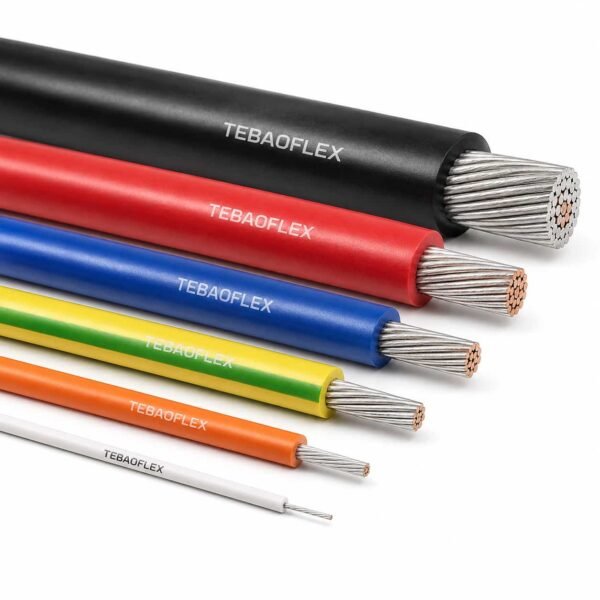
Fil de câblage UL XLPE et XLPO, 90°C à 150°C, 300–600 V
Fil de raccordement en polyoléfine recoupé dans sept styles UL AWM, 90 °C à 150 °C. Thermoset, sans halogène, et une fraction du coût de PFA à la même température.
- Styles : UL 3320, 3385, 3287, 3266, 3173, 3271, 3321
- Température : 90, 105, 125 ou 150 °C selon le style
- Tension : 300 V ou 600 V (3271 et 3321 également 750 V DC)
- Sections : 32 AWG à 4/0; UL 3271 jusqu’à 2000 kcmil
- Isolation : extrudé XLPE ou XLPO, toutes couleurs
- Options : Composé sans halogène, à faible émission de fumée et retardateur de flamme; cuivre étamé ou nu; XLPO résistant aux UV et à l’ozone pour applications photovoltaïques et de stockage
- Normes : UL 758 / UL 1581; CSA AWM au besoin
Envoyer le numéro de style, ou la température, la tension et le plus grand conducteur.
Le polyéthylène réticulé est la réponse à une plainte spécifique concernant les PE ordinaires et les PVC: Ils s'adoucissent, ils rampent, et ils s'éloigneront d'un terminal chaud avec suffisamment de temps. La liaison croisée tourne le thermoset de polymère — il ne peut plus fondre, seulement l'omble — et qu'un changement est ce qui prend une isolation bon marché, difficile, facilement dépouillée de 80 °C à 150 °C.
TEBAOFLEX construit la famille à travers sept styles UL AWM, de 90 °C à 150 °C et de 300 V à 600 V, sur cuivre massif ou toronné :
UL 3320 (90 °C / 600 V, jusqu’à 2 AWG) · UL 3385 (105 °C / 300 V) UL 3287 (105 °C / 600 V, cuivre à haute résistance) · UL 3266 (125 °C / 300 V) UL 3173 (125 °C / 600 V) UL 3271 (125 °C / 600 V, jusqu’à 2000 kcmil, conducteurs de moteur) · UL 3321 (150 °C / 600 V, à 4/0).
Deux éléments distinguent cette famille des fluoropolymères et des silicones présentés ailleurs dans notre câble haute température gamme. Le premier est prix: à 125 °C, la polyoléfine réticulée fait un travail qui aurait autrement besoin de PFA ou de silicone, pour une fraction du coût. La seconde est que le composé peut être fait Sans halogène, sans fumée et sans flamme — ce qu’aucun numéro de style UL ne vous indiquera, car l’absence d’halogènes est une propriété du composé, pas du style.
Le XLPO variante de UL 3173 ajoute UV et la résistance à l'ozone et est celui utilisé sur le côté DC des équipements photovoltaïques et de stockage d'énergie. C'est le même numéro de style que la version XLPE, et cela surprend les gens — voir l'onglet Normes.
Envoyez le numéro de style si vous en avez un. Si vous ne le faites pas, envoyez la température, la tension et le plus grand conducteur, et nous vous indiquerons lequel des sept que vous demandez réellement.
Simple à construire, et la simplicité est le point: un conducteur de cuivre et une paroi extrudée. Tout ce qui rend cette famille intéressante se passe à l'intérieur du complexe.
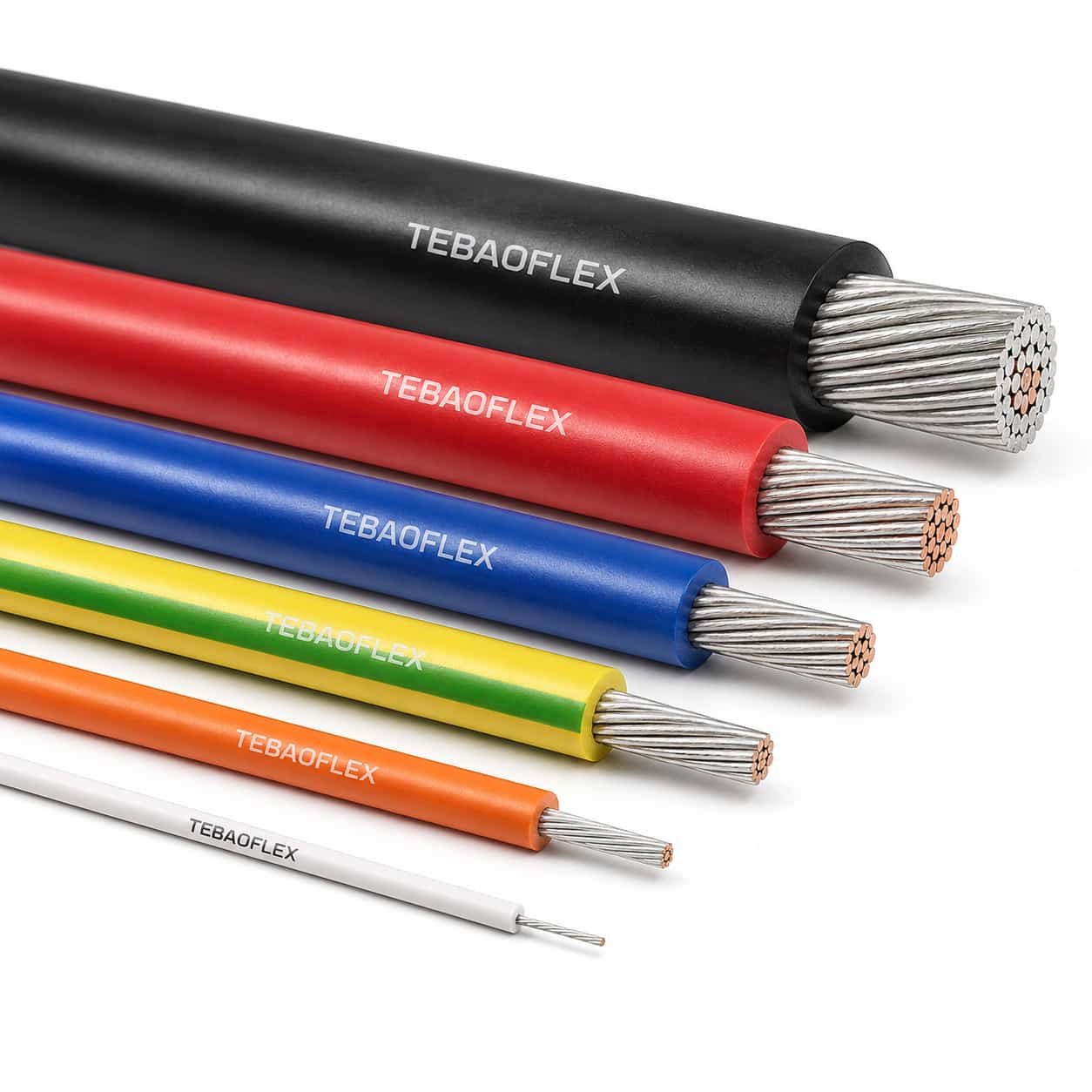
- Conducteur : cuivre solide ou échoué, nu ou étamé. La taille dépend du style — 32 AWG à l'extrémité fine, 2000 kcmil à l'extrémité grossière.
- Isolation : une seule paroi extrudée Polyéthylène réticulé (XLPE) ou polyoléfine recoupée (XLPO), recoupement après extrusion.
Ce qui change réellement
Le polyéthylène non réticulé est un thermoplastique : chauffées, les chaînes glissent les unes sur les autres, le matériau se ramollit, flue puis s’écoule. La réticulation lie chimiquement les chaînes. Le matériau ne fond plus; à la limite supérieure il reste dimensionnellement stable et, au-delà, se carbonise au lieu de s’éloigner du conducteur. C’est pourquoi une polyoléfine peut être classée 125 °C ou 150 °C alors que le même polymère de base non réticulé est un matériau 80 °C.
Deux itinéraires vous y mènent. Raccordement chimique utilise un peroxyde et une phase de durcissement — c'est ce que précise UL 3320. Raccordement de l'irradiation passe le fil fini sous un faisceau d'électrons après extrusion, ce qui permet une paroi plus mince et plus cohérente parce que la géométrie est fixée avant que le matériau devienne thermoset. La plupart des styles à parois minces de cette famille sont faits de la deuxième façon.
XLPE ou XLPO — et pourquoi un numéro de style couvre les deux
XLPE est un polyéthylène réticulé. XLPO est la famille la plus large: un mélange de polyoléfines, généralement formulé pour un retard de flamme, une résistance UV ou une performance sans halogène que le polyéthylène droit ne donnera pas. Ils sillonnent et coupent de la même façon et se comportent de la même façon dans un terminal, de sorte qu'un style UL écrit autour des propriétés plutôt que le polymère exact peut accepter l'un ou l'autre. UL 3173 est exactement ce — le style permet d'extruder XL, XLPO ou - Oui. Si vous avez reçu deux fiches de données à la fois marquées 3173 qui ressemblent à des produits différents, c'est pourquoi, et aucun d'eux n'est faux.
L’absence d’halogènes est une propriété du composé, pas du style
C'est le malentendu le plus courant dans cette famille. Un style UL AWM fixe la classe de matériaux, la paroi, la température et la tension. Il ne dit rien sur la teneur en halogène, la densité de fumée ou la corrosivité. Un fil UL 3266 sans halogène et un fil UL 3266 avec halogène sont tous deux légitimement UL 3266. Si votre spécification doit être exempte d'halogène, elle doit être appelée séparément contre IEC 60754-1, et les propriétés de la fumée et de la flamme en fonction de leurs propres normes — exactement comme elles le seraient sur une Câble en silicone sans halogène. Demandez le composé, pas seulement le style.
Options de conducteur, y compris une option qui n'est pas du cuivre ordinaire
- Cuivre — par défaut.
- Cuivre plaqué étain — la soudabilité et une surface de sertissage stable; le choix habituel pour le câblage de panneau et d'équipement.
- Cuivre à haute résistance revêtu — précisé par UL 3287, et la raison pour laquelle ce style existe comme autre chose qu'un duplicata de 3320. Lorsque le plomb est tiré, tendu ou blessé, la force de traction du conducteur est la propriété achetée.
- Massif ou toronné — chaque style de cette famille permet les deux. Solide pour insertion automatisée et terminaison de masse; échoué pour tout ce qui bouge ou est habillé à la main.
Pourquoi il survit à l'imprégnation
Les fils d'enroulement du moteur et du transformateur sont trempés, vernis ou imprégnés de vide. Un mur thermoplastique dans un bain de vernis chaud est une responsabilité; un thermoset ne l'est pas. Cette résistance au vernis et à l'imprégnation, conjuguée à la résistance à l'ozone, à l'huile et à l'essence, explique pourquoi cette famille maintient la position de plomb moteur et de plomb enrouleur que son prix ne justifierait pas autrement.
Cette famille est le cheval de bataille du groupe 105–150 °C. Ce n'est pas le matériau le plus résistant à la chaleur que nous fabriquons et ce n'est pas le plus chimiquement inerte — c'est celui qui est assez bon pour la plupart de ce qui doit être au-dessus de 90 °C, à un prix qui vous permet de l'utiliser partout plutôt que seulement là où vous devez.
Où il est utilisé
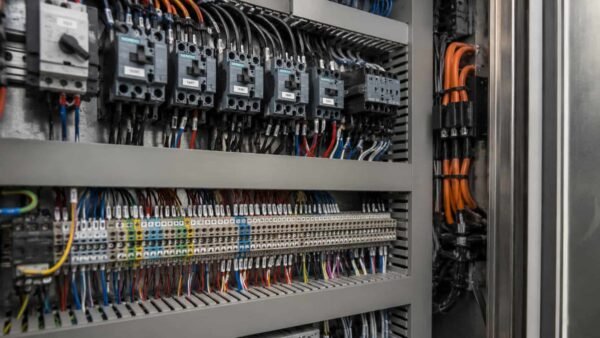
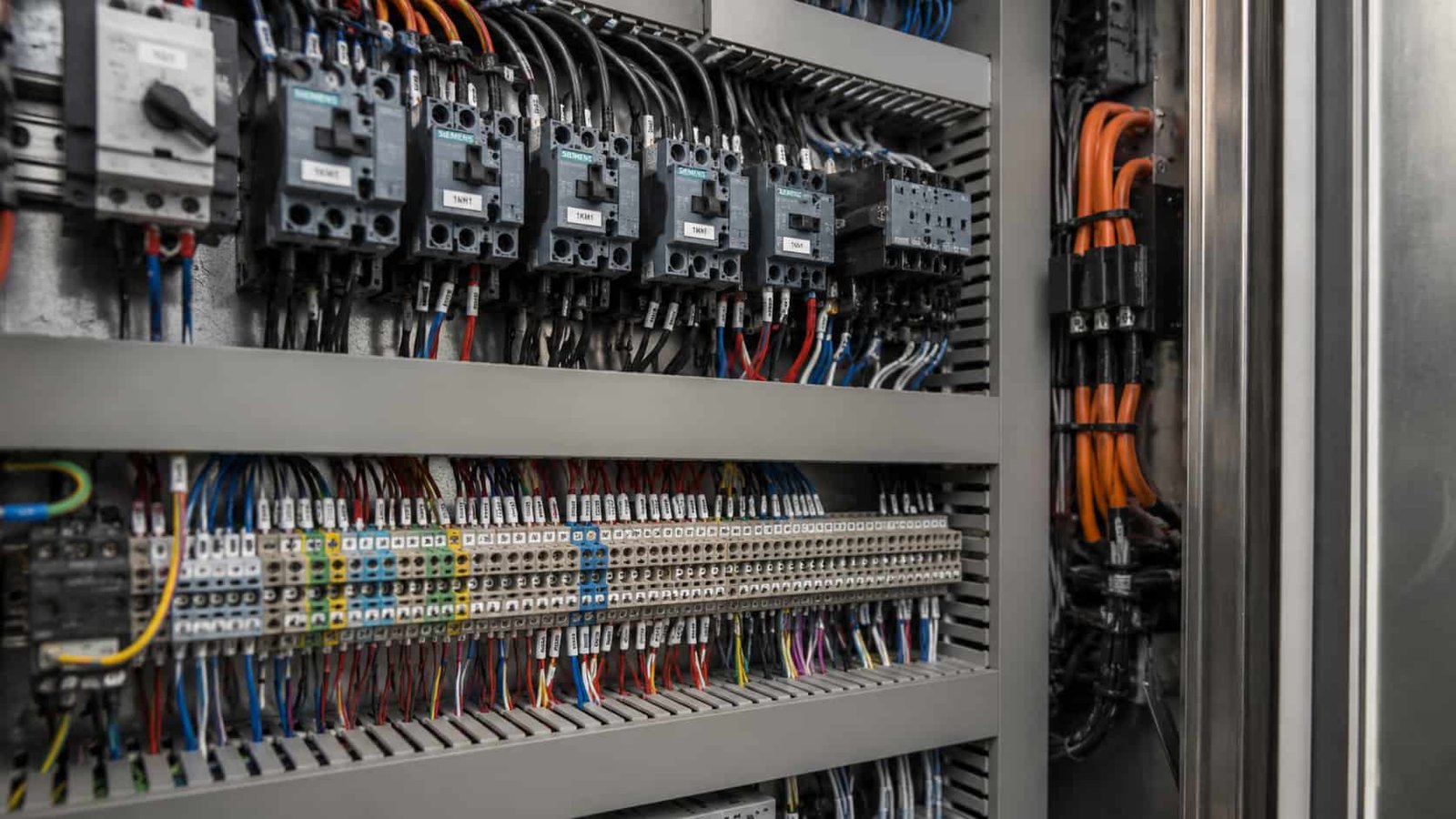
- Panneaux de commande et commutateurs — la version sans halogène, à faible fumée de ce fil est ce qui a remplacé PVC dans le câblage de l'armoire dans la majeure partie de l'Europe.
- Lignes d'enroulement pour moteurs et transformateurs — le raccordement d'un enroulement qui doit survivre à l'imprégnation, au vernis et à la chaleur de la machine. UL 3320 et UL 3271 sont désignés pour exactement cela.
- Chocs, relais et inducteurs — de petits enroulements avec le même problème d'imprégnation.
- Câblage interne des appareils — la plus grande application de volume, et la raison pour laquelle la plupart de ces styles existent.
- Matériel électrique et électronique — où les styles 300 V sont souvent étiquetés pour une utilisation électronique maximale plus élevée. Lisez la section suivante avant de vous y fier.
- Stockage d'énergie photovoltaïque et batterie — voir ci-dessous.
- Gros moteurs — UL 3271 se dirige vers 2000 kcmil, où cette famille cesse d'être un fil de branchement et commence à être une source d'énergie.
Applications photovoltaïques et de stockage d’énergie : version XLPO
La construction de XLPO UL 3173 est composé pour UV et résistance à l ' ozone en plus de la classification 125 °C et 600 V, et il est utilisé pour la connexion interne du système, la connexion d’onduleur et connexion batterie dans l'équipement de stockage. Il s'enroule et se coupe facilement, ce qui importe lorsqu'un technicien termine des centaines de connexions dans un rack, et il est nettement plus économique qu'un fluoropolymère à la même cote.
Deux limites méritent d'être indiquées. Voici matériel câblage interne, pas un câble de réseau PV — module-à-module et câblage de chaîne à l'extérieur est EN 50618 / IEC 62930 territoire et une construction différente. Et sur le côté haute tension DC d'un véhicule ou d'un grand système de stockage, 600 V ne suffit pas: c'est Câble ISO 19642 XLFE à 1 500 V DC.
Le piège « 600 V crête — usage électronique uniquement »
Plusieurs styles 300 V dans cette famille — UL 3266 et UL 3385 parmi eux — peuvent porter une balise de lecture 600 V crête, usage électronique uniquement, et UL 3287 une étiquette similaire au pic volts 2 500. Ce n'est pas une cote 600 V. Il s'agit d'une marge de tension maximale pour les circuits électroniques, accordée dans des conditions définies par l'étiquette, et il ne rend pas un style 300 V interchangeable avec un 600 V pour le câblage électrique. Si un fournisseur répond à une exigence 600 V avec un numéro de pièce 3266, c'est la distinction qu'il a dépassée.
Choisir un style, dans l'ordre les questions arrivent réellement
| Question | Réponse |
|---|---|
| Quelle température? | 90 → 3320. 105 → 3385 (300 V) ou 3287 (600 V). 125 → 3266 (300 V), 3173 ou 3271 (600 V). 150 → 3321. |
| Quelle tension? | 300 V → 3385, 3266. 600 V → 3320, 3287, 3173, 3271, 3321. |
| Combien? | Jusqu'à 9–10 AWG → la plupart des styles. Vers 4/0 → 3321. Vers 2000 kcmil → 3271. |
| C'est un moteur? | 3320 et 3271 portent cette désignation explicitement. |
| Le conducteur prend-il de la tension? | 3287 — le style spécifie le cuivre à haute résistance revêtu. |
| À l’extérieur, aux UV ou dans une armoire photovoltaïque/de stockage ? | 3173 dans le composé XLPO. (xlpo) |
| Sans halogène? | N'importe lequel d'entre eux — c'est un choix complexe, pas un style. Dis-le séparément. |
Ce à quoi ce fil n'est pas destiné
- Pas au-dessus de 150 °C. La famille s'arrête là. Au-dessus, vous êtes en fluoropolymère ou en silicone — voir PTFE, PFA ou fil de raccordement en silicone.
- Pas un câble de construction ou d'installation. AWM est le matériel de câblage de l'appareil: un composant reconnu à l'intérieur de l'équipement, et non une méthode de câblage.
- Pas un câble PV. Le câblage des modules et des cordes à l'extérieur a ses propres normes.
- Pas automatiquement sans halogène. Demande l'enceinte.
- Pas aussi chimiquement inerte qu'un fluoropolymère. Une bonne résistance au pétrole, à l'essence, à l'ozone et au vernis n'est pas la même que l'indifférence de PTFE à presque tout.
Les sept styles
| Style | Température | Tension | Sections des conducteurs | Isolation | Désignation d'utilisation UL |
|---|---|---|---|---|---|
| 3320 | 90 °C | 600 V CA | 30 – 2 AWG | XLPE extrudé, réticulé chimiquement | Lignes motrices ou câblage interne des appareils |
| 3385 | 105 °C | 300 V CA | 32 – 10 AWG | Extrudé XLPE | Câblage interne des appareils |
| 3287 | 105 °C | 600 V CA | 32-9 AWG, cuivre à haute résistance revêtu | XLPE extrudé, moyenne minimale 30 mils / minimum 27 mils | Câblage interne des appareils |
| 3266 | 125 °C | 300 V CA | 32 – 10 AWG | XLPE extrudé, moyenne minimale 15 mils / minimum 13 mils | Câbles internes |
| 3173 | 125 °C | 600 V CA | 26 – 9 AWG | Extrudé XL, XLPO ou XLPE, 30 millions min avg / 27 millions min | Câblage interne des appareils |
| 3271 | 125 °C | 600 V AC / 750 V DC | 30 AWG – 2000 kcmil | Extrudé XLPE | Lignes motrices ou câblage interne des appareils |
| 3321 | 150 °C | 600 V AC / 750 V DC | 30 AWG – 4/0 AWG | Extrudé XLPE | Câblage interne des appareils |
Tous les sept sont notés flamme horizontale. Les cotes, tailles et désignations d'utilisation ci-dessus sont tirées des enregistrements de style UL plutôt que d'une fiche technique du fournisseur, ce qui explique pourquoi ils sont parfois en désaccord avec ce que vous avez été cité.
UL 3173 — 125 °C, 600 V, construction XLPE
| AWG | Toronnage | Diamètre du conducteur (mm) | Isolation (mm) | Dia global. (mm) | Résistance maximale à 20 °C (en km) |
|---|---|---|---|---|---|
| 10 | 105/0.254 | 3.00 | 0.80 | 4.60 ± 0.15 | 3.54 |
| 12 | 65/0.254 | 2.36 | 0.80 | 3.95 ± 0.15 | 5.64 |
| 14 | 41/0.254 | 1.88 | 0.80 | 3.45 ± 0.15 | 8.96 |
| 16 | 26/0.254 | 1.50 | 0.80 | 3.10 ± 0.10 | 14.60 |
| 18 | 16/0.254 | 1.17 | 0.80 | 2.75 ± 0.10 | 23.20 |
| 20 | 21/0.18 | 0.95 | 0.80 | 2.55 ± 0.10 | 36.70 |
| 22 | 17/0.16 | 0.76 | 0.80 | 2.35 ± 0.10 | 59.40 |
| 24 | 11/0.16 | 0.61 | 0.80 | 2.20 ± 0.10 | 94.20 |
| 26 | 7/0.16 | 0.48 | 0.80 | 2.08 ± 0.10 | 150.00 |
D'autres échafaudages sont disponibles à 18 et 20 AWG (34/0.18, 19/0.235 et un solide 0.813 mm) avec la même résistance et des diamètres légèrement différents.
UL 3173 — Construction de XLPO pour le stockage photovoltaïque et énergétique
| AWG | Diamètre du conducteur (mm) | Isolation (mm) | Dia global. (mm) | Poids (kg/km) | Résistance maximale à 20 °C (en km) |
|---|---|---|---|---|---|
| 12 | 2.4 | 0.76 | 4.00 ± 0.20 | 40.9 | 5.640 |
| 14 | 1.9 | 0.76 | 3.50 ± 0.15 | 28.1 | 8.960 |
| 16 | 1.5 | 0.76 | 3.10 ± 0.15 | 19.9 | 14.60 |
| 18 | 1.2 | 0.76 | 2.80 ± 0.15 | 14.1 | 23.20 |
| 20 | 0.9 | 0.76 | 2.60 ± 0.15 | 10.7 | 36.70 |
| 22 | 0.8 | 0.76 | 2.40 ± 0.15 | 8.4 | 59.40 |
| 24 | 0.6 | 0.76 | 2.20 ± 0.15 | 6.8 | 94.20 |
| 26 | 0.5 | 0.76 | 2.10 ± 0.15 | 5.6 | 150.00 |
Rayon de courbure minimal pour installation fixe, construction XLPO : 10 × diamètre du câble. Résistant aux UV et à l’ozone; satisfait UL VW-1 et CSA FT1.
UL 3321 — 150 °C, 600 V AC / 750 V DC
| AWG | Toronnage | Diamètre du conducteur (mm) | Isolation (mm) | Dia global. (mm) |
|---|---|---|---|---|
| 4/0 | 2146/0.254 | 15.70 | 2.09 | 17.80 ± 0.15 |
| 3/0 | 1615/0.254 | 13.65 | 2.09 | 15.97 ± 0.15 |
| 2/0 | 1330/0.254 | 12.36 | 2.09 | 15.00 ± 0.15 |
| 1/0 | 1026/0.254 | 10.85 | 2.09 | 13.58 ± 0.15 |
| 2 | 665/0.254 | 8.74 | 1.20 | 10.73 ± 0.15 |
| 4 | 420/0.254 | 6.94 | 1.20 | 8.42 ± 0.15 |
| 6 | 259/0.254 | 5.46 | 1.20 | 8.00 ± 0.15 |
| 8 | 161/0.254 | 3.72 | 0.82 | 6.40 ± 0.15 |
| 10 | 105/0.254 | 3.01 | 0.82 | 4.80 ± 0.10 |
| 14 | 41/0.254 | 1.88 | 0.82 | 3.60 ± 0.10 |
| 18 | 34/0.18 | 1.21 | 0.82 | 2.86 ± 0.10 |
| 22 | 17/0.16 | 0.76 | 0.82 | 2.45 ± 0.10 |
| 26 | 7/0.16 | 0.49 | 0.82 | 2.20 ± 0.10 |
| 30 | 7/0.10 | 0.31 | 0.82 | 1.95 ± 0.10 |
Les tailles intermédiaires (12, 16, 20, 24, 28 AWG) sont standard et ne sont omises ici que pour que la table soit lisible. Rayon de courbure 10 × D; tressée en option.
UL 3266 — 125 °C, 300 V, construction sans halogène
| AWG | Dia global. (mm) | Cuivre (kg/km) | Poids (kg/km) |
|---|---|---|---|
| 22 | 1.60 | 3.40 | 5.50 |
| 20 | 1.80 | 6.00 | 7.90 |
| 18 | 2.05 | 8.30 | 12.00 |
| 16 | 2.35 | 13.00 | 16.00 |
Conducteur en cuivre étamé flexible, isolation polyoléfine à haute température, tension d'essai 3 000 V, plage de température −30 °C à +125 °C, rayon de flexion minimal 6 × diamètre extérieur. Sans halogène pour IEC 60754-1, corrosivité au gaz pour IEC 60754-2, retardateur de flamme pour IEC 60332-1, densité de fumée pour IEC 61034-1 et -2. Résistant à l ' ozone, à l ' oxygène et aux intempéries, ainsi qu ' aux processus de vernis et d ' imprégnation; bonne résistance à l'huile et à l'essence.
UL 3385 — 105 °C, 300 V
30 disponible à 10 AWG avec une paroi nominale 0.40 mm sous 16 AWG et 0.50 mm à 14 AWG et au-dessus; diamètres hors tout de 1.10 mm à 30 AWG à 4.00 mm à 10 AWG. Données dimensionnelles complètes sur demande — le plan de mur et de diamètre suit le même modèle que UL 3173 avec le mur 300 V plus fin.
Dimensions UL 3320, 3287 et 3271
Ces trois sont faits pour commander contre l'horaire du mur UL pour la taille et ne sont pas tenus à une table fixe publiée ici. UL 3271, en particulier, va de 30 AWG à 2000 kcmil, avec isolation de 30 mils moyenne minimale à l'extrémité fine à 95 mils aux plus grandes tailles — une gamme beaucoup trop large pour être utile comme une seule table. Envoyez la taille et nous émettrons le dessin.
Ce que le style UL corrige, et ce qu'il ne corrige pas
| Référence | Portée | Ce que ça veut dire ici |
|---|---|---|
| UL 758 | Matériau de câblage d’appareil — la norme dont relèvent les sept styles | AWM est composant reconnu statut du fil utilisé à l'intérieur de l'équipement. Ce n'est pas une liste pour votre produit fini et ce n'est pas une approbation d'installation. |
| UL 1581 | Norme de référence pour les fils électriques, câbles et câbles flexibles — les méthodes d'essai | Lorsque les procédures d'essai réelles derrière les exigences de style vivent. |
| CSA AWM I A / I A B | Reconnaissance équivalente canadienne | En général porté à côté du style UL; le déclarer à l'enquête si votre marché en a besoin. |
| Le numéro de style | Classe de matériau, épaisseur de paroi, température, tension, gamme de dimensions, essai de flamme, désignation d'utilisation | Sept choses réparées. Voir la ligne ci-dessous pour ceux qui ne le sont pas. |
| Pas le numéro de style | Teneur en halogène, densité de fumée, corrosivité au gaz, résistance UV, résistance à l'huile, couleur | Toutes les propriétés composées. Deux fils du même style peuvent différer complètement sur chacun d'eux. |
| IEC 60754-1 / -2, IEC 61034-1 et -2, IEC 60332-1 | Sans halogène, corrosivité au gaz, densité de fumée, propagation de la flamme | Cité séparément pour les composés sans halogène. C'est le vocabulaire que vos clients européens utiliseront pour le même fil. |
UL 3173 permet deux polymères différents, et ce n'est pas une erreur
La fiche du style UL 3173 indique « XL, XLPO ou XLPE extrudé ». Cette ligne explique la confusion récurrente : deux fiches UL 3173 peuvent être correctes, l’une pour un fil de raccordement d’appareil et l’autre pour un fil photovoltaïque résistant aux UV; toutes deux sont authentiques. Le style est défini par la température, la tension, la paroi et le comportement au feu, pas par un polymère précis.
La conséquence pratique: sur ce style, le numéro de style seul n'est pas une spécification d'achat. Si vous avez besoin de la performance UV et de l'ozone, demandez le composé XLPO par nom. Si vous remplacez un fil existant, demandez lequel des deux vous avez avant de commander un tambour de l'autre.
3271 ou 3173? La question est la taille et l'utilisation, pas le matériel
Les deux sont 125 °C et 600 V. Ils sont couramment cités l'un contre l'autre et la différence n'est pas l'isolation:
- UL 3173 s'arrête à 9 AWG et est désigné câblage interne des appareils.
- UL 3271 cours à 2000 kcmil et est désigné conducteurs de moteurs ou câblage interne des appareils, et ajoute une cote 750 V DC.
Donc: petite, dans une machine, 3173. Grand, ou une tête de moteur, ou une qualification DC nécessaire, 3271. Être demandé pour -125 °C 600 V XLPE, sans numéro de style signifie habituellement 3271 si le conducteur est grand et 3173 si ce n'est pas.
L'étiquette de tension maximale n'est pas un indice de tension
UL 3266 et UL 3385 sont des styles 300 V qui peuvent être étiquetés 600 V crête — pour usage électronique seulement; UL 3287 a une allocation similaire au pic de volts 2 500. Il s'agit de quotas d'utilisation électronique conditionnels, et non de cotes de tension générale, et ils ne font pas d'un style 300 V un substitut à un 600 V dans le câblage électrique. Si une devis répond à une exigence 600 V avec 3266, c'est l'étape qui a été ignorée.
Sur les numéros de fichiers UL
Un numéro de dossier UL identifie l'entreprise qui détient le certificat, et non le fil. Un numéro de fichier imprimé sur une feuille de données de quelqu'un d'autre ne transfère pas à un fil acheté d'un tiers, et tout fournisseur citant un document qui n'est pas leur propre devrait être invité à l'expliquer. Nous n'imprimons ni ne citons les numéros de fichiers d'autres sociétés.
Ce dont nous avons besoin pour établir un devis
- Le numéro de style si vous en avez un — ou la température, la tension et le plus grand conducteur si vous ne
- Solide ou échoué, nu ou étamé; et si le conducteur est tendu ou blessé
- Indique si Sans halogène, sans fumée ou sans flamme est nécessaire et par rapport à laquelle la norme
- XLPE ou XLPO, si l’application est extérieure, exposée aux UV ou dans une armoire photovoltaïque/de stockage
- Reconnaissance CSA, couleur, marquage et mise en place
Certification TEBAOFLEX
Jiangsu TEBAOFLEX Special Cable Co., Ltd détient le certificat UL UL-US-2449012-0 et le certificat cUL UL-CA-2437036-0, tous deux datés du 27 décembre 2024 selon le rapport E542560-20241225, ainsi que le certificat VDE 40060055 datée de 28 Mars 2025. Ce sont des certifications au niveau de l'entreprise. Envoyez le style exact, la taille et le composé que vous avez l'intention de commander et nous confirmerons la portée d'approbation qui s'applique à elle avant de vous engager, et de délivrer la documentation d'essai avec l'expédition.
Documentation fournie avec une commande
- Plan de construction et données dimensionnelles pour le style et la taille convenus
- Feuille de données composée où les performances sans halogène, fumée ou flamme font partie de la spécification
- Procès-verbaux des essais de routine du lot de production, y compris l’essai de tension appliqué
- Certificat de conformité faisant référence au style et aux normes convenues
- Liste des tourets et colis avec les détails de marquage
Pour connaître la portée d'un style AWM spécifique, consultez directement l'organisme émetteur — UL Solutions.
Options de câbles associées
Comparez ces options de câbles selon les fonctions requises, le mouvement, la charge, la tension et les besoins de transmission.
Fil de câblage PFA 150–250°C, 150–1000 V, styles UL AWM
Une autre option de câble pour une application ou des conditions de service différentes.
Voir le produit
Fil de câblage silicone 105–250°C, 300–1000 V, styles UL AWM
Une autre option de câble pour une application ou des conditions de service différentes.
Voir le produit
Câble haute tension ISO 19642, XLFE 200°C, 1500 V CC
Une autre option de câble pour une application ou des conditions de service différentes.
Voir le produitDemandez une recommandation et un devis pour un câble.
Indiquez les fonctions requises, la longueur du câble, les contraintes mécaniques, l’environnement, les terminaisons et la quantité. Notre équipe évaluera l’aptitude à l’application avant d’établir une soumission.
- Veuillez inclure le nom du produit ou son SKU, ainsi que la longueur et la quantité de câble requises.
- Joignez une fiche technique, un dessin ou une fiche de spécifications si disponible.