

Mining & Tunnelling Cable Guide
Mining Cable Selection: SHD-GC vs Type G-GC vs Type W
SHD-GC, Type G-GC and Type W identify different construction paths. Select from the electrical system and duty first, then verify the exact offered cable, marking and approval documents.
Last technical review:
Separate the 2 kV and medium-voltage paths before comparing names.
Specify phase shielding, grounding and ground-check conductors separately.
Confirm round or flat geometry, conductor count and movement duty.
Match the offered construction to the required standard and acceptance record.
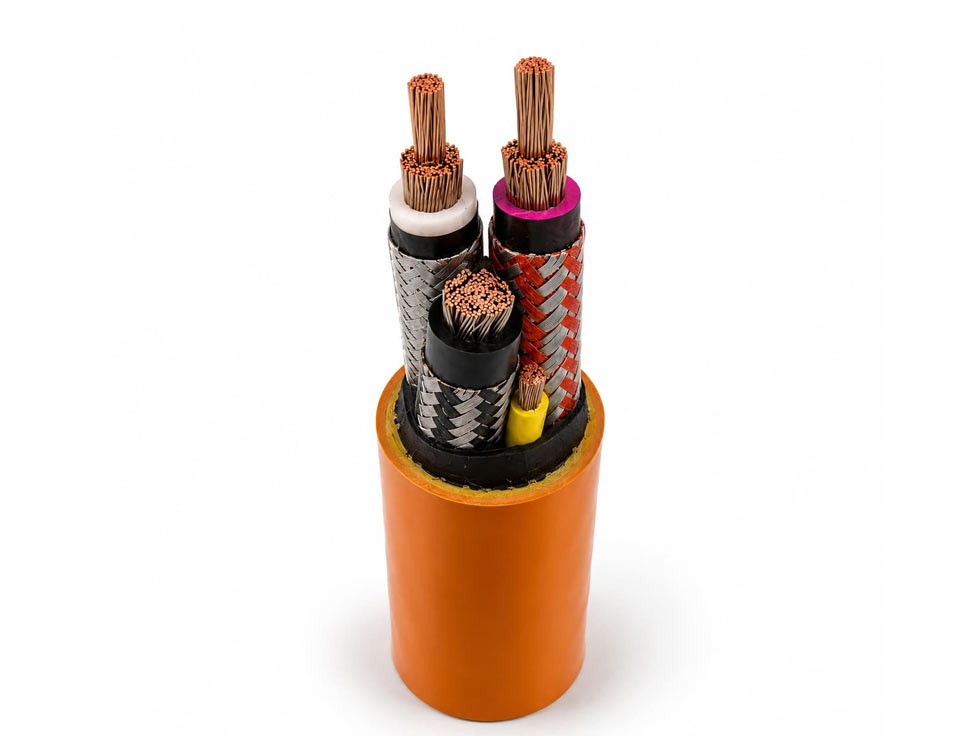
Quick decision: choose by voltage and protection system
Choose the SHD-GC product specifications when the schedule requires a shielded mining power construction in the applicable voltage class, together with grounding and an insulated ground-check conductor. Choose Type G-GC cable 2000 V when the schedule calls for a 2000 V portable mining cable with grounding conductors and a ground-check conductor but does not call for SHD-GC phase shielding. Choose Type W only when its stated voltage, conductor layout, grounding arrangement, geometry and movement duty match the circuit.
The names are not a substitution ladder. A Type W cable does not become a Type G-GC cable because it serves portable equipment, and Type G-GC does not become SHD-GC because both descriptions mention a ground-check conductor. The project cable schedule, protection design and exact datasheet control the decision.
| Cable construction | Reference product record | Electrical distinction | Do not assume |
|---|---|---|---|
| SHD-GC | 2, 8, 15 and 25 kV family | Shielded round construction with grounding conductors and an insulated ground-check conductor | That every voltage, size or marking has the same approval |
| Type G-GC | 2000 V | Portable power with grounding conductors and a ground-check conductor | That it has SHD-GC-style phase shielding |
| Round Type W | 600 or 2000 V; three-conductor round record | Portable-power layout for the stated movement and equipment duty | A ground-check conductor or medium-voltage phase shielding |
| Flat Type W | 600 or 2000 V; four-conductor flat record | Flat portable-power layout for the stated equipment and route | Electrical equivalence to round Type W or any GC type |
Define the electrical system before selecting the cable name
Begin with the single-line diagram, equipment manual and existing cable schedule. Record the nominal and maximum system voltage, phase count, conductor size or load current, grounding method, protective-device arrangement and whether the system monitors grounding continuity. Only then should the team compare cable family names.
For a replacement, read the complete jacket marking rather than relying on an abbreviated maintenance note. Capture photographs of the marking, cross-section, coupler and termination. A useful selection record separates each requirement so a supplier cannot satisfy one item and unintentionally hide a mismatch elsewhere.
- Rated voltage and conductor size for the actual circuit.
- Phase shielding, grounding conductors and ground-check conductor as separate fields.
- Round or flat geometry, overall dimensions and termination space.
- Trailing, dragging, coiling or non-automatic reeling duty.
- Required standard, cable marking, tests and acceptance evidence.
Use the selection map as a screening tool
The map below is a first filter for an enquiry, not an engineering approval. Follow its branches from voltage and protection requirements to conductor layout and movement, then compare the resulting candidate with the cable schedule.
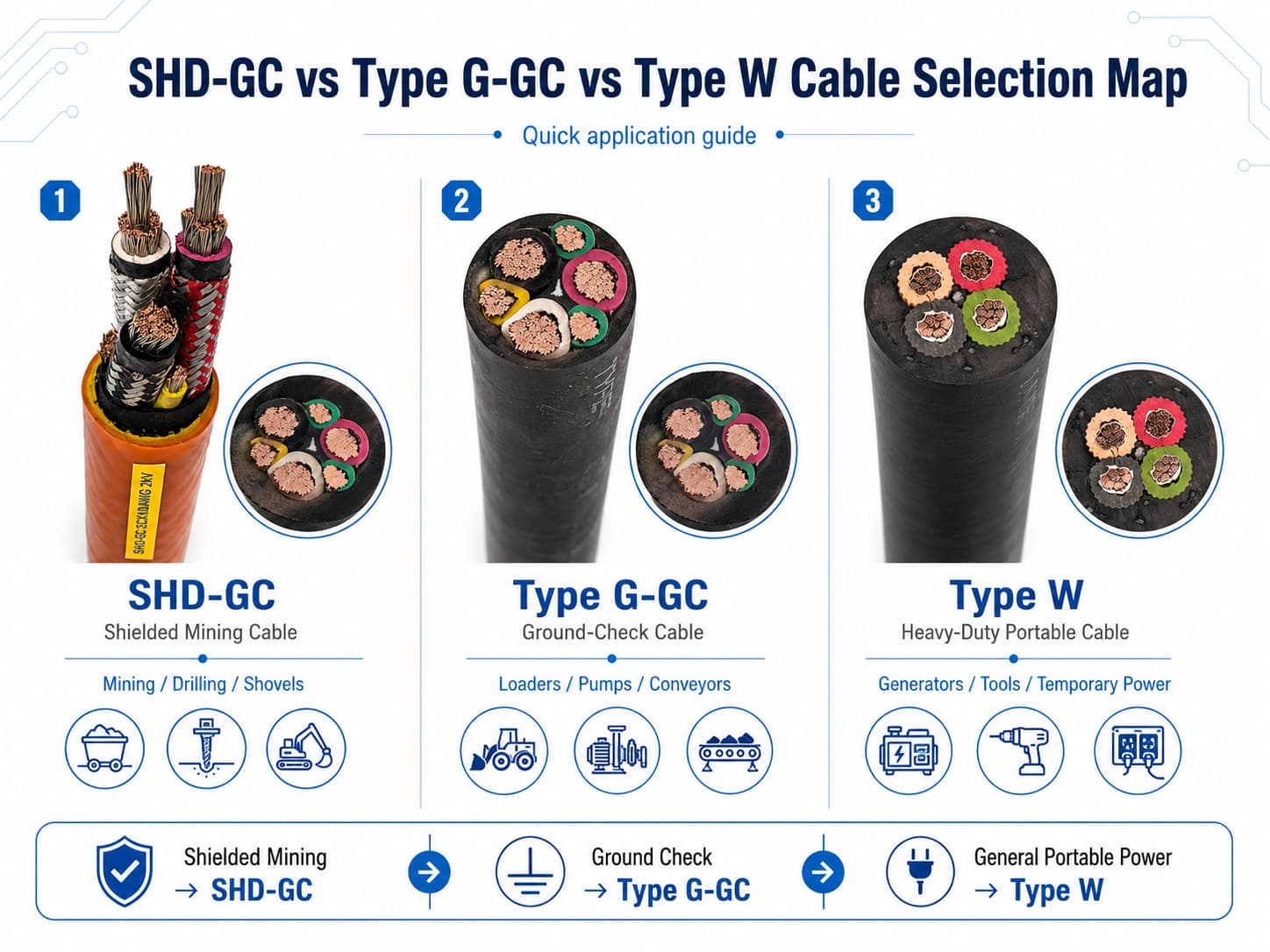
What separates SHD-GC cable
If the designation itself is the open question rather than the choice between families, start with what type SHD means in mining cables — it decodes the letters, the suffixes and the standard entries behind them.
The current TEBAOFLEX SHD-GC product record covers a 2, 8, 15 and 25 kV family. It describes a round shielded construction with power conductors, grounding conductors and an insulated ground-check conductor. This makes SHD-GC the logical starting point when the cable schedule explicitly requires that shielded architecture.
Do not stop at the family name. Ask which voltage construction is offered, how the conductor and insulation screens are arranged, the size and location of grounding and ground-check conductors, jacket compound, overall diameter, mass, minimum bend data and permitted movement. Termination design must suit the screens and grounding system.
The ICEA S-75-381 / NEMA mining-cable standard scope provides the standards-family context. Use the edition named by the project and compare the supplier’s declared construction and tests against it; this guide does not assign clause-level compliance to a product.
What separates Type G-GC cable
The current Type G-GC cable 2000 V record is a 2000 V portable mining cable path. It lists flexible conductors, grounding conductors, an insulated ground-check conductor, EPR insulation and a reinforced jacket. The GC suffix is important because it identifies a ground-check conductor in the recorded construction. All three families share 90 °C EPR insulation for the same reason, set out in why portable mining cable is EPR-insulated.
That does not make Type G-GC a low-voltage version of every SHD-GC cable. Confirm whether the circuit requires phase shielding, the exact grounding-conductor layout, the ground-check circuit interface, conductor size, overall diameter and coupler compatibility. Also define how the machine moves the cable. A rugged jacket description alone does not establish suitability for a reel, repeated torsion or a route with severe sidewall pressure.
Use Type G-GC as a candidate only after the project requirements and the offered datasheet agree on those points. If the tender specifies another type, document all deviations and obtain written acceptance before manufacture.
Type G vs Type G-GC cable: when a ground-check conductor is needed
Type G and Type G-GC are both 2000 V portable power cables with grounding conductors; the defining difference is the separate insulated ground-check conductor. The current Type G-GC record is a round 3/C cable with two grounding conductors and one yellow ground-check conductor; it describes Type G as the related family without that conductor.
United States coal-mining rules for low- and medium-voltage resistance-grounded systems call for a fail-safe ground-check circuit that continuously monitors grounding continuity and opens the circuit breaker when the ground or pilot check wire is broken. For underground coal mines the clause is 30 CFR 75.902 in Part 75. At surface coal mines, for three-phase systems supplying portable and mobile equipment, it is 30 CFR 77.902 in Part 77. In a G-GC construction the ground-check conductor is the conventional pilot wire, not a substitute for the grounding conductors. Both clauses also accept another device the rule regards as no less effective, and non-coal operations and other jurisdictions have their own rules; the protection design, not the cable name, decides.
| Check | Type G | Type G-GC |
|---|---|---|
| Construction described on the TEBAOFLEX record | Flexible stranded bare or tin-coated copper, color-coded 90°C EPDM, one green EPDM-insulated ground wire per phase conductor, flame-retardant oil- and sunlight-resistant CPE jacket | Round 3/C: three phase conductors, two grounding conductors, one ground-check conductor; rope-lay stranded tinned copper, 90°C EPR, reinforced mold-cured black CPE jacket |
| Ground-check conductor | Not part of the described construction | One, yellow insulation, separate from both grounding conductors |
| Voltage and size range on the TEBAOFLEX record | 2000 V; 8 AWG to 500 MCM | 2000 V; 8 AWG to 500 kcmil (500 MCM) |
| Standards wording | Record cites ICEA S-75-381 / NEMA WC 58 | Manufactured to ICEA S-75-381 / NEMA WC 58 |
| Choose it when | Grounding conductors only; no ground-check circuit in the protection design | Grounding continuity supervised through a pilot conductor; no phase shielding specified |
Choose the Type G cable where grounding conductors are needed and no ground-check circuit is used; its record states it is not interchangeable with Type G-GC or Type GC arrangements. Do not use Type G where the protection design calls for a pilot conductor. For OD, weight and ampacity by size, see the Type G-GC cable product page.
Record the answer on the grounding and ground-check line of the RFQ checklist before sending the enquiry.
Round Type W and flat Type W are separate layouts
The site’s Round Type W cable record describes a 600/2000 V, three-conductor round construction and records DC mining, non-automatic reeling and drag duty among its uses. The Flat Type W cable record describes a 600/2000 V, four-conductor flat construction and records AC shuttle cars, roof bolters and off-track equipment among its uses.
These are product-record applications, not a universal rule for every cable sold as Type W. The round profile can suit conventional routing and handling, while a flat profile can suit equipment or paths designed around that geometry. Shape changes bend direction, clearance, pulling behavior and termination arrangement. It does not by itself define the protection scheme.
Ampacity also differs by construction: see Type W ampacity for round 3/C, flat 2/C and flat 4/C, listed at 40°C beside the NEC Table 400.5(A)(2) 90°C-column reference values at 30°C.
| Question | Round Type W record | Flat Type W record |
|---|---|---|
| Voltage shown | 600/2000 V | 600/2000 V |
| Recorded layout | Three-conductor, round | Four-conductor, flat |
| Recorded duty examples | DC mining, non-automatic reeling and dragging | AC shuttle cars, roof bolters and off-track equipment |
| Still verify | Grounds, movement limits, dimensions, jacket and listing | Grounds, bend direction, dimensions, jacket and listing |
Ground-check function and MSHA acceptance are two checks
A ground-check conductor is part of a monitoring circuit. The applicable protection design determines how grounding continuity is supervised and how the circuit responds to a fault or loss of continuity. The cable drawing must therefore agree with the equipment and protection scheme. The official text for 30 CFR 75.803 ground-check circuit context is a starting point when that United States requirement applies.
MSHA flame-resistant cable acceptance is a different question. A cable may include a ground-check conductor without that fact proving an MSHA acceptance, and an acceptance reference does not remove the need to verify voltage, shielding or conductor layout. Check the MSHA flame-resistant cable acceptance list and obtain evidence that identifies the exact offered construction and marking.
Match movement duty, route and terminations
Cable type is only one layer of the mechanical decision. Tell the supplier whether the cable is dragged, manually coiled, moved through rollers, reeled without an automatic tension system, repeatedly bent at one point or exposed to vehicle traffic. Provide reel and sheave dimensions when they exist. A construction intended for portable power can still be unsuitable for a particular cycle rate, tensile load or torsional duty.
Route conditions also change the selection. Water, oil, sunlight, low temperature, sharp rock, mud and crushing exposure affect jacket and handling requirements. At each end, confirm gland or coupler dimensions, conductor preparation, shield treatment and ground-check connection. A dimensional mismatch discovered after production is not solved by a matching cable-family name.
Use a clause-level approval workflow for substitutions
When the requested type is unavailable or another construction is proposed, replace the word equivalent with a documented comparison. The responsible engineer or authority should be able to see every match, deviation and open item before approval.
- Freeze the requirement. Record the cable schedule, standard edition, equipment manual and acceptance wording.
- Identify the offered cable. State the exact manufacturer, type, voltage, conductor size, construction revision and marking.
- Compare electrical construction. Check insulation, screens, grounding conductors, ground-check conductor and protection interface.
- Compare mechanical duty. Check geometry, dimensions, jacket, bending, tension, torsion and route exposure.
- Attach evidence. Include datasheet, cross-section drawing, test plan and applicable acceptance record.
- Close deviations in writing. Obtain project approval before manufacture, shipment or installation.
Questions that prevent the most common selection errors
The fastest way to expose a weak comparison is to ask what the proposed cable does not include. The table below turns frequent assumptions into verifiable questions.
| Risky assumption | Question to put in the technical review |
|---|---|
| Both names contain GC, so they are equivalent | Are voltage, phase shielding, grounding layout and ground-check interface identical? |
| Type W means any portable mining cable | Which voltage, conductor count, grounds, geometry and movement duty does this exact Type W construction provide? |
| The same family has the same dimensions | Does the offered size and voltage have the stated diameter, mass, bend data and termination fit? |
| A logo proves mine acceptance | Which current record and cable marking identify this exact offered construction? |
| A lower price proves a better substitution | Are all deviations, service risks, tests and installation changes included in the comparison? |
RFQ checklist for SHD-GC, Type G-GC or Type W
A useful RFQ gives the engineering team enough information to reject a wrong path early. Attach the existing cable schedule or marking photographs where available, and identify any requirement that is mandatory rather than preferred.
- Nominal and maximum system voltage, phase count, load current and conductor size.
- Required cable type and standard edition, including any owner specification.
- Phase shielding, grounding conductors and ground-check conductor arrangement.
- Equipment name, AC or DC system, route length and cable length per drum.
- Dragging, coiling, reeling, bending, torsion and pulling conditions.
- Water, oil, sunlight, temperature, abrasion, crushing and flame-resistance requirements.
- Coupler, gland, termination, maximum diameter and installation constraints.
- Required datasheet, drawing, routine or type tests, marking and mine acceptance evidence.
Send the cable schedule to TEBAOFLEX for a technical quotation. For broader equipment-duty screening, use the mining cable selection guide or the medium-voltage mining cable guide before naming a product.
Frequently asked questions
What is SHD-GC cable?
SHD-GC is a shielded mining power cable construction. The current TEBAOFLEX record covers 2, 8, 15 and 25 kV versions with grounding conductors and an insulated ground-check conductor; verify the exact voltage, size and documentation offered.
What is the difference between Type G-GC and Type W cable?
The current Type G-GC record is a 2000 V portable cable with grounding conductors and a ground-check conductor. Type W records use different round or flat portable-power layouts; the name alone does not establish a ground-check conductor.
Is Type W the same as SHD-GC cable?
No. Type W and SHD-GC identify different construction paths. Compare voltage, phase shielding, grounds, ground-check requirements, movement duty and the exact datasheet before considering a substitution.
Does SHD-GC automatically mean MSHA accepted?
No. The cable family name and its ground-check conductor do not prove acceptance. Check the current official acceptance record and the marking for the exact offered construction.
Can flat Type W replace round Type W?
Not by shape or voltage alone. Confirm conductor count, grounding arrangement, bend direction, dimensions, movement, equipment interface, terminations and written project approval.
Do I need Type G or Type G-GC cable?
Start from the protection design, not the cable name. Both are 2000 V portable power cables with grounding conductors. Choose Type G-GC when the protection scheme monitors grounding continuity through a separate pilot conductor in the trailing cable; choose Type G when the circuit requires grounding only and no ground-check circuit is used. Confirm the required ground and ground-check functions before final selection.
Sources and editorial scope
This guide combines the linked TEBAOFLEX product records with the external sources below. Product links describe TEBAOFLEX reference constructions; they do not prove approval, certification or equivalence for a project. Confirm the governing standard, edition, machine instructions and acceptance documents with the responsible engineer or authority.
Related product references
Use these pages to compare construction details after the application and protection system are defined.