

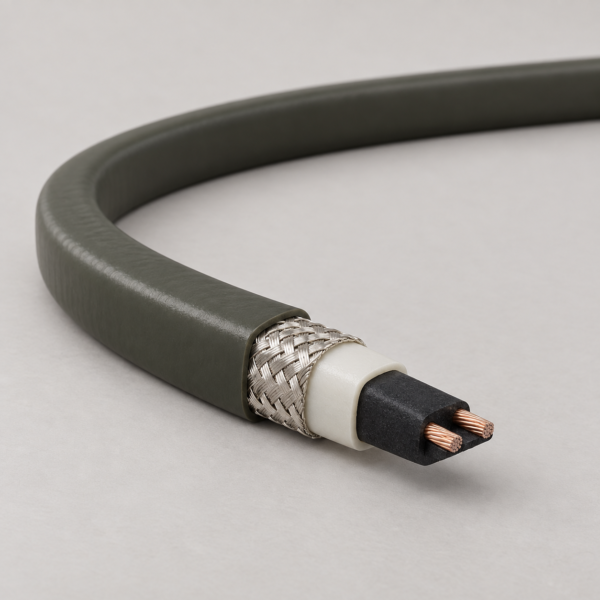
230 V 120°C High-Temperature Self-Regulating Heat Trace Cable
230 V self-regulating heat trace for safe-area pipe and tank temperature maintenance to 120°C, with 10, 15, 25, 30 and 60 W/m options at 10°C.
This 120°C self-regulating heat trace cable is a high-temperature choice for industrial pipes and tanks in safe areas. The reference product has a 230 V supply and five output choices measured at a pipe temperature of 10°C: 10, 15, 25, 30 and 60 W/m. Those wattages do not describe a constant output across all process temperatures; as the pipe warms, the self-regulating core changes its local power. For process maintenance, select the power option from calculated heat loss rather than choosing the largest rating by default.
The reference sheet permits a maximum of 120°C both while the cable is powered and while it is unpowered. It also lists −60°C as the minimum installation temperature and 25 mm as the minimum bend radius. This thermal window distinguishes the cable from the 65°C pipe-tracing family. It does not, however, make the construction appropriate for steam cleaning: the reference application statement explicitly excludes steam washing.
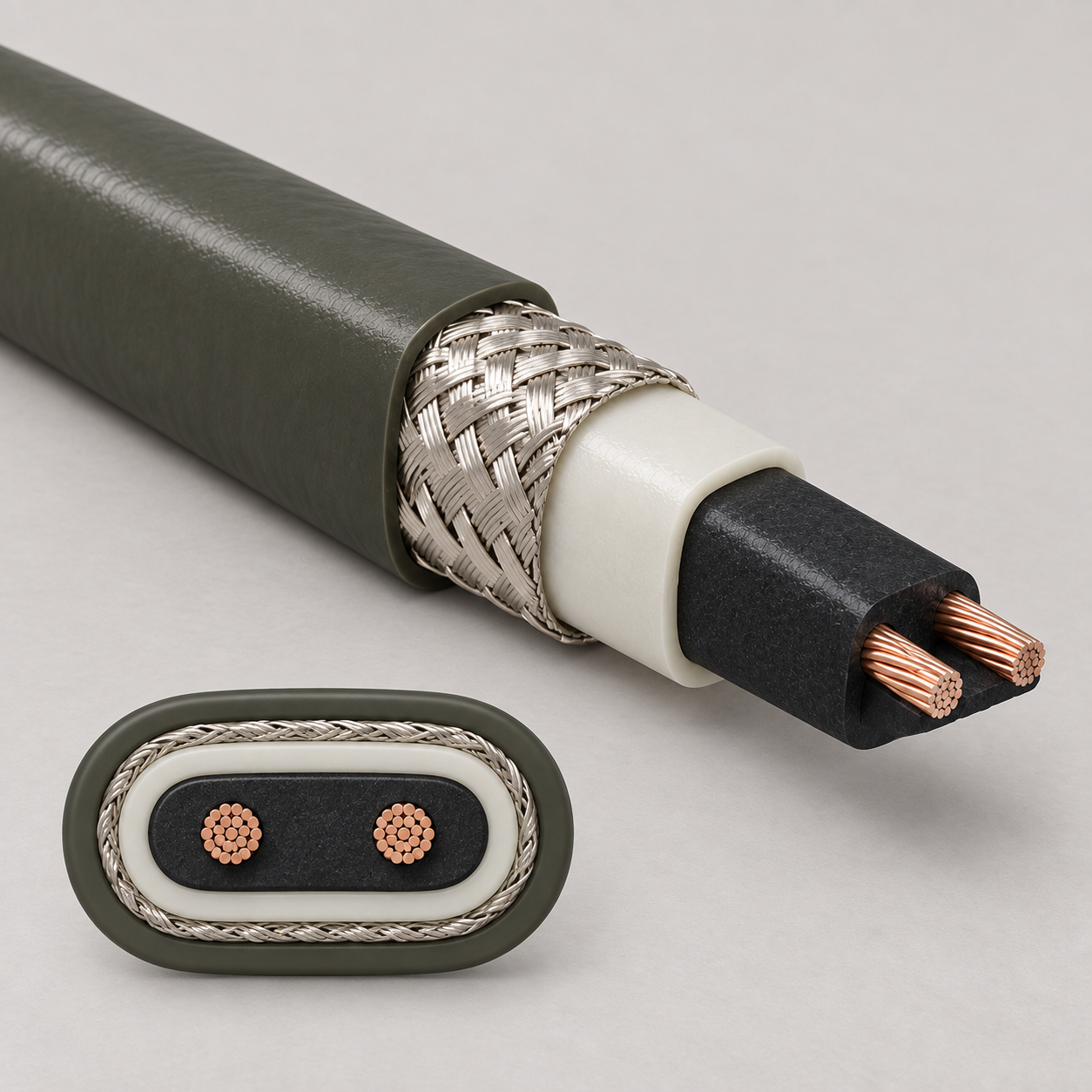
Construction includes copper conductors, a conductive self-regulating core, fluoropolymer insulation, a copper screen and a modified-polyolefin outer sheath. The source describes use on steel, painted steel and stainless-steel surfaces, and its application discussion includes exposure to acids and corrosives. Chemical suitability must be checked for the actual medium and concentration, especially because the outer jacket is not fluoropolymer. For a quotation, provide process temperature, possible upset temperature, pipe or tank dimensions, insulation, ambient minimum, chemical exposure, supply, area classification and desired circuit length. The steam-cleanable fluoropolymer-insulated and jacketed family is a separate selection when cleaning conditions demand it.
Compare related designs in our high-temperature cable range. Related resistive element: UL 3590 silicone heating wire; unlike this self-regulating cable, it uses resistance heating.
The reference structure uses copper conductors within a self-regulating conductive core, fluoropolymer insulation, a copper screen and a modified-polyolefin outer sheath. The fluoropolymer layer here is the insulation; the outside jacket is modified polyolefin. This distinction matters when comparing chemical or cleaning exposure with the fully fluoropolymer-jacketed high-temperature option.
- Conductors: copper; size and plating not supplied.
- Insulation: fluoropolymer.
- Metallic layer: copper screen.
- Outer jacket: modified polyolefin.
- Minimum bend radius: 25 mm.
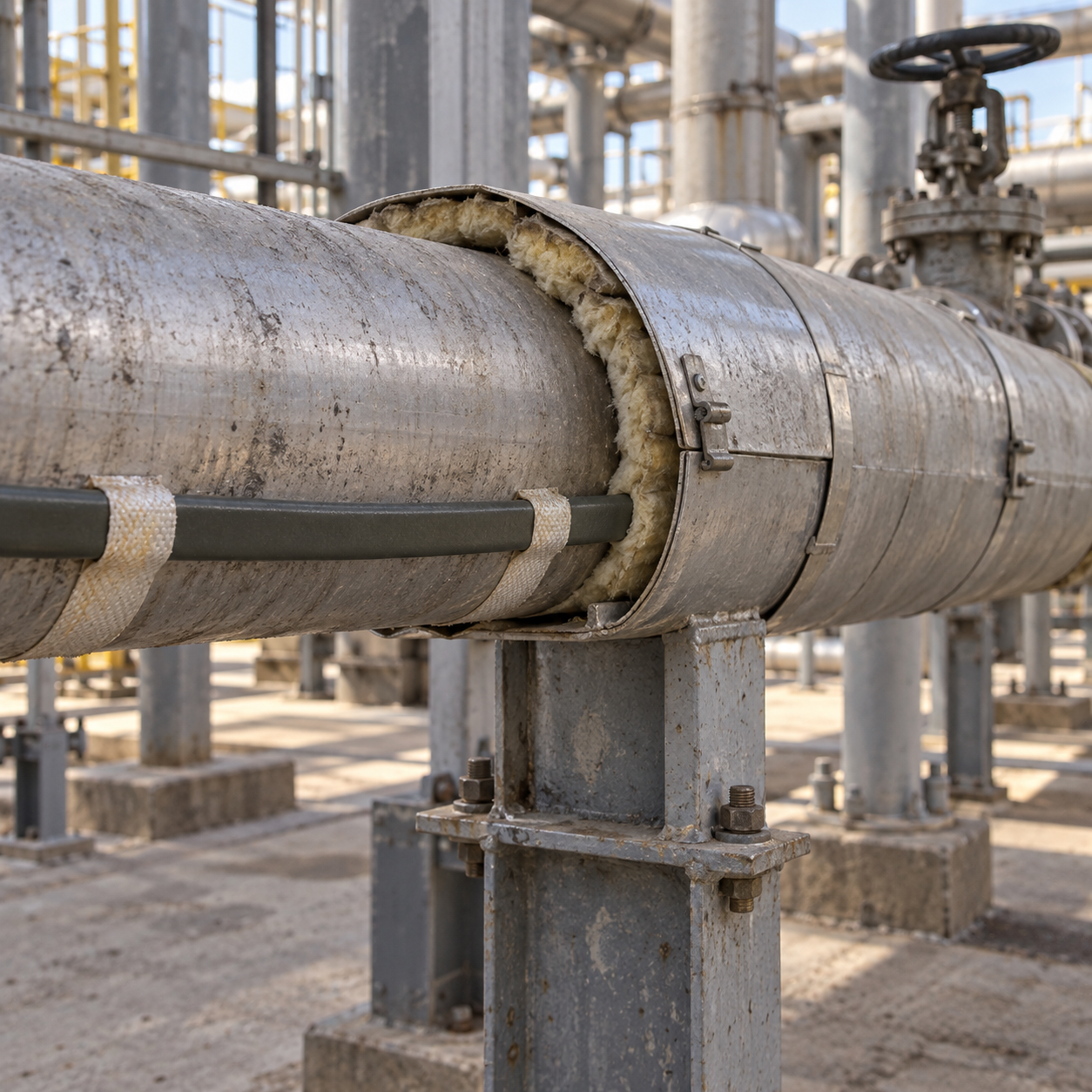
Consider this cable for process temperature maintenance or freeze protection on steel, painted-steel or stainless-steel pipes and tanks in safe areas. The source mentions acids and corrosives as possible exposure conditions, but exact chemical compatibility requires an application-specific check.
- Maximum pipe/process temperature: 120°C with the cable powered or unpowered.
- Choose 10, 15, 25, 30 or 60 W/m from a heat-loss calculation.
- Do not use the 120°C rating as evidence of suitability for steam washing; the source excludes that duty.
Where steam cleaning or a fluoropolymer outer jacket is needed, evaluate the separate 110°C/130°C construction instead.
Output is measured at the stated reference temperature. The temperature limits describe different operating conditions and are not interchangeable.
| Configuration | Output | Supply | Minimum installation temperature | Maximum powered temperature | Maximum unpowered exposure | Minimum bend radius |
|---|---|---|---|---|---|---|
| 230 V 10 W/m 120°C high-temperature self-regulating heat trace cable | 10 W/m at 10°C | 230 V AC | −60°C | 120°C | 120°C | 25 mm |
| 230 V 15 W/m 120°C high-temperature self-regulating heat trace cable | 15 W/m at 10°C | 230 V AC | −60°C | 120°C | 120°C | 25 mm |
| 230 V 25 W/m 120°C high-temperature self-regulating heat trace cable | 25 W/m at 10°C | 230 V AC | −60°C | 120°C | 120°C | 25 mm |
| 230 V 30 W/m 120°C high-temperature self-regulating heat trace cable | 30 W/m at 10°C | 230 V AC | −60°C | 120°C | 120°C | 25 mm |
| 230 V 60 W/m 120°C high-temperature self-regulating heat trace cable | 60 W/m at 10°C | 230 V AC | −60°C | 120°C | 120°C | 25 mm |
The maximum circuit length is a function of output option, starting temperature and protective-device selection. The source lists separate lengths for 16 A, 20 A and selected 30 A conditions; use a model-specific electrical design for the ordered cable.
| Parameter | Source specification |
|---|---|
| Bus conductors | Copper |
| Heating element | Self-regulating conductive core |
| Electrical insulation | Fluoropolymer |
| Metallic screen | Copper |
| Outer sheath | Modified polyolefin |
This construction is specified for safe-area industrial heat tracing. The source sheet does not give a UL AWM Style or hazardous-area certificate for this family. Final project documents should identify the chosen cable marking, supply protection and connection accessories for the installation jurisdiction.
Related cable options
Compare these cable options by service combination, movement, load, voltage and transmission requirement.
230 V Self-Regulating Pipe and Tank Heat Trace Cable, 10–40 W/m
A related cable option for a different application or duty profile.
View product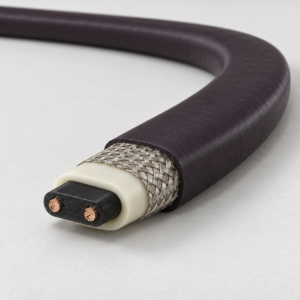
230 V Steam-Cleanable Self-Regulating Heat Trace Cable, 110°C/130°C
A related cable option for a different application or duty profile.
View productRequest a cable recommendation and quotation
Send the required services, cable length, mechanical duty, environment, termination and quantity. Our team will review the application before quoting.
- Include the product name or SKU plus the required cable length and quantity.
- Attach a specification, drawing or data sheet when available.