

Bulk flexible cable and made-to-order welding leads
Welding Cable Supplier for Custom Flexible Leads & Bulk Cable
Specify a welding lead around the actual circuit and working environment—not only a gauge and a length. TEBAOFLEX helps industrial buyers define flexible copper cable, custom electrode and return leads, terminations and RFQ documentation for a technically comparable proposal.
- Bulk cable or finished leads
- Custom lengths & terminations
- Mining, construction & fabrication
How do I choose a welding cable supplier for bulk or industrial orders?
Choose a supplier that documents the construction it proposes, asks about the installed duty, and makes any open decisions visible before purchase release.
Define the whole lead
A welding lead includes more than cable. Specify the electrode lead, return lead, source connection, holder or clamp, lugs, connector interfaces, length tolerance and any inspection requirement.
Compare documented scope
Request the conductor material and size, stated stranding, jacket construction, finished dimensions where available, marking, packaging and approved documents. A comparable quotation is more useful than a generic “heavy-duty” description.
Describe the site exposure
State movement, abrasion, UV, oil, cold, heat, dragging, traffic routes and the consequence of a cable failure. These are selection inputs, not afterthoughts.
Keep the selection auditable
Ask the supplier to identify the basis for any size or construction recommendation. This keeps product facts separate from assumptions that still need confirmation.
AWS guidance on proper selection of welding cables provides a practical selection frame: current, conductor size, cable length, voltage drop and welding duty need to be considered together. It is a technical reference, not a replacement for equipment instructions, project requirements or local rules.
For a JIS-style natural-rubber arc-welder secondary-lead route, review the existing WCT Welding Cable product page. For the European H01N2-D/H01N2-E route, compare the stated construction and application details on the H01N2-D / H01N2-E Welding Cable page before requesting a custom assembly.
Who should request a custom welding cable RFQ?
This route is intended for buyers who need repeatable industrial specifications rather than one-off retail leads.
| Buyer or application | Typical procurement issue | Useful RFQ detail |
|---|---|---|
| Fabrication and structural-steel contractor | Lead length and source connection vary by welding set. | Welding process, output, duty cycle, source/holder connectors. |
| Mining or construction equipment service team | Dragging, UV, cold, abrasion and frequent movement affect service life. | Exposure, movement pattern, lead length, cable route and protection. |
| Rental fleet or mobile repair operator | Replacement leads must fit several machine models consistently. | Equipment list, photos of both ends, current cable marking and standard lengths. |
| Welding distributor or OEM | Repeat purchasing needs a defined product and packing route. | Conductor, jacket, marking, packing, quantity, destination and documentation. |
If leads cross access ways or operate near moving equipment, include that detail. CCOHS electrical-welding safety guidance advises protecting cables from traffic, hot surfaces and sharp edges; selection and installation protection work together. If the same mobile package also needs flexible auxiliary power, keep that circuit separate from the welding lead and review the SOOW portable-power cable route.
What information should I send when requesting a welding cable quote?
Send the inputs that affect electrical selection, mechanical service and the finished assembly. A complete RFQ lets a supplier prepare a reviewable proposal instead of guessing from a gauge and length alone.
| RFQ input | Example wording |
|---|---|
| Welding output and process | MMA/MIG power source, up to 300 A DC. |
| Duty cycle | 60% duty cycle at stated output. |
| Complete circuit length | 15 m electrode lead + 15 m return lead. |
| Environment and movement | Outdoor mobile repair; gravel drag and direct sun exposure. |
| Terminations | Source connector, holder, return clamp and lug details attached. |
| Quantity and documentation | Set quantity, packing, marking, destination and requested records. |
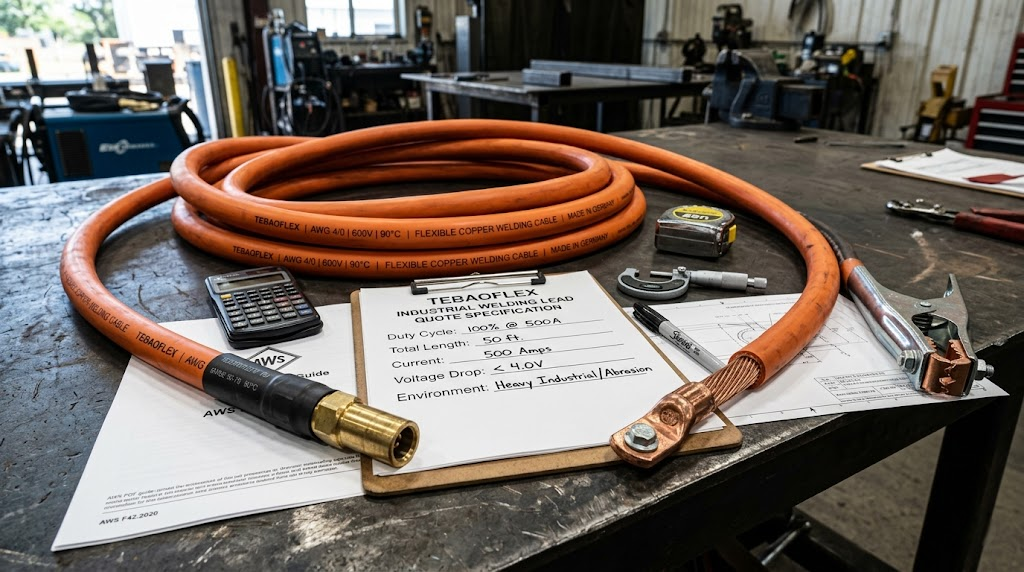
The checklist is not an ampacity chart. AWS F4.2 welding-cable selection guidance relates conductor selection to current, lead length and voltage drop; final sizing still needs the actual equipment and installation conditions.
What size welding cable do I need for my welder?
Size depends on current, duty cycle, complete circuit length, conductor construction, allowable voltage drop, ambient conditions and the way the lead is used. A context-free size table is only a starting point.
Sizing follows a repeatable method: match conductor ampacity to the output current, add the electrode lead and the work lead together to get total circuit length, then correct for duty cycle. The ampacity figures, the length correction and the assumptions behind every published chart are set out in our welding cable size chart guide. Send the output, the duty cycle and both lead lengths with an enquiry so the proposal can show its selection basis.
OSHA’s arc-welding cable requirement states that, within its US construction scope, welding cable must be flexible, fully insulated and capable of handling maximum work current for the duty cycle. The order record should state the duty basis rather than rely on a label alone.
What makes a flexible welding cable suitable for harsh mobile work?
For mobile welding, handling flexibility and jacket durability should be specified with the electrical size. UV exposure, abrasion, oil, cold, hot work, dragging and traffic are service conditions that must be described before a cable can be proposed responsibly.
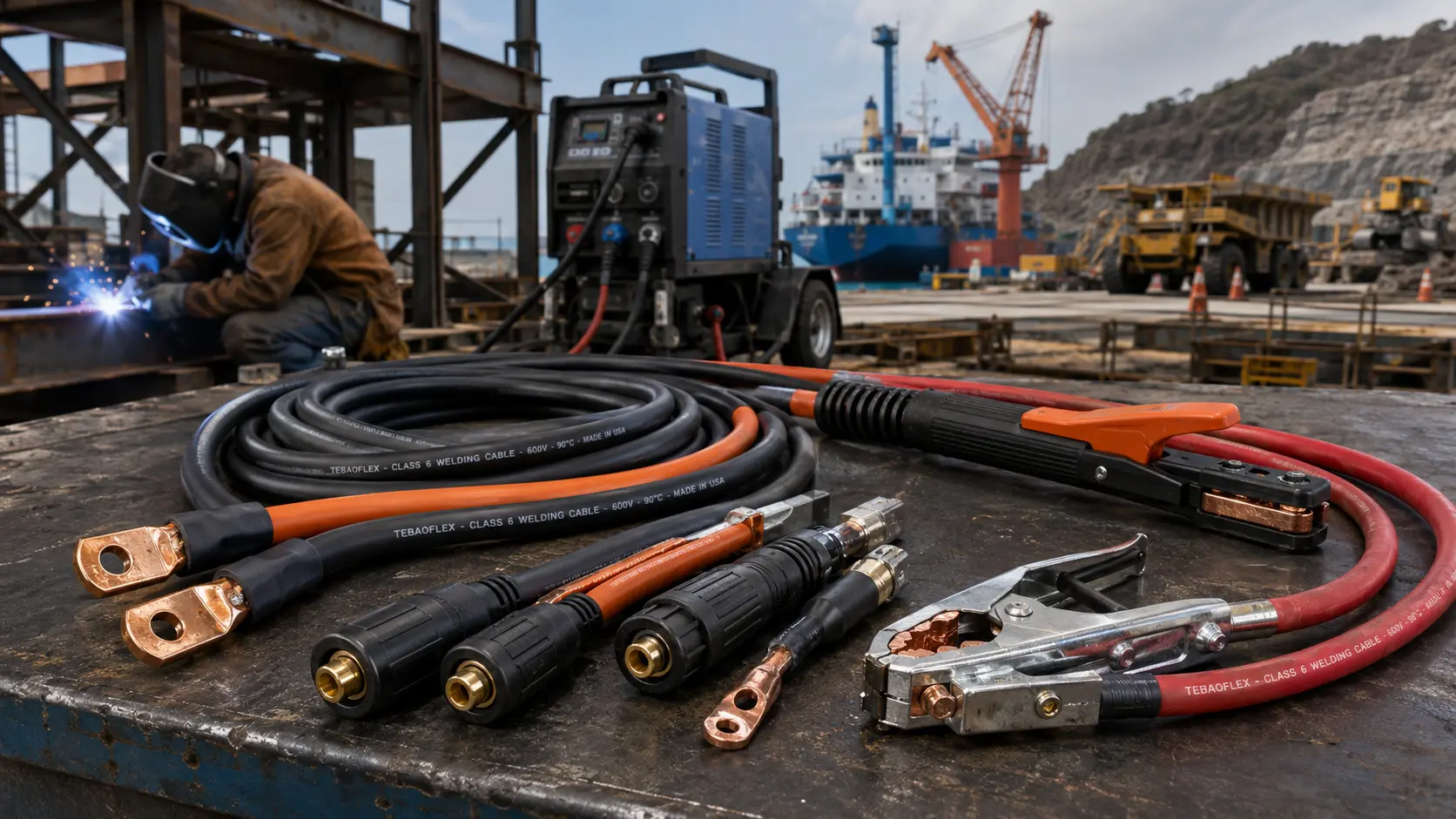
For a South American rental and industrial-service provider supporting mining, port construction and structural-steel work, TEBAOFLEX supplied custom Class 6 flexible copper welding cable with EPR/EPDM rubber sheathing for mobile welding stations. The customer reported about 70% longer cable service life and 35% less unplanned maintenance downtime versus prior PVC-insulated leads in that environment; these are customer-specific results, not a performance guarantee for every installation.
ASTM B172’s rope-lay stranded copper-conductor standard provides useful context when discussing high-flexibility conductor construction. It does not certify a complete cable or prove suitability for every exposure, so review the stated insulation, jacket, termination and product documentation for the job.
Which safety and specification details should I verify before buying?
Verify the full cable-and-assembly specification: conductor material and size, stated stranding, insulation and jacket construction, lengths, markings, connection components and the documents required by your project.
Do not convert a material description into an unverified certification or approval. AWS Z49.1:2021 safety guidance considers welding safety at a system level, while OSHA 1926.351 applies within its stated US construction scope; neither should be relabeled as universal product approval.
For a project specification, state the country or market, any required standard, requested documentation and applicable authority requirements. This makes it clear which evidence is needed at quotation stage and which final checks remain with the project and installation team.
How does the custom welding cable quotation process work?
The process starts with an application-led RFQ, identifies open decisions, and ends with a documented cable-and-assembly scope that a buyer can approve.
- Share the application.Send the RFQ inputs, existing cable marking, photos, drawings and any machine or project documentation.
- Review the proposed scope.Confirm conductor, jacket, lengths, terminations, marking, packaging and requested documents; resolve missing inputs before order release.
- Approve a purchase-ready specification.Use the agreed scope as the reference for bulk cable or completed lead assemblies.
This process does not promise a particular response time, approval or service-life result. It makes the decision traceable—an industrial lead should not require a detective novel to explain what was ordered.
Frequently asked questions about welding cable suppliers
Short answers before a project-specific RFQ.
Can a supplier quote only the cable without connectors?
Yes. Buyers can request bulk or cut-length welding cable when their team handles termination; state the intended use and required documentation so the proposal remains relevant.
Is 1/0 or 2/0 better for welding leads?
2/0 is the larger conductor in American Wire Gauge notation, but the correct choice depends on current, duty cycle, circuit length, handling needs and connector size.
Can welding cable be repaired or spliced?
Follow the employer’s safety procedure and applicable requirements rather than relying on improvised repairs. OSHA specifies standard insulating methods for welding-cable insulation repairs within its applicable scope.
What files help a supplier quote a replacement lead?
Photos of both ends, cable markings, welding-machine model, lead lengths and connector dimensions are useful. A prior data sheet or assembly drawing makes a replacement quotation easier to compare with the installed lead.
Request a Welding Cable RFQ
Send the current, duty cycle, electrode and return lead lengths, environment, termination details, quantity and destination. Attach photos, drawings or an existing data sheet when available so the proposed cable-and-assembly scope can be compared accurately.
- Welding process, maximum output and duty cycle
- Electrode-lead and return-lead length
- Movement, UV, oil, abrasion, temperature and traffic exposure
- Source connector, holder, clamp, lug and marking requirements
- Quantity, packaging, destination and project documents
Related welding cable resources
Use these routes to compare the correct product family, separate welding leads from auxiliary power circuits, or prepare an enquiry.