












Shielded High Frequency Litz Power Cable, 1 kV AC
Shielded high frequency litz power cable for 1 kV AC equipment interconnections. Choose two litz power cores or a four-core assembly combining two litz conductors with two conventional tinned-copper conductors.
High frequency litz power cable connects equipment that transfers medium- or high-frequency power at a rated voltage of 1 kV AC. Individually enamelled copper strands form the litz conductors, while silicone insulation, a common copper-braid screen and a polyurethane jacket complete the cable. Two-core and four-core designs cover different equipment connections.
Select the conductor arrangement for the circuit. The two-core version contains two equal litz conductors. The four-core version combines two litz conductors with two conventional tinned-copper conductors, allowing the associated circuit functions to travel in one screened cable. These constructions have separate outside diameters, temperatures, bend limits and voltage-test conditions.
Litz construction addresses the conductor arrangement used for high-frequency power transfer. The individual enamel layers electrically separate the fine strands. This differs from an ordinary fine-stranded power conductor, whose copper strands are in electrical contact. The converter waveform, frequency spectrum and current therefore belong in the cable-selection brief along with the voltage.
Check the complete route and terminations before choosing the cable. Moving bends need more space than fixed bends, and the cable screen requires a planned connection at the equipment. Specify whether the two conventional conductors are needed, the installed length, bend duty, operating temperature and connector interface. The two configuration tables allow the quoted construction to follow that equipment layout.
Explore the industrial cable range for related configurations.
For related high-current DC silicone leads and low-capacitance HV coaxial pulse cables, compare these constructions: High Current Silicone High Voltage Wire, 20–60 kV DC (for 20–60 kV DC large-cross-section finely stranded silicone power leads); High Voltage Coaxial Cable — PE-X, FEP and PE Configurations (for 10–100 kV DC coaxial pulse-power and diagnostic transmission lines). Confirm switching frequency (kHz range), individual enamelled strand diameter, and tinned-copper braid shield coverage before ordering.
Construction
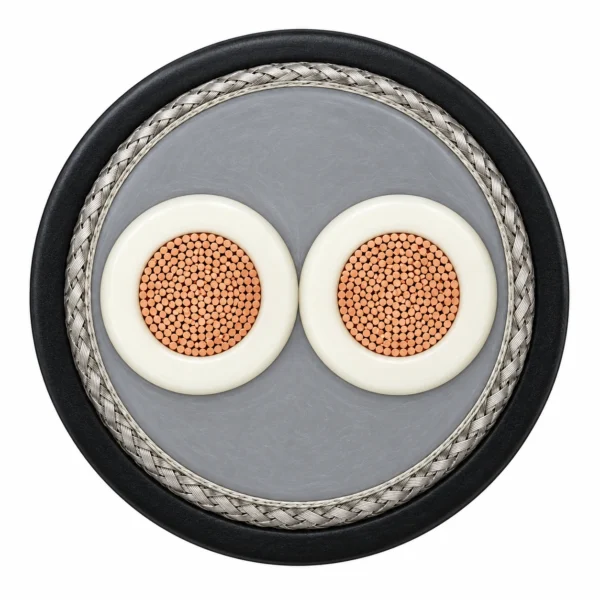
The illustration represents the two-core 1 kV AC design: two equal silicone-insulated litz conductors in silicone filling, enclosed by one common tinned-copper braid and a black PUR jacket. The four-core design has a separate mixed-conductor assembly.

| Component | Material and construction |
|---|---|
| Litz conductors: both designs | Two conductors, each made from 600 × 0.10 mm individually enamelled copper strands; nominal metal section 4.7 mm² and conductor diameter 3.6 mm. |
| Litz-core dielectric | Silicone insulation to 5.9 mm core diameter. The four-core version identifies these cores as 1 and 2. |
| Additional conductors: four-core only | Two conventional tinned-copper conductors, each 224 × 0.15 mm, nominal 3.9 mm² and 2.9 mm conductor diameter; silicone insulation to 5.2 mm core diameter. |
| Two-core assembly | Two insulated litz cores twisted together to 11.8 mm assembly diameter; silicone filling to 12.8 mm. |
| Four-core assembly | Two litz cores and two conventional cores laid around a silicone-on-glass-fibre filler; assembly diameter 14.0 mm and silicone filling diameter 15.5 mm. |
| Common metallic screen | Tinned-copper braid with at least 85% coverage: 0.161 mm braid wires on the two-core design, 0.127 mm on the four-core design. |
| Tapes: four-core only | PTFE tape below and above the common braid screen. |
| Outer jacket | TPE-U / PUR polyurethane. The illustrated two-core construction has a black jacket. |
Applications
Select these screened constructions for defined high-frequency power interconnections. State the circuit functions and electrical waveform so the conductor arrangement and termination can be matched to the equipment.
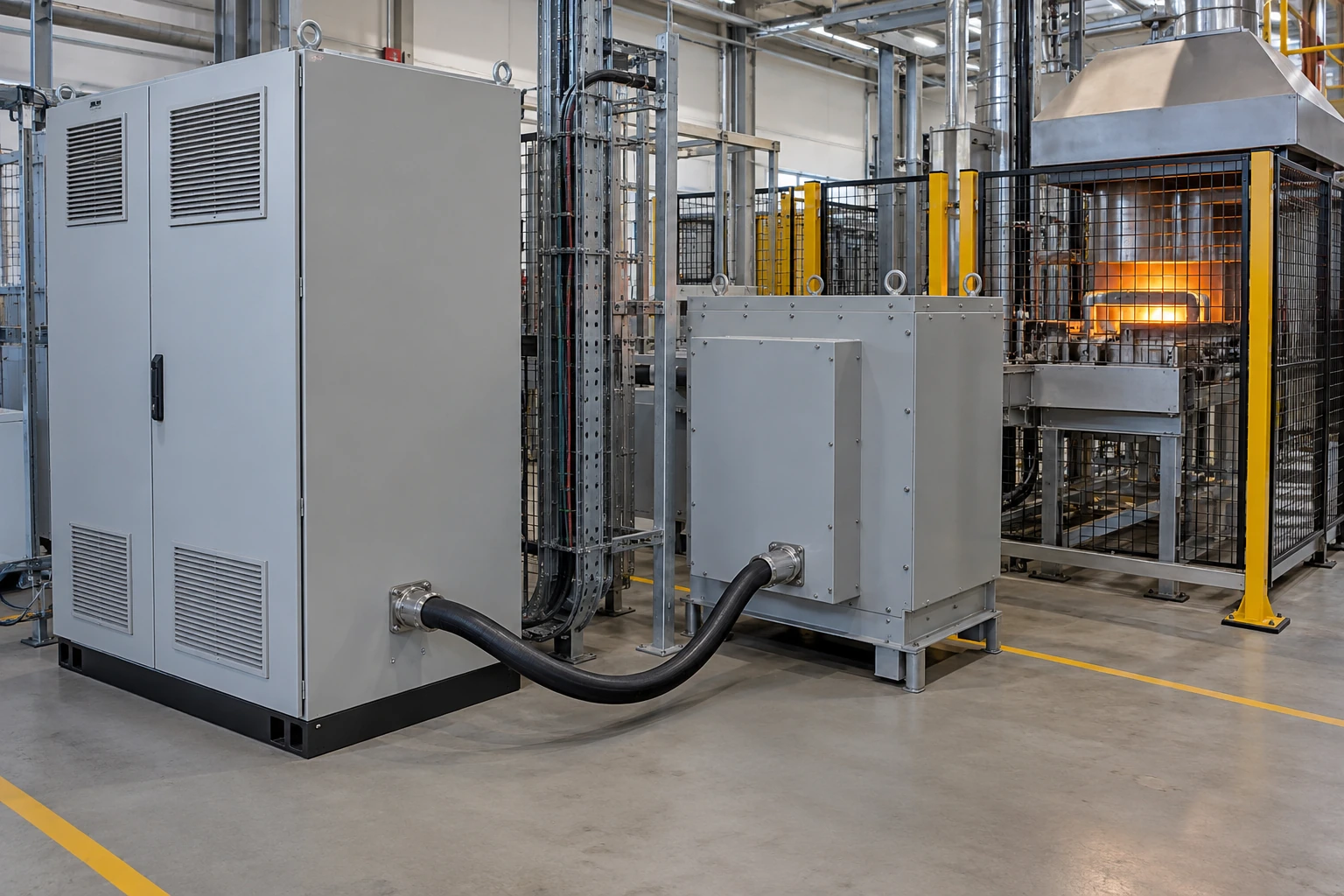
- Medium- and high-frequency power transfer between electronic equipment assemblies.
- Converter and resonant-power equipment connections where two litz conductors carry the specified power circuit.
- Four-core equipment connections requiring two litz power conductors and two additional conventional conductors in a common screen.
- Fixed routes or moving bends that meet the minimum radius of the selected construction; arrange strain relief at both ends.
- Terminate the braid as required by the equipment screening and bonding design, and prepare the litz ends for reliable strand connection.
- Provide frequency spectrum, waveform, RMS and peak voltage, current, duty cycle, length and bend conditions with the enquiry.
For metallic shield construction trade-offs and medium-voltage inverter-duty motor power cables, review: Spiral Shield vs Braided Shield: Tinned Copper Construction Compared (for transfer impedance, optical coverage, and flex-life differences between spiral and braided tinned-copper shields); Medium Voltage VFD Motor Cable — 3GSEGCH / 3GSEGCY (for 3.6/6–6/10 kV symmetrical three-core EMC-shielded VFD motor feeders). Verify skin-depth loss at the operating frequency, RMS current rating, and termination solder pot temperature during assembly design.
Specifications
| Parameter | Value |
|---|---|
| Rated voltage, conductor-to-conductor | 1 kV AC for both configurations. |
| Rated conductor-to-braid voltage | 1 kV AC for both configurations. |
| Conductor arrangements | Two-core: 2 × 4.7 mm² litz; four-core: 2 × 4.7 mm² litz + 2 × 3.9 mm² conventional tinned copper. |
| Insulation and jacket | Silicone dielectric and filling; common tinned-copper braid; TPE-U / PUR jacket. |
| Operating temperature | Two-core: −40 to +90°C; four-core: −40 to +80°C. |
| Minimum bend radius | Two-core: 230 mm moving / 115 mm fixed; four-core: 280 mm moving / 140 mm fixed. |
| Overall diameter | Two-core: 15.1 ± 1.0 mm; four-core: 18.7 ± 1.0 mm. |
| Two-core conductor resistance | At 20°C: ≤ 3.8 Ω/km. |
| Configuration | Litz conductors | Additional conventional conductors | Nominal overall diameter (mm) | Operating temperature (°C) | Moving / fixed bend radius (mm) | Approx. mass (kg/m) | Copper mass (kg/m) |
|---|---|---|---|---|---|---|---|
| 1 kV AC two-core litz cable, 2 × 4.7 mm² | 2 × (600 × 0.10 mm), 4.7 mm² each | None | 15.1 ± 1.0 | −40 to +90 | 230 / 115 | 0.406 | 0.170 |
| 1 kV AC four-core litz cable, 2 × 4.7 + 2 × 3.9 mm² | 2 × (600 × 0.10 mm), 4.7 mm² each | 2 × (224 × 0.15 mm), 3.9 mm² each | 18.7 ± 1.0 | −40 to +80 | 280 / 140 | 0.584 | 0.280 |
| Configuration | Conductor–conductor rating | Conductor–braid rating | Electrical test condition |
|---|---|---|---|
| 1 kV AC two-core litz cable | 1 kV AC | 1 kV AC | 10 kV AC spark test |
| 1 kV AC four-core litz cable | 1 kV AC | 1 kV AC | 4 kV AC conductor–conductor and conductor–braid |
| Layer or assembly diameter | Two-core design (mm) | Four-core design (mm) |
|---|---|---|
| Litz conductor | 3.6 | 3.6 |
| Insulated litz core | 5.9 | 5.9 |
| Additional conventional conductor | Not fitted | 2.9 |
| Insulated conventional core | Not fitted | 5.2 |
| Twisted core assembly | 11.8 | 14.0 |
| Silicone-filled assembly | 12.8 | 15.5 |
| Common braid outer diameter | 13.4 | 16.1 |
| Finished cable diameter | 15.1 ± 1.0 | 18.7 ± 1.0 |
The two-core spark test and the four-core conductor-to-conductor / conductor-to-braid tests are different procedures. Each applies only to its own configuration.
The 1 kV AC rating is stated separately for conductor-to-conductor and conductor-to-braid insulation. Include switching peaks and waveform details when defining the equipment connection.
Current, frequency-dependent losses, capacitance and impedance are specified for the circuit, cable length and operating waveform with the enquiry.
The litz conductors contain individually enamelled copper strands. Select stripping and termination methods that make reliable electrical contact to the required strand bundle.
The two additional conductors in the four-core design use conventional tinned-copper stranding. They are distinct from the two litz conductors.
Standards
| Standard or specification | Application |
|---|---|
| 1 kV AC insulation rating | Conductor-to-conductor and conductor-to-common-braid ratings are stated independently for both cable configurations. |
| Two-core spark-test reference | 10 kV AC spark test for the two-core construction. |
| Four-core voltage-test reference | 4 kV AC conductor-to-conductor and conductor-to-braid tests for the four-core construction. |
| UL AWM Style 20234 | Construction reference for the four-core 80°C, 1 kV AC PUR-jacketed design. |
| RoHS | Material-restriction reference listed for both constructions. |
Related cable options
Compare these cable options by service combination, movement, load, voltage and transmission requirement.

High Voltage Coaxial Cable — PE-X, FEP and PE Configurations
A related cable option for a different application or duty profile.
View product
High Current Silicone High Voltage Wire, 20–60 kV DC
A related cable option for a different application or duty profile.
View productRequest a cable recommendation and quotation
Send the required services, cable length, mechanical duty, environment, termination and quantity. Our team will review the application before quoting.
- Include the product name or SKU plus the required cable length and quantity.
- Attach a specification, drawing or data sheet when available.