

Project record · Chile · Floating platform
H07RN-F Cable for Floating Platform Power
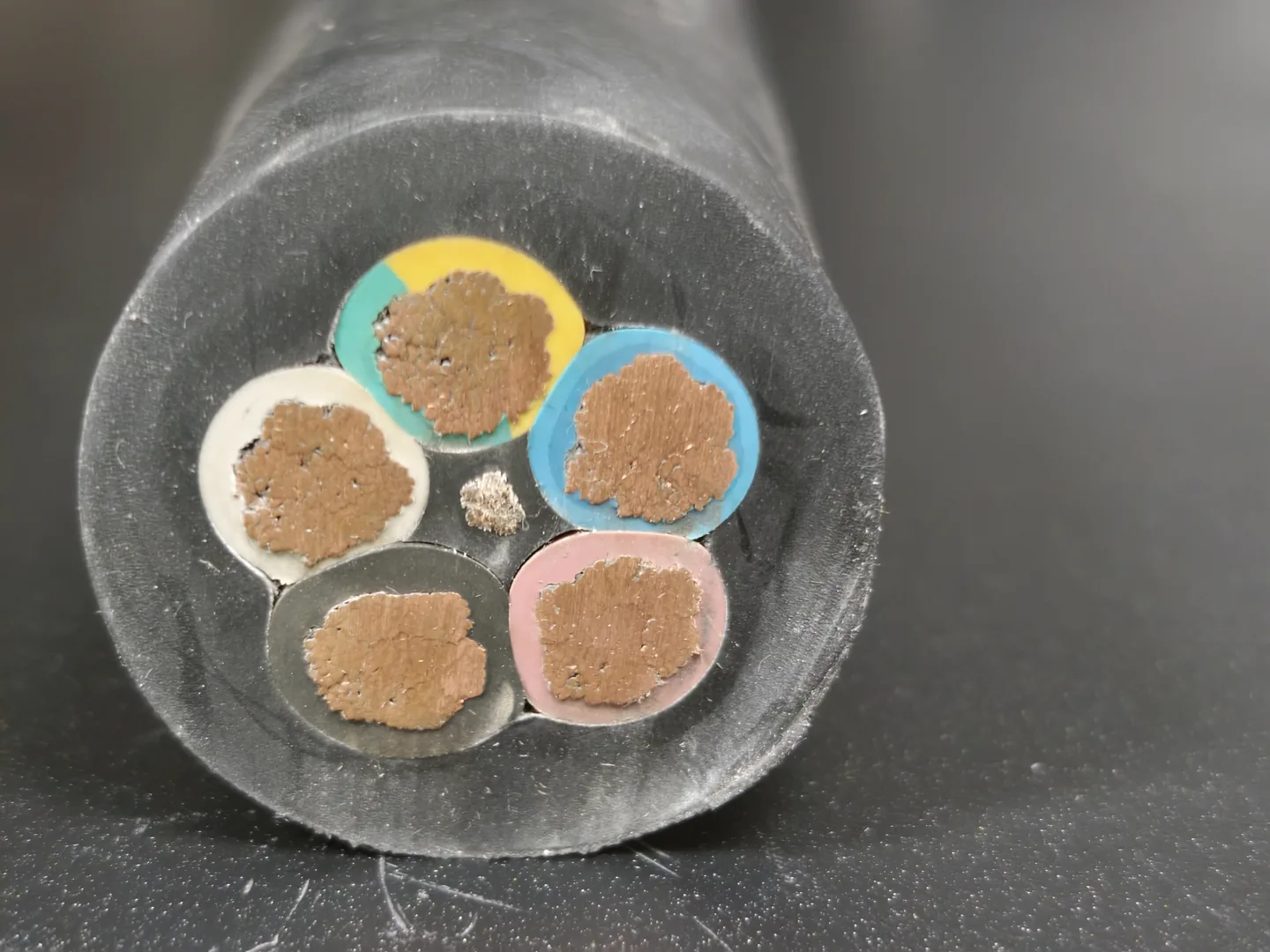
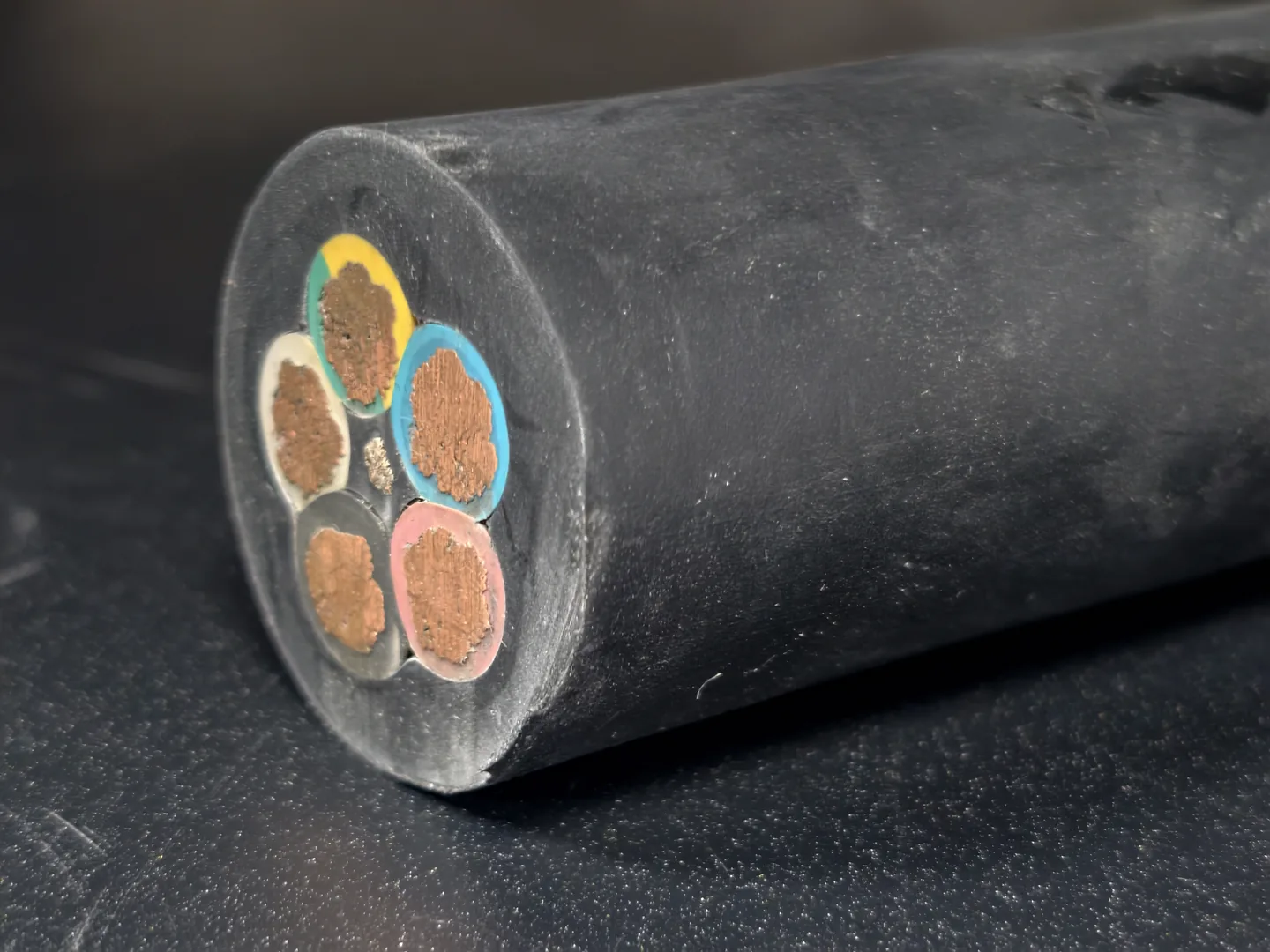
This project record covers an H07RN-F flexible rubber cable supplied for the power route of a floating platform in Chile. The photographs document the supplied five-core construction.
Project record
| Country | Chile |
|---|---|
| Application | Floating platform power |
| Cable family | H07RN-F |
| Visible construction | Five insulated conductors, rubber sheath |
What H07RN-F is
H07RN-F is a harmonised European designation, and each letter carries meaning: H harmonised type, 07 rated 450/750 V, R rubber (EPR) insulation, N polychloroprene sheath, F fine-wire flexible conductor. It is built to EN 50525-2-21, the standard that superseded HD 22.4.
The polychloroprene sheath is what makes it a common choice outdoors and around water: it is mechanically tough, oil-resistant, weather- and ozone-resistant, and stays flexible over a wide temperature range. That combination is why H07RN-F shows up on construction sites, pumps, portable equipment and platform power routes rather than only inside buildings.
The distinction that matters on a floating installation
H07RN-F is not the same as H07RN8-F, and on water applications the difference decides the service life.
H07RN-F is a heavy-duty rubber flexible cable for general use including wet and outdoor environments. H07RN8-F — the same family with the 8 — is the designation built for continuous water immersion, which is what a submersible pump motor or a permanently submerged run requires.
A floating platform can involve either, or both, on the same installation: a deck-level power route in the splash zone is H07RN-F territory; a permanently submerged run to a pump is not. Specifying H07RN-F where the duty is continuous immersion is the single most frequent cause of premature failure we see in this application. Which one applies depends on where the cable actually sits relative to the waterline.
What a floating-platform power route asks of the cable
The hardest section of a floating installation is usually not the submerged part. It is the splash zone at the waterline, where the cable sees UV, repeated wetting and drying, and mechanical chafe against the platform edge all at once — mechanically more demanding than being fully and constantly submerged.
Above that, wave and wind motion means the cable moves with the platform rather than sitting still, so the route needs support at intervals that stop it swinging and abrading. Where the water is saline, the sheath and any armour or gland hardware need to be assessed for that too. Longitudinal water blocking becomes relevant as soon as a nick at a gland could let water run inside the cable well beyond the visible damage.
What we review for a similar project
- Where the cable sits relative to the waterline
- Whether any section is continuously submerged
- Submerged depth, if applicable
- Fresh, brackish or salt water
- Platform movement and route length
- Support and clamping intervals
- Rated voltage and load
- Core count and cross-section
- Ambient and water temperature
- UV and weather exposure at deck level
- Potable-water contact, if any
- Required standard or approval
Related constructions
- H07RN-F 450/750 V heavy-duty rubber flexible
- H07RN8-F 450/750 V submersible
- Submersible pump motor cable with control cores
- SUBCAB for submersible pump motors
- Drincable 600 potable water pump cable
- NTSCGECEWOU / (N)TSCGECEWÖU 3.6/6 to 12/20 kV mine pump cable
Browse the full submersible pump cables and marine and offshore cables ranges. For the designation in depth, see the H07RN-F cable guide or look it up in the cable designation and standard index.
Questions on this application
Can H07RN-F be used underwater?
Not for continuous submerged service. H07RN-F is rated for wet and outdoor environments, which covers splash, rain and temporary wetting. For a run that stays underwater — a submersible pump motor, a permanently submerged feed — the correct designation is H07RN8-F, which is built for continuous immersion. Substituting one for the other is the most common cause of early failure in water applications.
What does each letter in H07RN-F mean?
H = harmonised type; 07 = 450/750 V rated voltage; R = rubber (EPR) insulation; N = polychloroprene sheath; F = fine-wire flexible conductor. The cable is built to EN 50525-2-21, which superseded HD 22.4.
Which part of a floating installation wears the cable out fastest?
Usually the splash zone at the waterline rather than the submerged section. That band sees UV, wetting and drying cycles, and chafe against the platform edge simultaneously. Support intervals that stop the cable swinging matter more there than anywhere else on the route.
Review a platform power cable →
Another project record: a screened silicone high voltage test cable for a cable test van reel.
← Back to all industrial cable application cases