

Industrial Cable Selection Guide
H07RN-F Cable Guide: Meaning, Uses, Sizes and Selection
H07RN-F is a 450/750 V heavy-duty flexible cable with a flexible copper conductor, rubber or elastomeric insulation and a robust outer sheath. Use this guide to decode the marking, define the application and prepare the electrical and mechanical inputs needed for a reliable quotation.
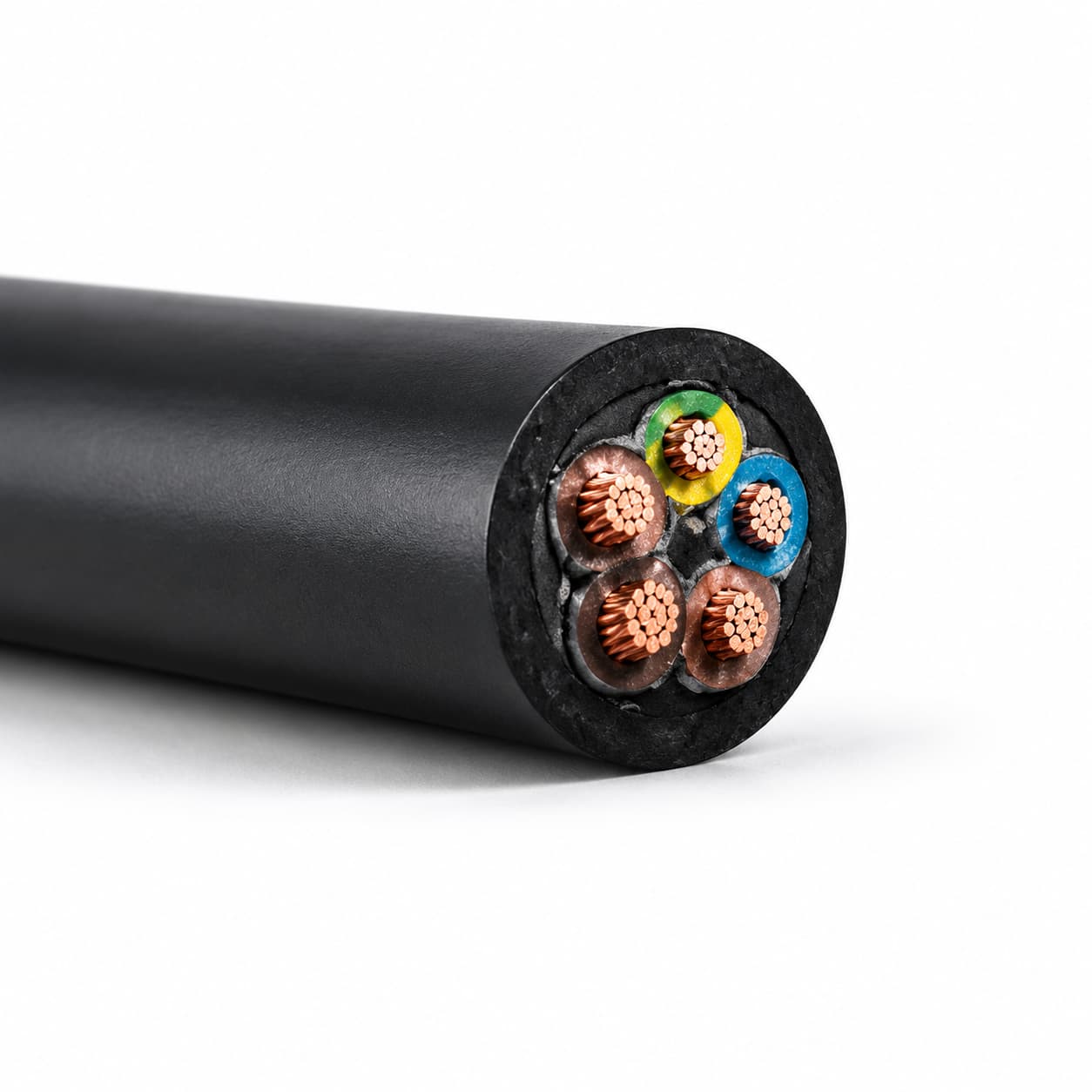
Start with the designation
What does H07RN-F mean?
H07RN-F identifies a harmonised, 450/750 V, flexible rubber-insulated cable family. The code is useful, but it is not a complete purchase specification. Core count, conductor cross-section, installation method, temperature, movement, sheath exposure and required approvals still need to be defined.
| Code | Meaning | What the buyer should verify |
|---|---|---|
| H | Harmonised cable designation | Confirm the applicable national adoption, product marking and documents required in the destination market. |
| 07 | Rated voltage 450/750 V U0/U | Match the circuit voltage, system arrangement, protection and any permitted protected fixed-installation use to the actual datasheet. |
| R | Rubber or crosslinked-elastomeric insulation family | Confirm the stated insulation compound and conductor-temperature limit for the quoted construction. |
| N | Polychloroprene or equivalent elastomeric sheath family | Check oil, weather, abrasion, chemical and water claims against the product data—not the letter alone. |
| F | Flexible conductor | Confirm conductor class, flexing duty, bend radius and whether the route involves reeling, torsion or tensile load. |
The scope of BS EN 50525-2-21 covers flexible cables with crosslinked elastomeric insulation at rated voltages up to 450/750 V, including connections where appliances or heavy industrial equipment require flexibility. IEC 60245-4:2026 separately defines requirements for rubber-insulated cords and flexible cables up to the same voltage class. A project specification should state which standard and edition govern the supplied cable.
Construction before marketing claims
Typical H07RN-F cable construction
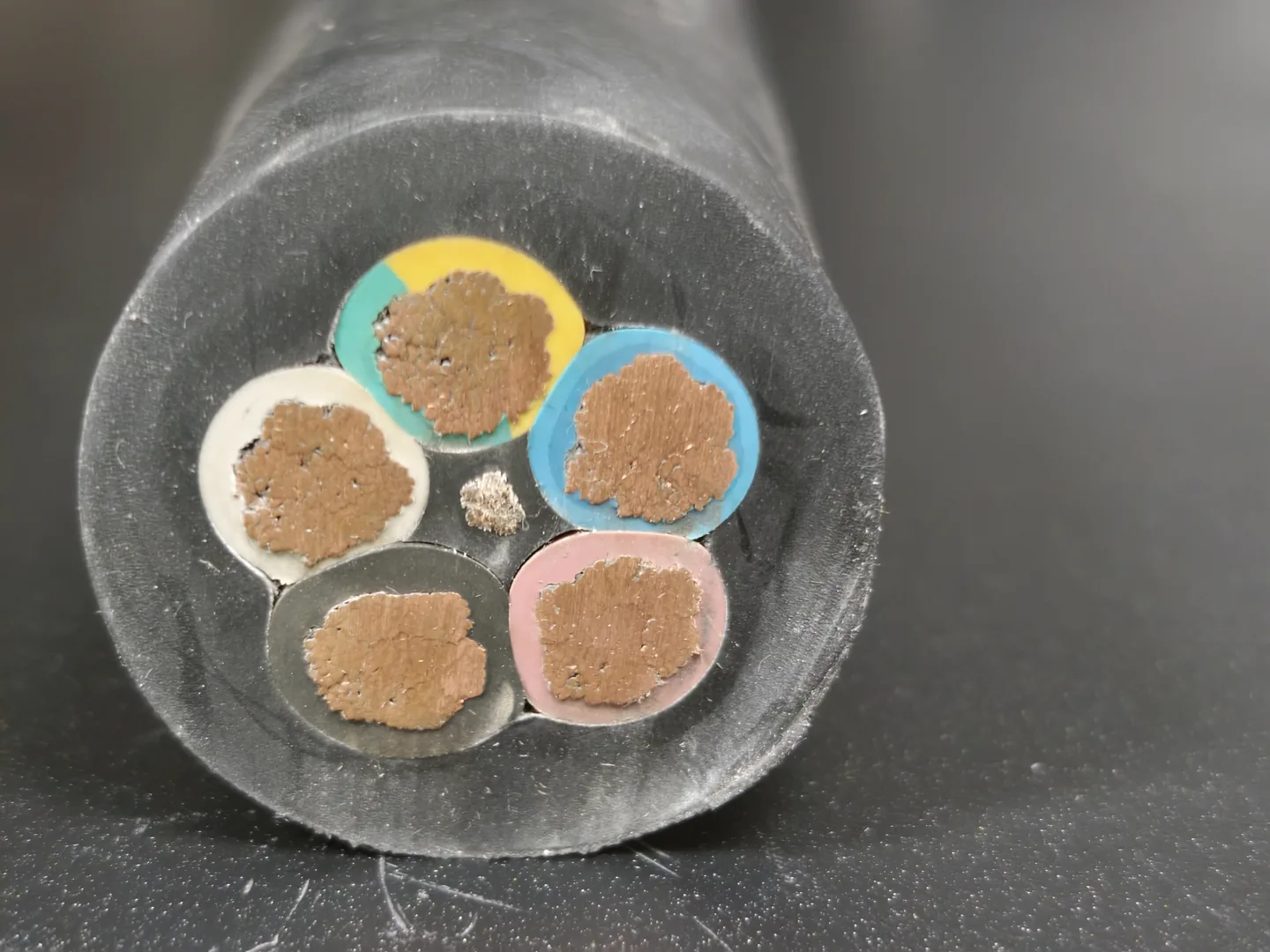
A general H07RN-F build combines fine-stranded flexible copper conductors, elastomeric core insulation, laid-up cores and a robust black outer sheath. The flexible conductor helps handling; the insulation and sheath system separates the electrical duty from the mechanical and environmental protection. Those functions should be checked individually.
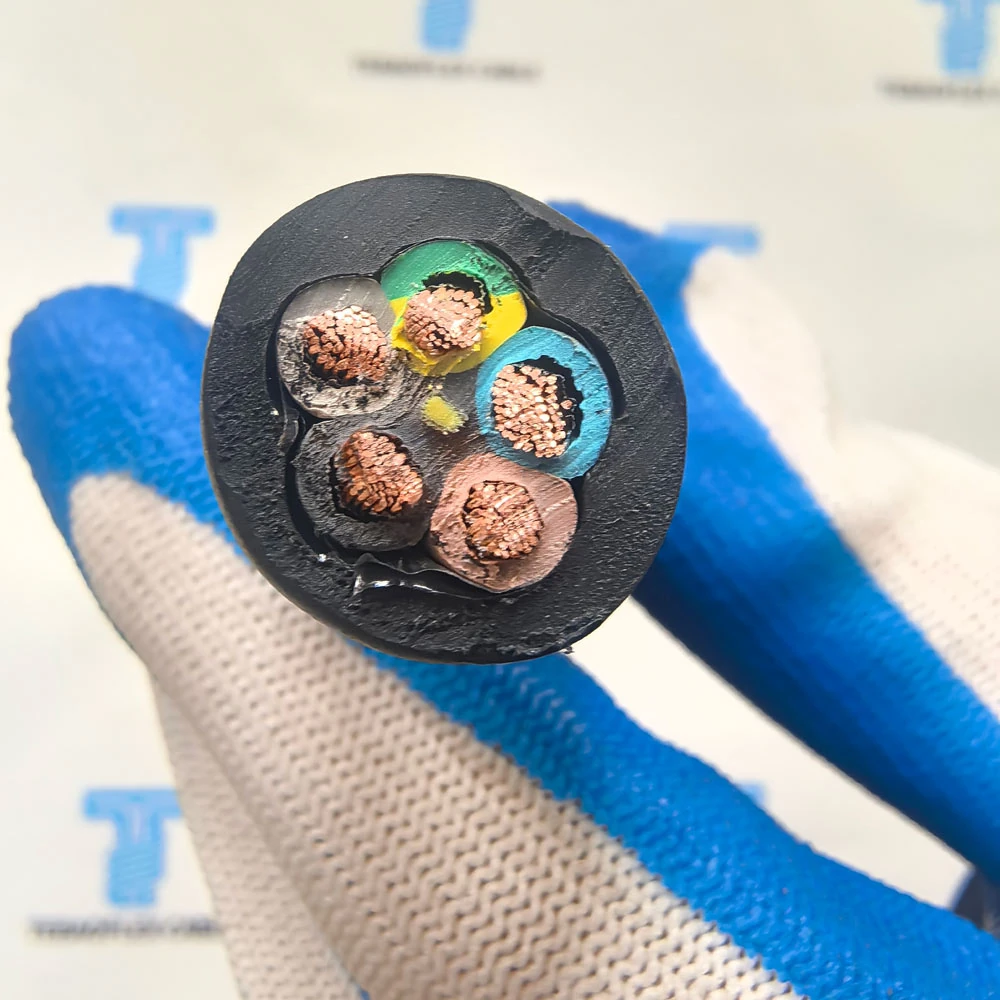
Class 5 is commonly specified for flexible copper conductors. IEC 60228 provides conductor-size and resistance requirements; it does not by itself define the finished cable’s complete application.
The insulation system must be matched to the product standard and temperature limit. Do not transfer a higher temperature from an enhanced branded construction to every H07RN-F cable.
“G” in a size such as 3G2.5 indicates that the cable includes a green/yellow protective conductor. “X” indicates a configuration without that protective conductor.
The sheath contributes resistance to handling, weather and certain oils or chemicals, but exposure limits remain compound- and product-specific.
For the current TEBAOFLEX construction, review the H07RN-F cable product page for the listed conductor, insulation, sheath, voltage and scoped documentation. Treat that page as the product record and this article as the selection guide.
Application fit
What is H07RN-F cable used for?
H07RN-F is commonly considered where portable or mobile equipment needs a tougher, more flexible connection than an ordinary light-duty lead. The correct question is not simply “Can H07RN-F be used here?” It is “Does the quoted H07RN-F construction match the voltage, movement, environment, routing and local rules for this installation?”
Generator leads, temporary distribution, portable tools and equipment connections where the cable is handled and the route needs mechanical protection.
Machine, motor and workshop connections involving vibration, repositioning or occasional movement within the cable’s documented duty.
Temporary power routes that are repeatedly installed and removed. Cable routing, ramps, connectors and inspection remain part of the safety system.
Flexible equipment connections exposed to weather and handling, provided the exact temperature, UV, chemical and mechanical conditions are supported.
The UK Health and Safety Executive advises event organizers to select and rate cables for the electrical duty and unusual environmental or adverse-weather conditions, then route them to reduce trip and mechanical-damage risks. That is useful selection logic even outside the UK, while the project’s local code still governs. See the HSE event electrical-safety guidance and its separate construction-site electrical guidance.
Important selection boundary
Is H07RN-F waterproof or suitable for submersion?
Do not translate “rubber cable,” “outdoor,” or “wet environment” into unlimited underwater use. Wet handling, temporary exposure and continuous immersion are different duties. Water type, depth, temperature, pressure, cable entry, suspension, duration and the manufacturer’s documented construction all matter.
Some enhanced H07RN-F products publish a defined AD8 or submersible duty. That is a product-specific statement, not a property that can be assigned to every cable carrying the same family designation. If the application is a pump lead or continuous freshwater connection, start with a construction designed and documented for that purpose.
| Condition | Selection question | Recommended route |
|---|---|---|
| Rain, wet ground or temporary outdoor handling | Are the cable, connectors, route and protection suitable for the actual weather and mechanical exposure? | Review the generic H07RN-F datasheet and installation rules. |
| Occasional splash or washdown | Which liquids, pressure, frequency and chemical agents are present? | Obtain compound-specific resistance and ingress details. |
| Continuous freshwater immersion or pump lead | What depth, temperature, duration, gland and suspension method apply? | Review H07RN8-F cable for documented wet-site and pump duty. |
| Seawater, deep water or pressure service | Is a dedicated subsea or marine construction required? | Do not assume generic H07RN-F is suitable; request project-specific engineering review. |
Read the size correctly
H07RN-F cable sizes, core counts and markings
H07RN-F sizes are usually written as the number of cores followed by the nominal conductor cross-section in square millimetres. A protective conductor changes the notation and often changes the equipment connection decision.
| Marking | Meaning | What remains to be checked |
|---|---|---|
| 3G2.5 | Three cores including green/yellow protective conductor; 2.5 mm² per core | Load, circuit type, run length, installation method, connectors and protective device. |
| 3G4 | Three cores including protective conductor; 4 mm² per core | Do not assign an amp rating without installation assumptions. |
| 4G6 | Four cores including protective conductor; 6 mm² per core | Confirm whether the circuit needs neutral and how many conductors are loaded. |
| 5G10 | Five cores including protective conductor; 10 mm² per core | Confirm three-phase arrangement, neutral loading, harmonics, voltage drop and termination size. |
| 4X16 | Four cores without a green/yellow protective conductor; 16 mm² per core | Confirm the earthing/protection design; “X” is not a substitute for a protective conductor. |
A datasheet can show a broad commercial size range, but the available core count, conductor size, overall diameter, weight, minimum bend radius and certification scope may differ by manufacturer and order. Send the complete marking from an existing cable or the equipment drawing when requesting a replacement.
The highest-value sizing question
H07RN-F current carrying capacity: why mm² is not enough
There is no single safe ampacity for “H07RN-F 3G4” or any other size without installation assumptions. The same conductor cross-section can receive different current ratings when the number of loaded cores, ambient temperature, grouping, installation method, conductor-temperature limit or duty changes.
Cable sizing should coordinate load current, protective device, current-carrying capacity and voltage drop. The relevant wiring rules also consider how the cable is installed. IEC 60364-5-52 addresses selection and erection of wiring systems, including conductor sizing and voltage-drop considerations. National rules or project specifications may add different tables and correction factors.
| Input | Why it changes the result | What to send with an enquiry |
|---|---|---|
| Load and supply | Single-phase, three-phase, DC, motor starting and continuous duty create different current and voltage-drop conditions. | Voltage, phases, full-load current, power factor and starting method. |
| Core configuration | Current rating depends on the number of loaded conductors and heat dissipation within the cable. | Core count, PE/neutral requirement and loaded-core schedule. |
| Installation method | Free air, tray, surface, conduit, insulation, coiling and enclosed spaces dissipate heat differently. | Route sketch, support method and whether the cable remains coiled in service. |
| Ambient and conductor temperature | Higher ambient temperature reduces the thermal margin; the cable compound sets the conductor-temperature limit. | Minimum/maximum ambient and quoted compound temperature rating. |
| Grouping | Adjacent loaded cables heat one another and normally require a correction factor. | Number of circuits, spacing and grouping length. |
| Run length | Voltage drop can require a larger conductor even when thermal ampacity is adequate. | One-way route length and allowable voltage drop. |
| Protection and fault duty | Overload, short-circuit and disconnection requirements must coordinate with the cable. | Protective-device type/rating and available fault data. |
Send the supply system, load current, route length, installation method, ambient temperature, grouping and protective device. TEBAOFLEX can then match the request to an order-specific datasheet or tell you which missing input prevents a reliable answer. Submit the sizing inputs with your RFQ.
Avoid designation shortcuts
H07RN-F vs H05RN-F, H07BN4-F and H07RN8-F
Nearby designations are not interchangeable simply because they are flexible or rubber-sheathed. The rated voltage, compound system, temperature, water duty and applicable product standard can change. Treat the comparison below as a routing aid and verify the selected manufacturer’s data.
| Designation | Selection signal | When to investigate it | Do not assume |
|---|---|---|---|
| H05RN-F | Lower voltage/light-to-normal duty family | Equipment documentation explicitly calls for H05RN-F and the application remains within its scope. | That H05RN-F and H07RN-F can be substituted without checking connectors, size and approval. |
| H07RN-F | 450/750 V heavy-duty flexible rubber/elastomeric family | Portable, temporary or protected equipment power where flexibility and mechanical robustness are required. | Universal immersion, deep-water, direct-burial or continuous-reeling suitability. |
| H07BN4-F | Different elastomeric compound/temperature family | Higher-temperature or compound-specific requirements point to BN4 construction. | That every BN4 product has identical temperature, oil or approval scope. |
| H07RN8-F | Water-resistant RN8 construction family | Freshwater pump or documented immersion duty needs a defined water boundary. | Seawater, deep-water or unlimited immersion without the exact product record. |
For North American portable-power specifications, a project may call for SOOW rather than a harmonised designation. These systems should be compared through their governing standard, voltage, conductor, compound, marking and approval requirements—not by calling one a universal equivalent. Review the separate SOOW 600 V portable power cable record when the project uses that designation.
From search query to usable specification
How to select H07RN-F cable for a project
- Define the electrical system. Record rated voltage, phases, frequency, load current, starting current, protective device and allowable voltage drop.
- Choose the core arrangement. State the live conductors, neutral, protective conductor and any control requirement. Use the full G/X notation when known.
- Describe movement honestly. Separate fixed, protected fixed, occasional flexing, trailing, torsion and reeling. A flexible conductor does not make every construction a reeling cable.
- Map the route. Provide installed length, support method, minimum bend space, cable entry, connectors, coiling and any vehicle or foot traffic.
- List environmental exposure. Include ambient temperature, sunlight, rain, water type/depth, oils, chemicals, abrasion and cleaning agents.
- Name the governing requirements. State the product standard, local installation rules, CPR/DoP needs, national approvals, test reports and required cable marking.
- Define the commercial package. Add quantity, individual lengths, drum/coil packing, destination, inspection requirements and the date the cable is needed—without assuming stock or lead time.
Common H07RN-F specification mistakes
- Choosing conductor size from one online amp table without confirming its installation assumptions.
- Treating “rubber,” “outdoor” or “weather resistant” as proof of continuous submersion.
- Ignoring bend radius, strain relief, connectors and cable protection at the equipment entry.
- Using a flexible power cable for continuous reeling, torsion or tensile duty without a construction designed for that movement.
- Requesting “CE” or another mark without identifying the product, intended market, standard, class, issuing scope and actual document needed.
- Ordering from nominal mm² alone and discovering that overall diameter, gland size or connector termination does not fit.
For cable intended for permanent incorporation in construction works subject to reaction-to-fire requirements, confirm the applicable CPR route, declared performance and supporting documents for that exact product and market. The European Commission’s CPR overview explains the role of the Declaration of Performance. Do not infer a Euroclass from the family designation alone.
Residual buyer questions
H07RN-F cable FAQ
What voltage is H07RN-F cable?
The harmonised designation identifies a 450/750 V U0/U cable family. Any use at a different system voltage or in a protected fixed arrangement must be supported by the exact product datasheet and governing installation rules.
Is H07RN-F suitable for outdoor use?
H07RN-F is commonly used in outdoor and temporary-power applications, but the complete system must match weather, temperature, mechanical protection, connectors and local rules. Outdoor use is not the same as continuous immersion.
What does H07RN-F 3G2.5 mean?
It means three conductors, including a green/yellow protective conductor, with a nominal cross-section of 2.5 mm² per conductor. It does not by itself state the permitted current, outside diameter or connector size.
How many amps can H07RN-F 3G4 carry?
There is no universal value without knowing the number of loaded cores, installation method, ambient temperature, grouping, conductor-temperature limit, run length, voltage drop and protective device. Use the applicable wiring rules and the quoted manufacturer data for the project.
Can H07RN-F be used for a submersible pump?
Only when the exact product documentation supports the water type, depth, duration, temperature, gland and mechanical arrangement. For a defined freshwater pump route, compare the documented H07RN8-F construction rather than assuming every H07RN-F is submersible.
Is H07RN-F an oil-resistant cable?
Many H07RN-F products publish oil-resistance properties, but the relevant test, compound, exposure type, temperature and duration must be confirmed for the quoted cable. “Oil resistant” does not mean resistant to every fluid.
Can H07RN-F be permanently installed?
Some standards and product datasheets allow specific protected fixed-installation conditions. The route, protection, voltage, fire-performance requirement and national code still need to be checked. Do not use a portable-cable assumption as a fixed-wiring design decision.
What should an H07RN-F datasheet confirm?
At minimum: product designation, standard/edition, voltage, conductor class and size, core identification, insulation and sheath compounds, temperature, bend radius, outside diameter, weight, relevant tests/marking, current-rating assumptions and the scope of any certificate or Declaration of Performance.
Make the enquiry answerable
Prepare an H07RN-F cable quotation
Send the information below so the response can match a construction to the application instead of returning a generic price for an incomplete cable description.
- Voltage, phase and load current
- Core count and conductor size
- Route length and movement pattern
- Ambient and environmental exposure
- Installation and minimum bend space
- Standard, marking and document needs
- Quantity and individual cable lengths
- Destination and packing requirement
Sources and editorial scope
This guide uses standards-body scope pages, regulator guidance and the linked TEBAOFLEX product records. It is a selection aid, not an installation design, approval, certificate or declaration of conformity. Final cable sizing and acceptance remain the responsibility of the qualified parties working from the governing project documents.
- BSI — BS EN 50525-2-21 scope
- IEC — IEC 60245-4:2026
- IEC — IEC 60228 conductor standard record
- IEC — IEC 60364-5-52 wiring systems
- UK HSE — Electrical safety on construction sites
- UK HSE — Event electrical safety
- European Commission — Construction Products Regulation overview
Technical review date: 2026-07-29. Standards, legislation and individual product data can change; confirm the applicable edition and order-specific documents before purchase or installation.