





Zheng LiPeng

Zheng LiPeng

I am Zheng LiPeng, manager at Jiangsu Tebaoflex Special Cable Co., Ltd., where I lead sales and strategic partnerships. I have worked in the electrical and cable manufacturing sector for more than 14 years. Tebaoflex is a flexible power cable manufacturer founded in 2014 in Taicang, Suzhou, that supplies more than 20 countries. My work sits where a specification meets a real order: trailing cables for mining shovels and continuous miners, reeling and festoon cables for port cranes, cables for deep-sea ROVs, airport ground power and submersible pumps. The articles here grow out of that work. They are written with our factory's samples and cross-sections on the bench and against the standards the cables are built to, including UL 62 and CSA C22.2 No. 49 for flexible cord, VDE-approved rubber cables to EN 50525-2-21 and ISO 9001 production. If a question goes beyond what an article covers, reach me through the enquiry form.

Type MV-105 Cable (5 kV, 15 kV & 35 kV): EPR vs XLPE Insulation, 100% vs 133% Levels and Mining/Industrial Feeder Selection
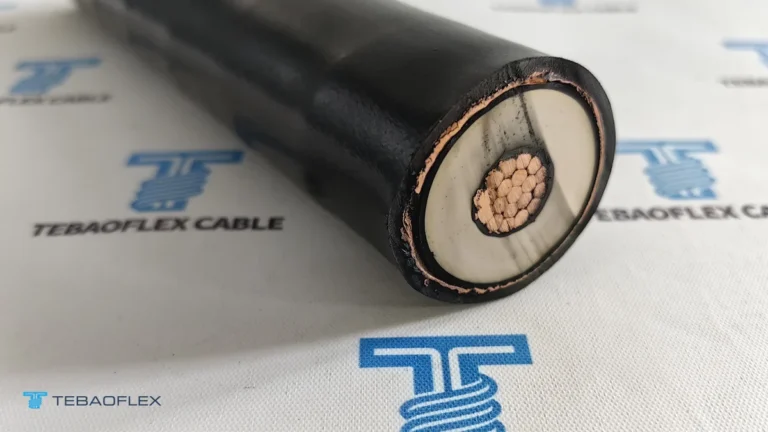
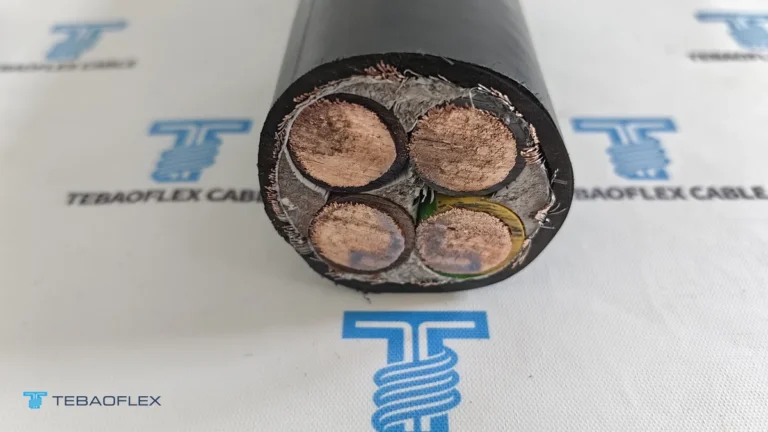
Finished TEBAOFLEX 33/35 kV single-core Class 2 copper HEPR medium-voltage cable showing conductor shield, thick white EPR insulation wall, outer semiconductive shield, copper tape metallic screen and black jacket

Engineering selection guide for 5 kV, 15 kV, 25 kV and 35 kV Type MV-105 medium-voltage distribution and mining feeder cables: MV-105 vs MV-90 thermal ratings, EPR vs TR-XLPE dielectrics, 100% vs 133% insulation wall thicknesses (90 to 420 mil), copper tape vs wire shield grounding and when to step to Type MP-GC or SHD-GC.

Hybrid Power & Fieldbus Crane Cables (CAN-BUS & PROFIBUS L2 in Reeling & Festoon Systems): Impedance, Shielding and Compact OD

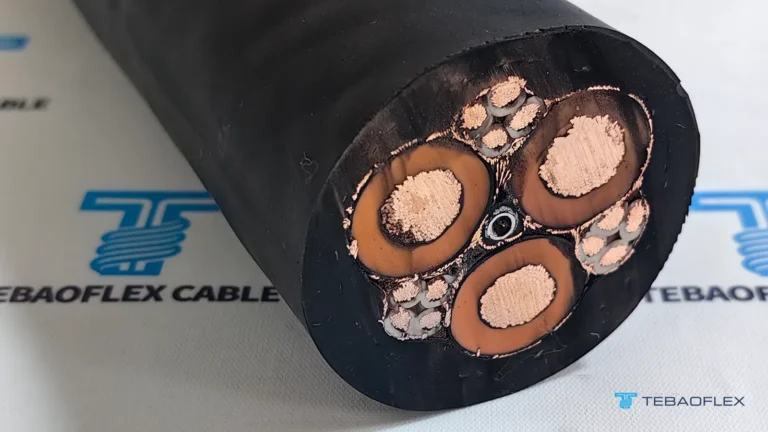
Macro cross-section of a TEBAOFLEX hybrid power-control and shielded CAN-BUS crane reeling cable showing 37 fine-stranded copper cores, central tensile core and braided twisted data pair inside a compact black PUR jacket

Engineering specification guide for dynamic crane reeling and festoon cables that combine 0.6/1 kV power and control cores with integrated copper fieldbus pairs (120 Ω CAN-BUS / ISO 11898 and 150 Ω PROFIBUS-DP L2): impedance stability under flex, tinned-copper braid EMC isolation, outer-diameter compaction and copper bus vs fiber-optic (+FO) selection boundaries.

CSP vs CPE vs CR (Neoprene) vs PUR Cable Jackets: Oil, Salt-Spray, Ozone and Heavy Reeling Selection Guide

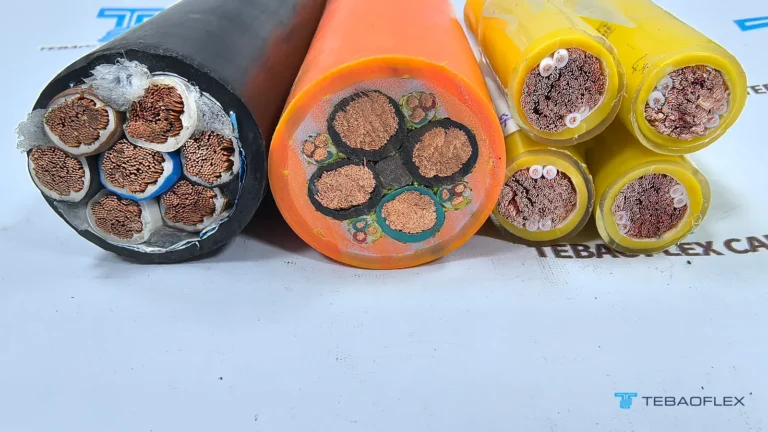
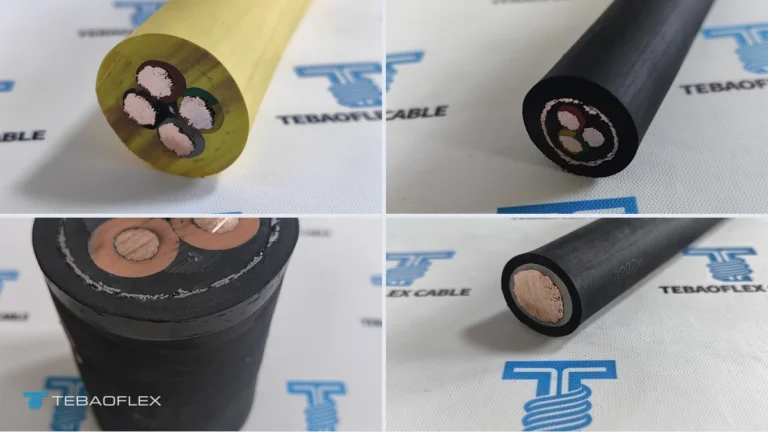
Four TEBAOFLEX heavy-duty elastomer cable jacket samples compared: yellow CR/PCP reeling cable, black thermoset CPE SOOW portable cord, matte black offshore PUR armored cable and black polychloroprene H07RN-F rubber cable

Engineering comparison of the four main heavy-duty industrial cable outer sheaths—chlorosulfonated polyethylene (CSP/CSM), chlorinated polyethylene (CPE), polychloroprene (CR/PCP/neoprene) and polyether polyurethane (PUR)—across oil immersion, offshore salt spray, UV/ozone weathering, thermal ceiling, tear resistance and reeling dynamics.

Fiber-Optic Composite Reeling Cable Specification Guide: +FO Designations, Split-Earth Layouts, 9/125 vs 50/125 Fibers and Drum OD Windows

Cut end of a TEBAOFLEX 6/10 kV (N)TSCGEWÖU+FO 3×35+35+3×(4×2.5)C+24FO (9/125 µm) composite medium-voltage crane reeling cable showing screened EPR power cores, control bundles, 24-fibre optical subunit and black 5GM5 rubber sheath

How to specify electro-optical crane and mining reeling cables across DIN VDE 0250-813 and JIS/JCS standards: round (N)TSCGEWÖU+FO vs flat (N)TSFLCGEWÖU-FO and FC-PNCT, split-earth notation (3×35/3E vs 2×25/2), single-mode 9/125 vs multimode 50/125 fibers, drum OD windows, and 2,000 mm breakout tails.