

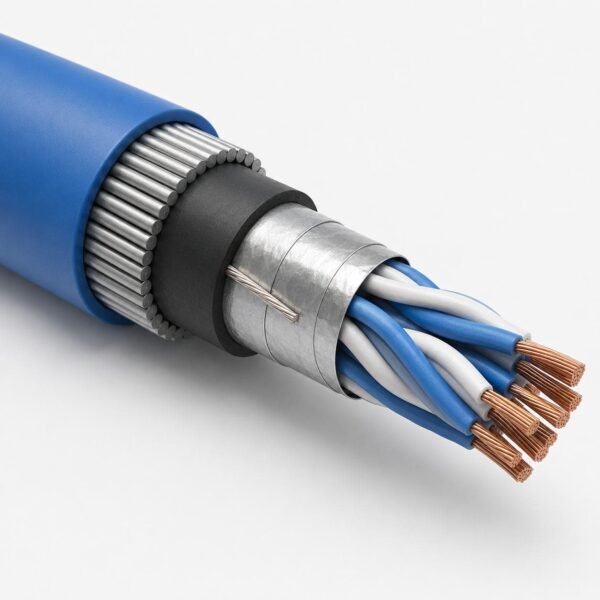
BS5308 / PAS5308 Part 1 Type 2 Armoured Instrumentation Cable 300/500 V
BS5308 / PAS5308 Part 1 Type 2 armoured instrumentation cable: polyethylene insulated, galvanised steel wire armoured, collectively or individually and collectively screened. Confirm conductor size, unit count, screening arrangement, route and documentation requirements at RFQ.
BS5308 Part 1 Type 2 armoured instrumentation cable carries analogue and digital signals between field instruments and control systems on routes that need mechanical protection. Part 1 denotes polyethylene insulation, which gives lower mutual capacitance and a wider temperature band than the PVC insulated Part 2 family. Type 2 denotes galvanised steel wire armour over a bedding layer, making the construction suitable for direct burial and for exposed routes where crushing, impact or rodent damage is credible.
Screening is a separate decision from Part and Type. A collective aluminium/polyester screen with a common tinned copper drain wire suits cables whose circuits share a signal type and an earthing reference. Individual pair or triad screens plus an overall screen suit mixed signal levels, low-level analogue circuits and any arrangement where intrinsically safe circuits must be segregated. State the screening arrangement explicitly; Part 1 Type 2 alone does not define the cable.
The armour is a mechanical element and is not a substitute for the screen. Screen and armour are terminated separately, and armour bonding must be resolved as part of the earthing design rather than assumed. Confirm gland type and armour termination method with the route drawings.
Standard status. BS 5308 Parts 1 and 2 were withdrawn in 2005 and PAS 5308-1:2009 was withdrawn by BSI on 3 April 2024. The current document covering these cables is BS EN 50288-7:2005. Cable can still be manufactured and supplied to the withdrawn constructions, but a project specifying them will normally need to record a deviation. Read the PAS 5308 specification guide before issuing a cable schedule.
Construction
| Element | Reference construction | Buyer check |
|---|---|---|
| Conductor | Plain annealed copper to BS EN 60228, Class 1 solid, Class 2 stranded or Class 5 flexible. | Confirm class, cross-sectional area and core identification. |
| Insulation | Polyethylene Type 03 to BS 6234 (Part 1 family). | Confirm compound where XLPE or a fire-resistant variant is required. |
| Formation | Conductors twisted as pairs, or as triads where three conductors are required. | Confirm number of pairs or triads and any mixed formation. |
| Screen | Aluminium/polyester tape, collective (CAM) or individual and collective (ICAM), with tinned copper drain wire. | Confirm arrangement, drain wire size and screen bonding at both ends. |
| Bedding | Extruded layer beneath the armour. | Confirm compound where a specific fire or chemical performance is required. |
| Armour | Galvanised steel wire armour (SWA) over the bedding. | Confirm gland type, armour termination and earthing arrangement. |
| Sheath | PVC Type TM1 to BS EN 50363, or low smoke zero halogen. | Confirm compound, colour and whether blue IS identification is required. |
Applications
- Direct buried instrument and control signal routes between field areas and control buildings.
- Exposed plant routes where crushing, impact or rodent damage is credible.
- Analogue 4-20 mA loops, digital fieldbus and low-level transmitter signals.
- Intrinsically safe circuits, where loop certification is held at system level and blue sheath identification is used.
- Petrochemical, refinery, power generation and water treatment field routes.
Where the route runs entirely inside tray, trunking or conduit and no armour is required, specify the unarmoured Type 1 construction instead.
Specifications
| Property | Reference value | Buyer check |
|---|---|---|
| Voltage rating | 300/500 V (Uo/U) | Confirm where a higher rating is specified for the circuit. |
| Conductor sizes | 0.5, 0.75, 1.0, 1.5 and 2.5 mm² reference range | Confirm the size required and availability in the chosen class. |
| Conductor class | Class 1 solid, Class 2 stranded or Class 5 flexible to BS EN 60228 | Solid conductors suit fixed terminations; stranded suit repeated handling. |
| Screening | Collective, or individual and collective | State explicitly. Required for IS circuit segregation. |
| Armour | Galvanised steel wire over bedding | Confirm wire diameter, gland selection and armour earthing. |
| Operating temperature | Reference range −30 °C to +75 °C, fixed installation | Confirm against the ordered compound and the route ambient. |
| Minimum bending radius | Reference 18 × overall diameter, fixed installation | Armoured constructions are stiffer. Confirm before tray and gland detailing. |
| Loop parameters | Inductance and capacitance per unit length available on request | Required for intrinsically safe loop verification. Request with the RFQ. |
| Fire performance | Flame propagation references to BS EN/IEC 60332-1 and 60332-3-24 | Confirm the category required by the project specification. |
Standards
- PAS 5308-1:2009 construction reference. Withdrawn by BSI on 3 April 2024.
- BS 5308-1 construction reference. Withdrawn and superseded by EN 50288-7 in 2005.
- BS EN 50288-7:2005, the current sectional specification for instrumentation and control cables.
- BS EN 60228 conductor reference.
- BS 6234 polyethylene insulation reference.
- BS EN 50363 sheath compound reference.
- BS EN/IEC 60332-1 and 60332-3-24 flame propagation references where specified.
Because PAS 5308 is withdrawn, no certification body issues conformity certificates against it and no supplier can offer one. Request the model-specific test and inspection documents in the RFQ. Standards names are selection references, not an approval claim.
Request a cable recommendation and quotation
Send the required services, cable length, mechanical duty, environment, termination and quantity. Our team will review the application before quoting.
- Include the product name or SKU plus the required cable length and quantity.
- Attach a specification, drawing or data sheet when available.