


Instrumentation cable specification
PAS 5308-1:2009 and PAS 5308-2:2009 were withdrawn by the British Standards Institution on 3 April 2024, and BS 5308 Parts 1 and 2 were withdrawn in 2005. Both designations are still specified worldwide, but neither is current, and a project specifying them will normally need to record a deviation. The current document is BS EN 50288-7:2005.
Specification at a glance
BS5308 and PAS5308 instrumentation cable carries analogue and digital signals between field instruments and control systems. The two names, written with or without a space, refer to the same constructions, and drum markings, datasheets and cable schedules use both forms interchangeably.
- Purpose
- Multi-pair and multi-triad signal cable between field devices and control systems, designed to form part of an intrinsically safe system.
- Voltage rating
- 300/500 V, expressed as Uo/U. A datasheet quoting a bare 300 V is stating Uo only, not a lower rating.
- Conductor sizes
- 0.5, 0.75, 1.0, 1.5 and 2.5 mm². These are signal cables, not power cables.
- Part
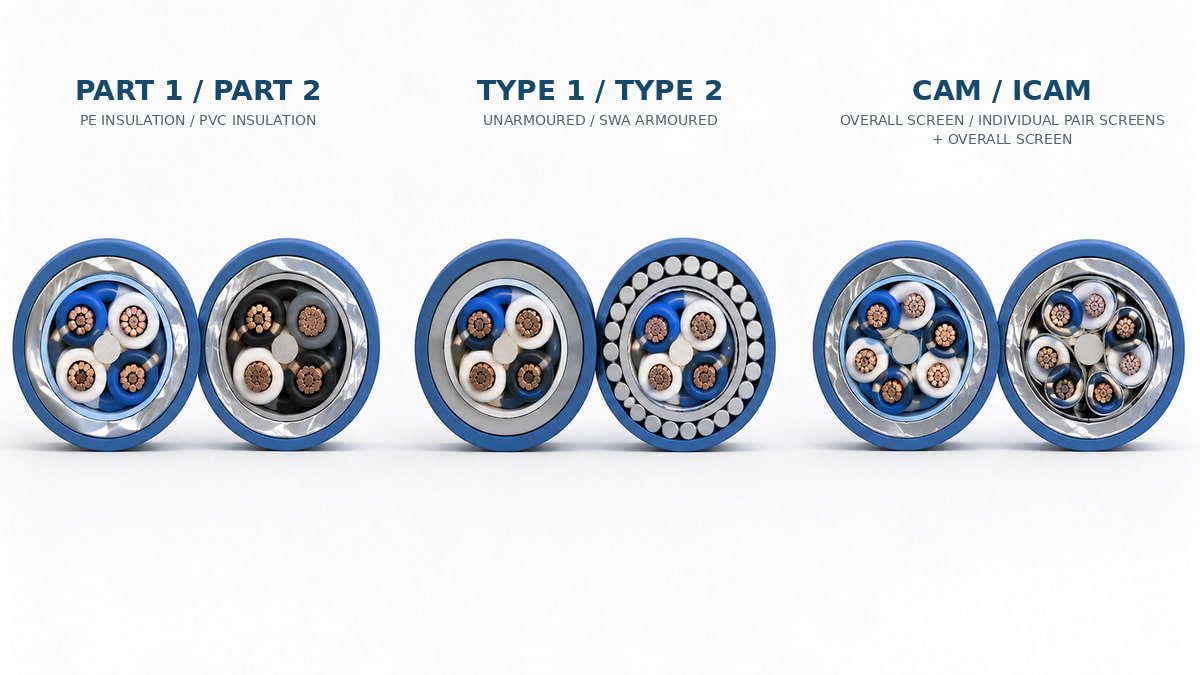
- The insulation. Part 1 is polyethylene, Part 2 is PVC.
- Type
- The armouring. Type 1 is unarmoured, Type 2 has galvanised steel wire armour.
- Screen
- CAM is one collective screen. ICAM is an individual screen on each pair or triad plus an overall screen.
Part, Type and screen are three independent choices. Quoting one of them alone does not define the cable.
Which standard is current, and which was withdrawn
Four documents are involved and three of them are withdrawn. The designation printed on a cable sheath records what it was built to, not what is currently specifiable.
| Designation | Scope | Status | Dates |
|---|---|---|---|
| BS 5308-1 and BS 5308-2 | Original British instrumentation cable specification | Withdrawn | Superseded by EN 50288-7 in 2005 |
| PAS 5308-1:2009 | Polyethylene insulated cables | Withdrawn | Published 31 July 2009, withdrawn 3 April 2024 |
| PAS 5308-2:2009 | PVC insulated cables | Withdrawn | Published 31 July 2009, withdrawn 3 April 2024 |
| BS EN 50288-7:2005 | Sectional specification for instrumentation and control cables | Current, under review | Rated 90, 300 and 500 V a.c. |
A PAS is not a British Standard. A Publicly Available Specification is issued by BSI but does not carry the status of a full British Standard. PAS 5308 appeared in 2009 because industry kept asking for the withdrawn BS 5308 constructions; its own withdrawal in 2024 left no direct replacement other than BS EN 50288-7.
Practical consequence. Specifying or installing to a withdrawn document is not prohibited, but it is a departure from current standards. Most project quality regimes require this to be recorded as a deviation and signed off. Raise it at design stage rather than at handover.
Part, Type and screen are three independent choices
The most common specification error is treating Part 1 Type 2 as a single product code. Fixing one axis does not fix the others.
| Axis | Option | What it means | Choose this when |
|---|---|---|---|
| Part insulation | Part 1 | Polyethylene insulation. XLPE, silicone and mica-taped fire-resistant variants sit in this family. | Signal integrity matters over long runs, or the ambient range is wide. Polyethylene gives the lower capacitance and the wider temperature band. |
| Part 2 | PVC insulation. | General industrial routes with a moderate temperature range, where the electrical advantage of polyethylene is not needed. | |
| Type armour | Type 1 | Unarmoured. | The route runs inside trunking, tray or conduit and needs no mechanical protection beyond the sheath. |
| Type 2 | Galvanised steel wire armour over a bedding layer. | Direct burial, or any route where crushing, impact or rodent damage is credible. | |
| Screen | CAM, collective | One aluminium/polyester screen over all units, with a common drain wire. | Every circuit in the cable shares a signal type and an earthing reference, and crosstalk between units is not a concern. |
| ICAM, individual and collective | Each pair or triad screened separately, plus an overall screen. Each screen carries its own drain wire. | Mixed signal levels share the cable, low-level analogue signals are present, or circuits must be segregated for intrinsic safety. |
Because the axes are independent, a Part 2 Type 2 cable exists in both collectively screened and individually-plus-collectively screened forms.
Conductor, screen and sheath construction
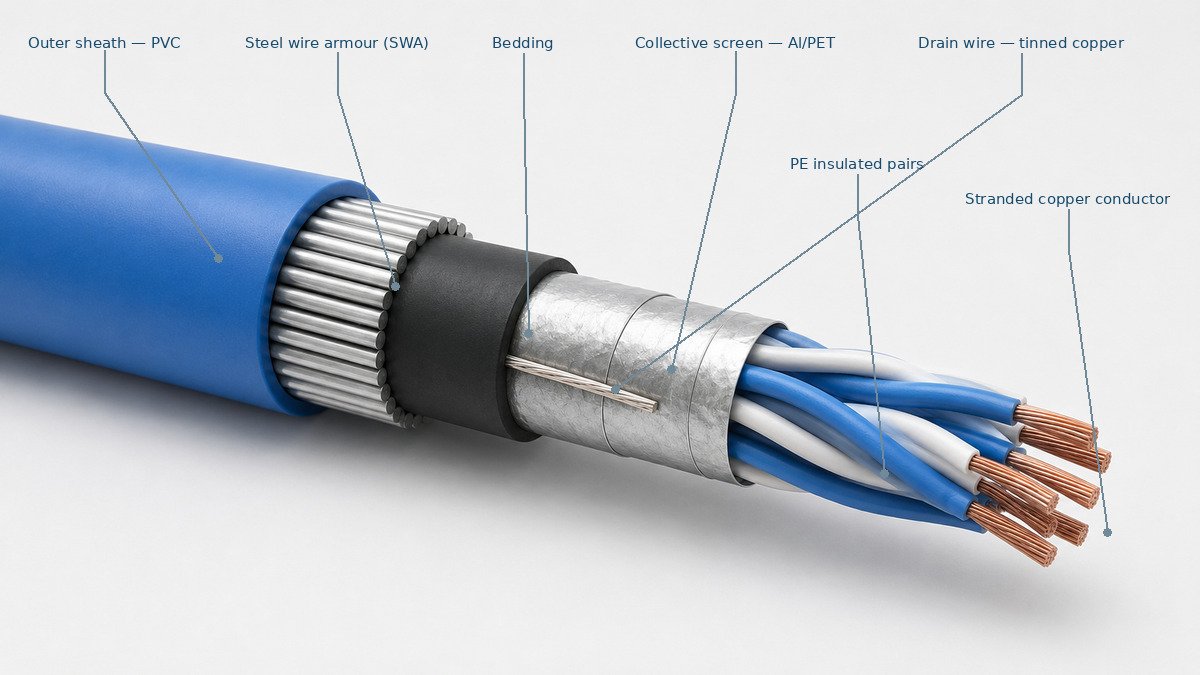
The elements below are those the withdrawn specifications describe and that the market still builds to. Confirm every figure against the datasheet for the specific build.
| Element | Specification | Governing standard |
|---|---|---|
| Conductor | Plain annealed copper, Class 1 solid, Class 2 stranded or Class 5 flexible | BS EN 60228 |
| Conductor sizes | 0.5, 0.75, 1.0, 1.5 and 2.5 mm² | — |
| Formation | Two conductors twisted as a pair, three as a triad or triple | — |
| Insulation, Part 1 | Polyethylene, Type 03 | BS 6234 |
| Insulation, Part 2 | PVC | — |
| Screen | Aluminium/polyester tape, collective or individual and collective | — |
| Drain wire | Tinned copper, commonly 0.5 mm² | — |
| Bedding, Type 2 only | Extruded layer beneath the armour | — |
| Armour, Type 2 only | Galvanised steel wire | — |
| Sheath | PVC Type TM1, or low smoke zero halogen | BS EN 50363 |
| Fire performance | Flame propagation, single vertical wire and bunched cables | BS EN/IEC 60332-1, BS EN/IEC 60332-3-24 |
Voltage and temperature ratings
Temperature is set by the insulation and sheath compounds rather than by the Part or Type designation.
| Material system | Fixed installation | Minimum during installation |
|---|---|---|
| Part 1, polyethylene insulated | −30 °C to +75 °C | Confirm per build |
| Part 2, PVC insulated | −20 °C to +65 °C | 0 °C |
| BS EN 50288-7, LSZH sheathed | −30 °C to +70 °C | −5 °C |
A minimum bending radius of 18 times the overall diameter is commonly specified for fixed installation. Confirm the figure for the specific construction before finalising tray, gland and termination detailing.
Intrinsic safety and the blue sheath
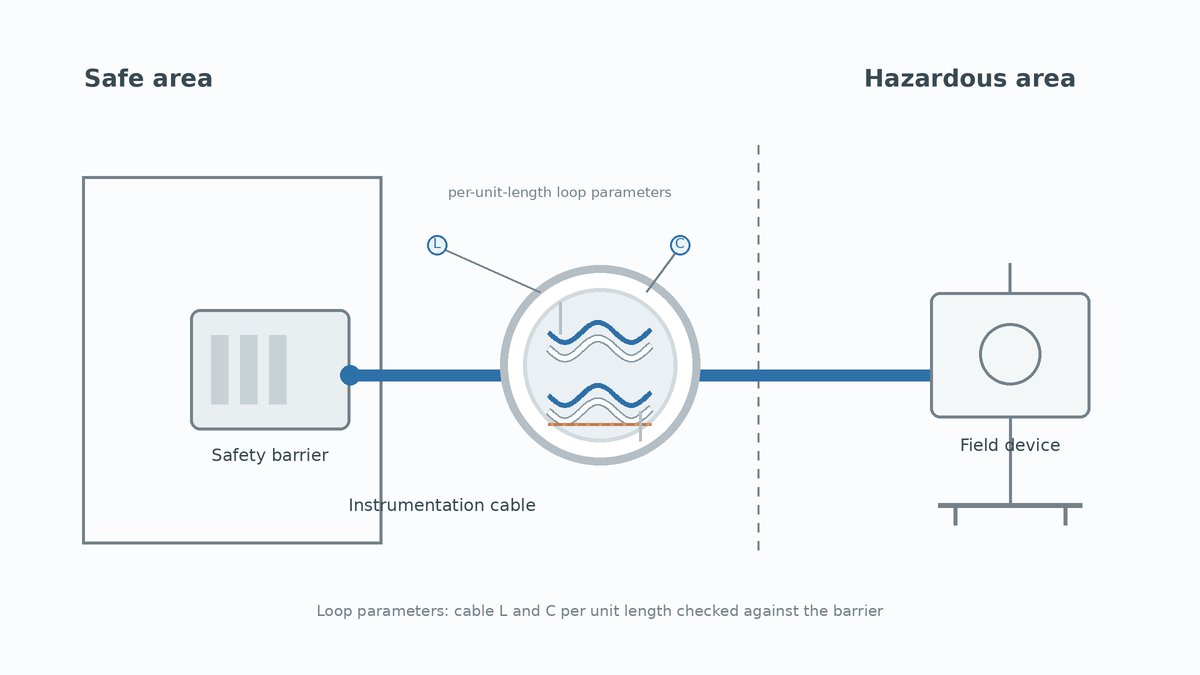
Where the cable serves intrinsically safe circuits, a blue sheath is the convention used to identify those circuits and keep them segregated from non-IS wiring.
Sheath colour and cable construction do not by themselves make a circuit intrinsically safe. Intrinsic safety is a property of the complete loop, covering the barrier, the field device, the cable parameters and the installation. The cable inductance and capacitance per unit length must be checked against the permitted values for that loop. Request those parameters as part of the enquiry rather than assuming them.
What to specify now that both standards are withdrawn
Three routes are open, and the choice belongs to the design authority rather than the supplier.
- Specify BS EN 50288-7 and translate the construction. This is the only current standard covering these cables. State the insulation, armour and screening arrangement as an explicit construction description rather than relying on the legacy code.
- Continue to specify PAS 5308 and record a deviation. Legitimate where an existing plant standard, spares holding or asset register is built around the designation. The deviation should name the withdrawn document, the withdrawal date and the reason for continued use.
- Specify by construction alone. State insulation, screening, armour, sheath, conductor class, conductor size and unit count. This is unambiguous, survives further standard changes, and is what a manufacturer needs in any case.
Whichever route is chosen, record it at design stage. A cable schedule that says only BS 5308 Part 1 Type 2 is now an incomplete instruction.
Information required for a PAS 5308 cable enquiry
| Data group | Minimum information | Why it matters |
|---|---|---|
| Circuit | Signal type, voltage, and whether the loop is intrinsically safe | Determines the screening arrangement and whether IS identification applies |
| Construction | Part, Type, screening arrangement, conductor class and size | All three axes must be stated; one alone does not define the cable |
| Unit count | Number of pairs or triads | Sets overall diameter, drum length and gland selection |
| Route | Buried, tray, trunking, ambient range, chemical exposure | Decides armour, sheath compound and temperature class |
| Compliance | Standard to appear on the drum and in documentation, and any deviation already agreed | Avoids a rejected submission after manufacture |
| Delivery | Lengths required, drum or coil, marking and packaging | Fixed lengths and marking are set before production, not after |
Questions buyers ask
Can the cable be built to a non-standard unit count or length?
TEBAOFLEX manufactures instrumentation cable to order rather than from a fixed catalogue. The minimum order quantity is 50 m for standard and customised constructions alike, as of August 2026, and customer logo and identification can be printed on the sheath, the drum and the packaging.
Drums are available in steel, steel and timber, all timber, and export packaging, and cable can be supplied in fixed lengths or in coils. Describe any structural customisation in the enquiry so that it can be assessed before quotation.
What lead time should be allowed?
Allow 7 to 45 working days, depending on product type, material position and the extent of customisation, as of August 2026. The range is wide because instrumentation builds vary from short standard runs to project-specific constructions. A written quotation from sales is the binding statement for any specific order.
What can be stated on the documentation?
TEBAOFLEX manufactures instrumentation cable designed to the PAS 5308-1 and PAS 5308-2 constructions, with conductors to BS EN 60228 and sheath compounds to BS EN 50363. Because both PAS 5308 parts are withdrawn, no certification body issues conformity certificates against them, and no supplier can offer one.
Where a project requires third-party testing or a specific market listing, state the requirement in the enquiry so that scope and feasibility can be confirmed before order.
What is the difference between Part 1 and Part 2?
Part refers to the insulation material. Part 1 cables are polyethylene insulated, which gives lower capacitance and a wider temperature band. Part 2 cables are PVC insulated and suit general industrial routes at moderate temperature. Part says nothing about armouring or screening, which are separate choices.
What is the difference between Type 1 and Type 2?
Type refers to armouring. Type 1 cables are unarmoured and suit routes inside tray, trunking or conduit. Type 2 cables carry galvanised steel wire armour over a bedding layer, for direct burial or where crushing and impact are credible. Type says nothing about the screening arrangement.
What is the difference between a pair and a triad?
A pair is two insulated conductors twisted together, and a triad, also called a triple, is three. Triads are used where a circuit needs three conductors, such as certain resistance thermometer connections. Both pairs and triads can be collectively screened, or individually and collectively screened, within the same cable family.
Can PAS 5308 cable still be used on a new project?
PAS 5308 cable can still be supplied and installed, and it is still widely specified. Because the document is withdrawn, the design authority will normally need to record a deviation naming the withdrawn standard, its withdrawal date and the reason for continued use. Agree that position at design stage rather than at handover.
Related cable routes
- BS5308 and PAS5308 instrumentation cables — the manufactured range in Part 1 and Part 2, unarmoured and steel wire armoured, with collective or individual screening.
- Oil and gas cables — power, control and signal routes for drilling, refinery and offshore installations.
- Type P signal and I/O cable — the North American offshore signal route, specified against a different standard family. Do not substitute one for the other without checking the governing specification.
- Armoured underwater instrumentation cables — a separate family for subsea sensor and deployment duty, not a PAS 5308 construction.
- Industrial cables — the wider flexible power, control and equipment cable range.
Source and review status
Standard status, publication dates and the 3 April 2024 withdrawal date are taken from the British Standards Institution records for PAS 5308-1:2009 and PAS 5308-2:2009. Rated voltages for BS EN 50288-7:2005 are as published in that standard scope statement. Construction details reflect published manufacturer and distributor datasheets for cables built to these specifications and should be confirmed against the datasheet for any specific build.
Reviewed 2 September 2026. Standard status is subject to change, and BS EN 50288-7:2005 is recorded as under review.
Send the construction, not just the standard number
State Part, Type, screening arrangement, conductor size, unit count and route conditions. TEBAOFLEX can use them as the starting point for a project-specific instrumentation cable review.