








TGGT Wire — PTFE-Glass High Temperature Lead Wire 250°C, 300/600 V
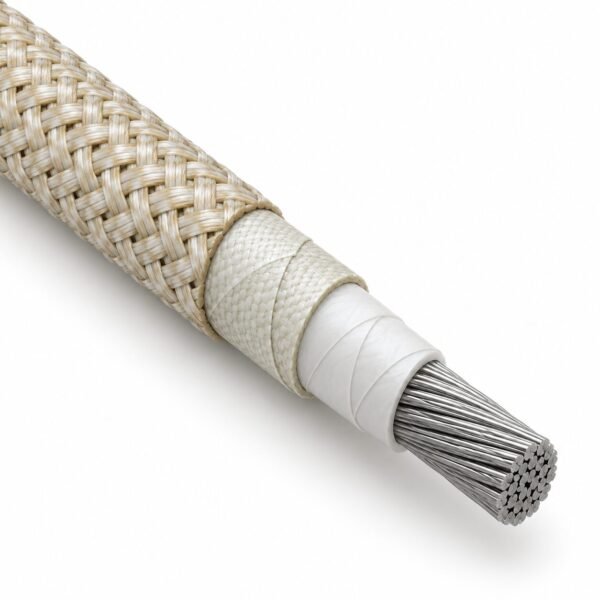
TGGT stands for the four layers it is made of — Teflon, glass, glass, Teflon. It is the wire for equipment that runs hot, wet and chemically unpleasant at the same time: 250 °C in damp or dry service, with the chemical and moisture resistance of PTFE and the abrasion resistance of an impregnated glass braid. TEBAOFLEX builds it on nickel-plated copper from 18 AWG to 4/0.
- Construction references: UL AWM style 5256 (18–2 AWG) and style 5251 (1/0 AWG and larger); CSA AWM I A/B FT1
- Temperature: 250 °C, wet and dry
- Voltage: 600 V; 300 V constructions available
- Conductor: flexible stranded 2% nickel-coated copper to ASTM B355, B8, B173 and B174
- Insulation: two PTFE tapes with a fiberglass serve
- Jacket: braided fiberglass with a high-temperature finish, impregnated against moisture, heat and flame
- Sizes: 18 AWG to 4/0 AWG
Send the AWG size, voltage, hot-spot temperature, length and any documentation requirement for a technical quotation.
Cross-reference: a buyer quoting Chem-Gard 200 RTD 40551 or 40552 can compare it on the Chem-Gard 200 RTD reference review; for mica-glass Thermo-Trex 2800 RTD 41250 leads, the Thermo-Trex 41250 reference review lists the original construction before a TEBAOFLEX offer is prepared.
Construction
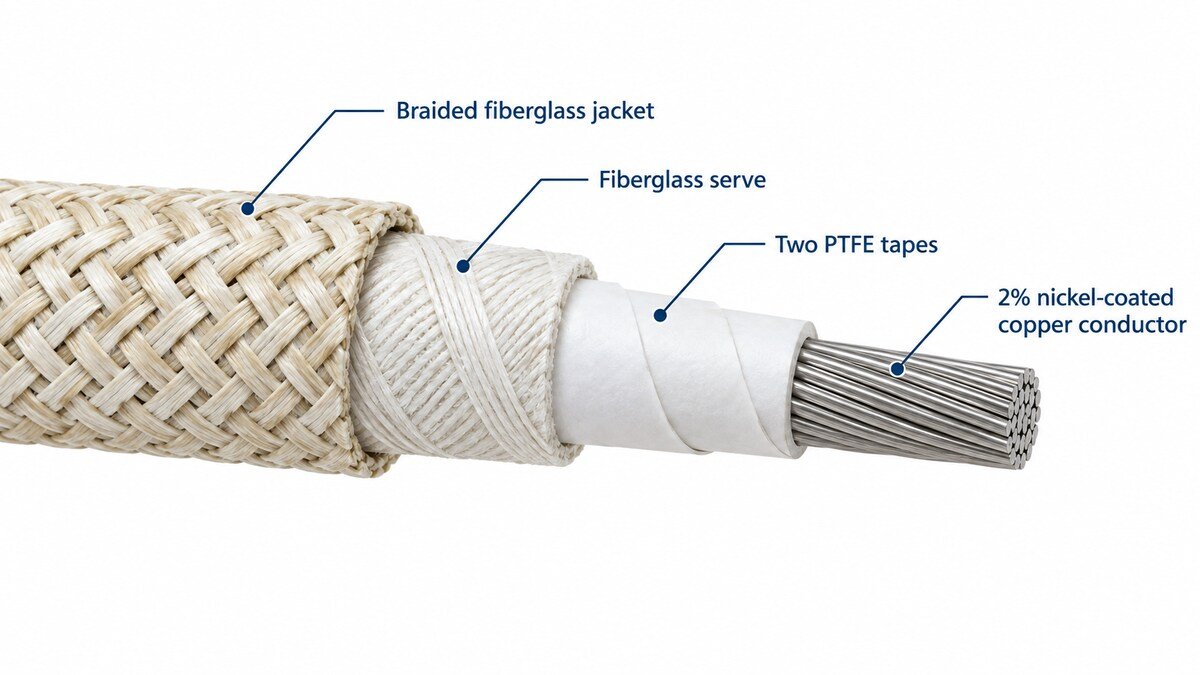
The name is the specification. TGGT is Teflon, glass, glass, Teflon — a four-layer composite in which no single layer does more than one job, which is why it holds together in conditions that defeat an extruded wire.
| Layer | What it is | What it is there for |
|---|---|---|
| Conductor | Flexible stranded soft-drawn copper, 2% nickel coated, to ASTM B355, B8, B173 and B174 | Above about 200 °C bare copper oxidises and goes brittle. A light nickel coating stops that, and improves conductance at the same time. |
| Inner PTFE | Two non-extruded PTFE tapes, wrapped | The dielectric, and the chemical barrier. Tape rather than extrusion is what lets the wall stay thin without losing coverage on a stranded conductor. |
| Glass serve | Fiberglass tape wrapped over the PTFE | Mechanical reinforcement and thermal spacing between the dielectric and the outside world. |
| Outer braid | Braided fiberglass with a high-temperature finish, impregnated against moisture, heat and flame | Abrasion resistance and handling strength. This is the layer that survives being pulled through a machine frame. |
2% nickel here, 27% on MGT. Both wires use nickel-plated copper, but the coating weight follows the temperature the conductor has to survive, not the product family. A 250 °C wire does not need — and should not be priced as though it needs — the heavy coating that a 450 °C wire depends on.
Why the wall is wrapped, not extruded
An extruded PTFE wire gives you a smoother, more exact wall. A tape-wrapped wall gives you something an extrusion cannot: layers that can move slightly against each other as the wire is bent hot, without the dielectric splitting. That is the reason TGGT survives thermal cycling in equipment that is switched on and off every day for years.
Reading the size range correctly
The available sizes track the UL style rather than the product name: style 5256 covers 18 AWG through 2 AWG, and style 5251 picks up at 1/0 AWG and larger. A specification that names TGGT without naming the style will usually still be quotable, but naming the style removes a round of questions. On the reasoning behind temperature ratings generally, see what a 200 °C insulation rating actually guarantees.
Applications
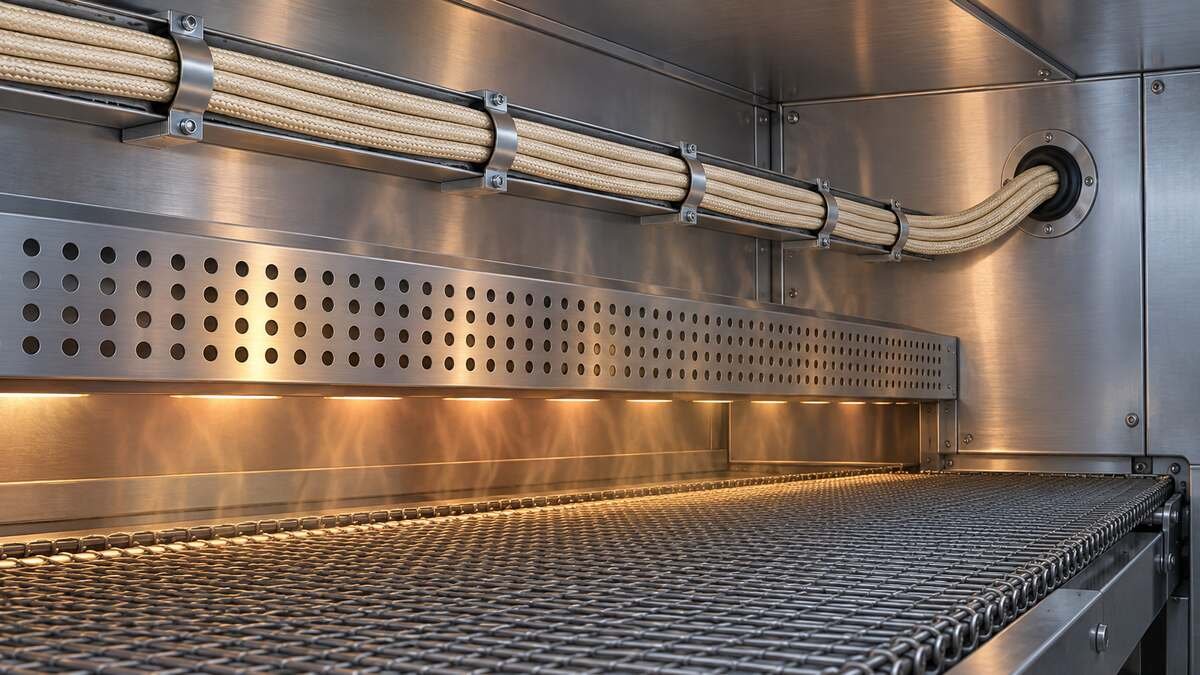
TGGT is apparatus and motor lead wire for the internal wiring of domestic, commercial and industrial heating equipment, cooking equipment, and the control and power circuits attached to them — anywhere high temperature and abrasion arrive together and the circuit may also be damp.
Equipment this wire is built for
| Where | What it does there | Why TGGT rather than a silicone or a plain PTFE wire |
|---|---|---|
| Industrial and bakery ovens | Internal looms and element leads | 250 °C soak with steam, grease and repeated cleaning |
| Paint drying and curing tunnels | Power and control wiring | Solvent exposure that would attack a silicone jacket |
| Steel rolling mills and furnaces | Hot-spot wiring near the line | Abrasion plus radiant heat; the glass braid takes the contact |
| Cement kilns and glass manufacture | Equipment wiring in severe hot spots | Continuous dust abrasion at temperature |
| Dryers and commercial cooking equipment | Internal appliance wiring | Damp-duty rating, and a wall thin enough for dense terminations |
| Halogen, metal halide and arc lamps | Lamp lead wire | High local temperature in a very small space |
Where TGGT is the wrong answer
- Above 250 °C. PTFE begins to decompose above about 300 °C, and the fumes are a genuine health hazard, not a performance footnote. Above 250 °C the answer is MGT mica-glass lead wire at 450 °C.
- Continuous flexing. This is lead wire and fixed internal wiring, not a flexing cable.
- Ordinary panel and equipment wiring below 200 °C. A silicone hook up wire or a PTFE hook up wire will be cheaper, more flexible and entirely adequate.
Oven and hot-equipment circuits above 250 °C that must be specified by UL style can also be compared with the UL 5334 and UL 5335 mica-glass wires, rated 450 °C, with separate 300 V AC and 600 V AC constructions.
TGGT or MGT?
Both are sold as high-temperature lead wire, both use nickel-plated copper and an impregnated glass braid, and they are routinely substituted for each other by mistake. The dividing line is temperature, and the second line is moisture.
| TGGT | MGT | Choose this when | |
|---|---|---|---|
| Temperature | 250 °C | 450 °C UL, 538 °C factory | TGGT at or below 250 °C; MGT above it |
| Insulation | PTFE tape with fiberglass serve | Glass-reinforced mica tape | TGGT for chemical and moisture duty; MGT where nothing may melt |
| Wet duty | Rated damp or dry | Review before specifying | TGGT where moisture is part of the duty |
| Conductor coating | 2% nickel | 27% nickel | Follows the temperature, and it is a real cost difference |
| Handling | Thinner wall, more flexible | Thicker wall, stiffer | TGGT where the loom is tight or terminations are dense |
Specifications
Ratings at a glance
- Temperature
- 250 °C, wet and dry
- Voltage
- 600 V; 300 V constructions available by style
- Sizes
- 18 AWG to 4/0 AWG, by style
- Conductor
- Flexible stranded soft-drawn copper, 2% nickel coated, ASTM B355 / B8 / B173 / B174
- Insulation
- Two PTFE tapes with a fiberglass serve
- Jacket
- Braided fiberglass, high-temperature finish, impregnated against moisture, heat and flame
- Flame
- VW-1 flame test; CSA AWM I A/B FT1 construction reference
TGGT 250 °C / 600 V — dimensional data
| Size | Strands | PTFE wall (mm) | Glass wrap (mm) | Braid (mm) | Overall dia. (mm) | Min. bend radius (in) | Net weight (lbs/kft) |
|---|---|---|---|---|---|---|---|
| TGGT 18 AWG | 19 | 0.38 | 0.25 | 0.13 | 2.29 | 0.72 | 9 |
| TGGT 16 AWG | 26 | 0.38 | 0.25 | 0.13 | 2.72 | 0.86 | 14 |
| TGGT 14 AWG | 41 | 0.38 | 0.25 | 0.13 | 3.05 | 0.96 | 20 |
| TGGT 12 AWG | 65 | 0.38 | 0.38 | 0.25 | 3.53 | 1.11 | 29 |
| TGGT 10 AWG | 105 | 0.38 | 0.38 | 0.13 | 4.17 | 1.31 | 43 |
| TGGT 8 AWG | 133 | 0.38 | 0.38 | 0.13 | 5.36 | 1.69 | 66 |
| TGGT 6 AWG | 133 | 0.51 | 0.38 | 0.18 | 6.53 | 2.06 | 99 |
| TGGT 4 AWG | 133 | 0.51 | 0.38 | 0.18 | 8.51 | 2.68 | 164 |
| TGGT 2 AWG | 133 | 0.51 | 0.38 | 0.18 | 10.19 | 3.21 | 248 |
| TGGT 1/0 AWG | 259 | 0.89 | 0.51 | 0.25 | 13.49 | 4.25 | 404 |
| TGGT 2/0 AWG | 259 | 0.89 | 0.51 | 0.25 | 14.78 | 4.66 | 499 |
| TGGT 4/0 AWG | 259 | 0.89 | 0.51 | 0.25 | 17.83 | 5.62 | 762 |
3/0 AWG is not shown in the reference construction data and is quoted on request. Ampacity falls sharply with temperature — a size that carries 35 A at 30 °C ambient may carry only about a third of that at 200 °C — so size the conductor against the hot-spot temperature, not the room.
Standards
What the style numbers mean here
TGGT is published across several UL AWM styles that differ in PTFE tape thickness and the number of fiberglass layers, which is why two wires both sold as TGGT can have different walls and different size ranges. TEBAOFLEX builds to the construction requirements of the following styles.
| Reference | What it covers in this construction |
|---|---|
| UL AWM style 5256 | 250 °C, 600 V construction in 18 AWG through 2 AWG |
| UL AWM style 5251 | 250 °C, 600 V construction in 1/0 AWG and larger |
| UL AWM styles 5196 / 5214 / 5180 | Related 250 °C constructions with different PTFE and fiberglass thicknesses; named on the enquiry where a project specifies them |
| CSA AWM I A/B FT1 | Canadian appliance wiring material designation and vertical flame test reference |
| UL VW-1 | Vertical wire flame test |
| ASTM B355, B8, B173, B174 | Nickel-coated copper wire, and rope-lay / bunch stranded conductor references |
These are the standards this construction is designed and manufactured to. Certificate scope for a specific style is confirmed per order — send the style number with your enquiry and we confirm what documentation can be issued before you commit.
A safety boundary worth stating plainly
PTFE begins measurable thermal decomposition above roughly 380 °C, and its pyrolysis products cause polymer fume fever from about 300 °C upward. This is why the 250 °C rating on a PTFE-based construction is a hard design limit and not a conservative estimate, and why equipment that can overshoot into that range needs ventilation and a mica-based wire rather than a hotter-rated fluoropolymer.
Documentation supplied with an order
- Confirm the required style number, voltage, size and any sheath marking on the purchase specification
- Request conductor, insulation, dimensional and flame test records where the project requires them
- State any third-party inspection, witness testing, drum schedule, custom print or packing requirement before production
Request a cable recommendation and quotation
Send the required services, cable length, mechanical duty, environment, termination and quantity. Our team will review the application before quoting.
- Include the product name or SKU plus the required cable length and quantity.
- Attach a specification, drawing or data sheet when available.