

Silicone Hook Up Wire 105–250°C, 300–1000 V UL AWM Styles
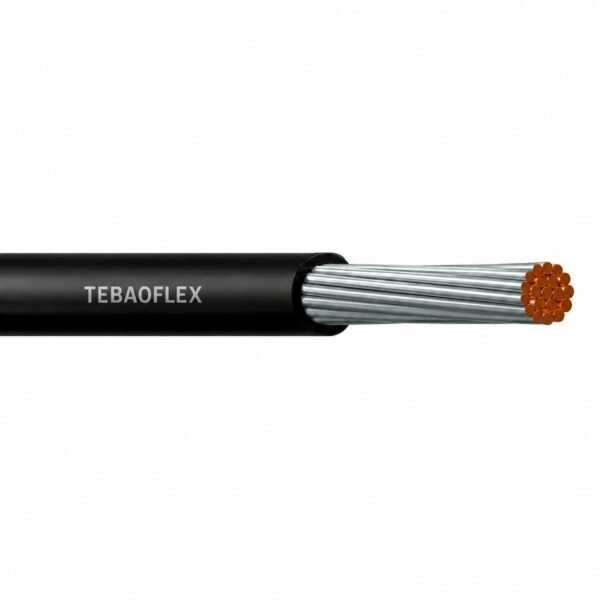
Silicone hook up wire for anything that has to stay flexible while it is hot. TEBAOFLEX manufactures seventeen UL AWM silicone styles with extruded silicone rubber over annealed copper, rated 105 °C to 250 °C at 300 V to 1000 V, in sizes from 30 AWG to 12 AWG and larger to order.
- 105 °C styles: UL 3171, 3232, 3243
- 150 °C styles: UL 3099, 3113, 3123, 3132, 3133, 3530
- 200 °C styles: UL 3135, 3139, 3143, 3367, 3512, 3530
- 250 °C styles: UL 3253, 30144, 30145
- Voltage rating: 300 V, 600 V or 1000 V by style
- Conductor: annealed solid or stranded copper, tinned or bare; Class 5 and Class 6 flexible strandings
- Insulation: extruded silicone rubber, nominal wall 0.40–0.78 mm by voltage class
- Behaviour in fire: burns to a non-conductive SiO₂ ash rather than a carbon track; halogen free
- Colours: a 21-colour standard range plus custom striping to order
For a quotation, send the UL style, voltage, AWG size, stranding class, colour and the length per reel.
Silicone Hook Up Wire for Ovens, Motor Leads and Appliance Wiring
Silicone is the high-temperature insulation you pick when the wire still has to bend. Fluoropolymers beat it on chemical resistance and wall thickness, but they stiffen; a Class 6 silicone lead stays soft at 200 °C and will still take the bend an installer gives it at the third service visit. It is also halogen free and burns to a non-conductive silica ash instead of a carbon track. TEBAOFLEX builds seventeen UL AWM silicone styles from 105 °C to 250 °C at 300 V through 1000 V.
The range is organised by two things and nothing else. Wall thickness follows voltage: roughly 0.40 mm for the 300 V styles and 0.76–0.78 mm for the 600 V styles. Temperature follows the compound, not the wall — which is why UL 3133 at 150 °C and UL 3135 at 200 °C are both 600 V and land within 0.1 mm of each other on diameter. Pick the temperature grade first, then the voltage, then the stranding class.
- Suitable for: motor and generator leads, industrial ovens and dryers, luminaires and lighting, domestic and commercial appliances, heaters, transformer and coil leads, panel wiring.
- Confirm before ordering: UL style, voltage, AWG size, stranding class, colour and reel length.
- Choose another construction when: the wire rubs on steel — add a fiberglass braid — or when chemical exposure or a thin wall matters more than flexibility, where PTFE, PFA or FEP are the answer.
Comparing insulations first? The high temperature wire selection matrix puts silicone next to the fluoropolymers, and the wider range sits under High Temperature Cables.
For a named UL AWM construction, compare UL 3232 at 105°C/300 V, UL 3123 at 150°C/600 V, UL 3580 motor lead at 150°C/1 kV and UL 3644 appliance wire at 1 kV. Select the temperature grade, covering and size from each style page rather than treating silicone wires as interchangeable.
When a 105°C lead inside refrigerating equipment calls for extruded PVC instead of silicone, the UL 1056 PVC wire provides a 600 V AC single-conductor construction from 20 AWG to 10 AWG.
Construction
A silicone hook up wire is a single core with an annealed copper conductor and an extruded silicone rubber wall over it. Everything that distinguishes one UL style from the next comes down to three choices: the silicone compound grade, the wall thickness, and how finely the conductor is stranded.
- Conductor: annealed copper, solid or stranded, tinned or bare. Strandings run from a single 0.255 mm wire at 30 AWG through 7-, 10-, 16- and 26-strand constructions, and into Class 5 and Class 6 flexible ropes where the wire has to move.
- Insulation: extruded silicone rubber, cured by high-temperature vulcanisation. Nominal wall is about 0.40 mm on the 300 V styles and 0.76–0.78 mm on the 600 V styles.
- Compound grade: the temperature rating comes from the silicone formulation, not the thickness. The same 0.76 mm wall appears at 150 °C and at 200 °C on different compounds.
- Colours and marking: a 21-colour standard range with custom colours and striping to order, surface printed with the style, size and rating.
Why silicone and not a fluoropolymer
Three properties keep silicone in production despite PTFE and PFA being better on paper. It stays genuinely flexible hot, so motor leads and oven looms survive being handled at temperature. It is halogen free, and when it does burn it leaves a silica ash that still insulates, so a fire in one loom does not immediately become a phase-to-frame fault. And it takes compression and vibration without cold flow. What you give up is wall thickness, abrasion resistance and chemical resistance — silicone scuffs easily, which is why a fiberglass braid goes over it anywhere it can rub.
Stranding class is the flexibility decision
Two wires of the same UL style and the same AWG can behave completely differently in the hand. At 24 AWG the same style is built as 7 strands of 0.20 mm, 11 of 0.16 mm, 19 of 0.12 mm or 133 of 0.05 mm — identical conductor area, wildly different bend behaviour and a 0.16 mm spread in finished diameter. If the wire has to be routed by hand into a hot assembly, say so at enquiry and we will quote the stranding to match rather than the cheapest construction that meets the style.
The 150 °C and 200 °C 600 V pair
UL 3133 and UL 3135 are the same idea at two temperature grades: 600 V, a wall around 0.76–0.78 mm, tinned copper, and diameters that overlap within a tenth of a millimetre. You cannot tell them apart with a micrometer. Order by the marking, not by the measurement.
Applications
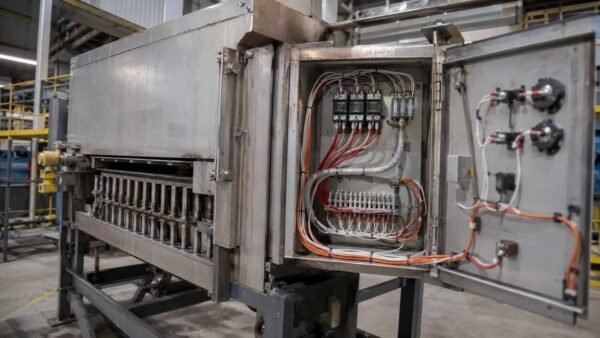
Silicone hook up wire goes where the ambient is high and the wire still has to be handled — inside ovens and dryers, out of motor windings, around luminaires and into appliances. It is internal equipment wiring, not an installation cable.
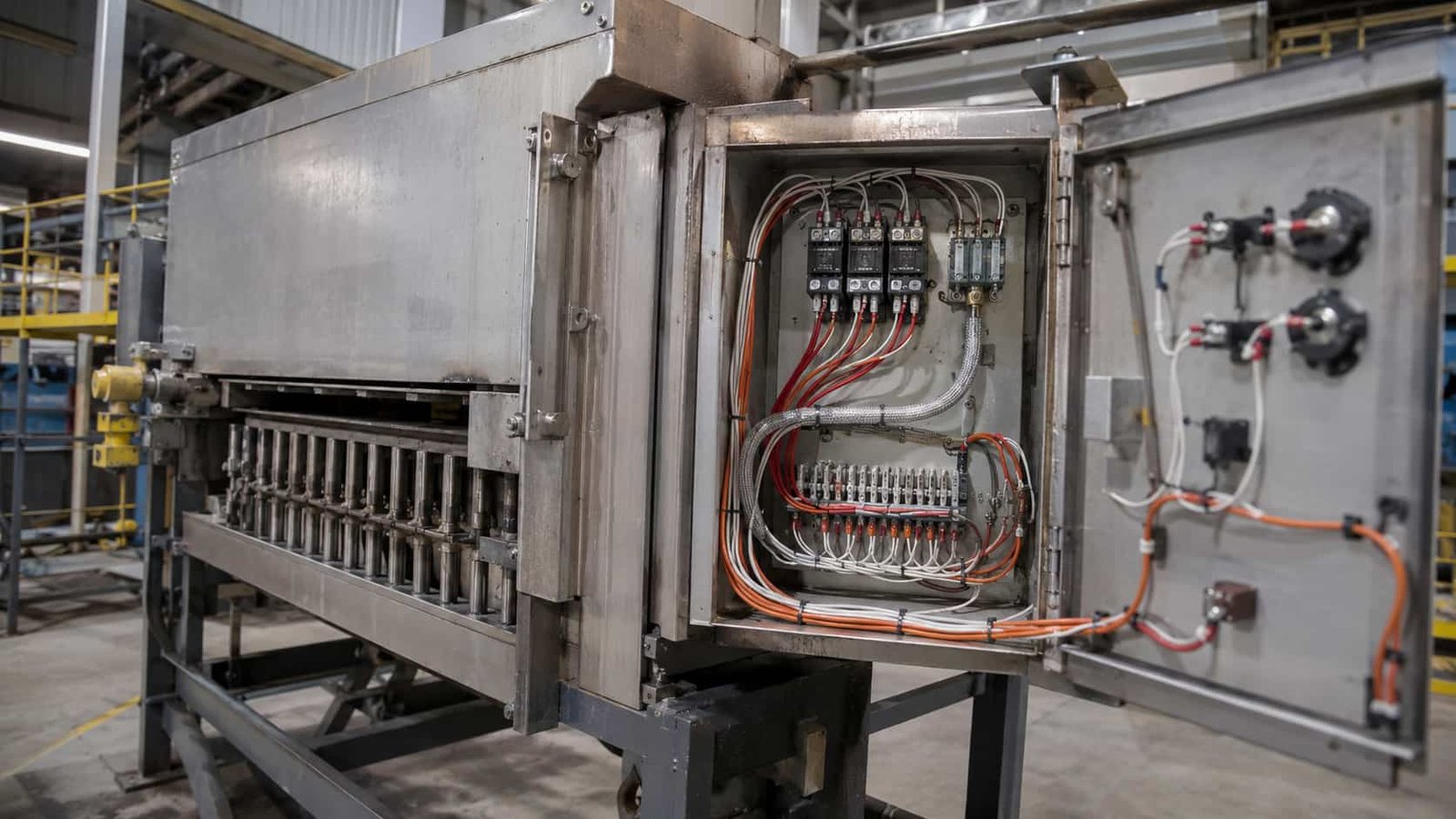
Equipment and duty this wire is built for
- Motor and generator leads — winding heat plus repeated flexing at the exit, the single most common silicone application.
- Industrial ovens, dryers and conveyor furnaces — element wiring, control cabinet looms, door and sensor leads.
- Domestic and commercial appliances — cookers, catering equipment, dishwashers, sterilisers.
- Lighting and luminaires — fixture internal wiring where the lamp runs hot and the loom is assembled by hand.
- Transformer, coil and solenoid leads — where the lead-out must tolerate impregnation and heat.
- Heaters and heating assemblies — element connections up to the temperature grade of the compound.
- Panel and switchgear wiring — where halogen-free and low-smoke behaviour is specified.
- Sauna, solarium and process heating equipment — high ambient with regular maintenance access.
Where silicone is the wrong answer
- Abrasion against steel structure — silicone scuffs and cuts. Specify a fiberglass-braided construction over the silicone core, or protect the bundle.
- Aggressive chemicals, solvents or fuels — a fluoropolymer is the correct choice; silicone swells.
- Tight space and dense looms — at 600 V a silicone wall is roughly twice a PTFE wall. If the connector shell is full, move to PTFE or PFA.
- Above 250 °C — outside the range of these compounds entirely.
- Fixed building installation or direct burial — AWM appliance wiring material carries no such listing.
A note on high-voltage silicone
Silicone is also the standard insulation for high-voltage DC lead wire — UL style 3239 covers constructions from roughly 3 kV up to 60 kV depending on wall, with UL 10475 continuing the same idea in 8 AWG through 2 AWG. Those are a different product with a different buyer: X-ray and imaging equipment, photomultiplier and image-intensifier supplies, electrostatic precipitators, signs and ignition systems. The styles on this page are the 300 V to 1000 V appliance and equipment range. If you need a high-voltage silicone lead, tell us the kV class and we will quote it separately.
Cross-referencing an existing wire
Silicone lead wire is often called out on a drawing as SRML, SF-2 or simply “silicone lead wire” with a temperature and a voltage, rather than by UL style. Send a photograph of the printed marking plus the measured overall diameter and the conductor size and stranding, and we will identify the matching style before quoting — particularly useful between the 150 °C and 200 °C 600 V grades, which measure the same.
Specifications
Eighteen styles across four temperature grades. Find your temperature, then your voltage; the wall and the diameter follow from there.
Silicone hook up wire styles at a glance
| Temperature grade | UL AWM styles | Voltage | Nominal wall | Typical use |
|---|---|---|---|---|
| 105 °C −60 °C to +105 °C | 3171, 3232, 3243 | 300 V / 600 V | 0.40 mm / 0.76 mm | General appliance and equipment internal wiring |
| 150 °C −60 °C to +150 °C | 3099, 3113, 3123, 3132 (300 V), 3133 (600 V), 3530 | 300 V / 600 V | 0.40–0.46 mm / 0.76 mm | Appliances, luminaires, panel wiring |
| 200 °C −60 °C to +200 °C | 3135, 3139, 3143, 3367, 3512, 3530 | 300 V / 600 V | 0.78 mm at 600 V | Motor leads, ovens, dryers, heaters |
| 250 °C −60 °C to +250 °C | 3253, 30144, 30145 | 300 V – 1000 V | By voltage class | The top of the silicone range |
Style 3530 is published at 150 °C or 200 °C at 600 V and therefore appears in both grades — specify which rating you need.
Dimensions and Electrical Data
Nominal overall diameter in mm for the three volume styles, side by side. UL 3132 is the 300 V thin-wall construction; UL 3133 and UL 3135 are the 600 V pair at 150 °C and 200 °C.
| AWG | Typical cond. Ω/km @20 °C | UL 3132 150 °C 300 V | UL 3133 150 °C 600 V | UL 3135 200 °C 600 V |
|---|---|---|---|---|
| 30 | 361 | 1.10 | 2.2 | — |
| 28 | 227 | 1.18 | 2.3 | — |
| 26 | 143–150 | 1.28 | 2.4 | 2.05 |
| 24 | 94.2 | 1.41 | 2.5 | 2.15 |
| 22 | 59.4 | 1.70 | 2.7 | 2.32 |
| 20 | 36.7 | 1.85 | 2.9 | 2.51 |
| 18 | 23.2 | 1.97 | 3.1 | 2.74 |
| 16 | 14.6 | 2.30 | 3.4 | 3.06 |
| 14 | 8.96 | — | — | 3.46 |
| 12 | 5.64 | — | — | 3.95 |
Conductor resistance depends on the stranding actually supplied, so treat the column above as the value for the common construction in each size; very fine multi-strand ropes run higher. Diameter tolerance is typically ±0.10 mm. Larger sizes than 12 AWG are built to order.
Conductor weight, UL 3133 (150 °C 600 V)
| AWG | Stranding | Conductor Ø mm | Wall mm | Overall Ø mm | Weight kg/km |
|---|---|---|---|---|---|
| 30 | 1 / 0.255 | 0.255 | 0.76 | 2.2 | 5 |
| 28 | 1 / 0.321 | 0.321 | 0.76 | 2.3 | 6 |
| 26 | 1 / 0.407 | 0.407 | 0.76 | 2.4 | 7 |
| 24 | 7 / 0.202 | 0.61 | 0.76 | 2.5 | 8 |
| 22 | 7 / 0.255 | 0.77 | 0.76 | 2.7 | 10 |
| 20 | 10 / 0.255 | 0.92 | 0.76 | 2.9 | 12 |
| 18 | 16 / 0.255 | 1.15 | 0.76 | 3.1 | 16 |
| 16 | 26 / 0.255 | 1.47 | 0.76 | 3.4 | 21 |
Other properties
| Conductor | Annealed copper, solid or stranded, tinned or bare; Class 5 and Class 6 flexible strandings available |
|---|---|
| Insulation | Extruded silicone rubber, high-temperature vulcanised |
| Working temperature | −60 °C to +105, +150, +200 or +250 °C by grade; some 150 °C constructions are published from −40 °C |
| Behaviour in fire | Halogen free; burns to a non-conductive SiO₂ ash rather than a conductive carbon track |
| Mechanical | Stays flexible at temperature; good compression and vibration behaviour; low abrasion resistance — add a fiberglass braid where the wire can rub |
| Test method | UL 758 |
| Substance compliance | RoHS compliant, halogen free |
| Colours | 21-colour standard range; custom colours and striping to order |
| Cores | Single core |
Standards
Standards, test methods and compliance references that apply to silicone hook up wire in these UL AWM styles.
| UL AWM | Appliance Wiring Material styles 3171, 3232, 3243, 3099, 3113, 3123, 3132, 3133, 3530, 3135, 3139, 3143, 3367, 3512, 3253, 30144 and 30145 |
|---|---|
| Test method | UL 758 |
| cUL / CSA | cUL AWM I A, FT2 on the 300 V constructions |
| Flame | Horizontal flame test as per UL approval; VW-1 available on specified constructions |
| Halogen | Halogen-free silicone compound |
| Substance compliance | RoHS compliant |
What a UL AWM style settles, and what it does not
A UL AWM style fixes the insulation material, the temperature rating and the voltage rating for appliance wiring material. It does not fix the stranding, and on silicone that is the omission that matters — the same style and size can arrive as a stiff 7-strand or a rope-lay Class 6, and only one of them will route through your assembly. Specify the stranding class alongside the style.
Silicone in a fire
The reason silicone keeps its place in appliance and equipment wiring has as much to do with what happens when it fails as with normal service. Silicone rubber is halogen free, so it does not contribute acid gas, and it burns to silicon dioxide — a white ash that is still an insulator. A silicone loom that has been through a fire can hold off voltage where a carbonised organic insulation would already have flashed over. That is a material property, not a rating, and it is not a substitute for a circuit-integrity cable where one is specified.
TEBAOFLEX certification
Jiangsu TEBAOFLEX Special Cable Co., Ltd holds UL certificate UL-US-2449012-0 and cUL certificate UL-CA-2437036-0, both dated 27 December 2024 under report E542560-20241225, and VDE certificate 40060055 dated 28 March 2025. These are company-level certifications. Send the exact UL style, size and stranding you intend to order and we will confirm the approval scope that applies to it before you commit, and issue the test documentation with the shipment.
Documentation supplied with an order
- Construction drawing and dimensional data for the agreed style, size and stranding
- Routine test records for the production batch
- Certificate of conformity referencing the agreed standards
- Reel and packing list with marking and colour details
For the scope of a specific standard, consult the issuing body directly — for example the International Electrotechnical Commission or UL Solutions.
Related cable options
Compare these cable options by service combination, movement, load, voltage and transmission requirement.
High Temperature Silicone Rubber SIAF/GL Cable with Fiberglass Braid
A related cable option for a different application or duty profile.
View product
PTFE Hook Up Wire up to 250°C, 150–1000 V UL AWM Styles
A related cable option for a different application or duty profile.
View product
SiF Silicone 180 Single Core Flexible Cable
A related cable option for a different application or duty profile.
View productRequest a cable recommendation and quotation
Send the required services, cable length, mechanical duty, environment, termination and quantity. Our team will review the application before quoting.
- Include the product name or SKU plus the required cable length and quantity.
- Attach a specification, drawing or data sheet when available.