


Sour Service Wireline Cable
S75 / S77 / MP35N alloy armour · nickel-plated copper conductor · 5.69–8.18 mm · 21.4–48.9 kN · FEP/ETFE to 260 °C · for H2S and CO2 wells above the NACE MR0175 threshold.
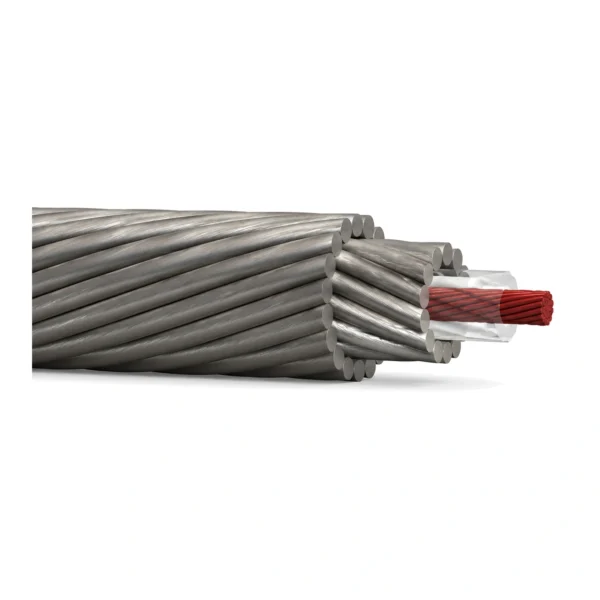
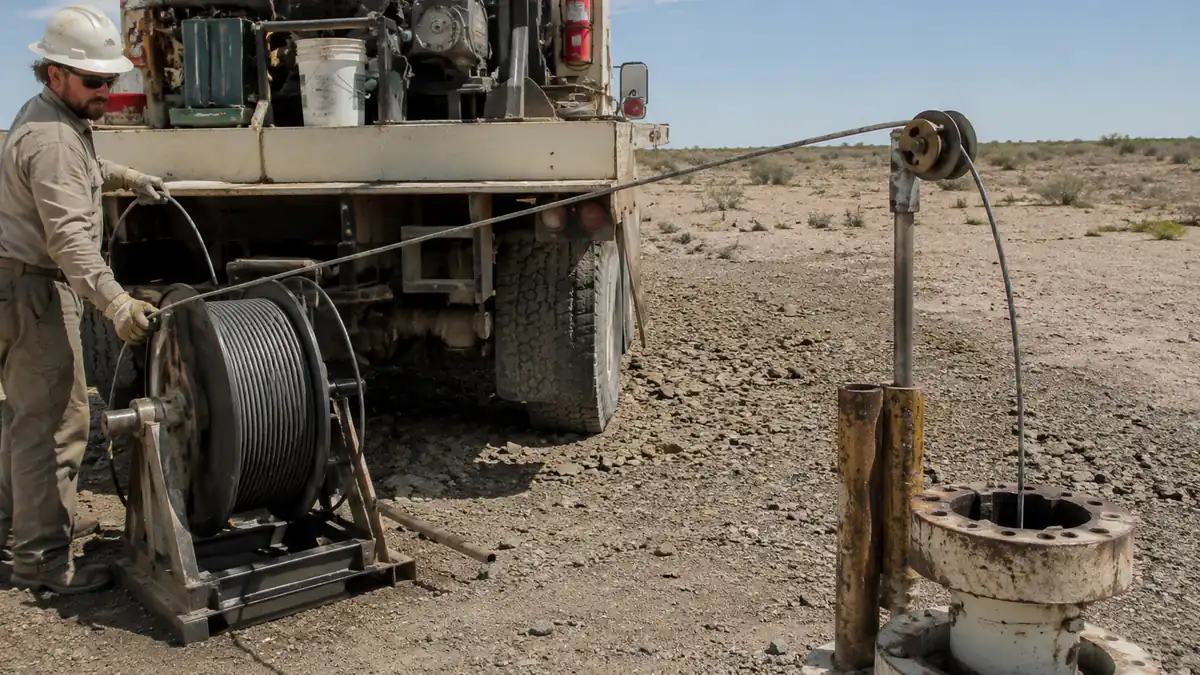
A sour service wireline cable replaces the galvanised steel armour of a conventional logging cable with a corrosion-resistant alloy, and the bare copper conductor with nickel-plated copper. Everything else — the contra-helical double armour, the fluoropolymer insulation, the geometry — stays the same.
The reason is specific and unforgiving. Hydrogen sulphide attacks the iron in steel: first it eats the zinc coating, then it embrittles the wire underneath until strands snap on the way out of the hole. A cable that came out of a sour well looking fine can fail on the next trip, and the failure mode is a toolstring on the bottom.
The threshold is not a matter of opinion. NACE MR0175 / ISO 15156 defines sour service as an H2S partial pressure of 0.05 psia (0.3 kPa) or more. Multiply H2S concentration in ppm by bottom-hole pressure in psi, divide by one million, and if the answer reaches 0.05 you are in sour service and galvanised armour is no longer the right material. The Standards tab works that through with numbers, including the version of the rule that circulates with the divisor missing.
We build the alloy armour in three grades — S75 nickel-chromium, S77 nickel-iron and MP35N cobalt-nickel-chromium-molybdenum — across four diameters from 7/32″ to 5/16″. Swapping to alloy costs you breaking strength and, less obviously, it multiplies the armour’s DC resistance by four to six. That second one catches people out, because the armour is the return conductor. Both effects are tabulated on the Specifications tab.
Send a current fluid analysis, the bottom-hole pressure and the temperature — the same three numbers that drive material selection everywhere else in our oil and gas cable range. Without a fluid analysis nobody can specify this cable honestly, including us.
Construction
The three armour alloys
| Grade | Alloy family | Iron content | Where it belongs |
|---|---|---|---|
| GIPS / GEIPS | Galvanised plough steel | Steel — zinc coated | Sweet wells only. Below the NACE threshold. |
| S75 | Nickel-chromium | Low | Moderate H2S and CO2, moderate temperature |
| S77 | Nickel-iron | Low | Severe corrosive conditions |
| MP35N | Cobalt-nickel-chromium-molybdenum | Near zero | The most hostile wells — best strength-to-corrosion balance of the three |
Iron content is the whole story. H2S attacks iron; the less iron the armour contains, the less there is to attack. MP35N is close to iron-free, which is why it survives conditions that finish the others.
Nickel-plated conductor
Every sour build uses nickel-plated copper, not bare copper. This is not belt-and-braces. Insulation on a wireline cable takes crush damage from the armour over its life, and a single breach in a sour well exposes bare copper to H2S along the whole flooded length — not at one point. Nickel plating buys the time to notice.
Insulation
Dual-layer FEP/ETFE at 260 °C on all sour builds: the FEP does the dielectric work, the ETFE skin faces the armour and takes the crush. For wells hotter than 260 °C see the high temperature wireline cable page.
What does not change — and one thing that does
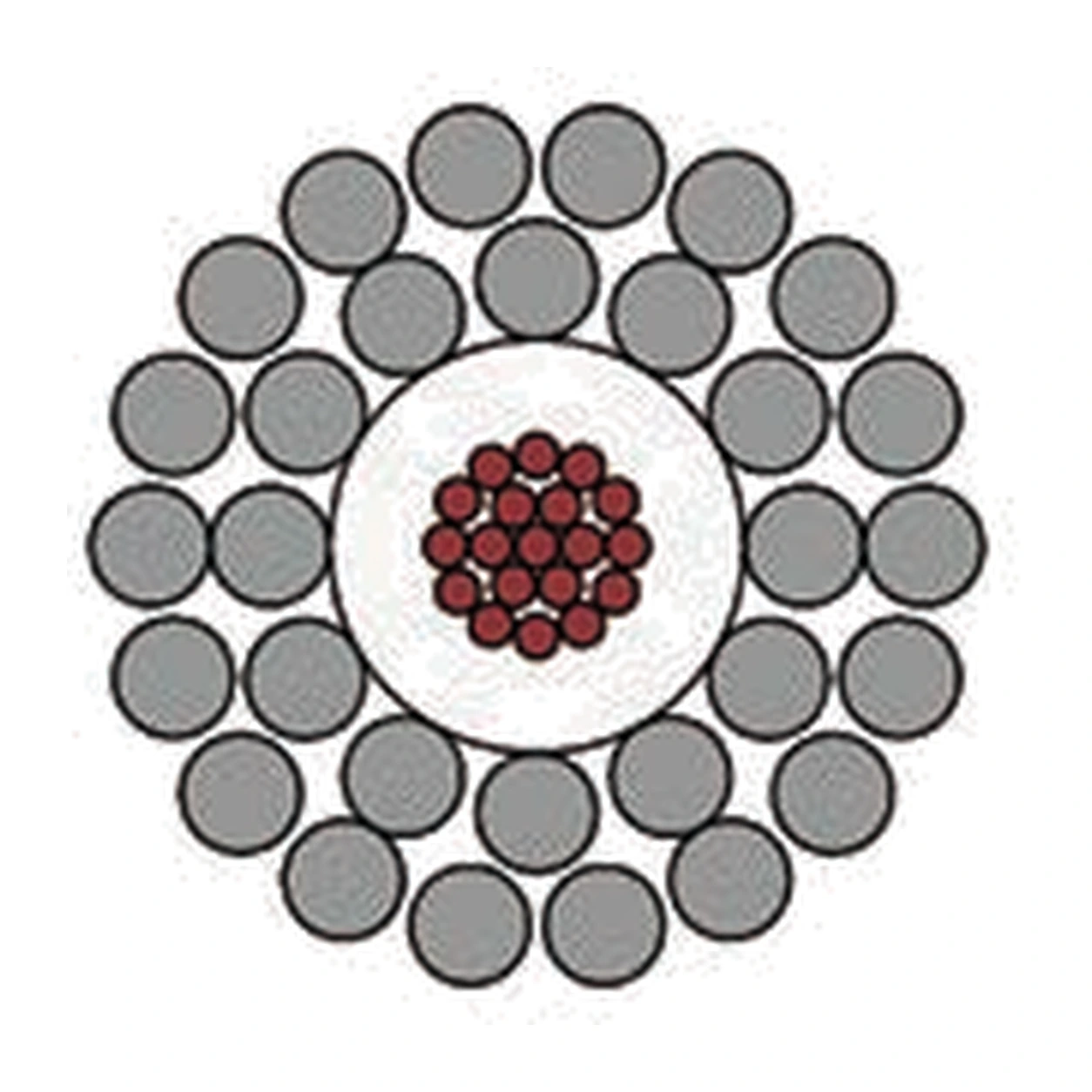
Wire counts, wire diameters and finished OD are identical to the galvanised build of the same size — 12 inner over 18 outer, same lay. A sour cable drops onto the same drum and runs over the same sheave as the conventional cable it replaces.
The conductor is the exception. On two of the four sizes the alloy build uses a different conductor from the galvanised one: the 7/32″ goes from 16 AWG 19-strand to 18 AWG 7-strand, and the 9/32″ from 15 AWG to 16 AWG. Conductor resistance rises accordingly — 13.1 to 22.0 Ω/km on the 7/32″. It is on the specification table, but it is easy to miss when you are comparing armour grades and assume the rest of the cable stayed put.
Applications
Sour gas and sour oil wells, and the CO2-rich wells that corrode by a different mechanism but end the same way.
| Condition | What it does to galvanised armour | Grade |
|---|---|---|
| H2S below the NACE threshold | Zinc holds; steel survives with grease and good practice | GIPS — the conventional cable |
| H2S at or above 0.05 psia partial pressure | Zinc consumed, then hydrogen embrittlement — wire ends up as brittle as glass | S75 minimum |
| High H2S plus chlorides and heat | Pitting and stress cracking accelerate together | S77 or MP35N |
| High CO2 partial pressure | Sweet corrosion — general metal loss rather than cracking | S75 or S77 |
| Sour plus deep and heavy toolstring | Corrosion and load at once; you cannot afford the strength loss | MP35N |
| CO2 injection and storage wells | Continuous CO2 exposure, often with water | S75 or S77 |
What alloy armour does not fix
It does not raise the temperature rating — that is the insulation's job. It does not make the cable stronger; it makes it weaker. And it does not remove the need to wash and inspect the cable after a sour run.
Specifications
Alloy armour builds by size
| Size | Grade | Breaking strength | Working load | Conductor Rdc | Armour Rdc | Weight in water |
|---|---|---|---|---|---|---|
| 7/32″ (5.690 mm) | S75 | 21.4 kN (4,800 lbf) | 10.7 kN | 22.0 Ω/km | 59.4 Ω/km | 120 kg/km |
| S77 | 23.1 kN (5,200 lbf) | 11.6 kN | 22.0 Ω/km | 72.2 Ω/km | 120 kg/km | |
| MP35N | 23.1 kN (5,200 lbf) | 11.6 kN | 22.0 Ω/km | 72.2 Ω/km | 132 kg/km | |
| 1/4″ (6.553 mm) | S75 | 26.7 kN (6,000 lbf) | 13.3 kN | 14.4 Ω/km | 44.3 Ω/km | 161 kg/km |
| S77 | 28.9 kN (6,500 lbf) | 14.5 kN | 14.4 Ω/km | 54.2 Ω/km | 160 kg/km | |
| MP35N | 28.9 kN (6,500 lbf) | 14.5 kN | 14.4 Ω/km | 56.2 Ω/km | 171 kg/km | |
| 9/32″ (7.315 mm) | S75 | 36.5 kN (8,200 lbf) | 18.2 kN | 13.1 Ω/km | 32.8 Ω/km | 203 kg/km |
| S77 | 36.5 kN (8,200 lbf) | 18.2 kN | 13.1 Ω/km | 32.8 Ω/km | 203 kg/km | |
| MP35N | 40.9 kN (9,200 lbf) | 20.5 kN | 13.1 Ω/km | 32.8 Ω/km | 215 kg/km | |
| 5/16″ (8.179 mm) | S75 | 46.3 kN (10,400 lbf) | 23.1 kN | 10.8 Ω/km | 29.5 Ω/km | 250 kg/km |
| S77 | 46.3 kN (10,400 lbf) | 23.1 kN | 10.8 Ω/km | 36.0 Ω/km | 250 kg/km | |
| MP35N | 48.9 kN (11,000 lbf) | 24.5 kN | 10.8 Ω/km | 36.0 Ω/km | 262 kg/km |
All builds: FEP/ETFE insulation, 260 °C, 457 MΩ·km minimum insulation resistance, same OD and same minimum sheave diameter as the galvanised cable of that size.
What the swap costs, part one: strength
| Size | Galvanised | S75 | S77 / MP35N | Worst-case loss |
|---|---|---|---|---|
| 7/32″ | 24.9 kN | 21.4 kN | 23.1 kN | −14 % |
| 1/4″ | 31.1 kN | 26.7 kN | 28.9 kN | −14 % |
| 9/32″ | 44.5 kN | 36.5 kN | 40.9 kN | −18 % |
| 5/16″ | 50.3 kN | 46.3 kN | 48.9 kN | −8 % |
Recalculate the toolstring before the first sour run. An 18 % strength loss on a 9/32″ is not absorbed by the safety factor — it is the safety factor.
What the swap costs, part two: the armour is your return conductor
Alloy armour has four to six times the DC resistance of galvanised steel, and on a monoconductor cable the armour carries the entire return current. This is the number that surprises people, because nobody thinks of the armour as a circuit element until the telemetry starts failing.
| Size | Armour Rdc, galvanised | Armour Rdc, alloy | Multiplier |
|---|---|---|---|
| 7/32″ | 14.4 Ω/km | 59.4 – 72.2 Ω/km | 4.1 – 5.0 × |
| 1/4″ | 9.84 Ω/km | 44.3 – 56.2 Ω/km | 4.5 – 5.7 × |
| 9/32″ | 9.2 Ω/km | 32.8 Ω/km | 3.6 × |
| 5/16″ | 6.9 Ω/km | 29.5 – 36.0 Ω/km | 4.3 – 5.2 × |
Worked through on a 5,000 m run of 1/4″, loop resistance is conductor plus armour:
| Build | Conductor | Armour | Loop resistance at 5,000 m |
|---|---|---|---|
| Galvanised, bare copper | 13.1 Ω/km | 9.84 Ω/km | 115 Ω |
| MP35N, nickel-plated copper | 14.4 Ω/km | 56.2 Ω/km | 353 Ω |
Three times the loop resistance means three times the voltage drop at the same tool current. Check the surface power supply headroom and the telemetry budget before ordering, not after — a tool that ran fine on galvanised cable can be underpowered on the alloy version of the same cable.
Standards and selection
The threshold, from the standard itself
NACE MR0175 / ISO 15156 defines sour service as an H2S partial pressure of 0.05 psia (0.3 kPa) or greater in the gas phase. Partial pressure is concentration times total absolute pressure:
| Step | Calculation |
|---|---|
| 1 | H2S partial pressure (psia) = (H2S in ppm ÷ 1,000,000) × bottom-hole pressure in psia |
| 2 | Compare to 0.05 psia |
| 3 | At or above 0.05 → sour service. Galvanised armour is out. |
Worked example
A well at 4,000 psi with 50 ppm H2S: (50 ÷ 1,000,000) × 4,000 = 0.20 psia. Four times the threshold — alloy armour. The same 50 ppm in a 500 psi well gives 0.025 psia, below the threshold, and galvanised armour with proper greasing is defensible. Concentration alone tells you nothing; it is concentration times pressure that matters.
A warning about the version of this rule you may have seen
A rule of thumb circulates in the field as “ppm × psi ≥ 0.05, avoid galvanised”. Taken literally that is wrong by a factor of a million — 1 ppm in a 1 psi well would trip it. The ÷ 1,000,000 is the missing step, and once you put it back the rule of thumb and the standard agree exactly. If a supplier quotes you the short version, that is worth noticing.
CO2
The companion field rule is CO2 percentage × bottom-hole pressure in psi reaching about 130 psia of CO2 partial pressure. CO2 corrodes by general metal loss rather than by cracking, so it is less catastrophic and more predictable — but it still ends galvanised armour's useful life early.
Standards
| Standard | What it covers |
|---|---|
| NACE MR0175 / ISO 15156-1 | Definition of sour service and general material selection principles |
| NACE MR0175 / ISO 15156-3 | Corrosion-resistant alloys and their qualified environmental limits |
| IEC 60228 | Conductor resistance class for the nickel-plated copper centre |
Frequently asked
Which grade do I need — S75, S77 or MP35N?
S75 for moderate sour and CO2. S77 where the fluid analysis is severe. MP35N where it is severe and the toolstring is heavy, because it keeps the most strength of the three. If you are between two grades, the deciding factor is usually how many runs the cable has to survive before it is replaced.
Can I keep my galvanised cable and just grease it more?
Below the NACE threshold, protective grease on a well-seasoned line is legitimate practice. Above it, grease buys time and nothing more. The failure mode is hydrogen embrittlement inside the wire, not surface rust, and grease does not reach inside the wire.
Why did my alloy cable's signal get worse?
It probably did not get worse — it started worse. Alloy armour has four to six times the resistance of galvanised, and on a monoconductor cable the armour is the return path. See the loop resistance table on the Specifications tab.
Does the cable need different handling after a sour run?
Wash it. Alloy armour resists attack, it is not immune to it, and residual well fluid sitting in the armour interstices between runs is the worst case. Wash, dry and inspect — the same discipline that a conventional monoconductor wireline cable needs, done more seriously.
What do you need from me to quote?
A current fluid analysis with H2S and CO2 in ppm or percent, bottom-hole pressure, bottom-hole temperature, depth and toolstring weight. Anyone who quotes sour cable without asking for a fluid analysis is guessing.
Related cable options
Compare these cable options by service combination, movement, load, voltage and transmission requirement.
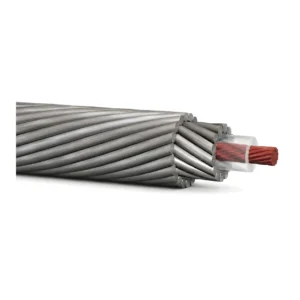
Monoconductor Wireline Logging Cable
A related cable option for a different application or duty profile.
View product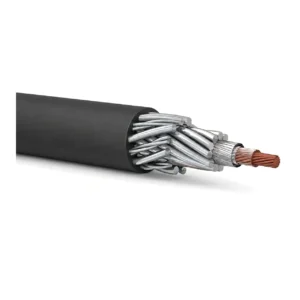
Greaseless Jacketed Wireline Cable
A related cable option for a different application or duty profile.
View product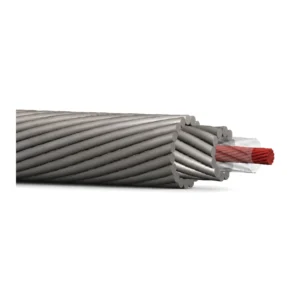
High Temperature Wireline Cable
A related cable option for a different application or duty profile.
View productRequest a cable recommendation and quotation
Send the required services, cable length, mechanical duty, environment, termination and quantity. Our team will review the application before quoting.
- Include the product name or SKU plus the required cable length and quantity.
- Attach a specification, drawing or data sheet when available.