


Greaseless Jacketed Wireline Cable
8.89 mm (.350″) over the jacket · 37.8 kN (8,500 lbf) · 1,500 V DC · 190 °C FEP/ETFE · runs without grease injection · 660 mm minimum sheave.
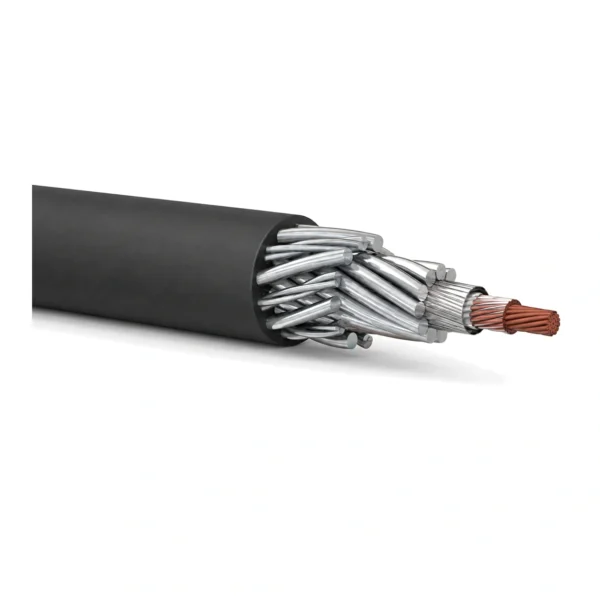
A greaseless wireline cable is an armoured logging cable with a polymer jacket extruded down into the outer armour, so the cable seals against well pressure by itself instead of being sealed by a grease injection head. No grease head, no flow tubes to size, no grease to buy, haul, contain and dispose of.
The jacket fills the valleys between the outer armour members and is then formed to a smooth 8.89 mm (.350″) round surface. That smooth surface is doing three jobs at once: it seals, it drops the friction against tubing and casing on extended-reach and horizontal runs, and it keeps well fluid out of the armour interstices, which is where corrosion normally starts on a conventional cable.
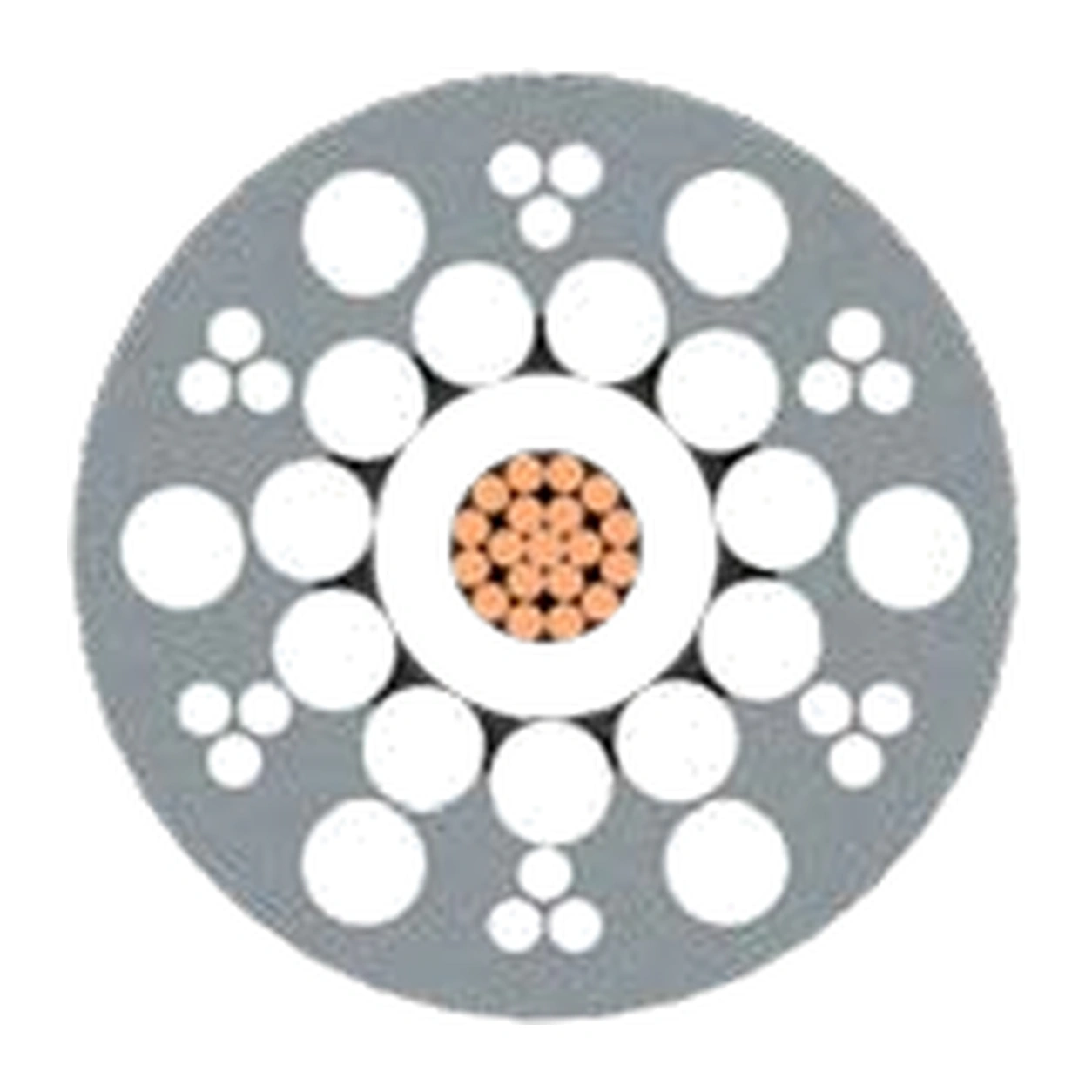
Underneath it is a conventional wireline build — 15 AWG stranded copper, FEP/ETFE insulation, eleven inner armour wires under twelve outer members, rated 1,500 V DC and 37.8 kN (8,500 lbf).
The jacket is not free, and we would rather tell you the price than have you find it at the wellsite. It caps the cable at 190 °C where the same fluoropolymer insulation on a bare-armour cable runs to 260 °C, and it needs a 660 mm sheave against 457 mm for a comparable bare cable. Both numbers are on the Specifications tab, next to the comparison that makes the trade explicit.
Send the bottom-hole temperature, the sheave and drum you have, and whether the well is horizontal. Those decide whether greaseless is the right call here or whether a conventional monoconductor wireline cable is. Both sit at the downhole end of our oil and gas cable range.
Construction
Five layers. The fifth one is the whole point.
| Layer | Standard build | Mixed-member build |
|---|---|---|
| Conductor | 15 AWG, 19 × 0.361 mm stranded copper — 1.803 mm | |
| Insulation | FEP/ETFE dual layer — 3.445 mm OD | |
| Inner armour | 11 GIPS wires @ 1.156 mm — 5.56 mm OD | |
| Outer armour | 12 members, each 3 × 0.508 mm strands — 7.67 mm OD | 6 members of 3 × 0.508 mm strands + 6 solid wires @ 1.016 mm — 7.67 mm OD |
| Jacket | Extruded polymer, filled into the armour and formed round — 8.89 mm OD | |
Why stranded outer armour members
Each outer member is itself a small three-wire strand rather than one solid wire. That gives the extruded jacket a deeply grooved surface to key into, so the polymer is mechanically locked rather than merely coating the cable — a coating would peel off at the first tight sheave. It also makes the outer layer more forgiving in bending.
The mixed-member option
The second build swaps half the stranded outer members for solid wires of the same diameter. The result has the same 7.67 mm armour OD, the same 8.89 mm finished OD and the same 37.8 kN breaking strength, but a slightly different stiffness and torque signature — 1.7 against 1.85 m/km/5kN of stretch. Pick the mixed build when the run is long and straight and stretch matters; pick the all-stranded build when the jacket is going to take a beating.
Applications
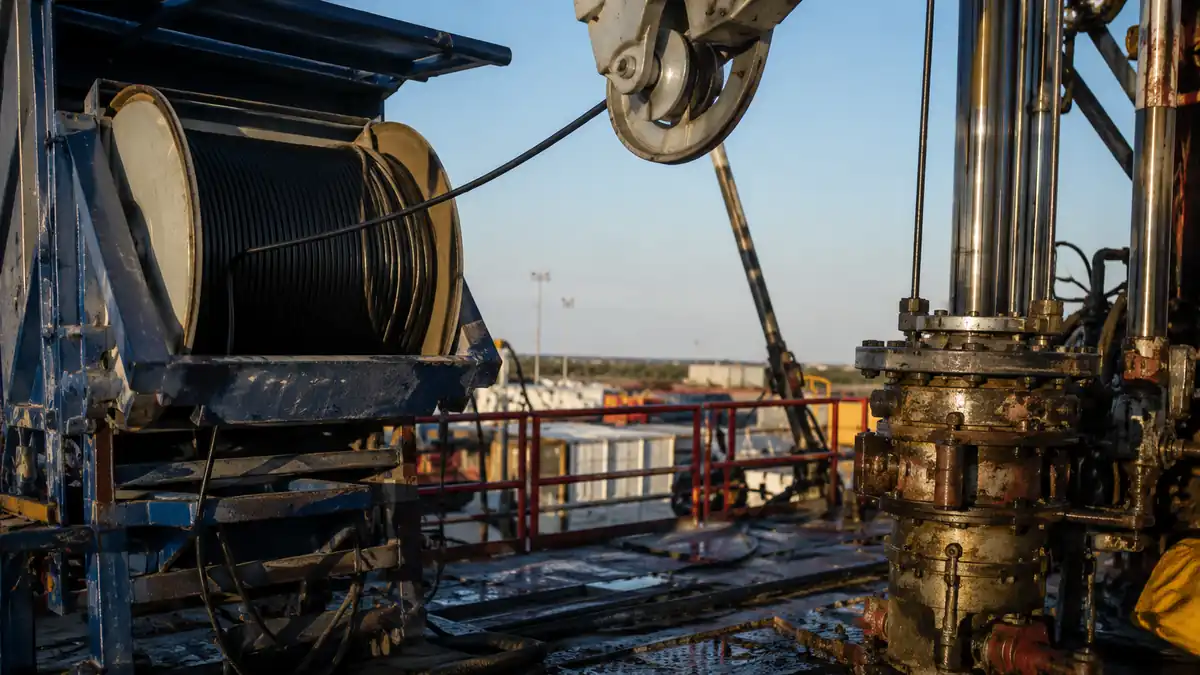
Greaseless cable exists because grease injection is expensive, slow to rig up, and a containment problem on every location where it is used. This cable is for the operations where that overhead is the binding constraint rather than the depth or the temperature.
| Where it earns its keep | Why |
|---|---|
| Cased-hole horizontal completions | Smooth jacket cuts drag through the build section and the lateral |
| Extended-reach wells | Lower surface friction means the toolstring reaches further before it stalls |
| Environmentally sensitive locations | No petroleum grease to contain, recover or dispose of |
| High-cycle intervention work | Faster rig-up and faster running speeds; no grease head to make up |
| Offshore and platform work | Deck space and waste handling both go down |
Where it is the wrong cable
Anywhere the bottom-hole temperature is over 190 °C — the jacket, not the insulation, is the limit. Anywhere the winch or the wellhead sheave is under 660 mm. And anywhere you need the full 50 kN of a comparable bare-armour cable, because the jacket does not add strength.
Specifications
| Property | Standard build | Mixed-member build |
|---|---|---|
| Outside diameter | 8.89 mm, +0.076 / −0.051 mm | |
| Breaking strength (ends fixed) | 37.8 kN (8,500 lbf) | |
| Maximum working load | 18.9 kN (4,250 lbf) | |
| Individual wire breaking strength, inner / outer | 2.39 / 1.30 kN | 2.39 / 1.65 · 1.30 kN |
| Voltage rating | 1,500 V DC | |
| Conductor Rdc at 20 °C | 9.2 Ω/km | |
| Armour Rdc at 20 °C | 11.2 Ω/km | |
| Minimum insulation resistance | 457 MΩ·km | |
| Capacitance, conductor to armour | 184 pF/m | |
| Temperature rating | 190 °C (375 °F) | |
| Minimum sheave diameter | 660 mm | |
| Stretch coefficient | 1.85 m/km/5kN | 1.70 m/km/5kN |
| Weight in air | 245 kg/km | 252 kg/km |
| Weight in water | 180 kg/km | 188 kg/km |
What the jacket costs you
Against a comparable bare-armour cable of similar diameter, greaseless trades strength, temperature and sheave size for the removal of grease injection. Here is the trade, without the marketing:
| This greaseless cable | Bare-armour 5/16″ | The difference | |
|---|---|---|---|
| Outside diameter | 8.89 mm | 8.179 mm | +9 % — check your pressure control |
| Breaking strength | 37.8 kN | 50.3 kN | −25 % |
| Temperature rating | 190 °C | 260 °C | −70 °C |
| Minimum sheave | 660 mm | 457 mm | +44 % |
| Grease injection | Not required | Required | The reason you are here |
Depth versus payload
Working load less the weight of cable in the hole, at the heavier of the two builds:
| Depth | Cable weight in water | Payload remaining |
|---|---|---|
| 3,000 m | 564 kg | 1,364 kg |
| 5,000 m | 940 kg | 988 kg |
| 7,000 m | 1,316 kg | 612 kg |
Standards and operating notes
Why the jacket sets the temperature, not the insulation
The FEP/ETFE insulation inside this cable is a 260 °C material, but the finished cable is rated 190 °C. The jacket polymer is the weakest link: above its limit it softens, loses its grip on the armour strands, and can extrude or peel under the pressure gradient at the stuffing box — which is precisely the seal the whole design depends on. Rating the cable to the insulation would be technically true and operationally dishonest, so we rate it to the jacket.
Rapid gas decompression
Any jacketed cable coming out of a gas well fast has gas dissolved in the polymer. If the pressure drops faster than the gas can diffuse out, the jacket blisters. Controlling pull-out speed from high-pressure gas wells matters more on a jacketed cable than on a bare one — ask us for the recommended rate for your pressure before the first run rather than after.
Standards
| Standard | Relevance |
|---|---|
| NACE MR0175 / ISO 15156 | Whether the armour under the jacket needs to be alloy rather than galvanised steel |
| API RP 9B (analogous) | Sheave ratio and inspection practice |
| IEC 60228 | Conductor resistance class |
Frequently asked
Does greaseless mean no pressure control equipment at all?
No. You still run a stuffing box or pack-off. What you drop is the grease injection head, the flow tubes sized to the cable, the grease pump and the grease itself. The seal is made against the smooth jacket instead of against a column of pressurised grease.
Can the jacket be repaired in the field?
Minor jacket damage can be dressed, but a jacket breach means well fluid is now inside the armour and the cable is behaving like a conventional cable at that point. Treat a breach as a reason to cut back, not to carry on.
How does it compare on cost?
The cable costs more per metre than bare armour. Whether it is cheaper overall depends on how many runs you make and what grease, disposal and rig-up time cost you per run. On a high-cycle intervention programme the crossover comes quickly; on two runs a year it does not.
Is it available in other diameters?
This build is .350″. Tell us the diameter and strength you need and we will quote the closest jacketed build — or tell you honestly that a bare-armour cable is the better answer for that size.
Related cable options
Compare these cable options by service combination, movement, load, voltage and transmission requirement.
Monoconductor Wireline Logging Cable
A related cable option for a different application or duty profile.
View product
Sour Service Wireline Cable
A related cable option for a different application or duty profile.
View product
High Temperature Wireline Cable
A related cable option for a different application or duty profile.
View productRequest a cable recommendation and quotation
Send the required services, cable length, mechanical duty, environment, termination and quantity. Our team will review the application before quoting.
- Include the product name or SKU plus the required cable length and quantity.
- Attach a specification, drawing or data sheet when available.