








Case 18 · Vietnam · Hai Phong Port · Medium-voltage flat reeling cable
6.6 kV F-3PNCT 3×50 mm² Port Crane Reeling Cable Replacement in Hai Phong, Vietnam
When a harbor crane at Hai Phong Port (Cảng Hải Phòng) in northern Vietnam needed its worn medium-voltage drum cable replaced, the initial maintenance inquiry named 6.6 kV 3PNCT 3×50 mm². Site photographs of the crane’s single-slot radial monospiral reel, three-roller vertical guide shoe and steel-lined quay trench confirmed that the drum winds a flat profile layer upon layer, so TEBAOFLEX engineered and supplied continuous-length 6.6 kV F-3PNCT 3×50 mm² flat EPR/polychloroprene reeling cable matched to the monospiral slot.
Project at a glance
This Hai Phong Port crane replacement order supplied continuous-length 6.6 kV F-3PNCT 3×50 mm² flat rubber reeling cable for a motorized radial monospiral harbor-crane drum in northern Vietnam, pairing IEC 50 mm² flexible tinned-copper conductors (≤ 0.393 Ω/km at 20 °C) with a 17 kV / 10 min AC withstand rating and 4,900 N/m lateral crush strength.
| Order item | Recorded detail |
|---|---|
| Project site | Hai Phong Port (Cảng Hải Phòng), northern Vietnam — quay harbor crane medium-voltage power reel replacement |
| Inquiry shorthand vs. built profile | Requested as 6.6 kV 3PNCT 3×50 mm²; verified from site reel geometry as flat 6.6 kV F-3PNCT 3×50 mm² |
| Core configuration | 3 × 50 mm² screened medium-voltage power cores arranged side by side in one flat plane |
| Rated & test voltage | 6.6 kV (6,600 V) three-phase AC; routine dielectric test basis 17 kV AC for 10 min |
| Conductor & dielectric | Flexible tinned annealed copper + semiconductive tape + +80 °C EPR insulation + outer semiconductive layer + copper-yarn/fibrous metallic screen |
| Reinforcement & outer sheath | Reinforced cabtyre body + black polychloroprene (PCP) rubber outer sheath for humid salt-fog quay service |
| Mechanical reeling limits | Minimum bending radius 7.5 × flat thickness D; permissible lateral drum pressure 4,900 N/m (4.9 kN/m); operating range −15 °C to +80 °C |
| Delivery & packing | Continuous uncut single length per reel; steel-spoked / lagged export wooden drums X-lashed inside sea containers |
Why did the Hai Phong crane reel require flat 6.6 kV F-3PNCT instead of round 3PNCT?
On Japanese-design ship-to-shore and portal harbor cranes in Vietnam, maintenance schedules often abbreviate any 6.6 kV chloroprene reeling cable as 3PNCT, yet a narrow radial monospiral drum whose flange spacing equals a single cable width physically stacks flat F-3PNCT turns radially; installing round 3PNCT-B would jam between the flanges and twist inside the vertical roller shoe.


Reviewing site photographs before releasing production drawings prevented a costly profile mismatch. As visible on the portal leg above, the motorized reel carries spoked radial flanges spaced just wider than one flat cable web, while the lower guide shoe uses three horizontal cylindrical rollers to feed the flat belt straight into the quay slot without axial twist. How JIS Grade 2 and Grade 3 cabtyre suffixes—including round 3PNCT-B versus flat F-3PNCT and H-3PNCT—map to drum hardware is detailed in our engineering comparison of JIS 2PNCT and 3PNCT reeling cables.

How is 6.6 kV F-3PNCT 3×50 mm² constructed for coastal port reeling?
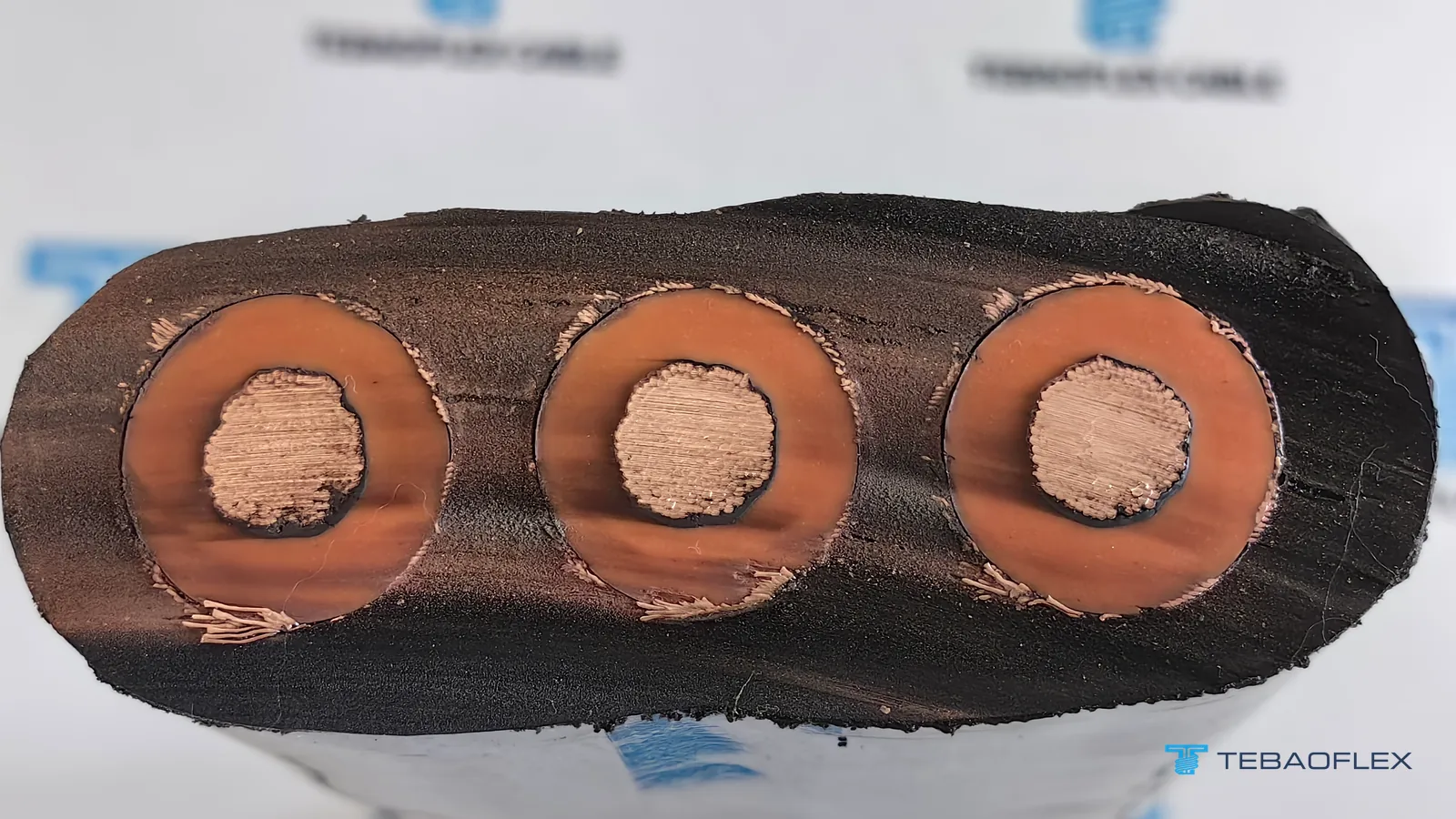
The 6.6 kV F-3PNCT 3×50 mm² construction aligns three individually screened medium-voltage cores parallel in one plane, combining flexible tinned annealed copper conductors, inner and outer semiconducting stress-control tapes around +80 °C EPR insulation, flexible copper-yarn metallic screens with red, white and blue identification braids, internal reeling reinforcement, and a black polychloroprene outer sheath.
- Flexible tinned annealed copper phase conductor (3 × 50 mm², 20 °C DC resistance ≤ 0.393 Ω/km per IEC 60228 Class 5 reference)
- Inner semiconducting layer smoothing electric-field stress over the stranded copper bundle
- Ethylene-propylene rubber (EPR) medium-voltage dielectric rated for +80 °C continuous conductor operation
- Outer semiconducting layer, flexible copper-yarn metallic screen and coloured fibrous core braid (red, white, blue)
- Reinforcing layer embedded inside the cabtyre wall for 4,900 N/m lateral reel crush resistance
- Heavy-duty black polychloroprene (PCP) rubber flat outer sheath for coastal port reeling service
| Layer / element | 6.6 kV F-3PNCT 3×50 mm² specification | Function on coastal crane reels |
|---|---|---|
| Conductor (3 × 50 mm²) | Flexible tinned annealed copper (IEC 60228 Class 5 resistance basis ≤ 0.393 Ω/km at 20 °C) | Resists bending fatigue on monospiral reels and prevents copper sulfide blackening or salt-fog oxidation |
| Inner semiconductive layer | Semiconducting tape applied over each stranded conductor | Eliminates air-gap corona at the conductor-to-EPR interface under 6.6 kV AC stress |
| MV insulation | Ethylene-propylene rubber (EPR) compound rated to +80 °C conductor temperature | Maintains dielectric stability across humid 30–38 °C Vietnamese quay ambients and multi-layer reel heat build-up |
| Outer semi-con & metallic screen | Semiconducting tape + flexible copper-yarn and fibrous composite braid | Confines the radial electric field and carries capacitive / earth-fault current without cracking under repeated flexing |
| Phase identification | Coloured fibrous braid over each core: red, white and blue | Matches Japanese three-phase switchgear termination coding inside the crane collector house |
| Reinforcement & outer sheath | Reinforced flat cabtyre wall + black polychloroprene (PCP) rubber compound | Withstands 4,900 N/m radial layer pressure, roller abrasion, hydraulic oil splashes, UV sunlight and sea spray |
Northern Vietnam’s Red River Delta ports expose quay reels to year-round salt mist, monsoon downpours and diesel soot. Tinning every fine copper wire protects both during rubber vulcanization and years later inside seaside junction boxes where moisture can wick past cable glands—a mechanism examined in our tinned copper vs bare copper corrosion performance in marine air guide. While polychloroprene resists salt spray, oil and abrasion along the moving span, crane engineers must still seal medium-voltage outdoor stress cones and slip-ring enclosures against direct water ingress.
How does 3×50 mm² bridge Japanese JCS 38 mm² and 60 mm² F-3PNCT tables?
Japanese JCS cabtyre catalogues step from 3 × 38 mm² (30.8 × 71.8 mm nominal, 0.525 Ω/km) directly to 3 × 60 mm² (34.0 × 80.0 mm nominal, 0.329 Ω/km) and omit 50 mm². Manufacturing a custom-tooled 6.6 kV F-3PNCT 3×50 mm² (≤ 0.393 Ω/km per IEC 60228) fits IEC 50 mm² lugs without forcing an 80–84 mm wide 60 mm² belt into a tighter monospiral slot.
| Model & size | Voltage & standard basis | Standard H × W (max. mm) | Max. 20 °C DC resistance (Ω/km) | Approx. mass (kg/km) | Permissible pull (kN) | Confirm before ordering |
|---|---|---|---|---|---|---|
| 6.6 kV F-3PNCT 3 × 38 mm² | 6.6 kV JCS cabtyre catalogue | 30.8 × 71.8 (32.3 × 75.4) | 0.525 | 3,760 | 3.3 | Use when existing crane lugs and breaker load match Japanese 38 mm² |
| 6.6 kV F-3PNCT 3 × 50 mm² (this order) | 6.6 kV JCS flat design + IEC 60228 50 mm² | Drawing-controlled between 38 & 60 mm² envelopes (cf. PNCT-RF 34.0 × 78.5) | 0.393 | Order drawing | 3.75–4.4 (by build) | Specify exact monospiral flange inside width and roller guide clearance on drawing |
| 6.6 kV F-3PNCT 3 × 60 mm² | 6.6 kV JCS cabtyre catalogue | 34.0 × 80.0 (35.7 × 84.0) | 0.329 | 4,880 | 5.2 | Check that monospiral slot width exceeds 84 mm maximum width plus side clearance |
| 6/10 kV PNCT-RF 3 × 50 mm² | 6/10 kV IEC-tier flat PNCT-RF | 34.0 × 78.5 (nominal) | 0.393 | 4,700 | Order drawing | Select when terminal network specifies IEC U0/U 6/10 kV (5.0 mm EPR wall) |
| (N)TSFLCGEWÖU 6/10 kV 3 × 50 + 3 × 25/3E | 6/10 kV DIN VDE 0250-813 flat | VDE flat schedule | 0.393 | VDE schedule | 2.25 (at 15 N/mm²) | Conditional alternative for European cranes needing concentric /3E earth core |
All 115 round, flat and optical-composite JCS and IEC sizes are published on our 3PNCT, H-3PNCT and F-3PNCT medium-voltage crane reeling cable schedule, where 20 °C conductor resistance follows IEC 60228. For European-built port cranes whose electrical drawings call for concentric split-earth conductors (/3E) under DIN VDE 0250-813 rather than three-core Japanese F-3PNCT, compare our conditional functional alternative (N)TSFLCGEWÖU flat medium-voltage reeling cable—never interchange the two without checking earth-fault protection and monospiral slot width. Drum barrel diameter, minimum 7.5 × D flat bending radius and multi-layer tension checks are worked step by step in our monospiral drum sizing and reeling tension calculation guide.
How are finished width, 17 kV AC withstand and container bracing verified before export?
Before export release, TEBAOFLEX verifies semi-finished core diameters and finished flat width-by-thickness against the approved production drawing, subjects 6.6 kV F-3PNCT reels to a 17,000 V AC 10-minute dielectric withstand test plus 20 °C DC conductor and insulation resistance checks, and ships uncut single lengths chocked inside sea containers.


Monospiral port reels leave only millimetres of clearance between the flat cable edge and the spoked steel drum flanges: too wide and the jacket scrapes every revolution; too narrow and upper wraps wedge beside lower wraps. Our quality-control technicians gauge conductor diameter, extruded EPR core diameter and finished flat width-by-thickness at each extrusion stage so the delivered reel matches the signed approval drawing, with zero mid-span factory splices or jacket patches. Buyers can review routine factory reports, sheath metre-mark photos and witness videos before balance release—see our medium-voltage cable factory acceptance testing guide for standard test protocols.
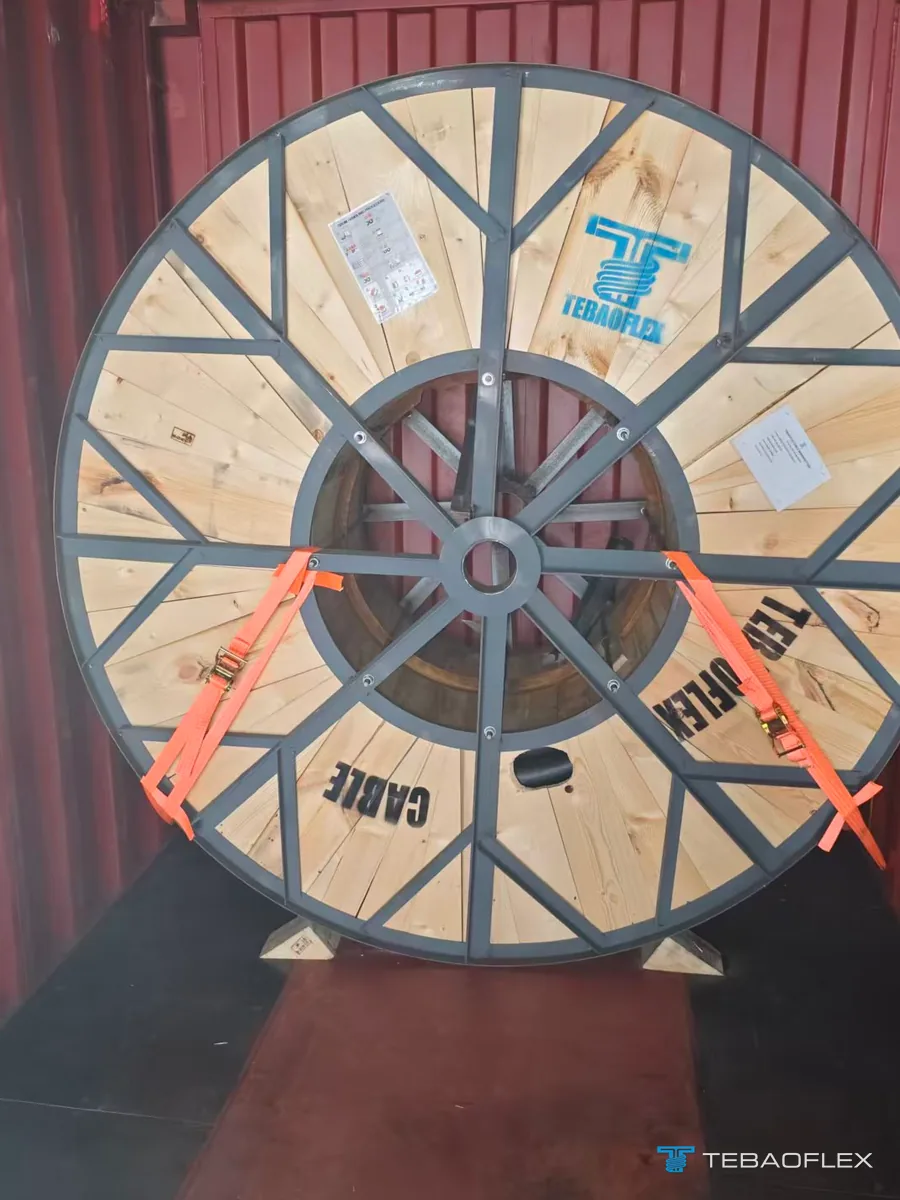
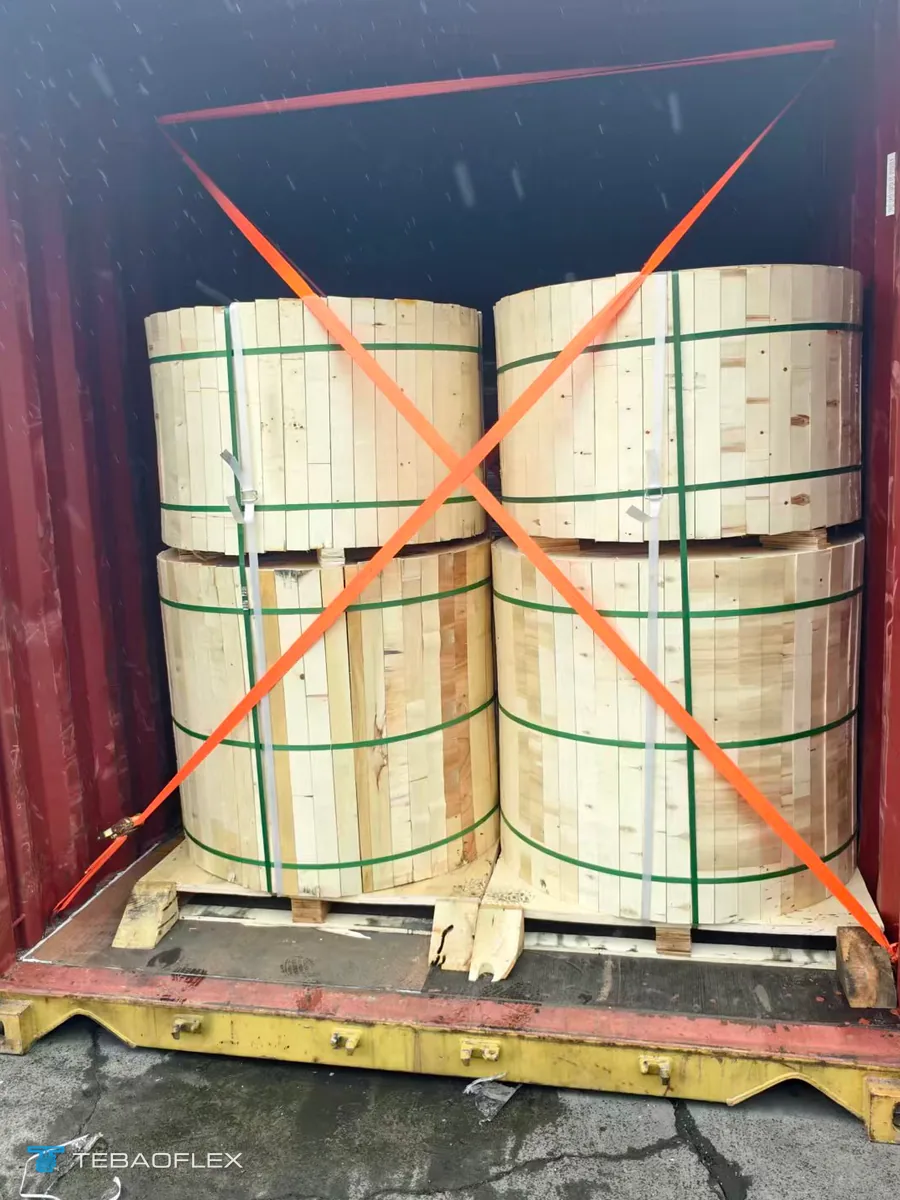
For export sea freight from our Taicang factory to northern and southern Vietnamese ports, reels are closed with full wooden lagging or mounted on heavy steel-spoked flanges, blocked with nailed timber chocks and cross-lashed to container lashing rings. For a companion low-voltage flat crane supply in southern Vietnam, see our Ho Chi Minh City portal and gantry crane flat cable project.
What to confirm when ordering 6.6 kV 3PNCT or F-3PNCT replacement cable
Providing your crane reel geometry (single-slot monospiral flat vs cylindrical multi-groove round), inside flange slot width, roller guide dimensions, system voltage, phase and earth core cross-sections, required continuous uncut drum length, and 17 kV AC test documentation lets our engineers confirm an exact fit before production.
- Reel type and cable profile: narrow radial monospiral drum (flat F-3PNCT / H-3PNCT) or cylindrical drum (round 3PNCT-B)
- Core count and cross-section: e.g. 3 × 38, 3 × 50, 3 × 60 or 3 × 100 mm², plus any earth core, 2.5 mm² control cores or GI/SM optical fibres
- Monospiral drum inside flange width, barrel core diameter, roller guide clearance and travel speed (m/min)
- System rated voltage (3.3 kV, 6.6 kV or IEC 6/10 kV) and required routine AC test protocol (such as 17 kV for 10 min)
- Exact continuous uncut length per reel, sheath print wording, metre marking and export container delivery port
TEBAOFLEX supplies custom 6.6 kV F-3PNCT and 3PNCT crane reeling cables from a 50 m minimum order quantity (MOQ), with a standard manufacturing lead time of 7 to 45 working days as of November 2026 depending on configuration and order schedule. Subsystem selection across main gantry reels, trolley festoons and spreader baskets is mapped on our port and container crane cable solutions page, and the full product line is listed under port and festoon cables.
Send your crane reel photos and 6.6 kV cable spec for a quote →
Frequently asked questions on 6.6 kV F-3PNCT port crane cable
Why did a 6.6 kV 3PNCT 3×50 mm² port crane inquiry require flat F-3PNCT cable?
Maintenance teams in Vietnam often write 6.6 kV 3PNCT 3×50 mm² as a general shorthand for Japanese-pattern medium-voltage chloroprene reeling cables. Inspection of the Hai Phong crane showed a narrow single-slot radial monospiral drum feeding through a three-roller vertical guide into a quay slot trench, which winds flat F-3PNCT layer upon layer rather than round 3PNCT-B.
How is a 6.6 kV F-3PNCT 3×50 mm² reeling cable tested before shipment?
For 6.6 kV (6,600 V) JCS-pattern F-3PNCT crane reeling cables, the primary routine dielectric test is 17 kV AC (17,000 V) applied for 10 minutes without breakdown, paired with 20 °C conductor DC resistance verification (≤ 0.393 Ω/km on 50 mm² tinned copper per IEC 60228 Class 5), insulation resistance measurement and finished width-by-thickness caliper checks.
What minimum bending radius and side pressure apply to 6.6 kV F-3PNCT?
Under the 6.6 kV F-3PNCT technical specification, minimum dynamic bending radius on the reel and guide rollers is 7.5 × D, where D is the finished flat thickness across the bending plane, and maximum permissible lateral pressure on the drum is 4,900 N/m (4.9 kN/m). Flat reeling cable must bend strictly across its minor axis with zero axial torsion.
Why use 50 mm² IEC cross-section inside a Japanese F-3PNCT construction?
Standard Japanese JCS cabtyre tables step directly from 3 × 38 mm² (0.525 Ω/km) to 3 × 60 mm² (0.329 Ω/km) and omit 50 mm². When a port crane’s slip-ring switchgear, crimping lugs or replacement tender specifies IEC metric 3 × 50 mm² (0.393 Ω/km), building 6.6 kV F-3PNCT 3×50 mm² matches the existing terminal lugs without oversizing cable width in the monospiral slot.
Can TEBAOFLEX supply 6.6 kV F-3PNCT in a single continuous uncut drum length?
Yes. TEBAOFLEX manufactures 6.6 kV F-3PNCT crane reeling cables in continuous single drum lengths without mid-span splices or factory repair joints, from a 50 m minimum order quantity with a standard manufacturing lead time of 7 to 45 working days depending on order length and custom specification.