








Project record · Philippines · Voice evacuation speaker circuits · 300/500 V shielded PVC cable
Shielded 2×2.5 mm² PVC Speaker Cable with Customer Marking: a Voice Evacuation Enquiry from the Philippines
An equipment supplier and engineering contractor in the Philippines asked for a fire-rated two-core speaker cable, 2 mm², LSZH preferred, for the emergency voice evacuation system of a building project, and named Prysmian FP200 GOLD as the reference product. The order was placed as a 2×2.5 mm² shielded speaker cable rated 300/500 V, with PVC insulation, a copper-wire braid screen and a PVC sheath (CU/PVC/CWB/PVC), printed with the customer's own company name and the specification and packed in 200 m coils. TEBAOFLEX makes both constructions: the screened PVC cable supplied here and a fire-resistant two-core CU/MICA/XLPE/OS/LSZH cable, made to order against the circuit-integrity test an enquiry names. This record explains the difference and how a voice evacuation design decides which one a circuit needs.
Project at a glance
| Application | Speaker circuits of a building emergency voice evacuation (voice alarm) system, as stated in the enquiry; routes and pathway requirements set by the customer's design |
|---|---|
| Customer | An equipment supplier and engineering contractor in the Philippines (not named) |
| Enquiry | Fire-rated two-core speaker cable, 2 mm², LSZH preferred; reference type FP200, a BS 7629-1 300/500 V cable |
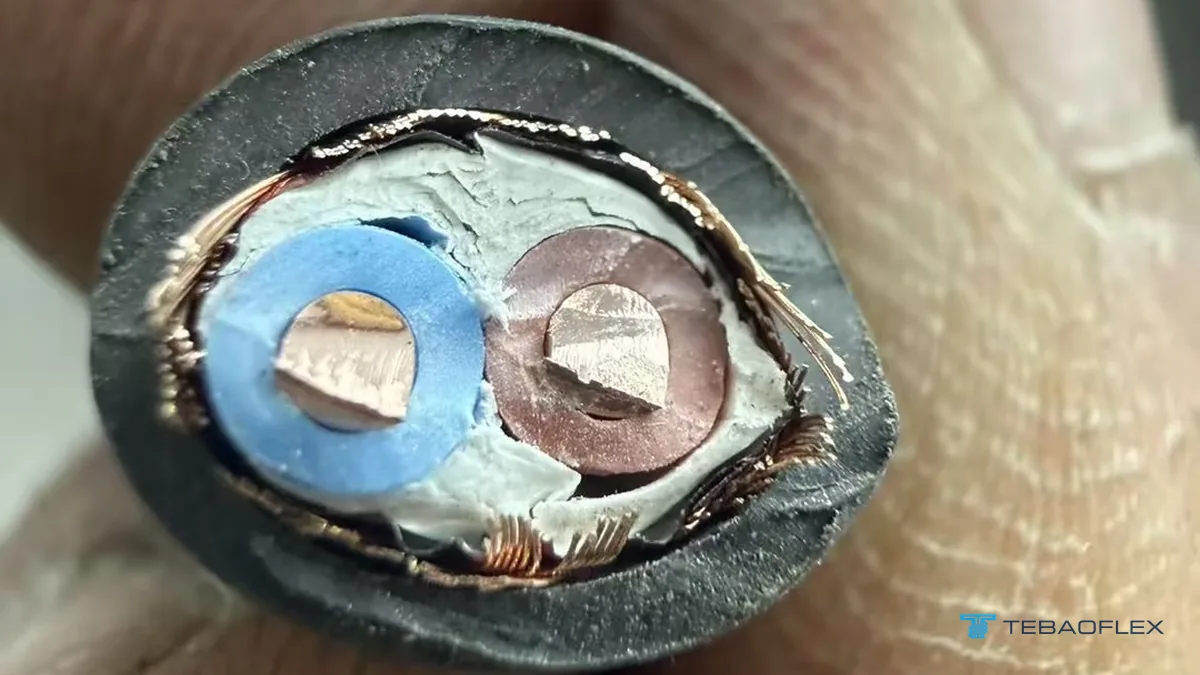
| Cable supplied | 2 × 2.5 mm² copper conductors, PVC insulation (blue, brown), copper-wire braid screen, black PVC sheath, 300/500 V: CU/PVC/CWB/PVC; not a fire-resistant cable |
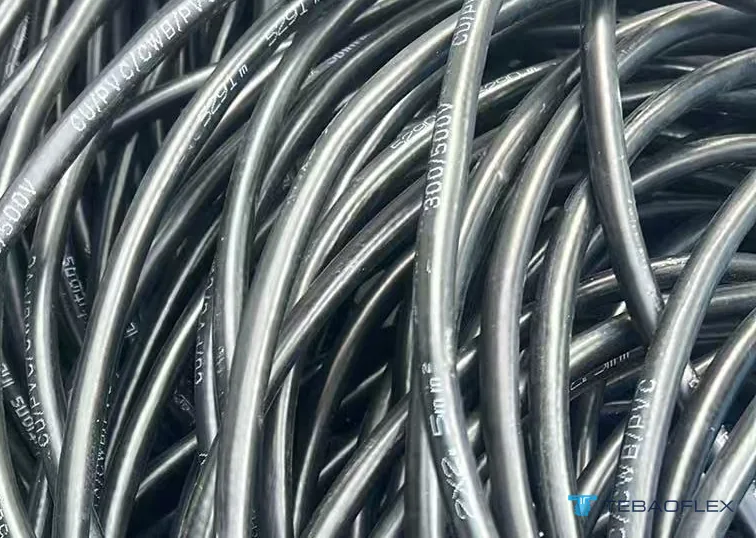
| Marking | The customer's own company name, 2×2.5mm² 300/500V CU/PVC/CWB/PVC and metre marks, signed off after a printing trial |
| Packing | 200 m coils in woven wrap with the TEBAOFLEX packing label, about 24 kg per coil as labelled |
| Fire-resistant construction (to order) | Two-core CU/MICA/XLPE/OS/LSZH (mica-glass tape under XLPE insulation, overall screen, LSZH sheath), quoted only against a circuit-integrity test named in the enquiry; not supplied on this order |
What did the enquiry ask for, and what does the BS 7629-1 reference cable mean?
The enquiry asked for a fire-rated two-core speaker cable, 2 mm², LSZH preferred, and named FP200 as the reference type. FP200 GOLD is a Prysmian fire-resistant cable made to BS 7629-1, the British specification for 300/500 V fire-resistant screened cables with low emission of smoke and corrosive gases. The customer was therefore asking for three properties at once: a cable that keeps the speaker circuit alive for a defined time in a fire, a sheath that gives off little smoke and no halogen acid gas, and a screened two-core construction.
BS 7629-1 covers 300/500 V screened cables with thermosetting insulation in three circuit-integrity categories, Standard 30, Standard 60 and Enhanced 120, assessed in fire tests with mechanical impact and water spray; a PVC-insulated cable is outside it by construction. The British fire alarm code, BS 5839-1, recommends that a “standard” fire-resisting cable meet the PH30 classification of BS EN 50200 and also survive the 30-minute BS EN 50200 Annex E test, in which water spray is added for the last 15 minutes; an “enhanced” cable meets PH120 and also survives 120 minutes in the BS 8434-2 test at 930 °C. The voice alarm code, BS 5839-8, applies the same two grades to loudspeaker circuits. A speaker cable in the Philippines is not bound by the British codes, but the enquiry used their vocabulary, and the grades are a useful way to say how long a circuit has to survive.
The size was the first practical difference. 2.0 mm² is not a size in IEC 60228, the conductor standard behind the 1.0, 1.5, 2.5 and 4 mm² series used by BS 7629-1; it is close to 14 AWG (2.08 mm²), the size that speaker-wire catalogues often list. 2 × 2.0 mm² is not a common size and few factories tool up for it, so the order was placed as 2 × 2.5 mm², the next standard size, with a lower conductor resistance.
| Item | BS 7629-1 reference specification | TEBAOFLEX mica-tape construction (to order) | Order as supplied |
|---|---|---|---|
| Voltage rating | 300/500 V | 300/500 V | 300/500 V |
| Conductors | 1.0 to 4 mm² copper | 2 × 2.5 mm² copper | 2 × 2.5 mm² copper |
| Fire barrier | Part of the thermosetting insulation system | Mica-glass tape on each conductor | None |
| Insulation | Thermosetting | XLPE over the mica tape | PVC |
| Screen | Overall screen with a protective conductor | Overall screen: foil with drain wire, or braid | Copper-wire braid, about 80 % coverage |
| Sheath | Low smoke zero halogen | LSZH | PVC, black |
| Circuit integrity in a fire | Standard 30, Standard 60 or Enhanced 120 category | Quoted against a circuit-integrity test named in the order (IEC 60331 type); test evidence agreed per order | Not a fire-resistant cable |
| Smoke and acid gas | Low smoke, halogen-free by specification | LSZH compounds specified to IEC 61034-2 and IEC 60754; test evidence agreed per order | PVC: smoke and hydrogen chloride when it burns |
The first column is what fire alarm, voice alarm and emergency lighting circuits under BS 5839-1, BS 5839-8 and BS 5266-1 call for. The second is the construction TEBAOFLEX quotes for circuits specified as fire-resistant, against the test named in the order. The third is a screened speaker and control cable for circuits where survivability is provided by the raceway or the building, or is not required, and where the installation code allows a PVC cable on that route.
What was supplied: 2 × 2.5 mm² CU/PVC/CWB/PVC 300/500 V shielded cable
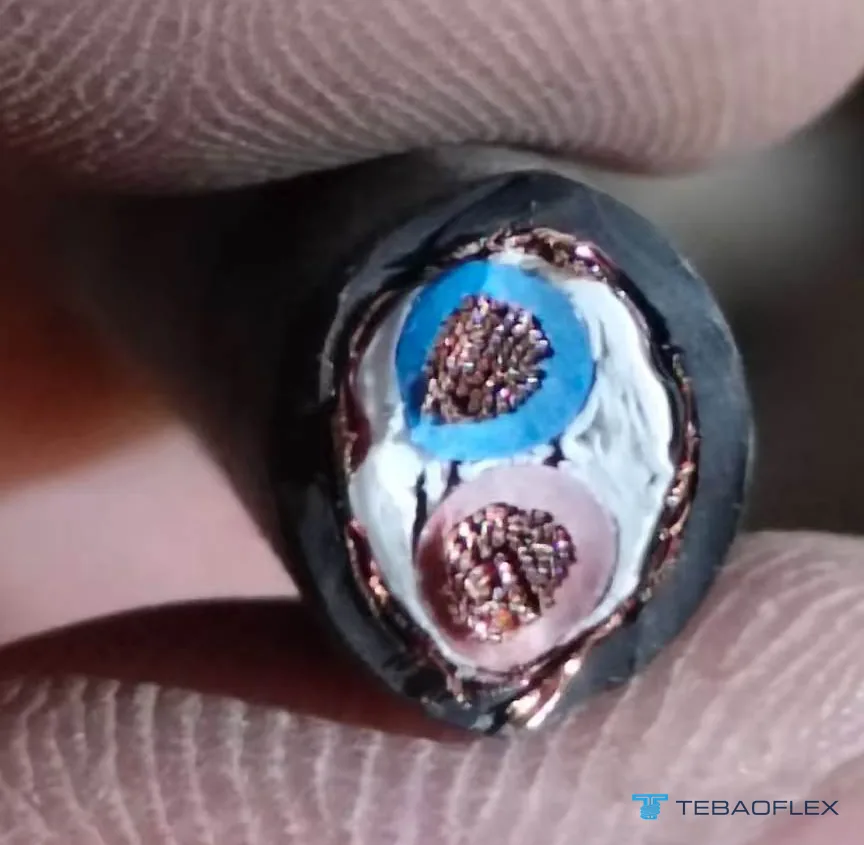
The cable the customer ordered is a two-core screened (shielded) cable: two 2.5 mm² copper conductors with blue and brown PVC insulation, white fillers that keep the assembly round, a separator tape, a copper-wire braid screen of about 80 % coverage and a black PVC sheath, rated 300/500 V. The packing label calls it a shielded control cable; the speaker line is the application. In Chinese control-cable vocabulary the construction corresponds to KVVP, or KVVRP with flexible conductors (rated 450/750 V in GB/T 9330; this order is rated and marked 300/500 V), and in IEC vocabulary it is closest to the screened PVC control cables of IEC 60227-7; the cable was made to the construction in the order, not to either standard.
- Conductors: 2 × 2.5 mm² copper (conductor class as stated in the order)
- Insulation: PVC, blue and brown
- Fillers that keep the two-core assembly round
- Separator tape over the laid-up cores
- Screen: copper-wire braid, about 80 % coverage
- Sheath: black PVC, printed with the customer's own company name, 2×2.5mm² 300/500V CU/PVC/CWB/PVC and metre marks
| Item | This order |
|---|---|
| Construction code | CU/PVC/CWB/PVC: copper conductor, PVC insulation, copper-wire braid, PVC sheath |
| Voltage rating | 300/500 V |
| Conductors | 2 × 2.5 mm² copper |
| Conductor resistance, class 1 or 2 (IEC 60228 maximum) | At most 7.41 Ω/km at 20 °C; reference value, not a measured result |
| Conductor resistance, class 5 (IEC 60228 maximum) | At most 7.98 Ω/km at 20 °C; reference value |
| Insulation | PVC, blue and brown |
| Screen | Copper-wire braid, about 80 % coverage, over a separator tape |
| Sheath | Black PVC |
| Marking | The customer's own company name, 2×2.5mm² 300/500V CU/PVC/CWB/PVC, metre marks |
| Packing | 200 m coils, woven wrap, TEBAOFLEX packing label |
| Weight | About 24 kg per 200 m coil as labelled (about 120 kg/km) |
The conductor figures come from IEC 60228, which fixes the maximum resistance of each conductor class and size: 7.41 Ω/km for a 2.5 mm² class 1 or class 2 copper conductor and 7.98 Ω/km for a class 5 flexible one, against 12.1 Ω/km for 1.5 mm². For a speaker line that resistance, doubled for the loop, is the number that sets the loss along the run, which is why the step from the requested 2.0 mm² to 2.5 mm² lowered the line loss rather than adding to it. The braid is a copper-wire braid rather than a foil because a braid keeps its coverage when the cable is bent and pulled through conduit and gives a low-resistance path to earth at the amplifier rack.
Is a fire-rated speaker cable the same as flame-retardant or LSZH? Three properties, three tests
No. The supplied cable is a general-purpose PVC construction: it is not a fire-resistant cable, and PVC is neither low-smoke nor halogen-free. Each of the three fire properties a speaker cable can have is a separate test, and a specification has to name the ones it needs: flame retardance (IEC 60332-1-2), low smoke and zero halogen (IEC 61034-2 and IEC 60754) and circuit integrity in a fire (the IEC 60331 series, or BS EN 50200 and BS 8434-2 in the British grades).
- Flame-retardant: a single vertical cable is exposed to a 1 kW flame; the cable passes when the burning does not spread beyond a set distance. It says nothing about whether the circuit still works.
- Low smoke, zero halogen: a sample is burned in a 3 m cube and the light transmittance through the smoke is measured; a second test measures the halogen acid gas in the combustion products. These tests describe the sheath and insulation compounds, not the circuit.
- Fire-resistant (circuit integrity): the cable is held in a flame at a set temperature for a set time, energised, and passes when the circuit stays alive; the British grades add mechanical shock and water spray. Only this group of tests makes a cable “fire-rated” in the sense of the enquiry.
For circuits that must keep working during a fire, TEBAOFLEX can make to order a fire-resistant two-core construction: copper conductors wrapped in mica-glass tape, XLPE insulation, an overall screen and an LSZH sheath, written CU/MICA/XLPE/OS/LSZH. The mica-glass tape is the fire barrier. When the XLPE burns away, the mica layer keeps the conductors insulated from each other and from the screen; that is the mechanism by which a mica-tape cable is intended to hold the circuit through the flame period of a circuit-integrity test, and which test applies, with the evidence for it, is agreed per order. The IEC 60331-21 method, which IEC has now withdrawn in favour of the fire-with-shock methods IEC 60331-1 and IEC 60331-2 at 830 °C, held the cable in a flame of at least 750 °C for 90 minutes and then for a further 15 minutes with the flame removed, energised at its rated voltage; the cable passed if no 2 A fuse blew and the lamp stayed lit. The same mica-tape principle is used on the fire-resistant marine and offshore cables in our range, such as the NEK 606 BFOU fire-resistant cable and the SW4 mica-tape marine cable; the fire-resistant and flame-retardant designations are explained in our article on RFOU and BFOU cable designations.
Does a voice evacuation speaker cable in the Philippines have to be fire-rated?
Only where the system design puts the speaker circuit on a pathway that must survive a fire, and that is a design decision, not a cable choice. The Revised Implementing Rules and Regulations of the Fire Code of the Philippines (Republic Act 9514) refer to NFPA 72, the National Fire Alarm and Signaling Code, for fire detection and alarm systems, and NFPA 72 does not require a particular cable: it requires a pathway survivability level for each circuit, from level 0 (no requirement) to level 3, with a 1-hour level 4 added in the 2022 edition. The designer and the authority having jurisdiction decide the level for the speaker circuits; the cable supplier then builds to it.
The Philippine rules, administered by the Bureau of Fire Protection, accept either NFPA 72 or the latest Philippine Electronics Code and Philippine Electrical Code for these systems and say nothing themselves about circuit-integrity cable. Level 2 is met with a 2-hour fire-rated circuit-integrity cable, a 2-hour fire-rated cable system, a 2-hour fire-rated enclosure or a 2-hour alternative accepted by the authority; level 3 requires the same measures in a building fully protected by automatic sprinklers. Level 1 is met in a building fully protected by automatic sprinklers with the conductors in a metal raceway or a metal-armoured cable. For an in-building emergency voice/alarm communications system, which the Philippine rules require in high-rise buildings of ten floors or more, NFPA 72 requires level 2 or 3 pathway survivability for the speaker circuits where the system is used for partial evacuation or relocation of occupants, with relaxations where the notification zones are separated by less than 2-hour construction or the pathways are redundant and routed apart; a system that evacuates the whole building at once may use any level. In the British codes the same decision is made through the standard and enhanced grades of BS 5839-1 and BS 5839-8.
For the supplier that gives a simple rule. Where the cable itself must provide the survivability, the enquiry has to name the fire-resistance test the authority accepts, and the cable must carry the evidence for that test, whether a listing or a test report; TEBAOFLEX quotes its mica-tape LSZH construction only against a test named in the enquiry. Where the survivability comes from the raceway, the enclosure or the sprinklered building, or where the circuit is not on a survivability pathway, a screened PVC or LSZH speaker cable is the usual choice, subject to the cable type and installation method the installation code prescribes for that route. The Philippine mandatory product certification for wires and cables (the DTI PS and ICC marks) covers thermoplastic building wires and flexible cords, not alarm or speaker cables, so acceptance of the cable rests with the authority. LSZH is still worth specifying wherever the route runs through the ceilings of occupied escape routes: a PVC-insulated wire gives off about 0.3 g of hydrogen chloride per gram when it burns (NIH PMC combustion study).
The cable supplied on this order is the screened PVC construction and is not a fire-resistant cable. Where it is installed on the project, and whether any pathway there calls for a fire-resistant cable, were decided by the customer's system design and the authority having jurisdiction; TEBAOFLEX supplied the construction the order specified.
Does 2.5 mm² make a difference on a 100 V speaker line?
Yes, once the run is long and the load is more than a few speakers. A 100 V line with P watts of speaker taps draws P ÷ 100 amperes, and the voltage drop is that current times the loop resistance of the run. With 300 W at the far end of a 200 m run, 2 × 2.5 mm² copper drops 8.9 % of the line voltage, about 0.8 dB at the speakers, and 2 × 1.5 mm² drops 14.5 %, about 1.4 dB (IEC 60228 maximum resistance at 20 °C, class 1 or 2). The British voice alarm code, BS 5839-8, recommends that the voltage drop on any loudspeaker circuit should not exceed 10 %.
| Run length | 2×1.5 mm² | 2×2.5 mm² | 2×4 mm² |
|---|---|---|---|
| 50 m | 3.6 % / −0.3 dB | 2.2 % / −0.2 dB | 1.4 % / −0.1 dB |
| 100 m | 7.3 % / −0.7 dB | 4.4 % / −0.4 dB | 2.8 % / −0.2 dB |
| 150 m | 10.9 % / −1.0 dB | 6.7 % / −0.6 dB | 4.1 % / −0.4 dB |
| 200 m | 14.5 % / −1.4 dB | 8.9 % / −0.8 dB | 5.5 % / −0.5 dB |
| 300 m | 21.8 % / −2.1 dB | 13.3 % / −1.2 dB | 8.3 % / −0.8 dB |
The loop resistance is twice the run length times the conductor resistance per metre, so the larger conductor buys either longer runs or more speakers per circuit. The table puts the whole 300 W load at the far end and uses the IEC 60228 maximum conductor resistance at 20 °C for class 1 or class 2 copper; a warm ceiling void raises the resistance by about 0.4 % per kelvin, and a load spread along the run drops less than the table shows. With 500 W on the line the drops are 1.7 times those shown. If the conductor is class 5 (fine-stranded, 7.98 Ω/km) the 2 × 2.5 mm² figures rise by 8 %: 4.8 % at 100 m, 9.6 % at 200 m and 14.4 % at 300 m. On a 70 V line the same tap power draws 1.43 times the current, so the percentage drop is about twice the 100 V figure for the same cable and run. Installers commonly design to 0.5 dB or 1 dB of level loss at the speakers, which is about 5.6 % or 10.9 % of voltage drop, and each voice alarm system manufacturer states the loss its amplifiers and line monitoring allow. The enquiry should therefore carry the longest run and the total tap power per circuit; the conductor size follows from those two numbers, not from the amplifier's power rating alone.
Why a braid-shielded speaker cable for voice alarm lines?
The speaker lines of a voice alarm system run through ceiling voids and cable trays that they share with lighting, mains and drive cables, and in a voice alarm system the line is monitored as well as driven. A braid screen reduces what the pair picks up from those neighbours over a long run and what the speaker line itself radiates into the microphone, data and detector cabling beside it; a copper-wire braid of about 80 % coverage keeps that screening when the cable is bent and pulled, and gives a low-resistance drain.
The screen does its work only when it is connected: bond it to earth at the amplifier rack, leave the far end insulated unless the system manufacturer's instructions say otherwise, and carry the screen through at every joint. A screened pair of this kind is the same idea as the collectively screened pairs of a BS 5308 Part 1 Type 1 instrumentation cable, which uses an aluminium tape and drain wire instead of a braid; the unscreened 300/500 V PVC counterpart is the H05VV-F flexible cable.
Can a two-core speaker cable be printed with your company name? Marking, coils and label
Yes, with a trial first. The customer asked whether its own company name and the cable specification could be printed on the cable. TEBAOFLEX prints customer names and specifications on request, but a two-core 2.5 mm² cable is thinner than the cables the sheath printer is normally set up for, so production ran a trial before the marking was promised. The trial passed, the customer signed off the text, and the cable was printed with its company name, 2×2.5mm² 300/500V CU/PVC/CWB/PVC and sequential metre marks; the coil photo shows the continuous production count, for example 5291 m.
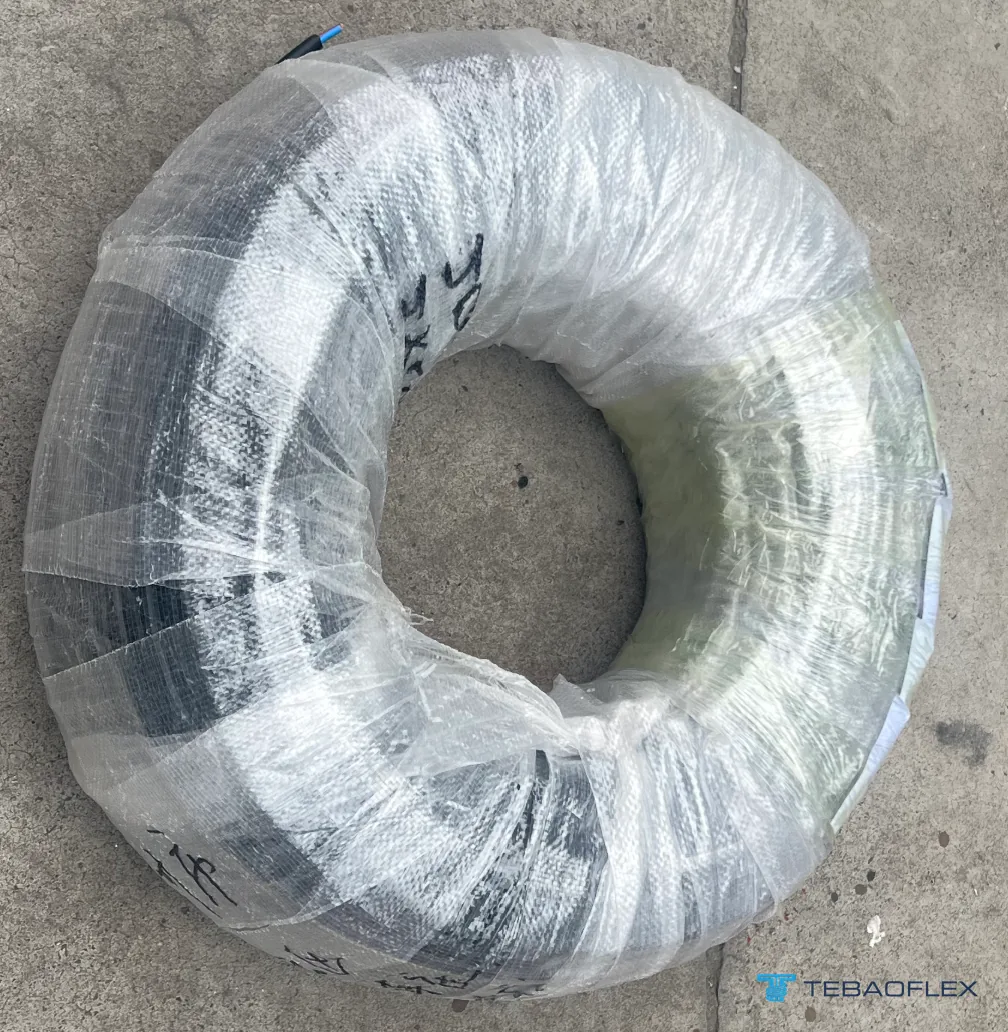
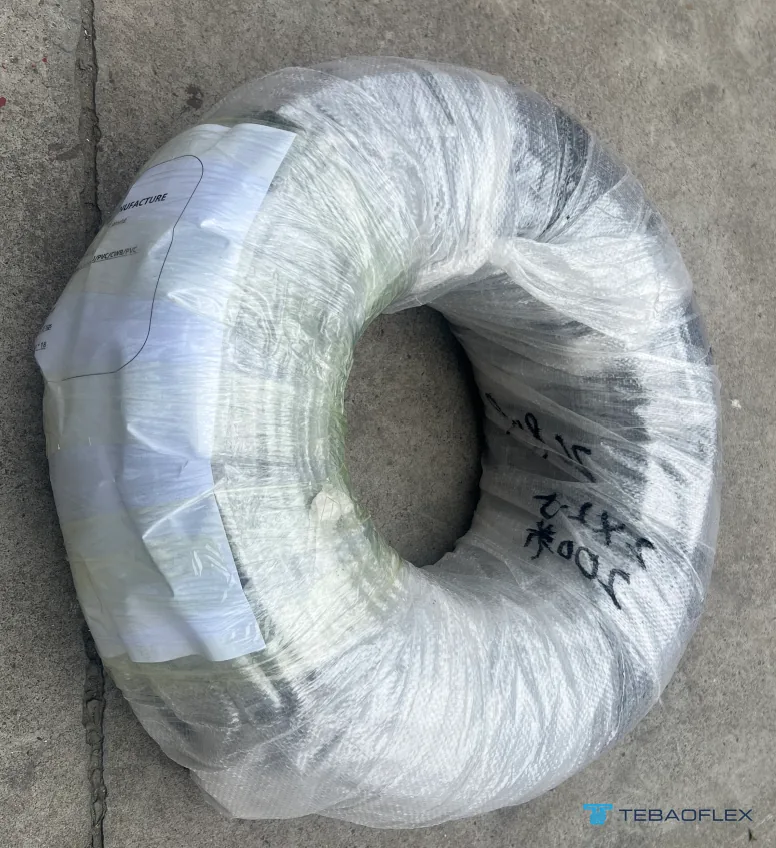
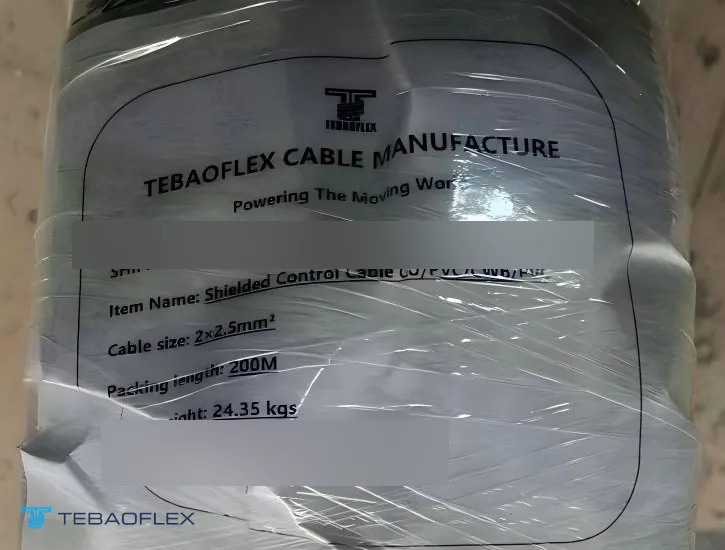
The coils were packed in 200 m lengths, each wrapped in woven polypropylene with the TEBAOFLEX label giving the item name, the size, the packing length and the weight (24.35 kg per coil, about 120 kg/km), so that the installer can check each coil against the delivery note without unwrapping it. Coil length is set per order: 100 m or 200 m coils suit installers pulling into conduit, while longer lengths go on drums.
What to send for a shielded or fire-resistant speaker cable quote
- The line voltage (100 V or 70 V) and the total tap power on the longest circuit, with its run length
- Whether the circuit is on a survivability pathway, and if so the fire-resistance test the authority having jurisdiction accepts (for example a 2-hour circuit-integrity listing, BS EN 50200 PH30 or PH120, BS 8434-2, IEC 60331-1 or -2)
- The flame-retardance class the specification calls for (IEC 60332-1-2 single cable or IEC 60332-3 bunched) and the cable designation it names (a BS 7629-1 type, an IEC 60227-7 type or a local standard)
- LSZH or PVC for the insulation and sheath, and the sheath colour
- Conductor size and class (solid or stranded), and the core colours
- Screen type (copper-wire braid or foil with drain wire) and how it will be earthed
- Total metres and number of circuits, the installation method (conduit, tray, clips) and any outer-diameter limit
- The marking text, including your own company name if the cable is for a project or for resale, and whether metre marks are wanted
- Coil or drum length, and the documents required with the delivery
Related screened and fire-resistant constructions are listed under industrial cables; the building speaker versions described here are made to order. As of August 2026, TEBAOFLEX's minimum order is 50 m for standard and custom cables alike. Lead times range from 7 to 45 working days depending on the product type and its customisation; the written quotation confirms the lead time for your order, and transit and customs time depend on the route.
Send your run lengths and speaker loads for a quote →
Questions on shielded and fire-rated speaker cables
Is a CU/PVC/CWB/PVC 300/500 V cable a fire-rated cable?
No. CU/PVC/CWB/PVC describes a copper conductor, PVC insulation, a copper-wire braid screen and a PVC sheath. It is a screened general-purpose cable: it has no fire barrier, PVC is a halogenated compound that gives off smoke and acid gas when it burns, and the construction is not designed to keep a circuit alive in a fire. A fire-rated (fire-resistant) cable has a mica-glass tape or a similar barrier under the insulation and is tested for circuit integrity in a flame, for example to the IEC 60331 series, BS EN 50200 or BS 8434-2.
What does an enquiry that names a BS 7629-1 standard fire-resistant speaker cable ask for?
A 300/500 V screened two-core cable to BS 7629-1 with “standard” circuit integrity under BS 5839-1, a low-smoke zero-halogen sheath and a screen with a protective conductor. An enquiry that names the Prysmian FP200 GOLD reference is asking for those three properties together, which a PVC cable does not provide.
Can a 2×2.0 mm² speaker cable be made?
2.0 mm² is not a size in IEC 60228, the conductor standard behind the 1.0, 1.5, 2.5 and 4 mm² series; it is close to 14 AWG (2.08 mm²), the size speaker-wire catalogues often list. A 2.0 mm² conductor can be made to order, but it then needs its own tooling, its own resistance figure and its own cross-reference to the standard sizes. On this order the customer accepted the next standard size, 2 × 2.5 mm², which has a lower resistance (7.41 Ω/km against about 9 Ω/km for 2.0 mm²) and so a lower loss on long speaker runs.
How long can a 100 V speaker line be with 2×2.5 mm² cable?
It depends on the load on the line. With 300 W of speaker taps at the far end, a 2 × 2.5 mm² copper line drops about 4.4 % of the line voltage at 100 m and 8.9 % at 200 m, against 7.3 % and 14.5 % for 2 × 1.5 mm²; BS 5839-8 recommends a maximum voltage drop of 10 % on a loudspeaker circuit. The figures use the IEC 60228 maximum resistance at 20 °C for class 1 or class 2 copper and put the whole load at the far end, which is the worst case. The voice-alarm system manufacturer states the loss its amplifiers and line monitoring allow; the run length and the load per circuit decide the conductor size.
Why do buyers prefer LSZH for speaker cables in public areas?
Because the cable is installed above the ceilings of corridors, stairways and lobbies that people use to leave the building. PVC gives off dense smoke and hydrogen chloride when it burns; a low-smoke zero-halogen (LSZH) sheath and insulation are tested for low smoke density (IEC 61034-2) and for the absence of halogen acid gas (IEC 60754), so they add less to the smoke and corrosive gas in an escape route. LSZH on its own does not make a cable fire-resistant: that is a separate property with a separate test.
Can a thin two-core cable be printed with your company name?
Yes, with a trial first. Sheath printers are set up for the larger cables, and a two-core 2.5 mm² cable is near the lower limit of what they can mark legibly. For this order production ran a trial, the print was accepted, and the cable was printed with the customer's company name, 2×2.5mm² 300/500V CU/PVC/CWB/PVC and sequential metre marks.
What should a buyer in the Philippines specify for an emergency voice evacuation speaker cable?
First the survivability the system design requires for each pathway: NFPA 72, which the Revised Implementing Rules and Regulations of the Fire Code of the Philippines (RA 9514) refer to for fire detection and alarm systems alongside the Philippine Electronics Code and Electrical Code, defines pathway survivability levels, and the designer and the authority having jurisdiction decide which level applies to the speaker circuits. Where the cable itself must provide the survivability, specify a fire-resistant cable and the test it must meet; where the raceway or the building provides it, a screened PVC or LSZH speaker cable can be used, subject to the cable type the installation code prescribes for the route. Then the conductor size for the run length and load, LSZH or PVC, the screen, the colours, the marking text and the coil length.