


NEK TS 606 · IEC 60092 · Offshore cable designations
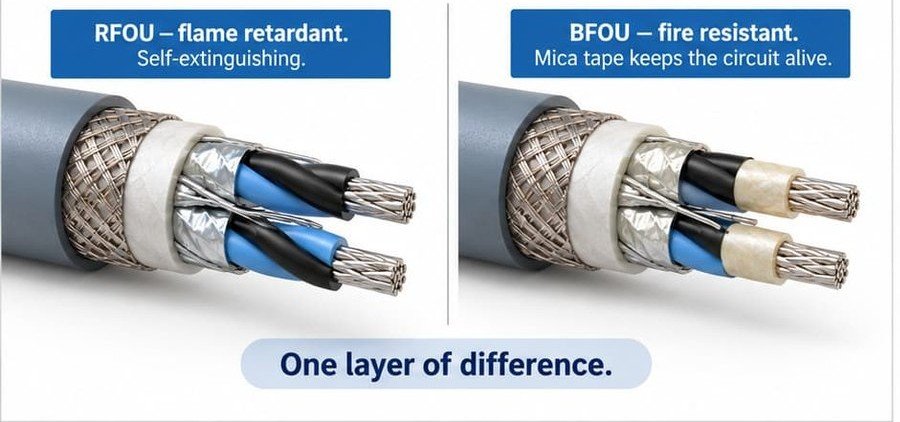
RFOU cable and BFOU cable are type designations from NEK TS 606, the Norwegian offshore specification. Both are built on EPR insulation, a halogen-free inner covering, a tinned copper wire braid and a mud-resistant SHF2 sheath. One layer separates them: BFOU carries mica tape under the insulation, so the circuit survives a fire. RFOU does not.
B = fire resistant
(c) collective
150/250 (300) V
0.6/1 kV
What RFOU and BFOU cables are
RFOU and BFOU are type designations used in NEK TS 606, the technical specification published by Norsk Elektroteknisk Komite for cables on offshore oil and gas installations. They are not IEC type codes and they are not brand names. They are a shorthand in which each letter names one physical layer of the cable, read from the conductor outwards.
That is the part most buyers never get told. A designation like RFOU(i) is not an arbitrary product code — it is a construction description. Once the letters are decoded, two cables can be compared without opening a single datasheet.
- NEK TS 606
- Norwegian technical specification for halogen-free and mud-resistant cables used on offshore installations. Built on the IEC 60092 series, with additional requirements the base IEC standards do not carry.
- RFOU
- EPR-insulated, flame-retardant, halogen-free, braided, mud-resistant cable. Self-extinguishing, but not required to keep working during a fire.
- BFOU
- The same construction with mica tape added under the insulation, so the circuit stays live while burning. Tested for circuit integrity to IEC 60331.
- Mud resistance
- Resistance to hydrocarbon-based drilling fluids. Delivered by the SHF2 sheath compound and verified by a dedicated NEK TS 606 test.
- (i) and (c)
- Screening arrangement on instrumentation types: each pair or triad screened separately, or one screen over the whole lay-up.
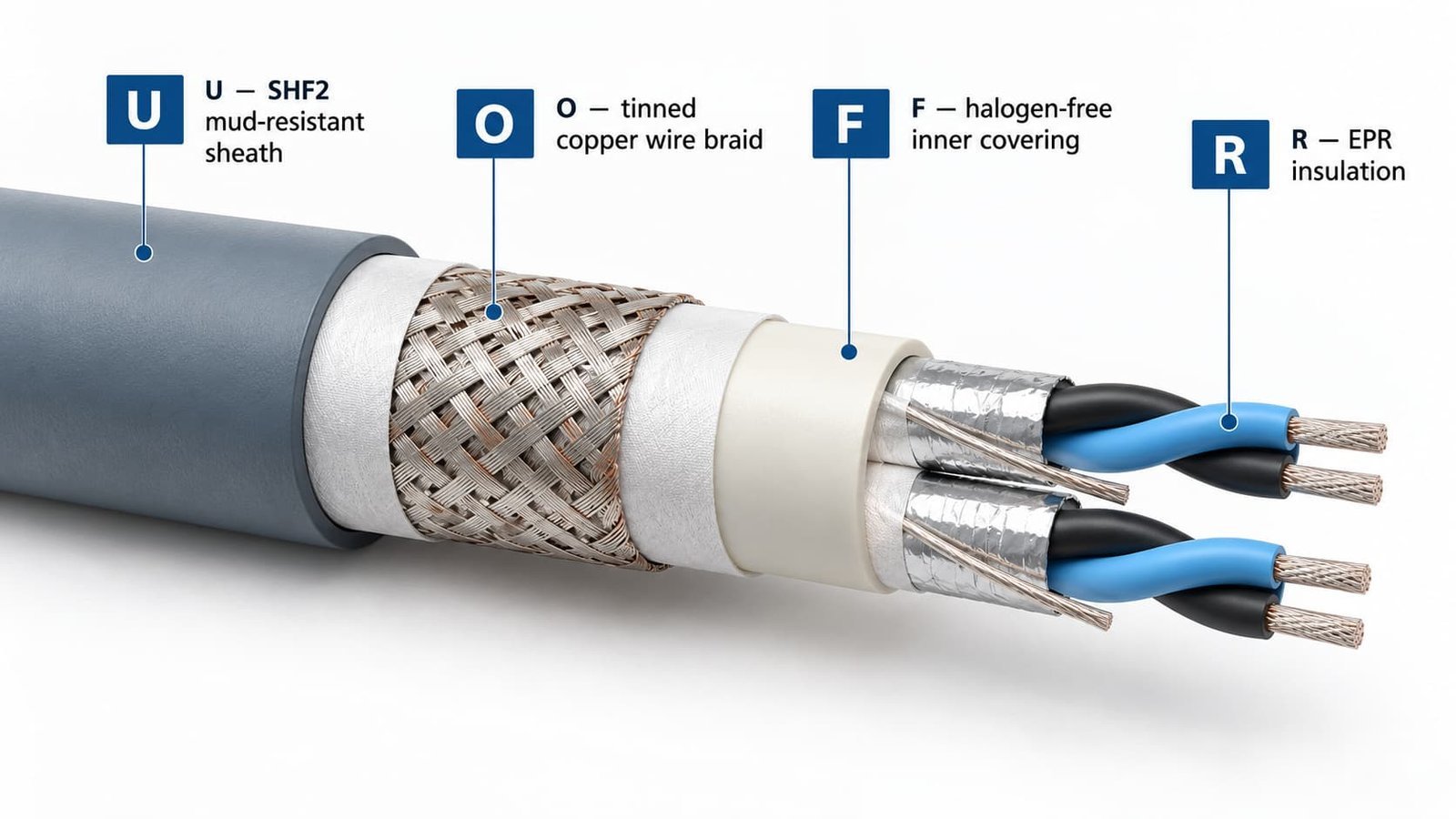
The letter code, layer by layer
Published construction tables for NEK 606 cables map the designation letters directly onto layers. Reading RFOU from the inside out:
| Letter | Layer | What it is |
|---|---|---|
| — | Conductor | Tinned annealed stranded copper, IEC 60228 class 2 |
| R | Insulation | EP rubber (EPR) to IEC 60092-360 |
| B | Insulation | Mica tape plus EP rubber — the fire-resistant alternative to R |
| F | Inner covering | Flame-retardant, halogen-free thermoset bedding |
| O | Braid | Tinned annealed copper wire braid |
| U | Outer sheath | Flame-retardant, halogen-free, mud-resistant thermoset, SHF2 to IEC 60092-360 |
So RFOU reads as: EPR insulation, halogen-free bedding, copper braid, SHF2 mud-resistant sheath. BFOU is the identical stack with mica tape added at the insulation. The R and the B occupy the same position in the code because they describe the same layer — they are alternatives, never combined.
What the U does not mean
The U is not “unarmoured”. It is widely repeated online that U stands for no armour. Construction tables do not support that reading: U names the SHF2 mud-resistant outer sheath. The unarmoured NEK 606 instrumentation types are designated RU and BU — codes that drop the F bedding and the O braid while keeping the same insulation and the same U sheath.
The distinction matters commercially. If a specification calls for RFOU and a quotation offers RU, the difference is not a naming preference — a copper braid and a bedding layer have been removed. That changes screening performance, mechanical robustness and price. Comparing the two codes letter by letter surfaces the substitution immediately.
RFOU vs BFOU: flame retardant is not fire resistant
This is the single most consequential distinction in the whole family, and the two terms are routinely used as if they were interchangeable. They describe opposite expectations of a cable during a fire.
Flame retardant means the cable does not propagate fire along its own length — it self-extinguishes and limits flame spread. Nothing is promised about the circuit. Fire resistant means the circuit continues to function while the cable burns, for a defined period, under a defined test flame.
| Attribute | RFOU | BFOU |
|---|---|---|
| Insulation system | EPR | Mica tape + EPR |
| Fire behaviour | Flame retardant, self-extinguishing | Flame retardant and fire resistant |
| Circuit during a fire | Not required to function | Required to keep functioning |
| Flame spread tests | IEC 60332-1-2, IEC 60332-3-22 | IEC 60332-1-2, IEC 60332-3-22 |
| Circuit integrity test | Not applicable | IEC 60331 series, including IEC 60331-21 |
| Halogen free / low smoke | IEC 60754, IEC 61034 | IEC 60754, IEC 61034 |
| Mud resistance | Yes, SHF2 sheath | Yes, SHF2 sheath |
| Typical duty | General power, control and instrumentation | Circuits that must survive: ESD, fire and gas, emergency lighting, shutdown valves |
Read the last row as the actual selection rule. BFOU is not a premium upgrade chosen for comfort — it is specified where a safety case requires the circuit to still be alive after the fire starts. Applying BFOU everywhere inflates cost; applying RFOU to a shutdown circuit removes a safety function.
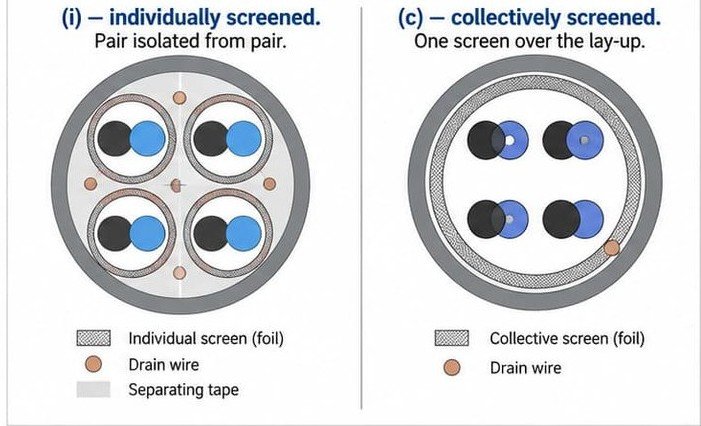
(i) or (c): screening arrangement and S-codes
The bracketed suffix applies to instrumentation types rated 150/250 (300) V. It states how the screens are arranged, and it changes the cable’s behaviour against interference rather than its fire performance.
(i) — individually screened. Every pair, triad or quad gets its own screen and drain wire, then a barrier tape so adjacent elements do not make contact. Signals in one pair are isolated from the others. This is the arrangement for mixed-signal multicore runs and for low-level analogue instrumentation.
(c) — collectively screened. The elements are laid up and a single screen is applied over the whole assembly. Interference from outside is handled; crosstalk between pairs inside the cable is not. Cheaper, smaller, and entirely adequate when every element in the cable carries the same class of signal.
| Type | Insulation | Screening | Braid | TS 606 code |
|---|---|---|---|---|
| RFOU(i) | EPR | Individual | Yes | S1 / S5 |
| RFOU(c) | EPR | Collective | Yes | S2 / S6 |
| BFOU(i) | Mica + EPR | Individual | Yes | S3 / S7 |
| BFOU(c) | Mica + EPR | Collective | Yes | S4 / S8 |
| RU(i) / RU(c) | EPR | Individual / collective | No | S11 / S12 |
| BU(i) / BU(c) | Mica + EPR | Individual / collective | No | S13 / S14 |
Quoting the S-code alongside the type designation removes almost all ambiguity from an enquiry, because the code fixes insulation, screening and braid in a single token.
Which IEC 60092 part applies
A recurring confusion is treating IEC 60092 as one document. It is a series, and the part number that belongs on a datasheet is decided by circuit duty and voltage — not by screening, and not by fire class.
| Part | Scope | Applies when |
|---|---|---|
| IEC 60092-350 | General construction and test methods for shipboard and offshore power, control and instrumentation cables, up to 18/30 (36) kV | Always — the umbrella document |
| IEC 60092-352 | Choice and installation of electrical cables | Installation design, not cable manufacture |
| IEC 60092-353 | Non-radial field power cables with extruded solid insulation, 1 kV and 3 kV | 0.6/1 kV power cables — RFOU and BFOU power types |
| IEC 60092-354 | Power cables 6 kV (Um 7.2 kV) to 30 kV (Um 36 kV) | Medium-voltage runs, including MV RFOU types |
| IEC 60092-360 | Insulating and sheathing materials | Defines EPR and the SHF2 sheath compound |
| IEC 60092-376 | Cables for control and instrumentation circuits, 150/250 V (300 V) | All (i) and (c) instrumentation types |
| IEC TR 60092-370 | Guidance on selecting telecommunication and data cables | Data and RF routes — a technical report, not a construction standard |
So a 0.6/1 kV BFOU power cable sits under IEC 60092-353, while a BFOU(i) 150/250 V instrumentation cable sits under IEC 60092-376. Same fire class, same manufacturer, different part number — because the circuit duty differs. A datasheet that cites the wrong part is usually a copy-paste error rather than a construction problem, but it is worth querying before approval.
Working the other way round: if you know the voltage and the circuit duty, you already know which part to demand on the test certificate. A 150/250 V instrumentation cable submitted without an IEC 60092-376 reference is an incomplete submission.
Where NEK TS 606 goes beyond IEC 60092
NEK TS 606 is built on the IEC 60092 series, but a cable that satisfies IEC 60092 does not automatically satisfy NEK TS 606. The specification adds requirements shaped by the North Sea drilling environment.
| Requirement | IEC 60092 baseline | NEK TS 606 position |
|---|---|---|
| Oil resistance | Standard resistance requirements | Stricter enhanced oil resistance requirements and tests |
| Mud resistance | Not a dedicated requirement | Dedicated drilling-fluid resistance requirement and test |
| Hydrocarbon fire | Not covered | Test methods for hydrocarbon (HC) fire-resistant cables |
| Jet fire | Not covered | Test methods for jet fire (JF) resistant cables |
Hydrocarbon and jet fire are worth separating in your own mind from ordinary fire resistance. A standard IEC 60331 circuit-integrity test uses a flame far cooler than a pressurised hydrocarbon release. Where a fire risk assessment identifies HC or jet fire exposure, an ordinary BFOU is not the answer — the HC and JF variants exist precisely because the base test does not represent that scenario.
Check the edition on the datasheet
NEK 606 was first published in 1993 and has been revised repeatedly. The current issue is NEK TS 606:2025, edition 7, which replaced NEK TS 606:2022. The instrumentation standard beneath it has moved too: IEC 60092-376 reached edition 4 in 2025, superseding the 2017 third edition and the 2003 second edition.
Catalogues and datasheets circulating today still cite NEK TS 606:2009 and IEC 60092-376:2003. That is not necessarily a defective cable — construction requirements are broadly stable across editions — but it does mean the paperwork has not been refreshed, and on a project where the specification names a current edition, stale references get submissions rejected. Ask which edition the type test was carried out against, and ask when.
A short diligence sequence that catches most problems: which edition of NEK TS 606 does the test report cite · which IEC 60092 part matches the voltage and duty · was circuit integrity tested to IEC 60331 if the type letter is B · does the sheath compound test to SHF2 · is the S-code stated, not just the type name.
Choosing between them
The choice is rarely free. On a live installation it is usually already made by the fire and gas philosophy, the safety case, and the requirements of the classification or verification body. What follows is how the decision decomposes, not permission to make it unilaterally.
Start with the circuit, not the cable. Ask whether this circuit must keep operating during a fire. Emergency shutdown, fire and gas detection, emergency lighting and safety-critical valve actuation normally must. General lighting, small power and routine process instrumentation normally need not.
Then set the voltage and duty, which fixes the IEC 60092 part and separates power types from instrumentation types.
Then choose screening. Mixed signal levels in one cable, or low-level analogue measurement, points to (i). Uniform signals point to (c).
Then confirm the environment. Drilling fluid exposure makes the mud-resistant SHF2 sheath non-negotiable. HC or jet fire exposure escalates the requirement beyond ordinary BFOU.
What an enquiry should state
Most delay in offshore cable enquiries comes from missing information rather than difficult requirements. Stating the following turns a quotation round trip into a single exchange.
| Item | Why it changes the answer |
|---|---|
| Type designation and S-code | Fixes insulation, screening and braid in one token |
| Voltage rating | Decides the IEC 60092 part and the construction family |
| Number of pairs, triads or cores, and cross-section | Drives dimensions, weight and price |
| Fire requirement | Flame retardant only, circuit integrity, or HC / JF |
| Edition of NEK TS 606 named in the project specification | Determines which test evidence is acceptable |
| Length per drum and total length | Affects drumming and delivery planning |
| Sheath colour and required marking text | OEM and ODM sheath printing is available on request |
| Documentation required at delivery | Test reports and traceability are prepared to order |
TEBAOFLEX manufactures marine and offshore cable designed to NEK TS 606 and the IEC 60092 series, with a minimum order quantity of 50 m and a production lead time of 7 to 45 working days depending on construction and quantity.
Common questions
What does RFOU stand for?
Each letter names a layer: R for EP rubber insulation, F for the flame-retardant halogen-free inner covering, O for the tinned copper wire braid, U for the flame-retardant, halogen-free, mud-resistant SHF2 outer sheath. Together they describe a complete construction rather than a product name.
What is the difference between RFOU and BFOU cable?
One layer. BFOU adds mica tape beneath the EPR insulation, which allows the circuit to keep operating during a fire and is verified by circuit-integrity testing to IEC 60331. RFOU is flame retardant and self-extinguishing but carries no requirement to function once burning. Every other layer is the same.
What does BFOU mean?
BFOU is the fire-resistant counterpart of RFOU under NEK TS 606. The B denotes mica tape combined with EP rubber at the insulation layer; F, O and U carry the same meanings as they do in RFOU.
Does the U in RFOU mean unarmoured?
No. The U denotes the mud-resistant SHF2 outer sheath. The unarmoured instrumentation variants carry the designations RU and BU, which omit both the F bedding and the O braid.
Is NEK 606 the same as IEC 60092?
No. NEK TS 606 is built on the IEC 60092 series but adds stricter enhanced oil resistance and mud resistance requirements, plus test methods for hydrocarbon fire and jet fire resistance that the IEC parts do not cover. Compliance with IEC 60092 alone does not demonstrate compliance with NEK TS 606.
Which edition of NEK TS 606 is current?
NEK TS 606:2025, edition 7, which replaced the 2022 edition. Many datasheets in circulation still reference the 2009 edition, so it is worth confirming which edition the type test evidence was produced against.
Can RFOU be substituted for BFOU?
Not where the circuit has been classified as needing to survive a fire. The substitution removes circuit integrity, which is a safety function rather than a performance margin. The reverse substitution is technically safe but adds cost with no benefit on circuits that do not need it.
Related cable routes
Where this guide ends, the product records begin. Each of the following carries construction detail, dimensions and the standards referenced for that specific type.
- Marine and offshore cables — the full range, organised by type and voltage
- 0.6/1 kV RFOU cable for marine and offshore projects — flame-retardant power construction
- 5G 35 mm² RFOU cable — with RFOU(i) and RFOU(c) S2/S6 instrumentation options
- NEK 606 BFOU cable, P5/P12 power and instrumentation — the fire-resistant family, BFOU(i) and BFOU(c)
- NEK 606 P108 UX offshore earth cable — earthing and equipotential bonding
- TCu/MGT/EPR/ZH/GSWB/ZH 0.6/1 kV SW4 marine cable — braided armour with mica glass tape construction
For the wider selection logic across a facility, the oil and gas cable selection guide works through circuit duty, environment and armour together. If your scope also covers onshore instrumentation to British specifications, the PAS 5308 instrumentation cable guide covers the equivalent pair and triad decisions under a different standard family. Project-level requirements are set out under marine and offshore solutions and subsea and marine cable engineering.
Send the type code, get a specific answer
Quote the designation and S-code, the voltage, the element count and the NEK TS 606 edition named in your specification. That is enough for a construction-level response rather than a price range.
Sources and review status
Standard identity, edition history and the scope of NEK TS 606 were taken from Norsk Elektroteknisk Komite, the body that publishes the specification. IEC 60092 part scopes and current edition status were taken from the IEC webstore. Designation letters, S-codes and layer construction were cross-checked against published manufacturer construction tables for cables built to NEK TS 606.
This guide explains designations and standards. It is not a substitute for the project specification, the fire and gas philosophy, or the requirements of the classification or verification body governing your installation. Where those documents conflict with anything written here, they govern.
Written 2026-09-03. Standard editions verified on that date.