

MGT Cable — Mica-Glass High Temperature Lead Wire 450°C / 538°C
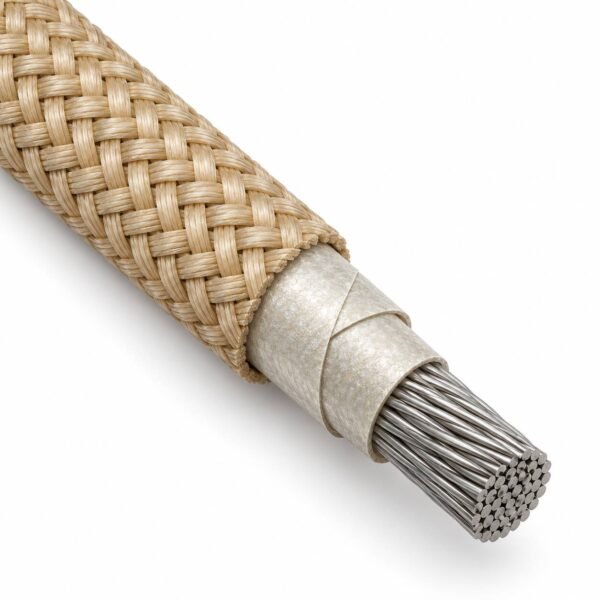
MGT cable is the wire you reach for when the fluoropolymers have run out of room. Mica tape does not melt and does not burn, so where PTFE tops out around 260 °C, a mica-glass construction keeps going to 450 °C on the UL rating and 538 °C on the factory rating. TEBAOFLEX builds it on 27% nickel-plated copper, in 300 V and 600 V constructions from 24 AWG to 4/0.
- Construction references: UL AWM style 5107 (600 V) and style 5128 (300 V); CSA AWM I A/B FT1
- Temperature: 450 °C to the UL style; 538 °C factory rated (non-UL)
- Conductor: flexible stranded 27% nickel-coated copper to ASTM B355, B8, B173 and B174
- Insulation: two glass-reinforced mica tapes
- Jacket: braided fiberglass impregnated with a moisture, heat and flame resistant saturant
- Sizes: 24 AWG to 4/0 AWG on the 600 V construction; 24 AWG to 6 AWG on the 300 V construction
- Colours: natural and solid colours, coloured tracers to order
Send the AWG size, voltage, temperature at the hot spot, length and any documentation requirement for a technical quotation.
Construction
MGT is a tape-wrapped construction, not an extruded one, and that single fact explains most of its behaviour. Mica is a mineral; it does not soften, melt or carbonise at temperatures that destroy every polymer in the catalogue. The trade is that mica tape has no mechanical strength of its own, so the construction is really three jobs done by three different layers.
| Layer | What it is | What it is there for |
|---|---|---|
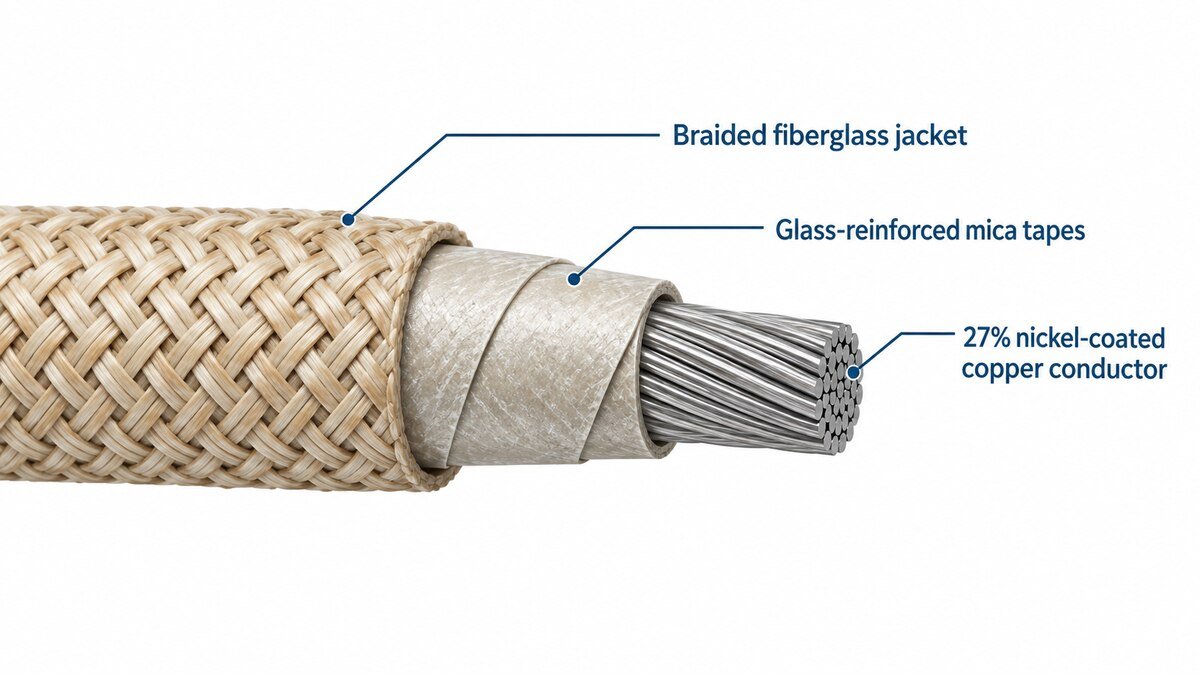
| Conductor | Flexible stranded soft-drawn copper, 27% nickel coated, to ASTM B355, B8, B173 and B174 | Carries the current, and survives the heat. Bare and tinned copper oxidise and embrittle long before 450 °C; a heavy nickel coating is what makes the conductor last as long as the insulation. |
| Insulation | Two glass-reinforced mica tapes, helically applied | The dielectric. Mica does not melt or burn; the glass scrim is what holds the tape together so it can be wrapped at all. |
| Jacket | Braided fiberglass, impregnated with a moisture, heat and flame resistant saturant | All the mechanical strength. It takes the abrasion, resists braid fray and push-back, and keeps the mica tapes in place during pulling and servicing. |
The 27% is not a rounding detail. Nickel coating is specified as a percentage of conductor weight, and the heavy 27% coating used on MGT is what holds up at 450 °C. The 2% coating common on 250 °C wire — including TGGT — is a different specification for a different ceiling. If a quotation does not state the coating percentage, it is not yet comparable.
Why the braid decides how the wire handles
A mica-taped core on its own is stiff, fragile and unpullable. The impregnated glass braid is what converts it into something an installer can route through a kiln wall. It also sets the minimum bend radius, which runs from about 0.6 in on 24 AWG to 5.66 in on 4/0 — bend tighter than that and the mica tapes can crack inside a jacket that still looks perfect from outside.
Where MGT differs from a fluoropolymer wire
PTFE, PFA and FEP are extruded, so they give a smooth, thin, dimensionally exact wall. MGT is wrapped, so its wall is thicker and its surface is textured. You accept a larger outside diameter and a stiffer wire, and in exchange you get roughly 200 °C more headroom. For the reasoning behind that trade, and why the conductor plating usually caps a wire before its insulation does, see what a 200 °C insulation rating actually guarantees.
Applications
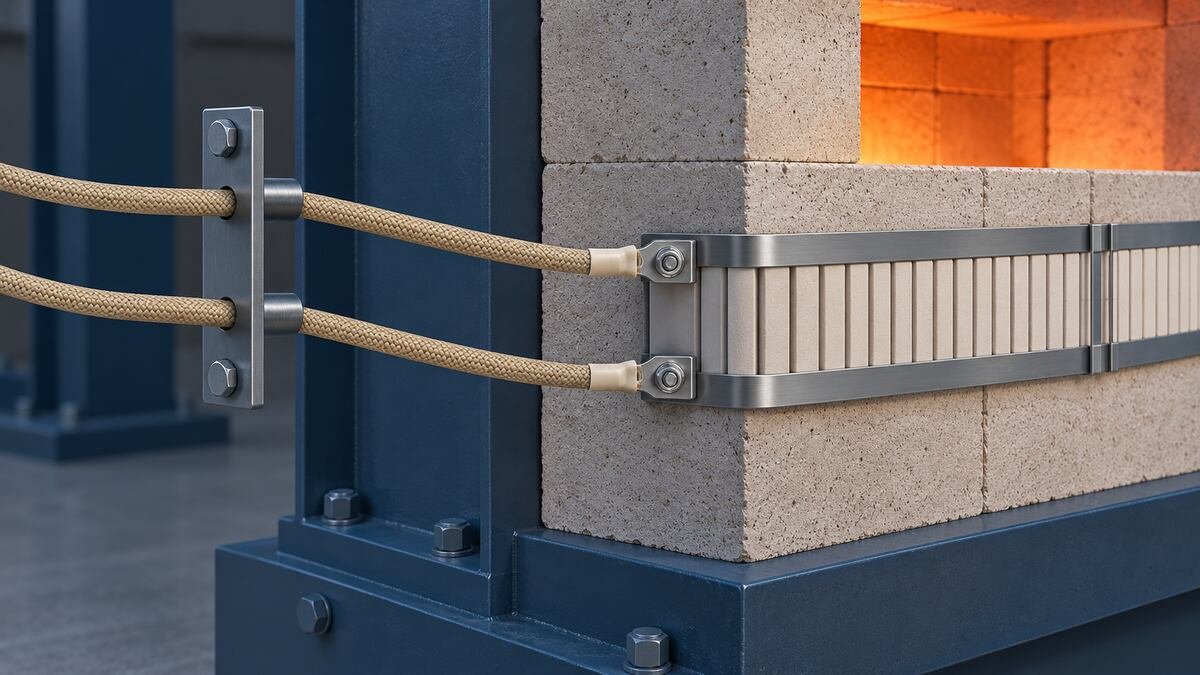
MGT is apparatus and motor lead wire for places where the ambient temperature is the design problem. It goes into the internal wiring of domestic, commercial and industrial heating equipment; kilns; cooking equipment; and the control and power circuits attached to them, wherever high temperature and abrasion arrive together.
Equipment this wire is built for
| Where | What it does there | Why MGT rather than a polymer wire |
|---|---|---|
| Steel and iron mills | Furnace and roller-hearth wiring, motor leads near the line | Radiant heat pushes conductor temperature past anything a fluoropolymer can hold |
| Glass plants | Furnace instrumentation and power circuits | Sustained soak temperature, plus handling abuse during rebuilds |
| Cement kilns | Kiln-shell equipment, drive and control circuits | Heat plus continuous dust abrasion on the jacket |
| Heater bands and heating elements | Element lead wire | The lead sits directly against the element; a non-melting insulation is the only safe answer |
| Industrial ovens and dryers | Internal looms and cooking equipment wiring | Thermal cycling over years, where a polymer would age out and embrittle |
Where MGT is the wrong answer
- Anything that moves continuously. This is lead wire and fixed internal wiring. A wrapped mica construction is not a flexing cable — for repeated motion use a silicone or a purpose-built flexible construction instead.
- Wet-duty circuits. The glass braid is impregnated, not sealed. Where moisture is constant, review the construction before specifying.
- Duty at or below 250 °C. You are paying for headroom you will never use. TGGT wire at 250 °C is the cheaper and more flexible answer, and below 200 °C a fiberglass braided silicone wire is usually right.
MGT or TGGT?
These two are ordered from the same suppliers, sit in the same catalogues and look similar on a drawing, so they get substituted for each other by mistake. They are not interchangeable.
| MGT | TGGT | Choose this when | |
|---|---|---|---|
| Temperature | 450 °C UL, 538 °C factory | 250 °C | MGT above 250 °C; TGGT at or below it |
| Insulation | Glass-reinforced mica tape | PTFE tape with fiberglass serve | MGT where nothing may melt; TGGT where chemical and moisture resistance matter more |
| Conductor coating | 27% nickel | 2% nickel | The coating follows the temperature, and it is a real cost difference |
| Wet duty | Review before specifying | Rated damp or dry | TGGT where moisture is part of the duty |
| Flexibility | Stiffer, larger OD | More flexible, thinner wall | TGGT where the loom is tight or the terminations are dense |
Specifications
Ratings at a glance
- Temperature — UL
- 450 °C
- Temperature — factory rating
- 538 °C, non-UL. UL does not rate this construction above 450 °C; the two numbers are not interchangeable and a specification should state which one it means.
- Voltage
- 300 V (style 5128 construction) or 600 V (style 5107 construction)
- Sizes
- 24 AWG to 6 AWG at 300 V; 24 AWG to 4/0 AWG at 600 V
- Conductor
- Flexible stranded soft-drawn copper, 27% nickel coated, ASTM B355 / B8 / B173 / B174
- Flame
- VW-1 flame test on specified constructions; CSA AWM I A/B FT1 construction reference
- Ampacity reference
- NEMA WC 73-2000 for the corresponding constructions
MGT 450 °C / 600 V — dimensional data
| Size | Strands | Mica tape (mm) | Braid (mm) | Overall dia. (mm) | Min. bend radius (in) | Net weight (lbs/kft) |
|---|---|---|---|---|---|---|
| MGT 22 AWG | 7 | 0.64 | 0.18 | 2.54 | 0.80 | 8 |
| MGT 20 AWG | 10 | 0.64 | 0.18 | 2.64 | 0.83 | 9 |
| MGT 18 AWG | 16 | 0.64 | 0.18 | 2.79 | 0.88 | 11 |
| MGT 16 AWG | 26 | 0.64 | 0.18 | 3.20 | 1.01 | 15 |
| MGT 14 AWG | 41 | 0.64 | 0.18 | 3.53 | 1.11 | 22 |
| MGT 12 AWG | 65 | 0.64 | 0.18 | 3.99 | 1.26 | 31 |
| MGT 10 AWG | 105 | 0.76 | 0.38 | 5.28 | 1.66 | 50 |
| MGT 8 AWG | 133 | 0.76 | 0.38 | 6.65 | 2.10 | 79 |
| MGT 6 AWG | 133 | 0.76 | 0.38 | 7.95 | 2.50 | 113 |
| MGT 4 AWG | 133 | 0.76 | 0.38 | 9.35 | 2.94 | 167 |
| MGT 2 AWG | 259 | 0.89 | 0.51 | 11.33 | 3.57 | 259 |
| MGT 1/0 AWG | 259 | 0.89 | 0.51 | 13.54 | 4.26 | 392 |
| MGT 2/0 AWG | 259 | 0.89 | 0.51 | 14.88 | 4.69 | 488 |
| MGT 3/0 AWG | 259 | 0.89 | 0.51 | 16.33 | 5.14 | 605 |
| MGT 4/0 AWG | 259 | 0.89 | 0.51 | 17.96 | 5.66 | 750 |
MGT 450 °C / 300 V — dimensional data
| Size | Strands | Overall dia. (mm) | Min. bend radius (in) | Net weight (kg/km) |
|---|---|---|---|---|
| MGT 24 AWG | 7 | 1.83 | 0.58 | 5.94 |
| MGT 22 AWG | 7 | 2.01 | 0.63 | 8.27 |
| MGT 20 AWG | 10 | 2.16 | 0.68 | 10.33 |
| MGT 18 AWG | 16 | 2.36 | 0.74 | 13.32 |
| MGT 16 AWG | 26 | 2.67 | 0.84 | 18.90 |
| MGT 14 AWG | 41 | 3.07 | 0.97 | 27.58 |
| MGT 12 AWG | 65 | 3.58 | 1.13 | 40.27 |
| MGT 10 AWG | 105 | 4.80 | 1.51 | 68.61 |
Alternative conductor materials and stranding — including solid or stranded Grade A nickel — are available to order. Multi-conductor versions and stainless steel armour are built on request.
Standards
What the style numbers mean here
A UL AWM style number fixes insulation, temperature and voltage in one token, which is why a purchase specification that names the style is faster and safer than one describing the construction in prose. TEBAOFLEX builds MGT to the construction requirements of the following styles.
| Reference | What it covers in this construction |
|---|---|
| UL AWM style 5107 | 450 °C, 600 V mica-glass appliance and lead wire construction |
| UL AWM style 5128 | 450 °C, 300 V construction. Style 5335 is also cited in the market for the lower-voltage build; state the style you require on the enquiry. |
| CSA AWM I A/B FT1 | Canadian appliance wiring material designation and vertical flame test reference |
| UL VW-1 | Vertical wire flame test, on specified constructions |
| ASTM B355, B8, B173, B174 | Nickel-coated copper wire, and rope-lay / bunch stranded conductor references |
| NEMA WC 73-2000 | Ampacity reference for the corresponding constructions |
These are the standards this construction is designed and manufactured to. Certificate scope for a specific style is confirmed per order — send the style number with your enquiry and we confirm what documentation can be issued before you commit.
450 °C and 538 °C are two different statements
450 °C is the rating carried by the UL AWM styles. 538 °C is a factory rating for the same construction family and sits outside the UL styles. Both numbers circulate in supplier catalogues, often in the same sentence, and a specification that simply says 538 °C UL is asking for something that does not exist. If your project document needs a third-party-rated temperature, it needs to be written against 450 °C.
Documentation supplied with an order
- Confirm the required style number, voltage, size and any sheath marking on the purchase specification
- Request conductor, insulation, dimensional and flame test records where the project requires them
- State any third-party inspection, witness testing, drum schedule, custom print or packing requirement before production
Request a cable recommendation and quotation
Send the required services, cable length, mechanical duty, environment, termination and quantity. Our team will review the application before quoting.
- Include the product name or SKU plus the required cable length and quantity.
- Attach a specification, drawing or data sheet when available.