








Project record · Southeast Asia · Pontoon project · 41.0 mm electro-optical umbilical
300 m of 41.0 mm Steel-Armoured Pontoon Umbilical and Deck Cable (9×16 + 5×4 + 4×0.34 + 12FO) for a Marine Contractor in Southeast Asia
A marine and offshore engineering contractor in Southeast Asia needed a 300 m continuous spare electro-optical umbilical cable for an active pontoon spread. Two engineering constraints governed the technical review: the replacement had to hold the 41.0 ± 0.5 mm overall diameter of the existing winch drum and sheave groove, and its internal core geometry had to match the original 9×16 mm² + 5×4 mm² + 4×0.34 mm² + 12 single-mode fibre specification one-for-one. TEBAOFLEX engineered the RS726 equivalent construction (Gs(12)+9×16+5×4+A2-0.35) as a single splice-free 300 m production length.
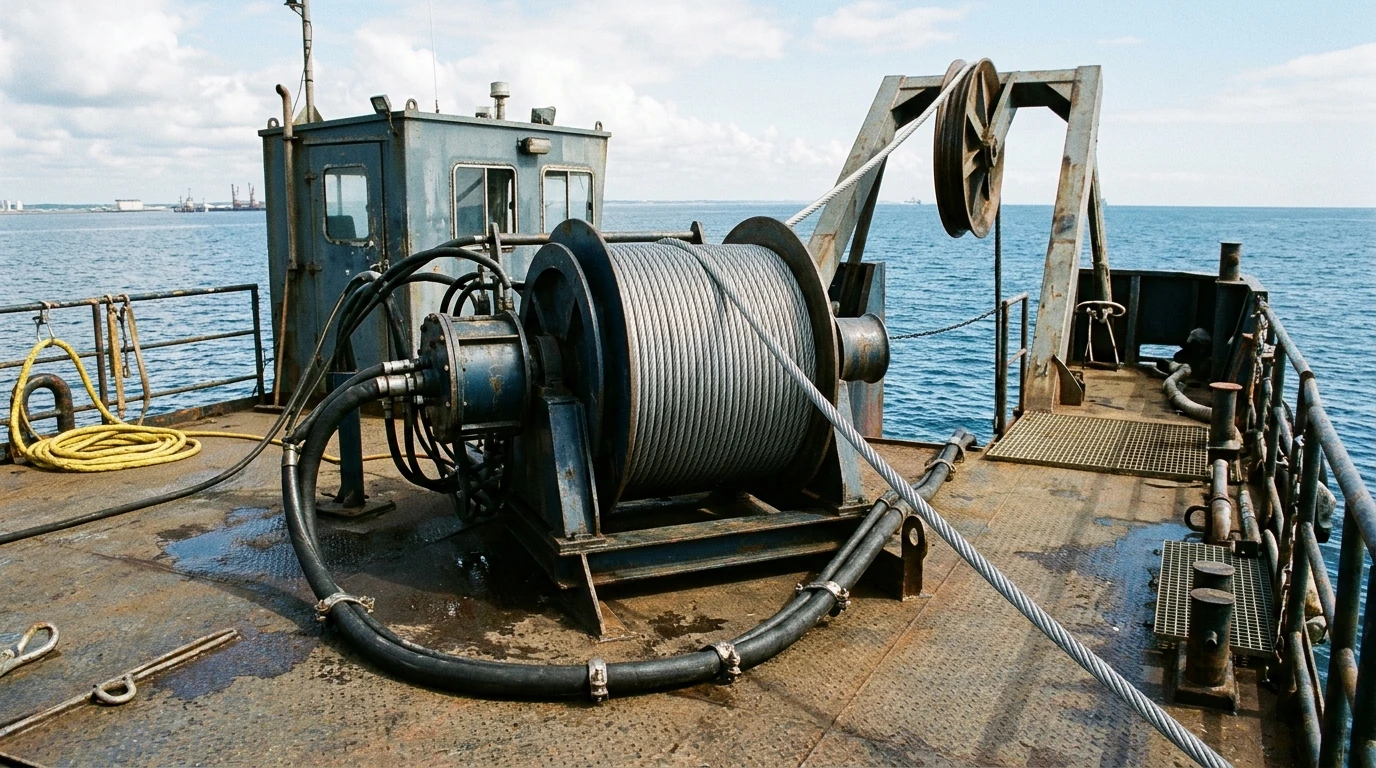
Project at a glance
| Application | Spare load-bearing electro-optical umbilical and companion FMBP deck cable engineering for an offshore pontoon project |
|---|---|
| Customer | Marine and offshore engineering contractor in Southeast Asia (company and personnel names withheld) |
| Designation | RS726 FMV-RP2.6/2.4 equivalent: Gs(12) + 9×16 mm² + 5×4 mm² + A2-0.35 mm² (1.8/3.0 kV, Um 3.3 kV) |
| Required length | 300 m in one continuous splice-free length on one export reel |
| Overall diameter | 41.0 ± 0.5 mm over the outer steel wire armour (31.0 mm nominal over the orange polyester inner sheath) |
| Mechanical rating | 36×2.6 + 46×2.4 mm contra-helical Zn-5Al steel armour wires; 670 kN breaking load; 190 kN yield load |
| Weight & bending | 5,800 kg/km in air (1,740 kg for 300 m); 4,400 kg/km in seawater (1,320 kg for 300 m); 600 mm min. dynamic bend radius |
Why did the spare pontoon umbilical have to hold 41.0 ± 0.5 mm overall diameter?
On a grooved marine winch, outer diameter is a mechanical interface dimension rather than a cosmetic tolerance. The pontoon spread uses a helical drum shell, guided sheave throat and mechanical armour termination socket sized for a 41.0 mm umbilical; supplying an oversize 43 mm or undersize 38 mm alternative would disrupt multi-layer spooling pitch and force costly mechanical modifications.
When an offshore contractor sources an alternative supplier for a legacy European subsea umbilical, electrical equivalence alone is not enough. Grooved drum shells typically machine the groove pitch to about 1.01–1.02 × nominal cable diameter and the groove radius to 0.525–0.55 × diameter. Keeping the finished cable within 41.0 ± 0.5 mm ensures clean layer-to-layer crossover pyramids, preserves fleet-angle geometry, and fits existing potted socket cones. We detail the full drum-pitch calculation in our guide to matching replacement umbilicals to existing winch grooves and sheaves.
How is the 9×16 + 5×4 + 4×0.34 + 12FO core layout built inside a 31.0 mm inner sheath?
Inside the 31.0 mm nominal orange thermoplastic polyester inner sheath, all power, control and optical circuits are laid up in concentric planetary layers around the central screened quad, sealing the electro-optical core against radial crush and longitudinal moisture ingress.


| Functional element | Count & size | Construction & insulation | Electrical / optical benchmark |
|---|---|---|---|
| Main MV power cores (UNIT-P16) | 9 × 16 mm² | Stranded copper (7×1.78 mm), semiconducting PP + colour-coded PP insulation (6.5 mm core OD) for Fwd HPU, Aft HPU & TMS | 1.8/3.0 (3.3) kV; ≤ 1.27 Ω/km DC at 20 °C; 16 kV DC / 5 min HV test; > 5 GΩ·km IR |
| Auxiliary MV power cores (UNIT-P4) | 5 × 4 mm² | Stranded copper (7×0.88 mm), semiconducting PP + colour-coded PP insulation (4.0 mm core OD) for Cage & Vehicle circuits | 1.8/3.0 (3.3) kV; ≤ 5.20 Ω/km DC at 20 °C; 16 kV DC / 5 min HV test; > 5 GΩ·km IR |
| Centre screened quad (UNIT-SQ / A2) | 4 × 0.35 mm² (0.34 mm² class) | Two pairs (7×0.25 mm Cu, 1.4 mm PP), jelly-filled with PET tape, 8×0.2 mm drain wires, Al/PET screen & PP sheath (4.6 mm OD) | ≤ 118 Ω/km loop DC resistance at 20 °C; 2.5 kV DC / 10 s routine test; > 5 GΩ·km IR |
| Laser-welded optical tube Gs(12) | 12 × 9/125 µm SMF | 2.3 mm hermetically laser-welded 316L stainless steel FIMT filled with gel and PP-sheathed to 4.0 mm OD | ITU-T G.652.D single-mode fibres; ≤ 0.6 dB/km @ 1310 nm and ≤ 0.4 dB/km @ 1550 nm cabled limit |
| Shared inner sheath | 31.0 mm nominal OD | Extruded high-strength orange thermoplastic polyester elastomer inner sheath over screened 27.1 mm core bundle | Mechanical bedding cushion under high radial crush loads on multi-layer winches |
On project inquiry sheets this construction is frequently abbreviated as UMBILICAL & DECK CABLE 9*16+5*4+4*0.34+12FO, reflecting the 0.34–0.35 mm² (~22 AWG) telemetry quad gauge conversion. Full variant tables covering both the 41.0 mm RS726 family and the 28.6 mm RS935 sister build are published on our RS726 and RS935 pontoon and ROV umbilical product page.
How do the 36×2.6 + 46×2.4 mm contra-helical steel armour wires achieve 670 kN breaking load?
Two contra-helical layers of high-tensile Zn-5Al alloy-coated steel wires—36 × 2.6 mm wires right-lay in the inner layer and 46 × 2.4 mm wires left-lay in the outer layer—carry the axial tension while opposing each other’s lay torque so the pontoon payload does not spin under load changes.

| Mechanical parameter | 41.0 mm RS726 FMV-RP2.6/2.4 specification | Engineering role on the pontoon spread |
|---|---|---|
| Armour wire package | 36 × 2.6 mm inner (right lay) + 46 × 2.4 mm outer (left lay) Zn-5Al steel wires | Balances rotational torque under cyclic wave heave and winch tension |
| Bedding & corrosion barrier | PUR bedding/separator tapes + Zn-5Al alloy coating + corrosion-blocking compound | Inhibits saltwater galvanic fretting between counter-wound wire layers |
| Minimum breaking load (MBL) | 670 kN | Ultimate axial tensile capacity of the double armour package |
| Working / yield load | 190 kN yield load | Tensile envelope protecting copper conductors and optical tube from axial strain |
| Minimum dynamic bend radius | 600 mm under tension (1,200 mm bend diameter, ~14.6 × OD) | Protects stainless FIMT and semiconducting PP cores over overboarding sheaves |
| Mass in air / seawater | 5,800 kg/km in air / 4,400 kg/km in seawater | 300 m net cable weight = 1,740 kg in air (1,320 kg submerged) |
| Operating envelope | 1.8/3.0 (3.3) kV MV power + 12 SM optical telemetry | Supports offshore pontoon winches and 150–250 HP work-class ROV spreads |
Where deeper subsea coring, seabed CPT rigs or heavy ROV LARS spreads demand lift capacities up to 880–1,014 kN, buyers can also review our RM-series and EOM work-class ROV main-lift umbilicals, our 2-layer and 4-layer steel-armoured seabed drilling umbilicals, and compact 0.680 / 0.681 inch oceanographic deep-tow winch cables.
41.0 mm FMV-RP wet umbilical vs 35.0 mm FMBP companion topside deck cable
Pontoon and ROV systems split the circuit at the winch slip-ring junction box: the dynamic overboard run uses the 41.0 mm FMV-RP2.6/2.4 double wire-armoured wet umbilical, while the fixed topside run from the winch to the HV power van uses the 35.0 mm RS726-DC FMBP steel-tape flame-retardant PVC deck cable.
| Comparison item | RS726 FMV-RP2.6/2.4 Wet Umbilical (Winch to Subsea) | RS726-DC FMBP Topside Deck Cable (Winch to Power Van) |
|---|---|---|
| Core schedule | Gs(12) + 9×16 mm² + 5×4 mm² + A2-0.35 mm² (31.0 mm core) | Identical Gs(12) + 9×16 mm² + 5×4 mm² + A2-0.35 mm² (31.0 mm core) |
| Outer mechanical layer | 36×2.6 + 46×2.4 mm contra-helical Zn-5Al steel wires | Dual 0.2 mm galvanized steel tapes (< 20% gap) + 1.5 mm black FR-PVC sheath |
| Nominal outer diameter | 41.0 ± 0.5 mm | 35.0 ± 1.0 mm |
| Nominal weight in air | 5,800 kg/km | 2,800 kg/km |
| Minimum bending radius | 600 mm dynamic under tension | 350 mm static routing on deck cable trays (1.0 kN SWL) |
Keeping the exact same 31.0 mm core layout and conductor colour coding across both cables eliminates cross-mapping mistakes at the winch junction box while cutting topside tray weight by more than half. For spreads that also include a Tether Management System (TMS) and neutrally buoyant excursion cable, see our engineering comparison of ROV main-lift umbilicals, excursion tethers and topside deck cables.
Factory electrical, optical and dimensional verification before reel dispatch
Before a 300 m spare umbilical leaves the Taicang plant, routine factory verification checks every conductor group, optical fibre and armour diameter on the finished reel so the contractor can install it directly into critical spares inventory.
| Routine factory check | Test parameter & acceptance benchmark |
|---|---|
| DC conductor resistance (20 °C) | ≤ 1.27 Ω/km on all nine 16 mm² cores; ≤ 5.20 Ω/km on all five 4 mm² cores; ≤ 118 Ω/km loop on A2-0.35 quad |
| High-voltage dielectric withstand | 16 kV DC for 5 min on both 16 mm² and 4 mm² 1.8/3.0 (3.3) kV cores; 2.5 kV DC for 10 s on 0.35 mm² quad |
| Insulation resistance | > 5 GΩ·km across MV power cores and screened quad at ambient factory temperature |
| Bidirectional OTDR optical trace | ≤ 0.6 dB/km at 1310 nm and ≤ 0.4 dB/km at 1550 nm across all 12 cabled G.652.D fibres, zero splice steps |
| Two-axis OD & surface inspection | 41.0 ± 0.5 mm verified along the run; continuous lay pitch, compound fill and zero armour birdcaging |
What to send for a replacement pontoon or ROV umbilical review
- Existing cable datasheet or legacy designation (for example RS726, RS935, RM-series, 23SSA33 or A302351), if replacing an installed cable
- Exact nominal outer diameter and maximum permissible +/- mm tolerance dictated by your winch drum grooves and sheaves
- Required continuous splice-free length per reel (such as 300 m, 1,200 m or 3,000 m) and any companion topside deck jumper length
- Power core count, cross-section (mm² or AWG), operating voltage (V AC/DC) and required DC test voltage
- Control/telemetry pair or quad count, characteristic impedance (Ω) and optical fibre type/count (G.652.D SM or OM3/OM4 MM)
- Required safe working load (SWL), minimum breaking load (MBL), operating water depth and outer finish (exposed galvanized steel armour or extruded HDPE/TPU jacket)
Browse full subsea schedules on our pontoon and ROV umbilical & deck cable page, explore our custom subsea and marine cable solutions, or view all marine and offshore cables.
Send your umbilical datasheet or core schedule for engineering review →
Questions on 41.0 mm pontoon and ROV spare umbilical cables
What does 9×16 + 5×4 + 4×0.34 + 12FO mean on an umbilical cable schedule?
It defines a four-function hybrid electro-optical core assembly: nine 16 mm² medium-voltage main power conductors, five 4 mm² auxiliary power conductors, one central screened star-quad of four 0.35 mm² (~0.34 mm² / 22 AWG) signal conductors, and twelve ITU-T G.652.D single-mode optical fibres housed inside a 2.3 mm laser-welded stainless steel tube (Gs(12)).
Why must a replacement pontoon or ROV umbilical match the original 41.0 mm outer diameter?
Because existing Lebus grooved winch shells, level-wind fleet angles, overboarding sheave throats and mechanical armour termination cones are machined around the exact nominal cable diameter. Holding 41.0 ± 0.5 mm prevents turn pinching, flange climbing and premature wire fatigue without re-machining the winch drum.
What are the yield load and minimum breaking load of the 41.0 mm double steel-armoured umbilical?
With two contra-helical layers of Zn-5Al alloy-coated steel armour wires (36 × 2.6 mm inner wires + 46 × 2.4 mm outer wires), the minimum breaking load is 670 kN and the copper-yield working load limit is 190 kN.
What is the difference between the 41.0 mm FMV-RP wet umbilical and the 35.0 mm FMBP topside deck cable?
Both cables share the identical 31.0 mm orange polyester electro-optical inner core (Gs(12)+9×16+5×4+A2-0.35), so junction-box pinouts match one-for-one. The 41.0 mm FMV-RP2.6/2.4 wet umbilical adds two contra-helical Zn-5Al steel wire armour layers (5,800 kg/km, 670 kN MBL) for dynamic winch tension, whereas the 35.0 mm RS726-DC FMBP topside deck cable wraps dual 0.2 mm galvanized steel tapes under a black flame-retardant PVC outer sheath (2,800 kg/km) for fixed routing between the winch slip ring and the power van.
How much does a 300 m continuous length of the 41.0 mm RS726 umbilical weigh?
At 5,800 kg/km in air, a 300 m continuous length has a net cable mass of 1,740 kg before adding the export steel or reinforced wooden reel. Submerged in seawater, the effective cable weight drops to 4,400 kg/km (1,320 kg for 300 m).