

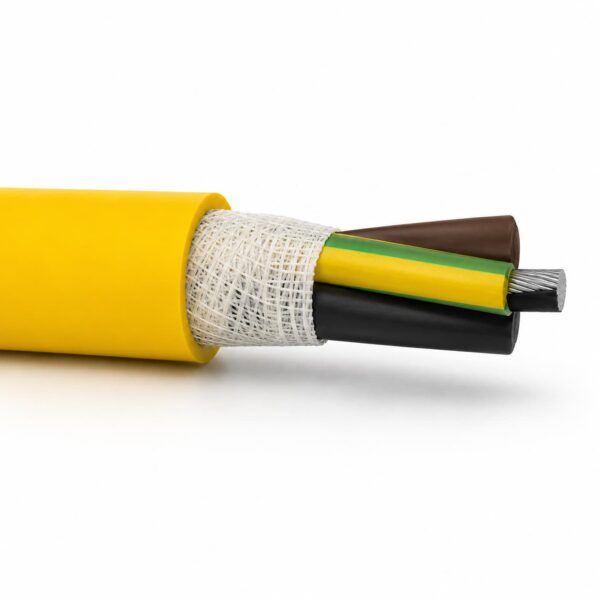
(N)SHTÖU 0.6/1kV Low Voltage Reeling Cable
(N)SHTÖU 0.6/1kV Low Voltage Reeling Cable is a TEBAOFLEX cable for the application and operating conditions identified in the original product record. Standard references describe the construction or test method stated in the product data. Project-specific approvals, certificates and test reports should be confirmed in the quotation documents. The following values are taken from the supplied product data. Minimum and maximum overall diameters support drum-groove, guide-roller and cable-entry planning. Send the exact size, length, installation duty and documentation requirements for a technical quotation.
(N)SHTÖU 0.6/1kV Low Voltage Reeling Cable is a TEBAOFLEX cable for the application and operating conditions identified in the original product record. Standard references describe the construction or test method stated in the product data. Project-specific approvals, certificates and test reports should be confirmed in the quotation documents. The following values are taken from the supplied product data. Minimum and maximum overall diameters support drum-groove, guide-roller and cable-entry planning. Final production dimensions should be confirmed for the selected conductor arrangement before equipment design is frozen. Select the conductor cross-section from the required current, route length, voltage-drop limit, ambient temperature, grouping and the applicable DIN VDE 0298-4 current rating. Reeling installations need an additional thermal check because multiple energized cable layers on a drum cannot dissipate heat as effectively as a freely exposed cable. Mechanical selection should include the minimum drum and guide-roller diameters, the bending radius required by DIN VDE 0298-3, acceleration, travel distance, reversing frequency and maximum pulling force. The travel-speed figures are upper limits for the stated installation modes, not a substitute for checking the complete cable-management system. Keep the working tensile load within 20 N/mm² and do not use the cable as a load-bearing lifting member. For an RFQ, provide the conductor arrangement, required length, drum orientation, number of cable layers, travel speed, duty cycle, ambient temperature, oil or water exposure, sheath colour and required inspection documents. The source record places this product in port & festoon cables. Before ordering, confirm the exact product variant, conductor or core arrangement, system rating, route conditions, equipment connection and required documentation against the project specification.
(N)SHTÖU 0.6/1kV Low Voltage Reeling Cable construction
The original product record does not separate a construction section, so the confirmed construction-related attributes are retained below.
| Conductor | Class 5 stranded tinned copper; plain copper on request |
|---|---|
| Insulation | 3GI3 HEPR-based elastomer |
| Inner Sheath | GM1b elastomer |
| Outer Sheath | 5GM3 heavy-duty special rubber |
| Sheath Colour | Black or yellow |
| Maximum Conductor Temperature | 90°C |
(N)SHTÖU 0.6/1kV Low Voltage Reeling Cable applications
Applications
- Motorized and spring-operated reeling drums
- Horizontal reeling systems on cranes and transport machinery
- Festoon systems with controlled cable loops
- Hoists, lifting equipment and material-handling machinery
- Drum and drag-cable service in dry, damp and wet industrial areas
- Mobile power connections exposed to bending, tensile and torsional stresses
Selection Notes for Buyers
Select the conductor cross-section from the required current, route length, voltage-drop limit, ambient temperature, grouping and the applicable DIN VDE 0298-4 current rating. Reeling installations need an additional thermal check because multiple energized cable layers on a drum cannot dissipate heat as effectively as a freely exposed cable.
Mechanical selection should include the minimum drum and guide-roller diameters, the bending radius required by DIN VDE 0298-3, acceleration, travel distance, reversing frequency and maximum pulling force. The travel-speed figures are upper limits for the stated installation modes, not a substitute for checking the complete cable-management system. Keep the working tensile load within 20 N/mm² and do not use the cable as a load-bearing lifting member.
For an RFQ, provide the conductor arrangement, required length, drum orientation, number of cable layers, travel speed, duty cycle, ambient temperature, oil or water exposure, sheath colour and required inspection documents. This information allows the cable dimensions, conductor size and mechanical design to be checked against the actual machine.
Selection checks
Confirm the equipment interface, installation method, route length, movement or flexing duty, environmental exposure, conductor or core requirements and project documentation before final selection.
Reference designation cross-reference
This reeling cable is also catalogued under a separate brand name for the same drum duty.
| Reference designation | TEBAOFLEX designation and build | Rated voltage | What the reference name marks |
|---|---|---|---|
| TROMMELFLEX KSM-S / (N)SHTOEU-J | (N)SHTÖU 0.6/1 kV reeling cable | 0.6/1 kV | A catalogue name for the same drum and festoon duty; its published figures are its own build and do not replace the values on this page |
For the full list of reference designations and the TEBAOFLEX build each one maps to, see the mining cable designation cross-reference.
Trademark note: TENAX®, TROMMELFLEX®, FELTOFLEX® and SCHRÄM® are trademarks of their respective owners, and TEBAOFLEX is neither affiliated with those companies nor reselling their cable. What we supply is the equivalent construction: we manufacture to the same VDE type designation and published construction, and every designation listed here can be quoted and supplied as a TEBAOFLEX build. The names appear so that an enquiry written in those terms reaches the matching construction, which is made to the standards and construction confirmed for the order.
(N)SHTÖU 0.6/1kV Low Voltage Reeling Cable specifications
The source-listed technical notes are retained below. Confirm the final size, tolerance, installation basis and ordered configuration before release.
Dimensions and Cable Weights
The following values are taken from the supplied product data. Minimum and maximum overall diameters support drum-groove, guide-roller and cable-entry planning. Final production dimensions should be confirmed for the selected conductor arrangement before equipment design is frozen.
Source-listed technical tables
The tables below retain the original product data, including units, ranges and ordering examples.
| Product Type | Low-voltage heavy-duty reeling and festoon cable |
| Model | (N)SHTÖU / NSHTÖU |
| Rated Voltage | 0.6/1 kV |
| Maximum Operating AC Voltage | 0.7/1.2 kV |
| Maximum Operating DC Voltage | 0.9/1.8 kV |
| AC Test Voltage | 3.5 kV |
| Maximum Conductor Temperature | 90°C |
| Maximum Short-Circuit Conductor Temperature | 250°C |
| Fixed Working Temperature | -40°C to +80°C |
| Mobile Working Temperature | -25°C to +80°C |
| Minimum Bending Radius | According to DIN VDE 0298-3, Table 3 |
| Current-Carrying Capacity | According to DIN VDE 0298-4 |
| Festoon Travel Speed | Up to 240 m/min |
| Horizontal Reeling Speed | Up to 120 m/min |
| Maximum Tensile Load | 20 N/mm² |
| Sheath Colour | Black or yellow |
| Construction | DIN VDE 0250-814 |
| General Requirements | DIN VDE 0250-1 |
| Guide to Use | DIN VDE 0298-3 |
| Electrical Tests | DIN VDE 0472-501, 502, 503, 508 |
| Non-Electrical Tests | DIN VDE 0472-401, 402, 602, 303, 615 |
| Tests Under Fire Conditions | DIN VDE 0472-803, 804 |
| Flame Test Methods | VDE 0482-332-1-2; DIN EN 60332-1-2; IEC 60332-1 |
| Oil-Resistance Test Methods | HD/EN/IEC 60811-2-1; DIN VDE 0473-811-2-1 |
| Conductors × Cross-Section (mm²) | Outer Diameter Min.-Max. (mm) | Approx. Cable Weight (kg/km) |
|---|---|---|
| 3 × 1.5 | 11.2-14.4 | 236 |
| 3 × 2.5 | 12.6-16.1 | 305 |
| 3 × 4 | 15.3-19.6 | 395 |
| 3 × 6 | 16.4-20.9 | 525 |
| 3 × 10 | 20.2-25.7 | 765 |
| 3 × 16 | 22.5-28.6 | 1080 |
| 3 × 35 | 31.7-40.0 | 2030 |
| 3 × 50 | 37.1-46.8 | 2680 |
| 3 × 70 | 42.5-53.5 | 3530 |
| 3 × 95 | 48.2-60.6 | 4400 |
| 3 × 120 | 51.6-64.9 | 5250 |
| 3 × 150 | 56.2-70.7 | 7040 |
| 3 × 185 | 63.3-79.4 | 8320 |
| 3 × 25 + 16 | 30.4-38.4 | 2720 |
| 3 × 35 + 16 | 34.0-42.8 | 3010 |
| 3 × 50 + 3 × 25/3 | 37.1-46.8 | 2730 |
| 3 × 50 + 25 | 38.6-48.6 | 3430 |
| 3 × 70 + 3 × 35/3 | 42.5-53.5 | 3740 |
| 3 × 70 + 35 | 45.6-57.4 | 4010 |
| 3 × 95 + 3 × 50/3 | 48.2-60.6 | 4690 |
| 3 × 95 + 50 | 53.1-66.7 | 5405 |
| 3 × 120 + 3 × 70/3 | 51.6-64.9 | 6220 |
| 3 × 120 + 70 | 55.5-69.7 | 6818 |
| 3 × 150 + 3 × 70/3 | 56.2-70.7 | 7480 |
| 3 × 150 + 70 | 64.0-80.4 | 9190 |
| 3 × 240 + 3 × 120/3 | 69.9-87.7 | 11760 |
Original product attributes
These product attributes are retained as supplied and should be checked against the ordered construction.
| Product Type | Low-voltage reeling and festoon cable |
|---|---|
| Model | (N)SHTÖU / NSHTÖU |
| Voltage Rating | 0.6/1 kV |
| Maximum AC Voltage | 0.7/1.2 kV |
| Maximum DC Voltage | 0.9/1.8 kV |
| Test Voltage | 3.5 kV AC |
| Conductor | Class 5 stranded tinned copper; plain copper on request |
| Insulation | 3GI3 HEPR-based elastomer |
| Inner Sheath | GM1b elastomer |
| Reinforcement | Anti-torsion textile braid embedded in sheath |
| Outer Sheath | 5GM3 heavy-duty special rubber |
| Sheath Colour | Black or yellow |
| Temperature Range | Fixed -40°C to +80°C; mobile -25°C to +80°C |
| Maximum Conductor Temperature | 90°C |
| Short-Circuit Temperature | 250°C maximum |
| Bending Radius | DIN VDE 0298-3, Table 3 |
| Maximum Tensile Load | 20 N/mm² |
| Travel Speed | Festoon up to 240 m/min; horizontal reeling up to 120 m/min |
| Standards | DIN VDE 0250-814; DIN VDE 0250-1; DIN VDE 0298-3 |
| Flame Test Methods | VDE 0482-332-1-2; DIN EN 60332-1-2; IEC 60332-1 |
| Oil-Resistance Test Methods | HD/EN/IEC 60811-2-1; DIN VDE 0473-811-2-1 |
| Application | Reeling drums, festoon systems, hoists, cranes, lifting and transport machinery |
TROMMELFLEX KSM-S reference variant
Part of the drum-reeling enquiries for this family arrive quoting the TROMMELFLEX KSM-S reference. It is a distinct build rather than another name for this cable, and the differences all sit in the mechanical package.
| Property | This page | KSM-S reference build |
|---|---|---|
| Conductor | Class 5 stranded tinned copper; plain copper on request | Plain copper, extra fine wire, class 5 |
| Earth conductor | Per the ordered core configuration | Split to the interstices |
| Torsion protection | Anti-torsion textile braid embedded in the sheath | Wide-meshed polyester braid embedded in the sheath |
| Outer sheath | 5GM3 heavy-duty special rubber | 5GM5 |
| Standard basis | DIN VDE 0250-814 | Similar to DIN VDE 0250 Part 814 |
| Minimum surface temperature, moved | -25 °C | -40 °C |
| Travel speed | Festoon up to 240 m/min; horizontal reeling up to 120 m/min | Up to 180 m/min |
| Minimum bending radius | DIN VDE 0298-3, Table 3 | 20 × D, bending radius to DIN VDE 0298 Part 3 |
| Test voltage | 3.5 kV AC | 4 kV AC, maximum operating voltage 1.2 kV |
The KSM-S column is reference-catalogue data for that variant and does not replace the values published for this cable. In particular the −40 °C moved temperature and the 180 m/min travel speed belong to the KSM-S construction, with its polyester braid and 5GM5 sheath. Before either figure is applied to an order against this page, the low-temperature cycling and the travel speed have to be verified for the build actually supplied. State the lowest expected start-up temperature and the required speed with the enquiry and the correct build will be quoted.
KSM-S current ratings are referred to a 30 °C ambient and corrected with the factors in DIN VDE 0298-4 Table 17: 1.1 at 20 °C, 0.95 at 35 °C, 0.89 at 40 °C, 0.84 at 45 °C and 0.77 at 50 °C.
For the generic rubber reeling entry point covering the TENAX-K family and TROMMELFLEX-K references, see NSHTÖU-J rubber reeling cable. For LHD duty see NSHTOEU LHD mining reeling cable.
Reference note: enquiries arriving marked TROMMELFLEX KSM-S or (N)SHTOEU-J are handled on this page; TEBAOFLEX manufactures to the (N)SHTÖU designation and the construction shown, and is not affiliated with the trademark holder.
(N)SHTÖU 0.6/1kV Low Voltage Reeling Cable standards and compliance
The following standard references are carried over from the original product record. They identify the source basis and do not replace project-specific certification or inspection requirements.
- Minimum Bending Radius According to DIN VDE 0298-3, Table 3
- Current-Carrying Capacity According to DIN VDE 0298-4
- Construction DIN VDE 0250-814
- General Requirements DIN VDE 0250-1
- Guide to Use DIN VDE 0298-3
- Electrical Tests DIN VDE 0472-501, 502, 503, 508
- Non-Electrical Tests DIN VDE 0472-401, 402, 602, 303, 615
- Tests Under Fire Conditions DIN VDE 0472-803, 804
- Flame Test Methods VDE 0482-332-1-2; DIN EN 60332-1-2; IEC 60332-1
- Oil-Resistance Test Methods HD/EN/IEC 60811-2-1; DIN VDE 0473-811-2-1
- Select the conductor cross-section from the required current, route length, voltage-drop limit, ambient temperature, grouping and the applicable DIN VDE 0298-4 current rating. Reeling installations need an additional thermal check because multiple energized cable layers on a drum cannot dissipate heat as effectively as a freely exposed cable.
Where a project requires a test report, certificate, marking record or inspection release, include that requirement in the quotation request.
Related cable options
Compare these cable options by service combination, movement, load, voltage and transmission requirement.
NSHTÖU-J Rubber Reeling Cable 0.6/1 kV for Hoisting and Hauling Equipment
A related cable option for a different application or duty profile.
View product
NSHTOEU 0.6/1kV LHD Mining Reeling Cable
A related cable option for a different application or duty profile.
View productRequest a cable recommendation and quotation
Send the required services, cable length, mechanical duty, environment, termination and quantity. Our team will review the application before quoting.
- Include the product name or SKU plus the required cable length and quantity.
- Attach a specification, drawing or data sheet when available.