

Project record · Poland · Mining stockyard · Bucket-wheel stacker-reclaimer
Stacker-Reclaimer Reeling Cable for a Polish Mine: (N)SHTÖU-J 3×70 and 3×185, Tested Before Shipment
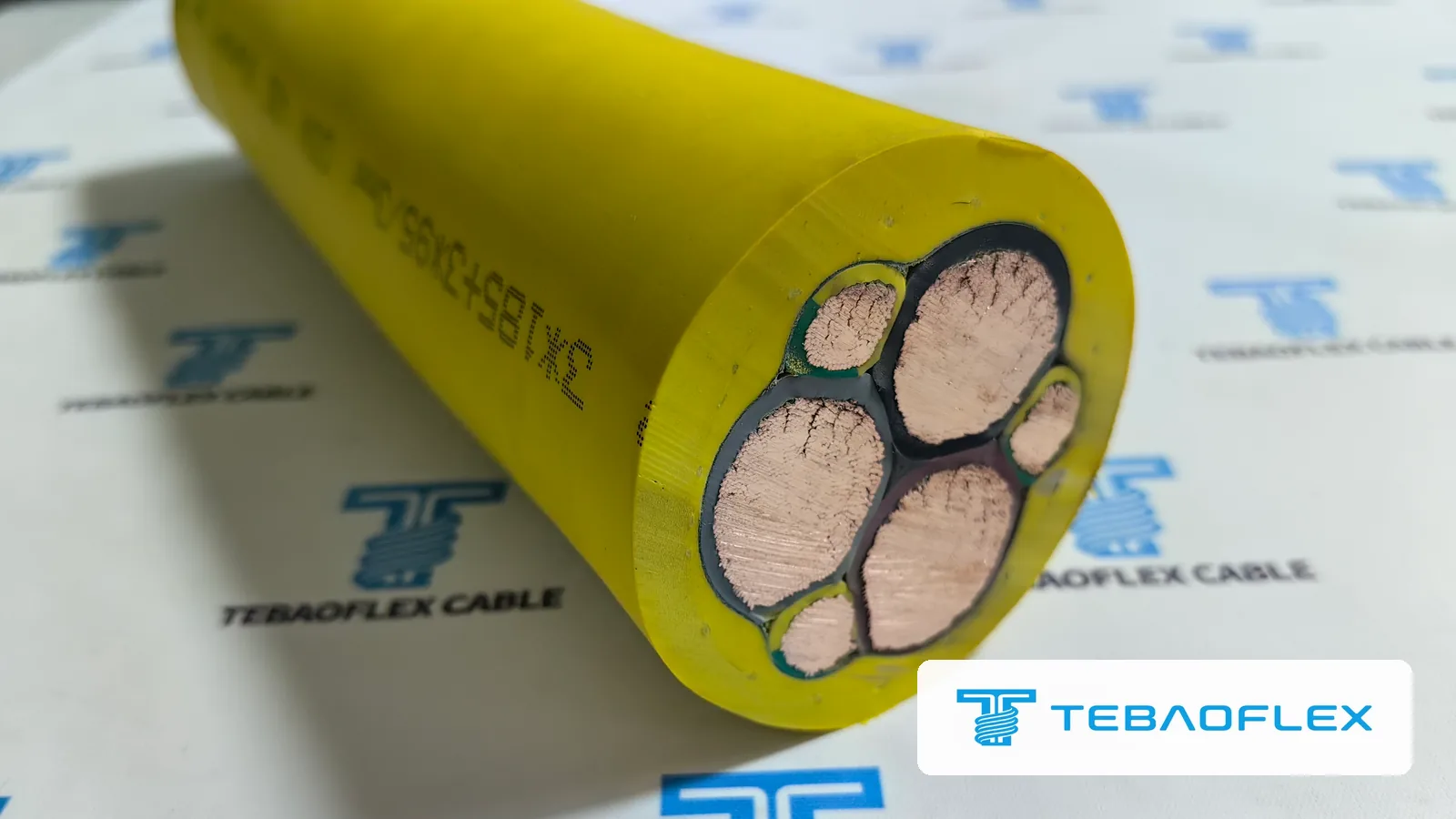
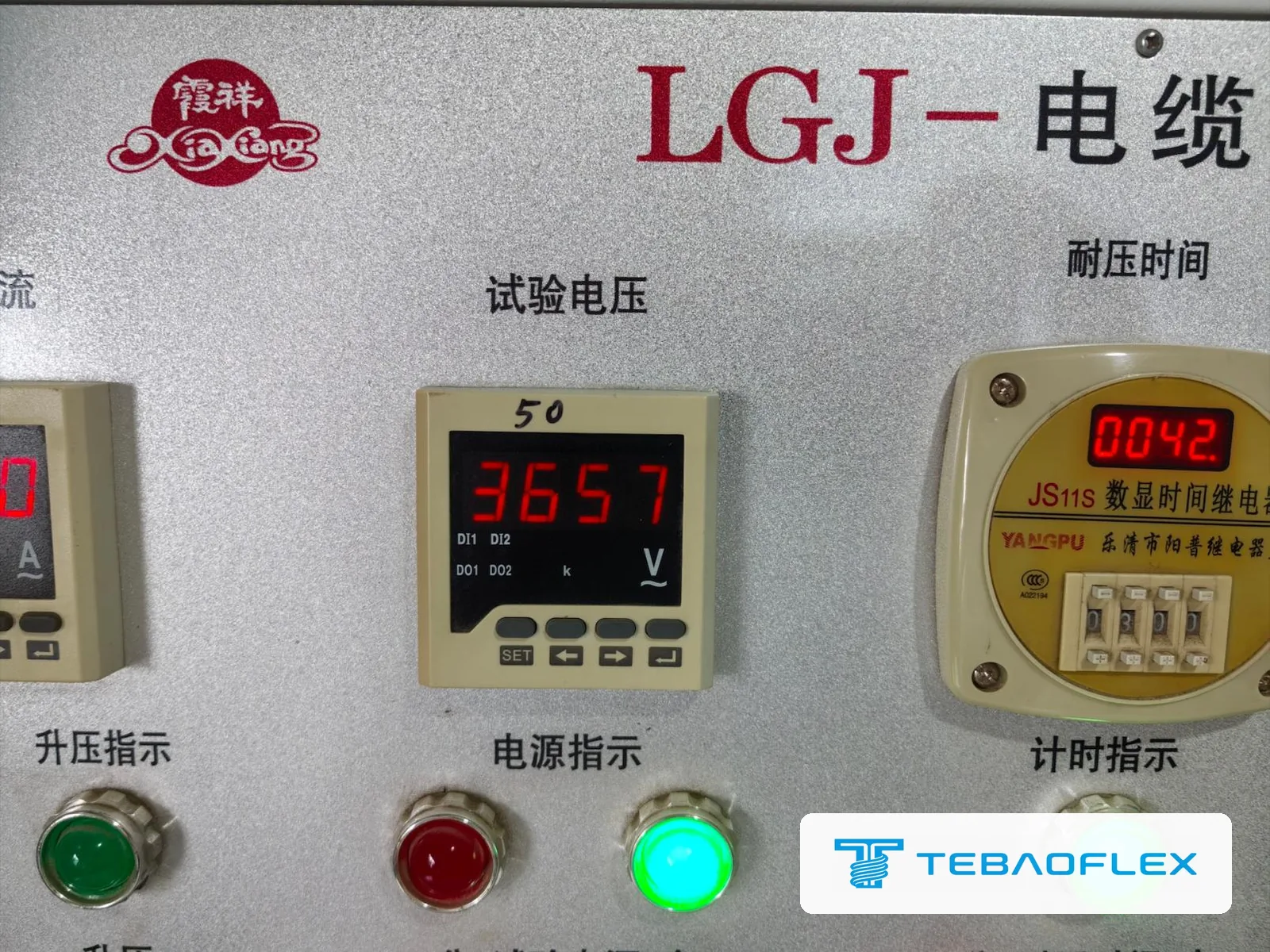
A Polish mining company needed stacker reclaimer reeling cable for the cable reeling drum of a rail-mounted bucket-wheel machine on an above-ground stockyard. TEBAOFLEX supplied two (N)SHTÖU-J 0.6/1 kV sizes, 3×70+3×35/3 and 3×185+3×95/3, with tinned copper conductors, EPR insulation, a yellow polychloroprene (PCP) inner and outer sheath and an aramid braid between them. Before the order TEBAOFLEX sent 160 m of each size, freight paid for this project, to the machine builder in Shandong, China, where both cables were installed on the reel and run during commissioning. The production drums then passed a factory acceptance test, including an AC voltage test at 3,657 V for 5 minutes with no breakdown.
Project at a glance
| Location | Poland |
|---|---|
| End user | A Polish mining company (name not published) |
| Same buyer, medium voltage | The 12/20 kV reeling cable for this buyer's bucket-wheel excavator is described in the bucket-wheel excavator reeling cable case. |
| Machine | Rail-mounted bucket-wheel stacker-reclaimer on an above-ground stockyard, built by a stacker-reclaimer maker in Shandong, China |
| Cable duty | Power cables wound on the machine’s cable reeling drum |
| Cable type | (N)SHTÖU-J 0.6/1 kV heavy-duty rubber reeling cable, construction with reference to DIN VDE 0250-814 (standard build on the NSHTOU-J reeling cable page) |
| Sizes | 3×70+3×35/3 and 3×185+3×95/3 |
| Measured outer diameter | 44.45 mm (3×70+3×35/3) and 63.23 mm (3×185+3×95/3) |
| Special features | Yellow 5GM5 PCP inner and outer sheath; aramid braid (conductors are tinned copper, as in the standard (N)SHTÖU build) |
| Trial | 160 m of each size, freight paid by TEBAOFLEX, installed on the reel and run during commissioning at the machine builder |
| Result | Order placed after the trial |
| Factory acceptance test | September 2026: continuity, insulation resistance, AC voltage test at 3,657 V for 5 minutes, conductor resistance, strip and section checks |
| Packing | Export drums sized to cable diameter and weight, closed with battens, braced in the container |
What reeling cable does a bucket-wheel stacker-reclaimer need?
A bucket-wheel stacker-reclaimer needs a heavy-duty rubber reeling cable. The machine travels the stockyard on rails, so its power cable is paid out and wound back on a motorised cable reeling drum. The cable must have a fine-stranded Class 5 conductor, rubber insulation and sheaths that tolerate constant winding, a braid that takes pull and torsion, and a sheath that resists weather, abrasion and oil. For a Polish mine TEBAOFLEX supplied (N)SHTÖU-J 0.6/1 kV, a construction with reference to DIN VDE 0250-814.
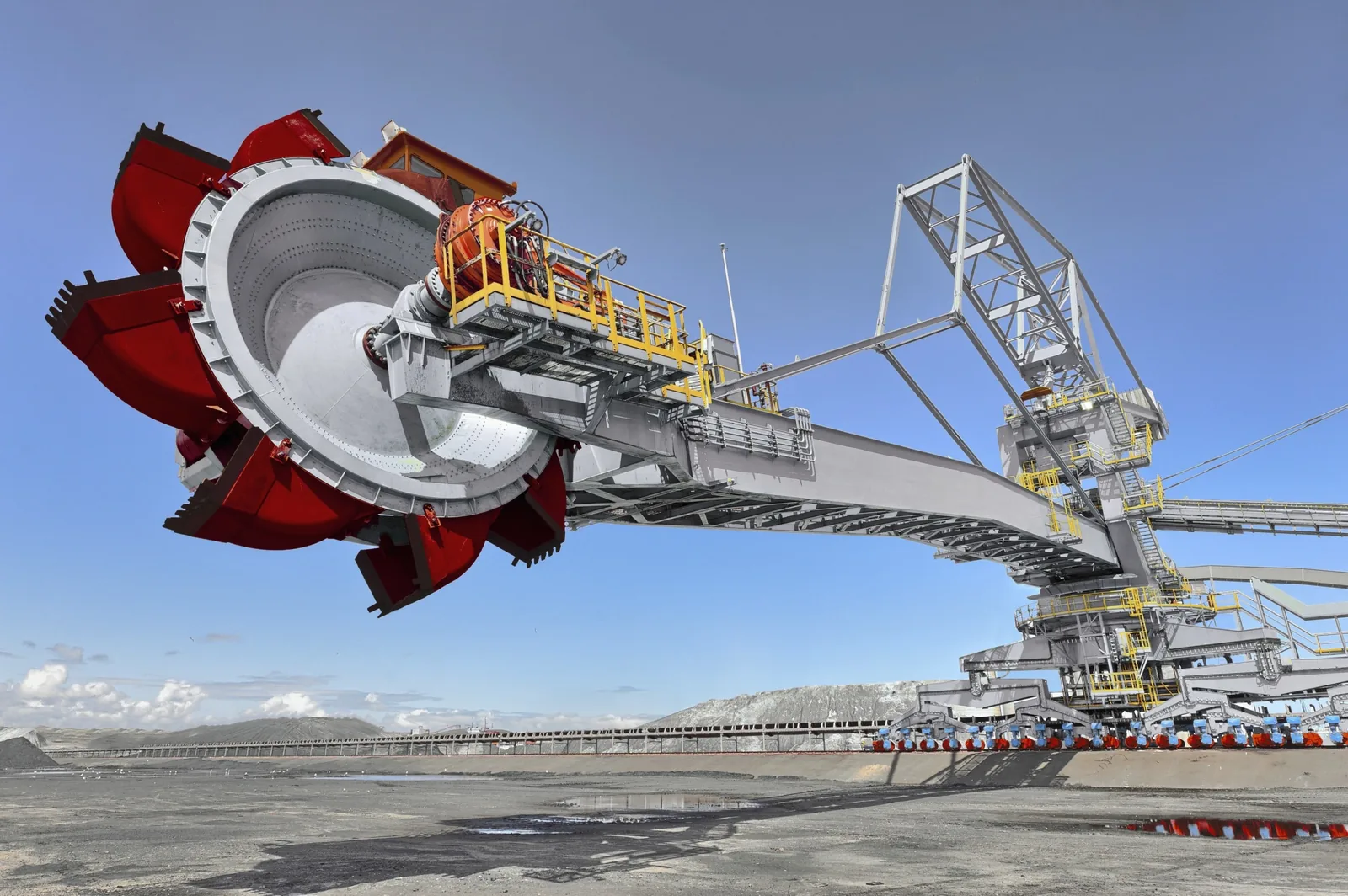
A stacker-reclaimer does two jobs with one machine. When stacking, its boom conveyor builds the stockpile; when reclaiming, the bucket wheel digs material back onto the yard conveyor. Both happen while the machine moves along its track, so the reeling cable works under tension, bending and torsion for the life of the machine, outdoors, in dust, rain and frost.
The designation describes that build. NSHTÖU is a heavy rubber sheathed cable with a strength member between the inner and outer sheath, and the J adds a green-yellow protective conductor inside the cable. The letters are decoded one by one in our guide to reading VDE cable designations, and the variants are compared on the NSHTOU cable family page.
NSHTOEU-J 3×70+3×35/3 and NSHTOEU-J 3×185+3×95/3: construction for this order
Both (N)SHTÖU-J 0.6/1 kV sizes in this Polish stacker-reclaimer order share one construction: Class 5 tinned copper conductors to IEC 60228, EPR insulation, a protective conductor split into three cores, a yellow PCP inner sheath, an aramid braid and a yellow PCP outer sheath, both sheaths in 5GM5 compound. Only the conductor sizes and the outer diameter differ: 44.45 mm for 3×70+3×35/3 and 63.23 mm for 3×185+3×95/3.
| Layer | NSHTOEU-J 3×70+3×35/3 | NSHTOEU-J 3×185+3×95/3 |
|---|---|---|
| Rated voltage U₀/U | 0.6/1 kV | 0.6/1 kV |
| Power conductors | 3 × 70 mm², Class 5 tinned copper (IEC 60228) | 3 × 185 mm², Class 5 tinned copper (IEC 60228) |
| Protective conductor | 35 mm² split into 3 green-yellow cores (3 × 35/3 mm²) | 95 mm² split into 3 green-yellow cores (3 × 95/3 mm²) |
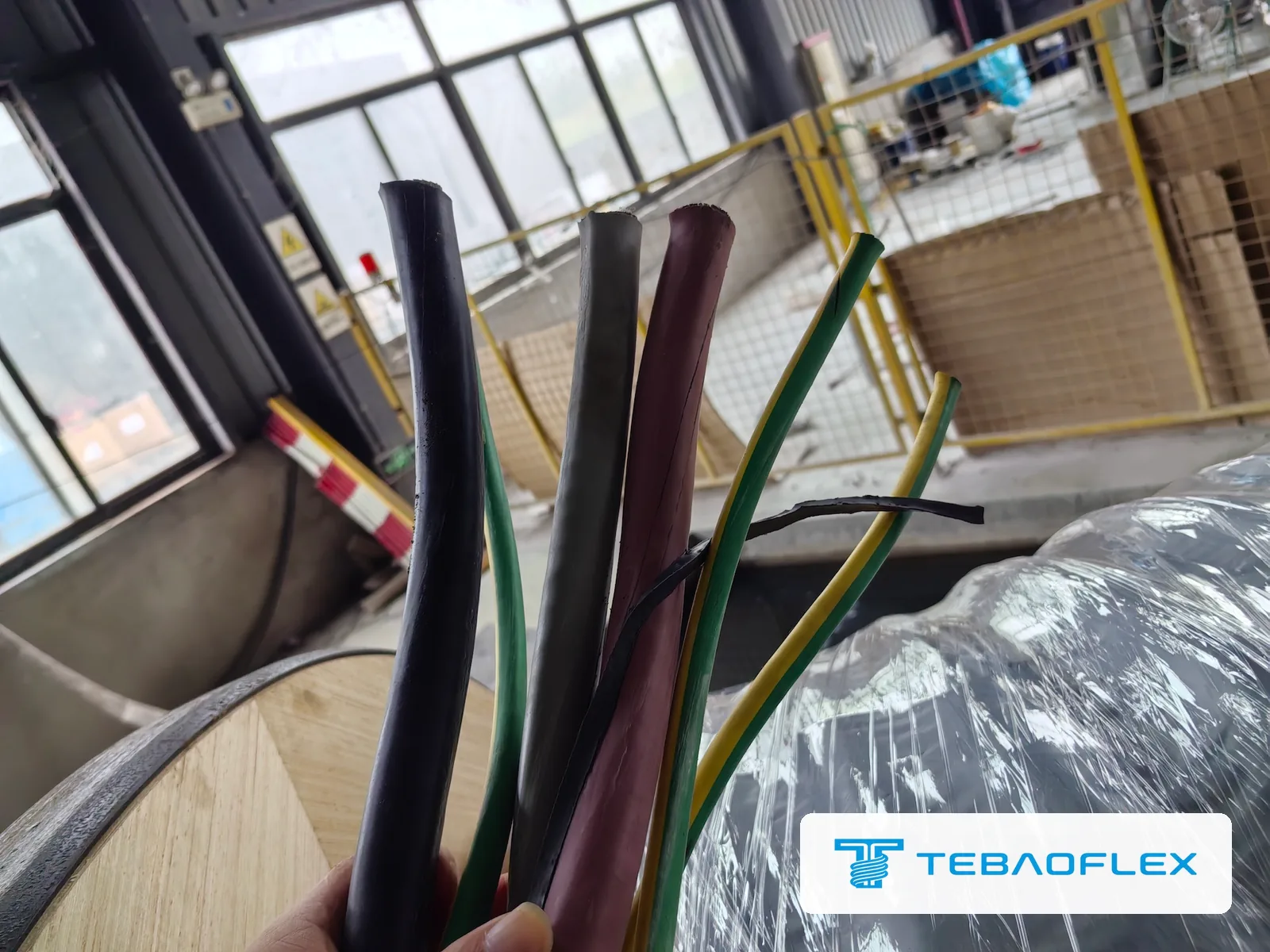
| Insulation | EPR; power cores brown, black, grey | EPR; power cores brown, black, grey |
| Lay-up | Cores laid up round a central rubber filler, non-woven tape over the lay-up | Cores laid up round a central rubber filler, non-woven tape over the lay-up |
| Inner sheath | Extruded PCP (polychloroprene) 5GM5, yellow | Extruded PCP (polychloroprene) 5GM5, yellow |
| Reinforcement | Aramid fibre braid | Aramid fibre braid |
| Outer sheath | Extruded PCP 5GM5, yellow, oil- and weather-resistant | Extruded PCP 5GM5, yellow, oil- and weather-resistant |
| Measured outer diameter | 44.45 mm | 63.23 mm |
These are the values on the order data sheet. The standard (N)SHTÖU build described on our NSHTOU family page uses a GM1b inner sheath, a textile anti-torsion braid and a 5GM3 outer sheath; this order used 5GM5 PCP for both sheaths and an aramid braid instead, in yellow.
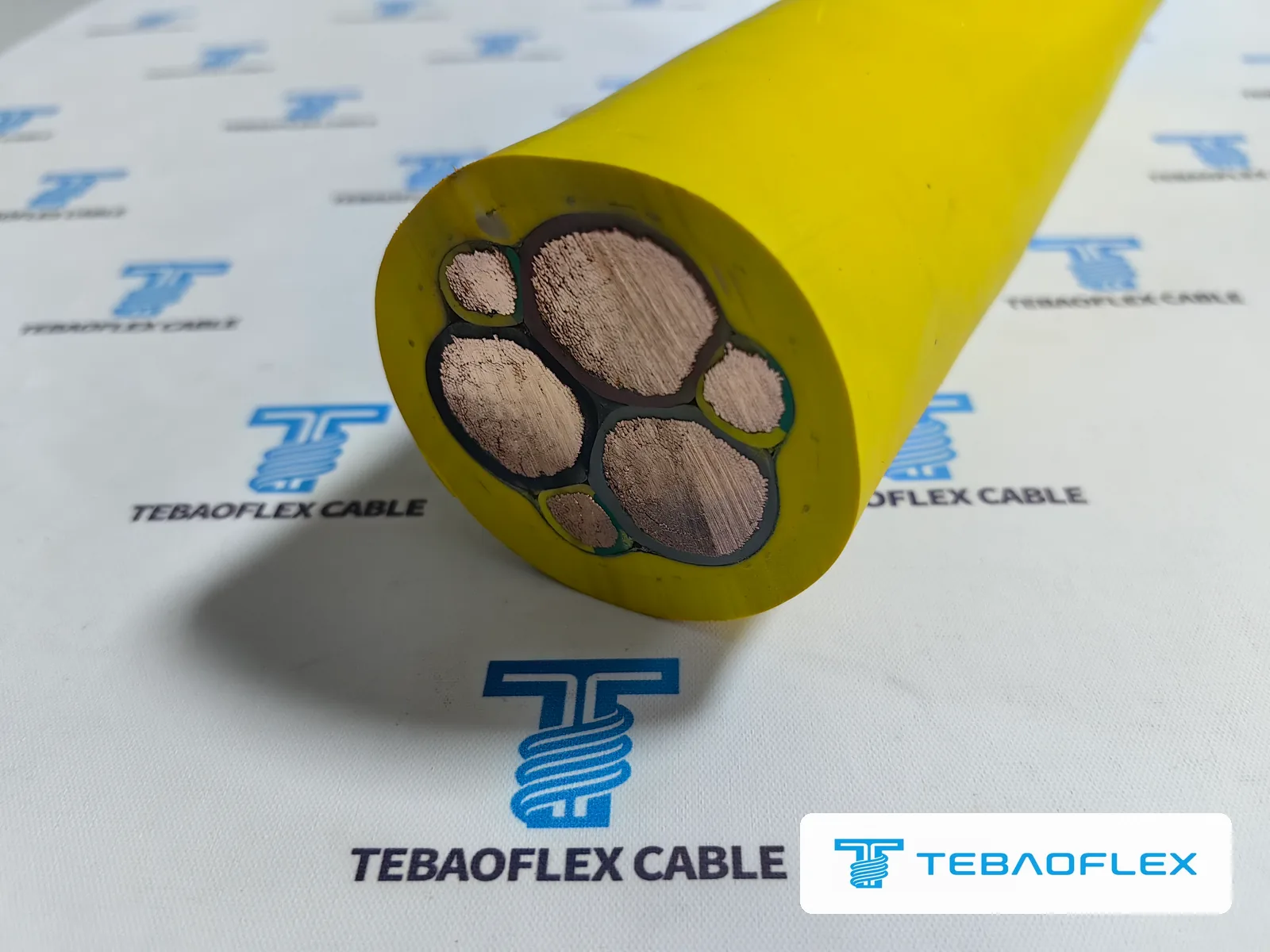
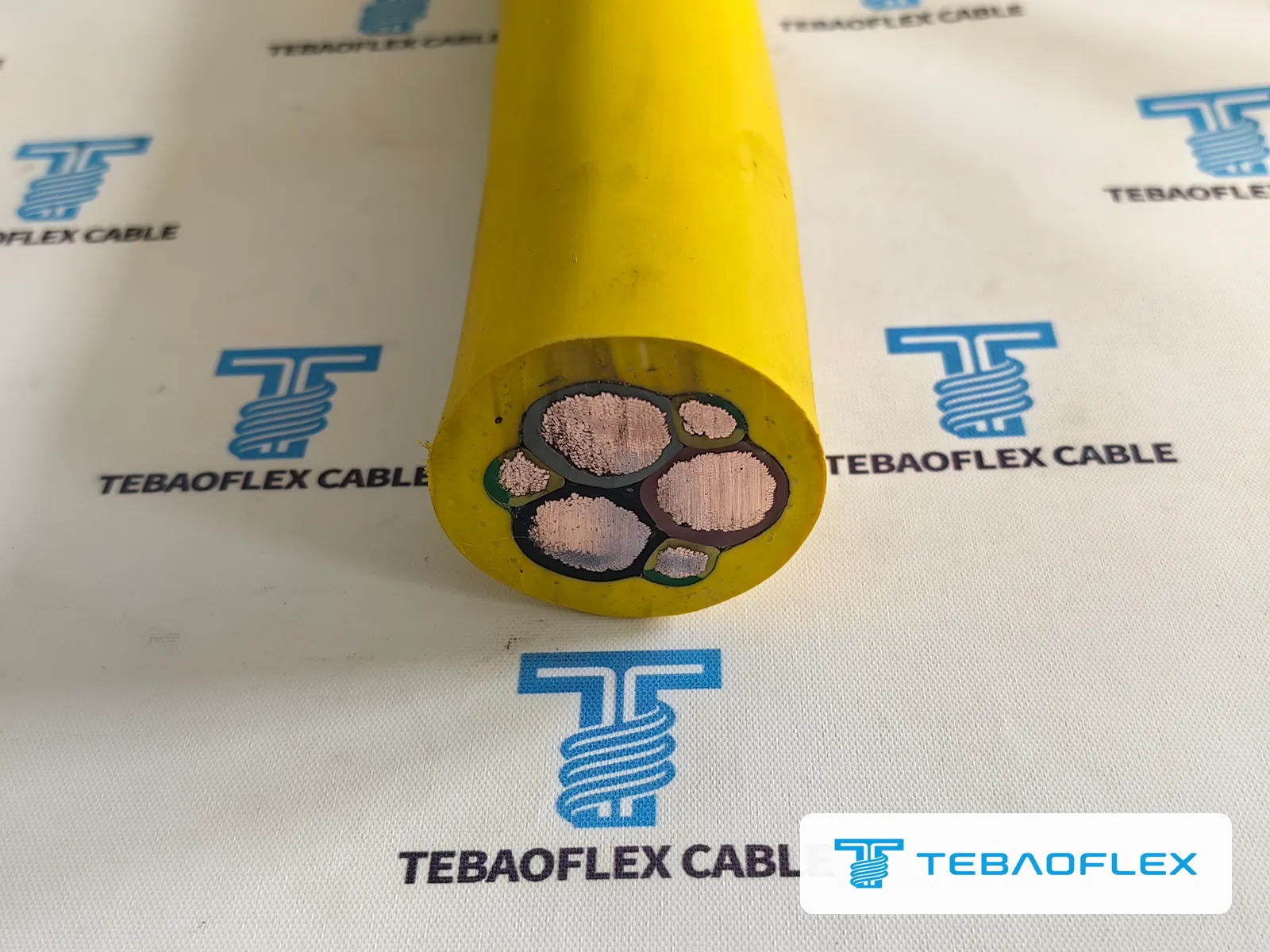
Reeling cable cross-section: where are the inner sheath, braid and outer sheath?
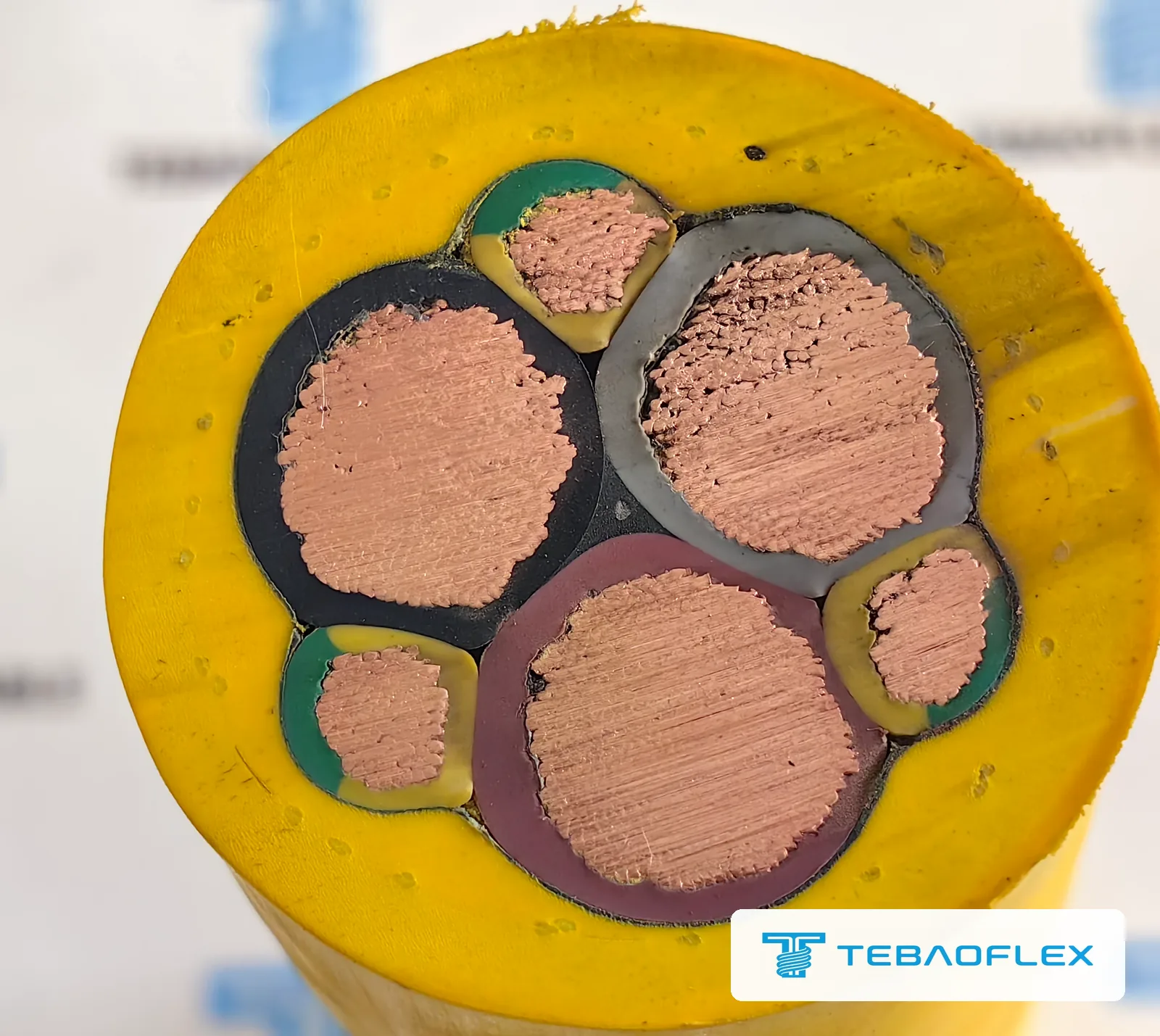
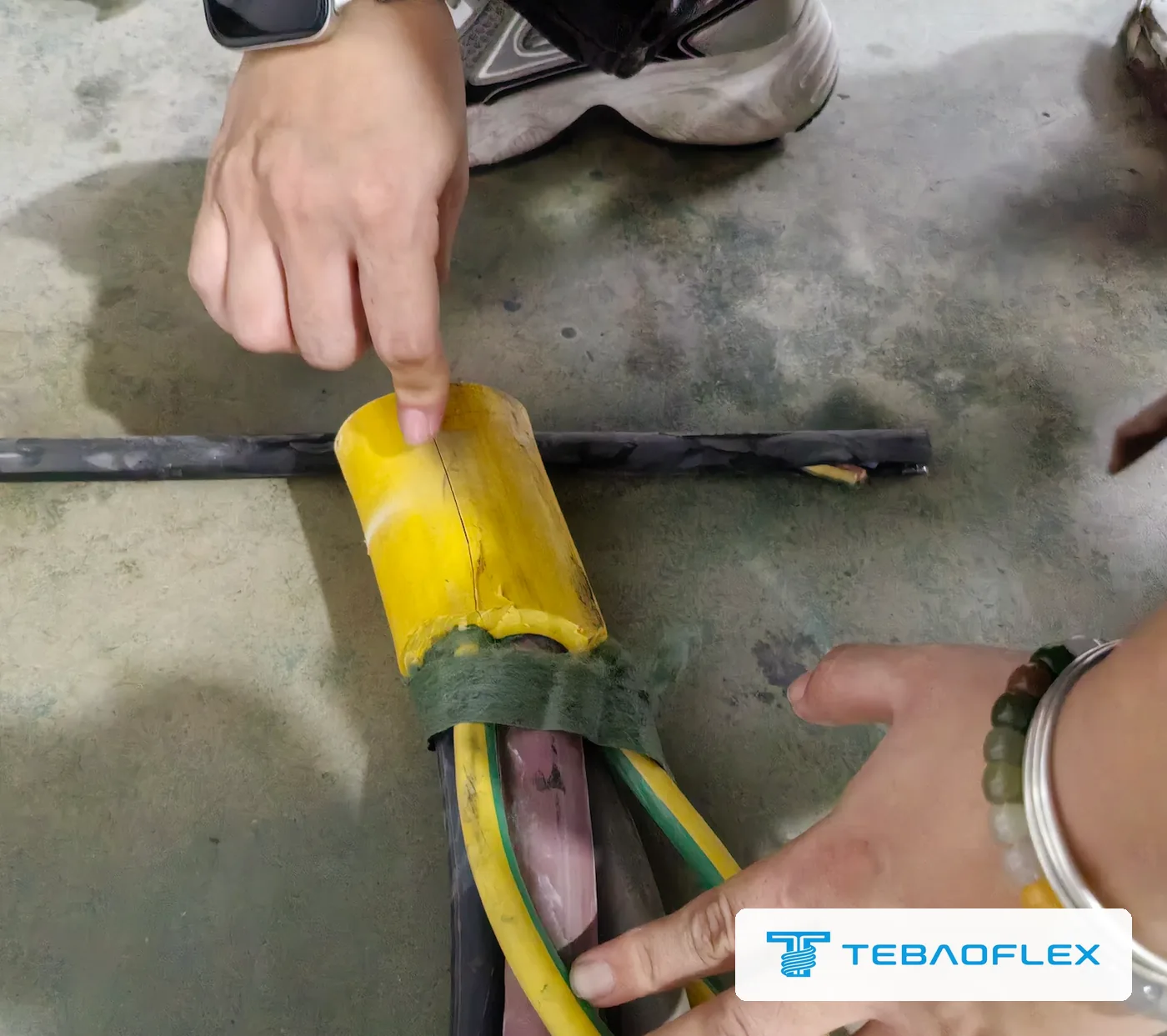
In the yellow (N)SHTÖU-J reeling cable of this order, the inner and outer sheaths are the same PCP compound and are vulcanised together, so a cut end looks like one thick yellow ring. The boundary is the aramid braid, visible as a ring of small dots at a constant radius inside the yellow: everything inside that ring is the inner sheath, everything outside it is the outer sheath.
The buyer asked for photos of each cable’s cross-section that clearly show the inner and outer sheath. The close-up below is the 3×70+3×35/3 cable; the drawing next to it numbers the layers from the conductor outwards.
- Power conductor: Class 5 fine-stranded tinned copper to IEC 60228 (3 × 70 mm² or 3 × 185 mm²)
- Power core insulation: EPR rubber, coloured brown, black and grey
- Protective (earth) conductor split into three green-yellow cores in the outer gaps (3 × 35/3 mm² or 3 × 95/3 mm²)
- Central rubber filler
- Non-woven tape over the laid-up cores
- Inner sheath: extruded yellow polychloroprene (PCP), compound 5GM5
- Aramid fibre braid between the two sheaths
- Outer sheath: extruded yellow PCP, compound 5GM5, oil- and weather-resistant
Why tinned copper conductors in a rubber reeling cable?
Rubber reeling cables such as (N)SHTÖU-J use tinned copper conductors because the insulation in direct contact with each conductor is vulcanised rubber. Where a rubber compound contains sulphur or sulphur-bearing accelerators, these react with bare copper to form copper sulphide, blackening the strands and raising contact resistance; a tin coating on every strand keeps copper and rubber apart. On a wet stockyard the coating also slows oxidation inside the strand bundle and keeps on-site terminations sound, which mattered on the damp Polish mine site of this order.
- Vulcanisation. The EPR insulation is cured with heat while in direct contact with the conductor; the sheaths never touch the copper. Where a rubber compound contains sulphur or sulphur-bearing accelerators, these form copper sulphide on bare copper, which darkens the strands, spoils soldering and raises contact resistance. Tin is a barrier between the two.
- Moisture on an open stockyard. Rain, snowmelt and condensation reach cable ends and any sheath damage. Oxidised copper has a higher resistance, so joints run hotter; tinned strands stay stable.
- Terminations made on site. Tinned strands crimp and solder cleanly and do not darken quickly once stripped, so lugs fitted at the machine keep a low contact resistance.
- Inside a conductor that never stops flexing. A Class 5 conductor is made of hundreds of fine strands. Moisture that creeps between them oxidises the strand surfaces, and oxidised strands are more prone to break under repeated bending. Each strand is tinned individually, so every strand is protected.
How do you check that the copper is really tinned?
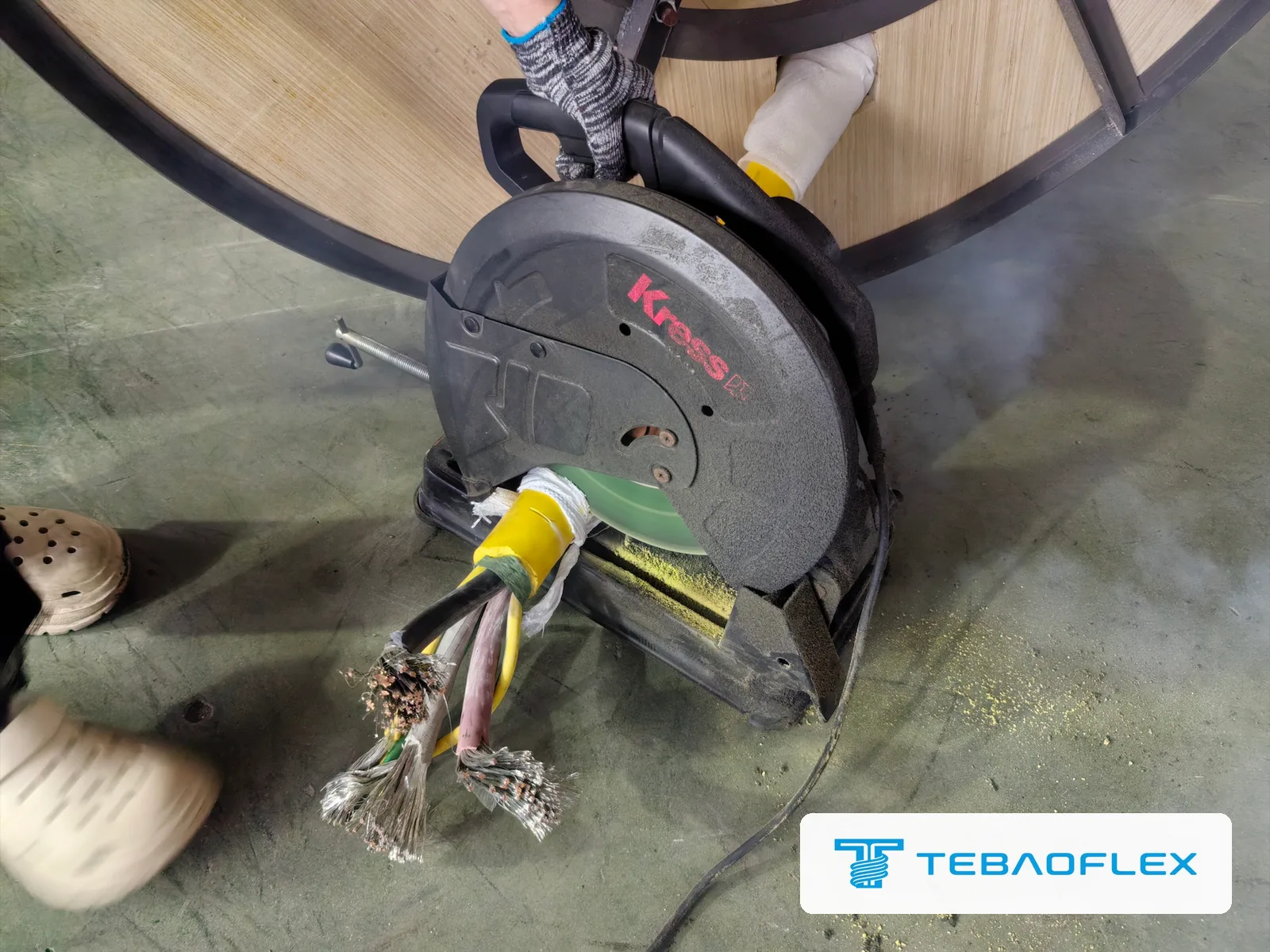
Strip the insulation and look at the strand surfaces: tinned strands are silver-grey along their whole length, bare copper is copper-red. At the factory acceptance test we stripped power and earth cores for the buyer. The conductor resistance test then confirms the copper section: the 70 mm² core measured 0.265 Ω/km at 20 °C, within the 0.277 Ω/km maximum IEC 60228 sets for a 70 mm² Class 5 tinned conductor.
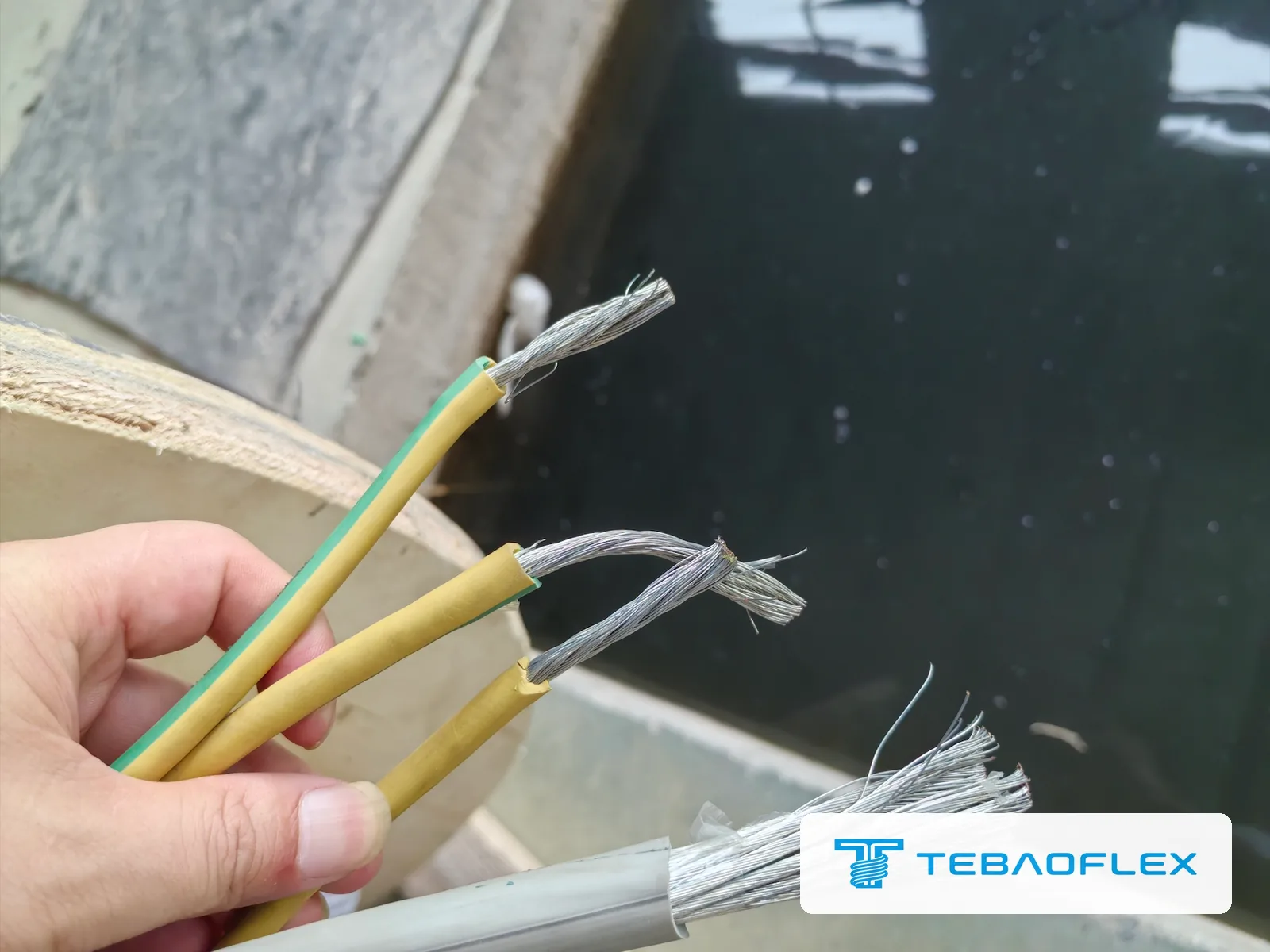
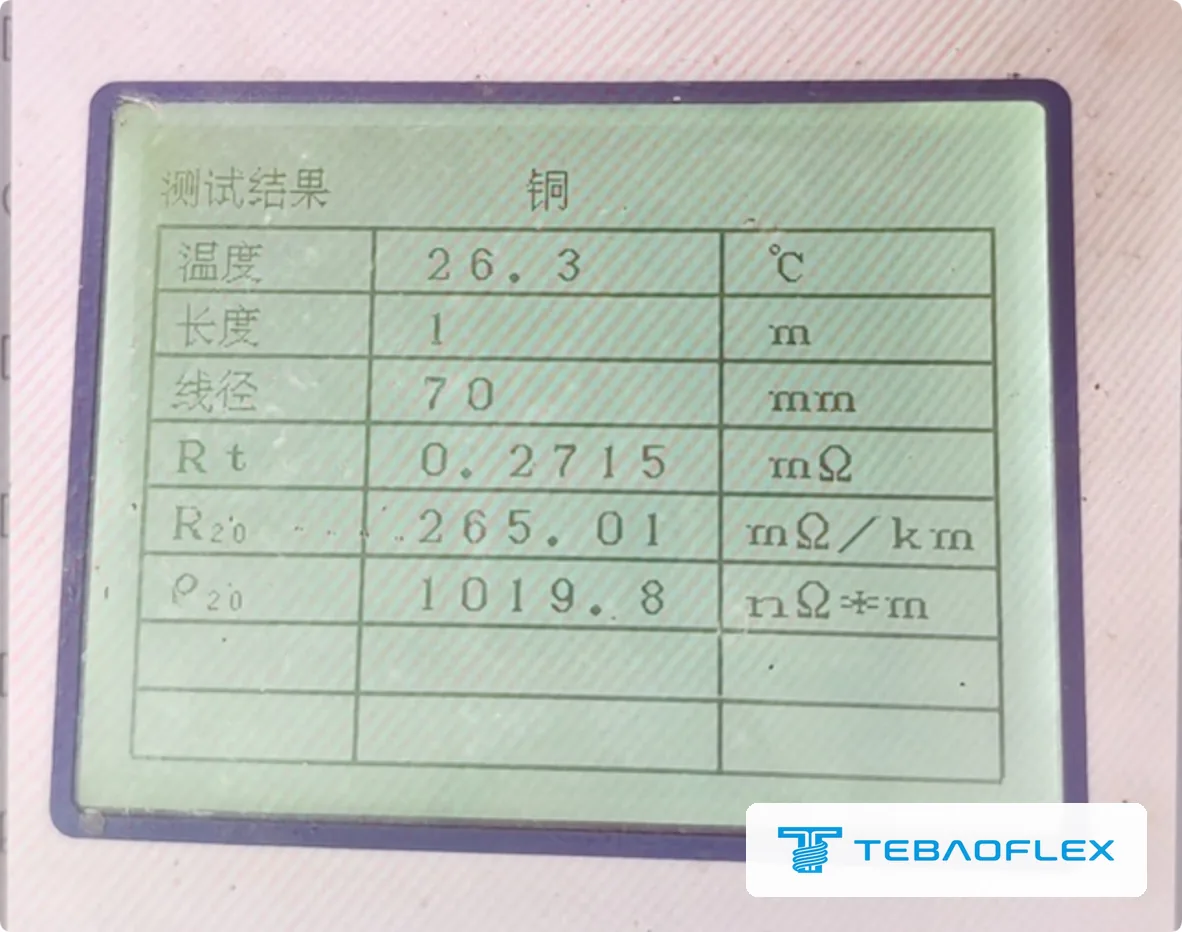
Two cautions when you check this yourself. First, look at the strands after stripping, not at the cut face: a saw cut exposes the copper core of every strand, so a freshly cut end looks copper-coloured even when the wire is tinned. Second, resistance alone cannot tell tinned from plain copper. For 70 mm² Class 5 conductors the IEC 60228 limits are 0.272 Ω/km for plain copper and 0.277 Ω/km for tinned copper, only about 2% apart, and a conductor of either kind usually measures below both, as this one did. Use the visual check for the coating and the resistance test for the copper section.
Reeling cable factory acceptance test: what we tested and the readings
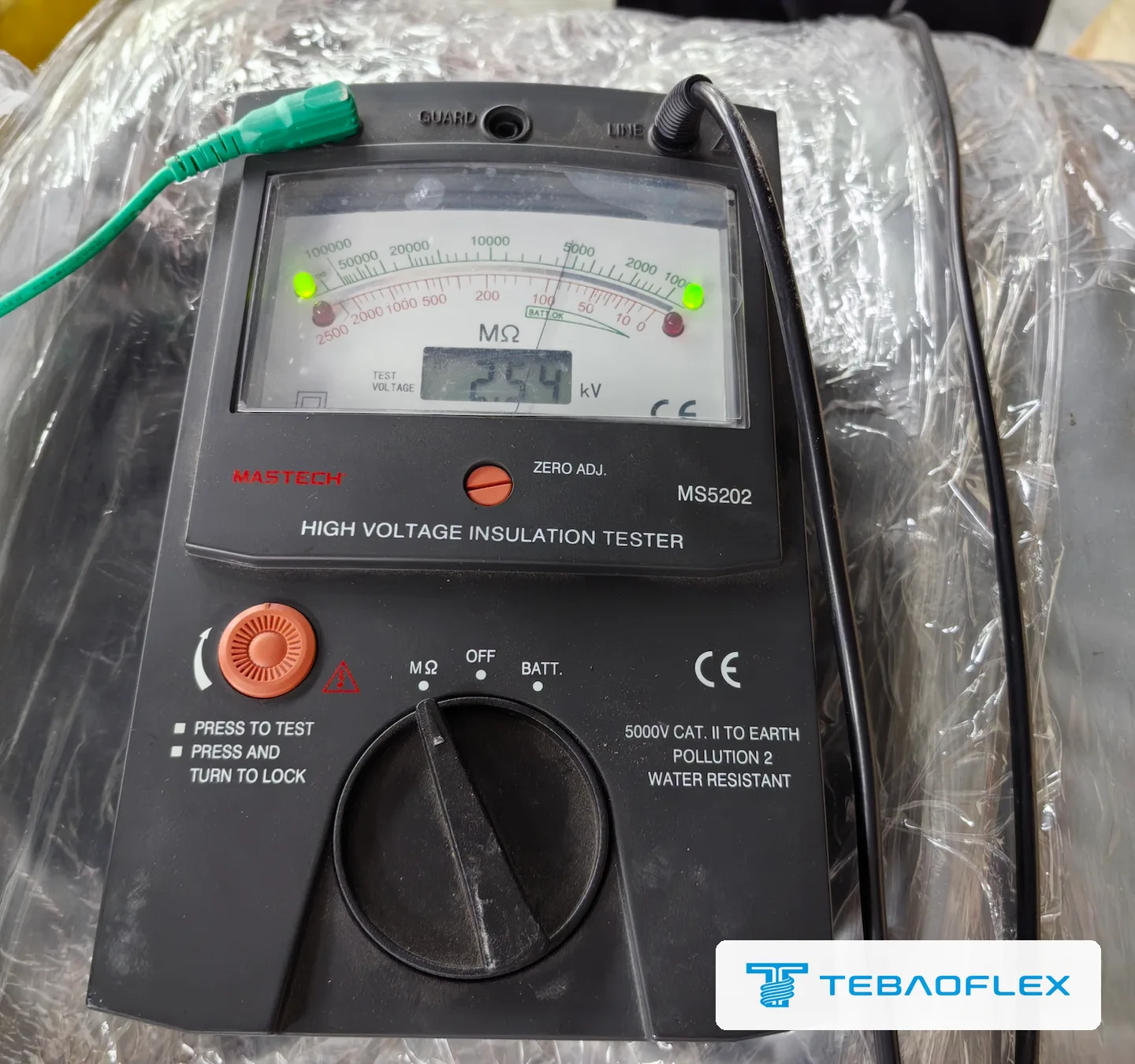
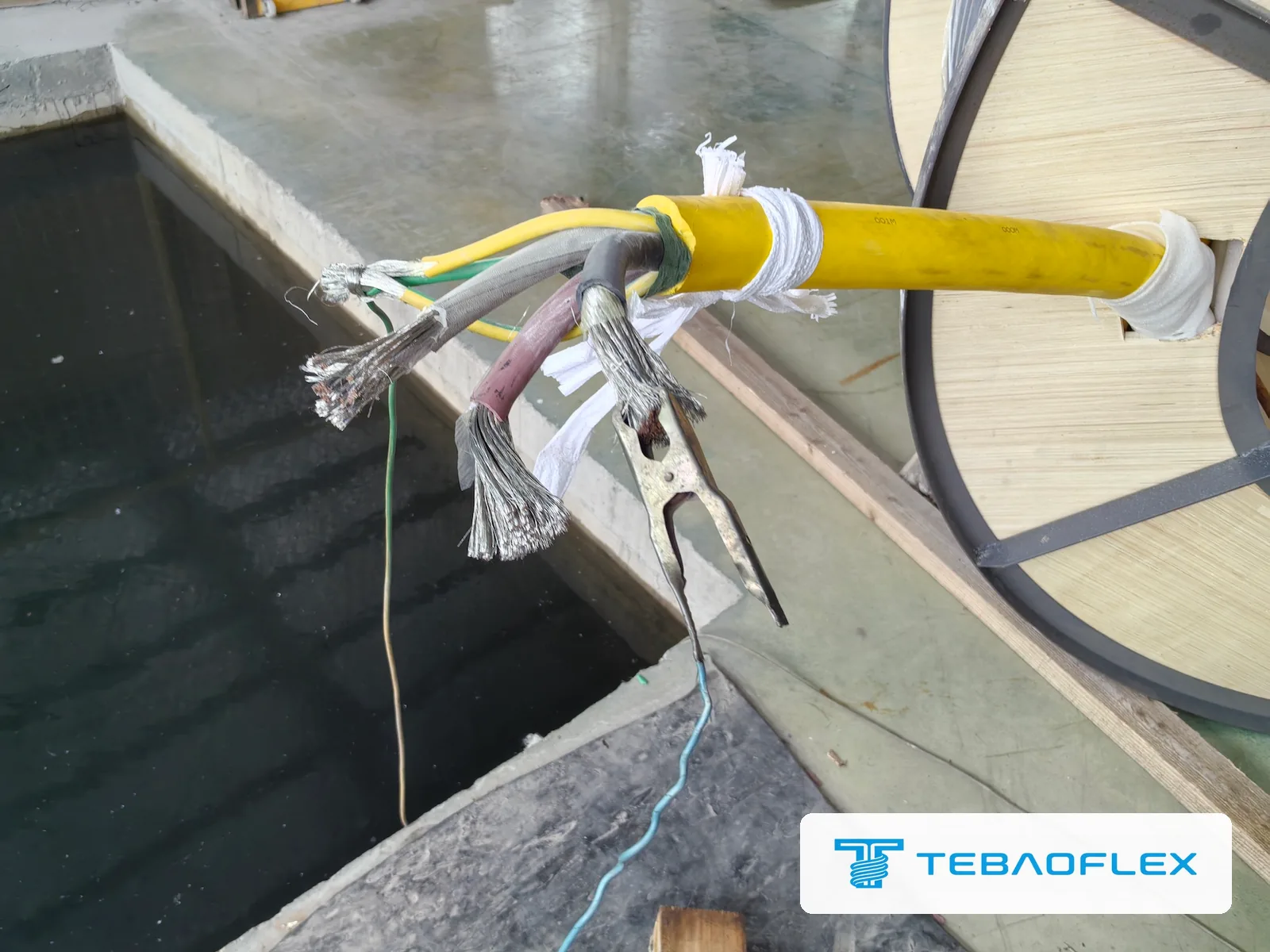
For this (N)SHTÖU-J reeling cable order, every insulated core was spark-tested during extrusion and voltage-tested in water at 3,500 V. On the finished drums every core was checked for continuity, insulation resistance read above 5,000 MΩ at 2.5 kV DC across the whole drum length, and the finished cable held an AC voltage test at 3,657 V for 5 minutes with no breakdown. Conductor resistance, measured on a 1 m sample of the 70 mm² core, was 0.265 Ω/km at 20 °C.
| Test | Requirement | Result on this order |
|---|---|---|
| Spark test, during insulation extrusion | Every insulated core passes the in-line spark tester; a fault alarm stops the line | Applied to every core |
| Core voltage test in water | 3,500 V on each insulated core, immersed in water | No breakdown |
| Continuity, finished drum | Every core continuous from end to end | All cores continuous |
| Insulation resistance, finished drum | ≥ 20 MΩ·km (order data sheet) | Needle above 5,000 MΩ at 2.5 kV DC across the whole drum length |
| AC voltage test, finished cable | 3.5 kV AC for 5 minutes (TEBAOFLEX (N)SHTÖU specification) | 3,657 V AC for 5 minutes, no breakdown |
| Conductor resistance at 20 °C, 70 mm² | ≤ 0.277 Ω/km (IEC 60228, Class 5, tinned) | 0.265 Ω/km |
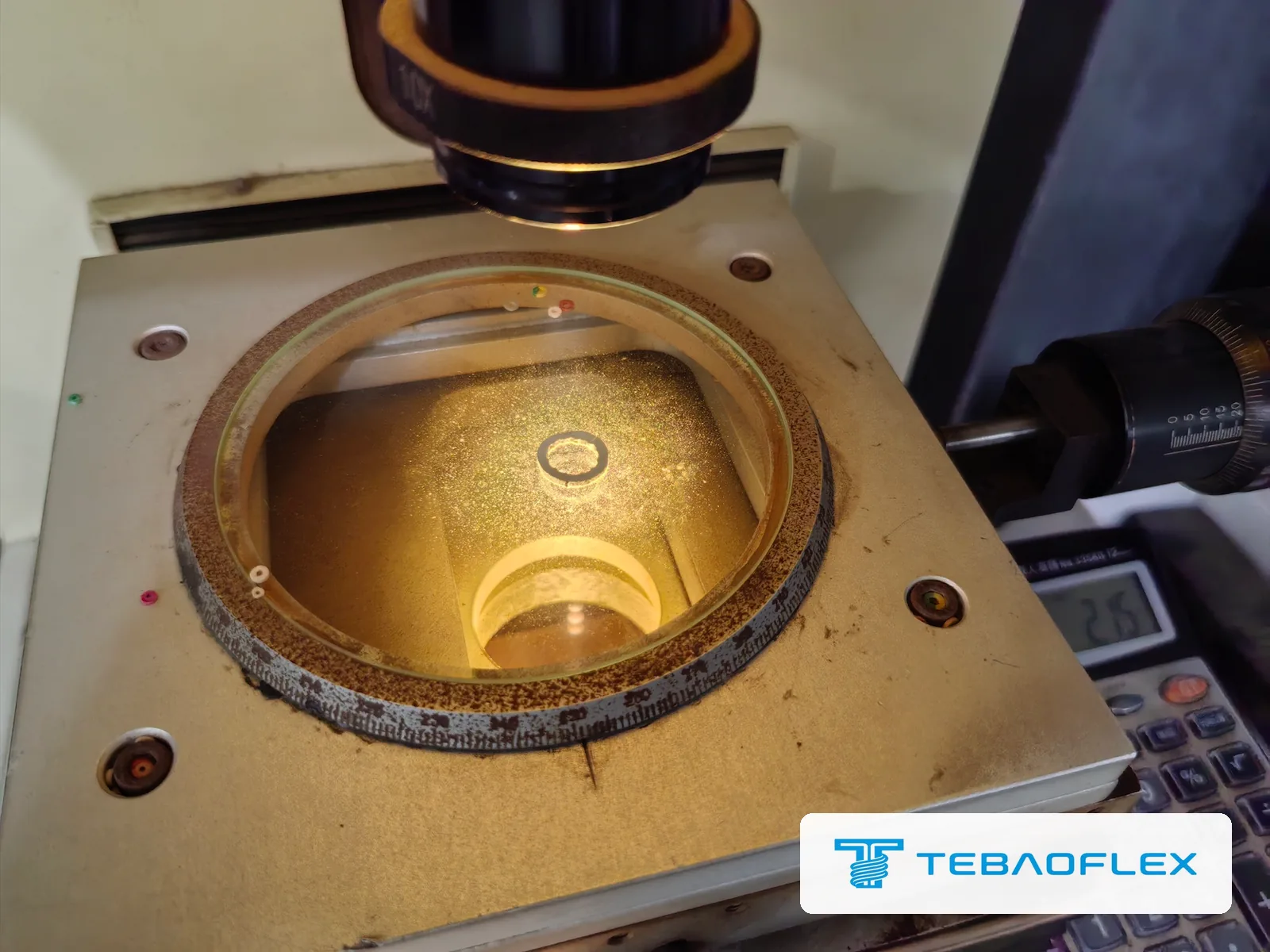
| Insulation and sheath thickness | To the order data sheet | Sample sections checked on the measuring projector |
| Strip check | Tinned strands; core colours as specified | Silver strands; brown, black, grey and green-yellow cores |
| Outer diameter | Within the reel’s maximum cable diameter | 44.45 mm and 63.23 mm |
Reeling cable insulation resistance on the finished drum: above 5,000 MΩ at 2.5 kV DC
The insulation tester applies a DC test voltage and shows it on the digital display, here 2.54 kV; the resistance is read on the analogue scale, where the needle stood above 5,000 MΩ. Insulation resistance per kilometre is the reading multiplied by the length in kilometres, so a 5,000 MΩ reading meets 20 MΩ·km on any length above 4 m, and on a full kilometre it would be 5,000 MΩ·km.
AC voltage test on the finished cable: 3,657 V for 5 minutes
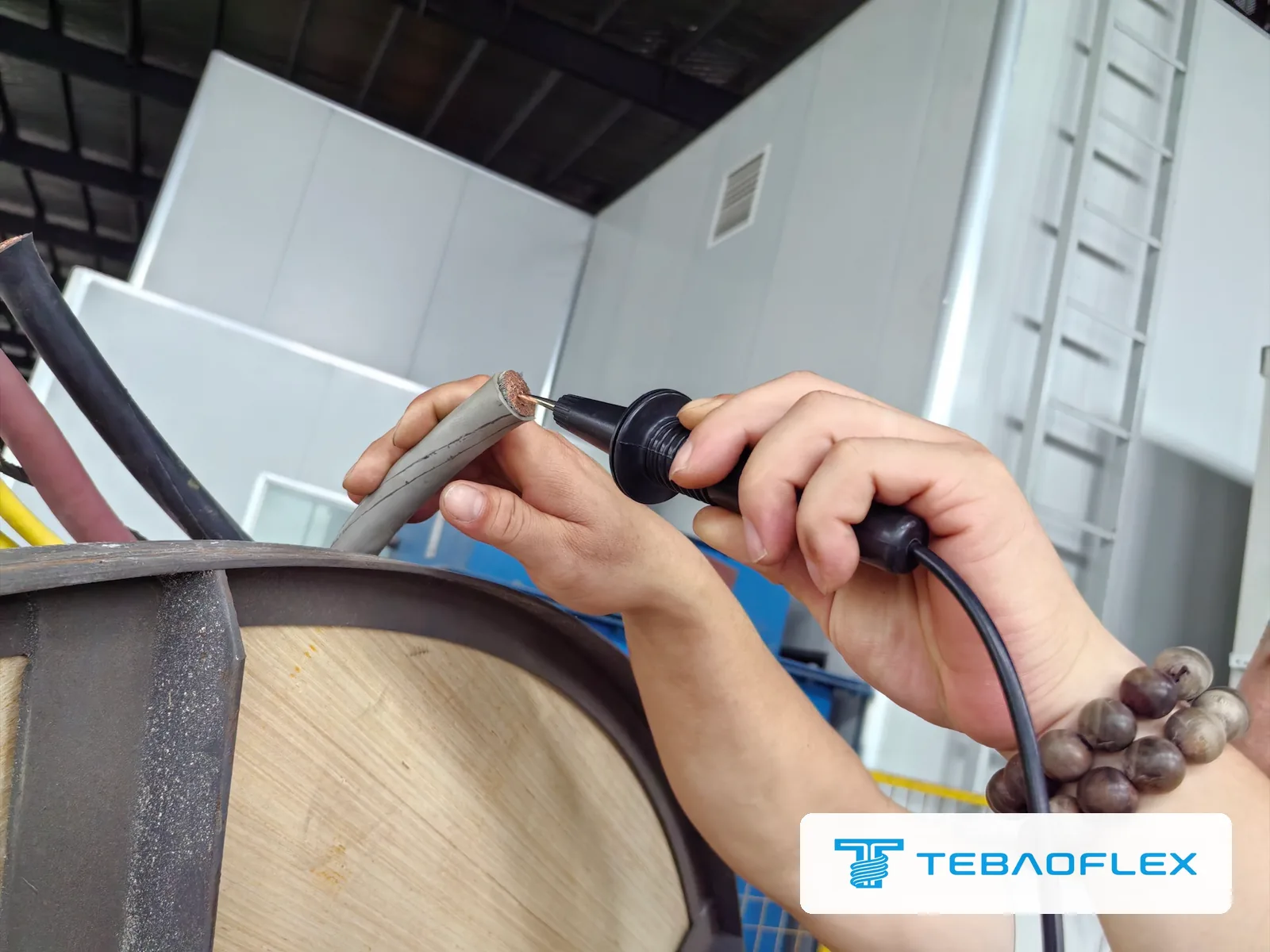
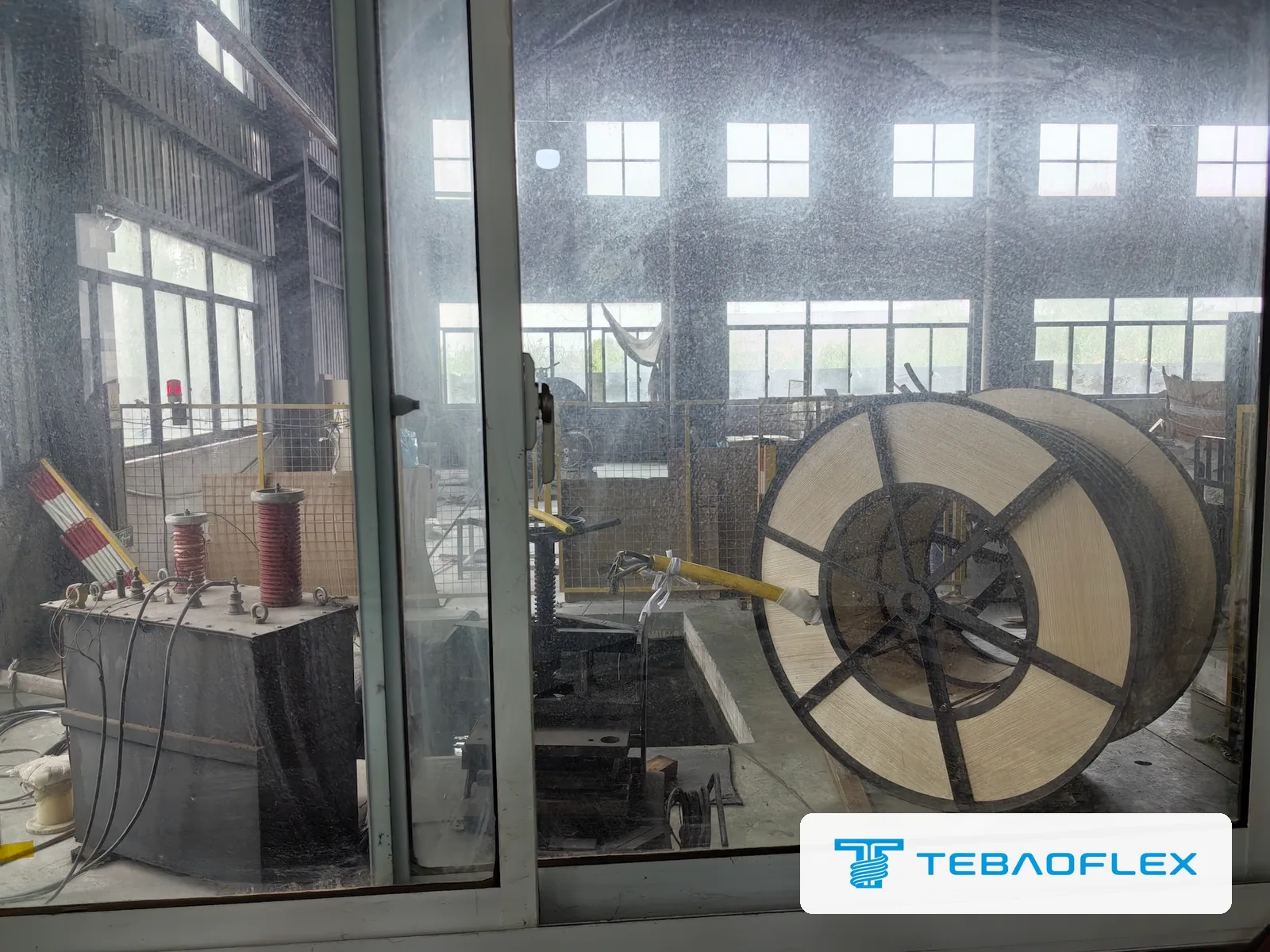
In the fenced test bay the test transformer raised the voltage on the finished cable to 3,657 V AC, above the 3.5 kV AC test voltage that TEBAOFLEX’s (N)SHTÖU family data gives for 0.6/1 kV cable, and held it for 5 minutes. There was no breakdown. The timer on the panel counts the seconds of the hold; the photo below was taken 42 s into it.
Section and thickness checks
How do you prove a reeling cable has no breaks or repairs?
A chain of tests shows that a reeling cable has no breaks. For this order the spark tester checked every insulated core as it was extruded, each core then withstood 3,500 V in water, and the finished cable showed continuity on every core and held 3,657 V AC for 5 minutes. A broken conductor or damaged insulation anywhere on the drum would fail one of these stages. A well-made repair can also pass them, so the tests alone do not prove that a cable was never repaired; the drums for this order were supplied as continuous lengths, without joints or repairs in the cable.
- During extrusion: the spark tester sees every metre of every core. A pinhole, a thin spot or a strand pushed through the insulation sets off the alarm and the line stops for inspection.
- Before cabling: each insulated core is voltage-tested at 3,500 V in a water bath, so any weak point in the insulation breaks down before the core is laid up.
- On the finished drum: continuity on every core shows the conductors are unbroken from end to end; insulation resistance and the 5-minute AC test show the insulation is sound over the whole length.
Cold-weather reeling cable: how does a rubber sheath cope with a Polish winter?
A rubber reeling cable copes with a Polish winter by staying elastic in the cold. The (N)SHTÖU-J in this order has polychloroprene (PCP) sheaths, which stay flexible at low temperature where PVC stiffens and cracks. TEBAOFLEX’s (N)SHTÖU family data gives −25 °C for moving cable and −40 °C for fixed installation. PCP also resists water, snowmelt, abrasion and tearing, which matters when a cold cable is pulled off the drum.
Winter frost is normal on a Polish stockyard, and the reeling cable is the part of the machine that moves the most. A sheath that hardens in the cold cracks where it bends over the drum and the guide rollers; a rubber sheath keeps bending without damage. TEBAOFLEX mixes its own rubber compounds. If a machine must travel and reel below −25 °C, give the lowest site temperature in the enquiry: TEBAOFLEX can supply lower-temperature sheath compounds to order, and the compound and its rating are stated on the order data sheet for the build quoted.
Why a yellow reeling cable sheath on a mine stockyard?
For the Polish stacker-reclaimer, the (N)SHTÖU-J reeling cable was made with a yellow sheath instead of the usual black, so that drivers of haul trucks, loaders and forklifts can see it where it leaves the drum and runs beside the track. That lowers the risk of the cable being driven over or crushed on a mine stockyard full of loose stone.
Colour does not change the electrical rating. Both yellow sheaths are made to compound class 5GM5, as stated on the order data sheet.
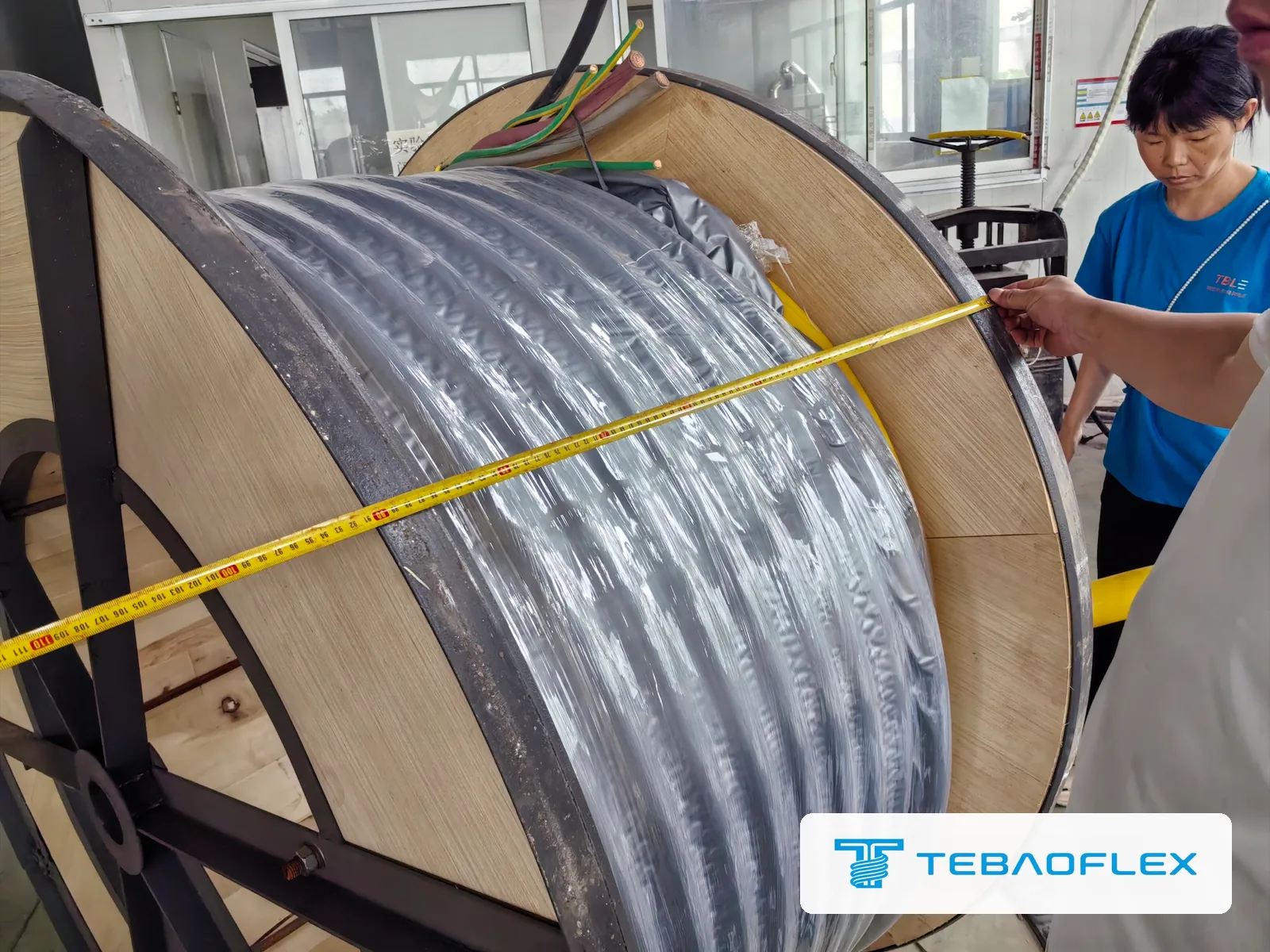
Will the cable fit the reel? Reeling cable outer diameter, minimum drum core diameter and maximum pull
Both (N)SHTÖU-J sizes fit the stacker-reclaimer’s reel: the measured outer diameters, 44.45 mm for 3×70+3×35/3 and 63.23 mm for 3×185+3×95/3, are within the reel’s maximum cable diameter. With the 6 × D reeling bend radius TEBAOFLEX specifies for cables above 20 mm, the drum core must be at least 534 mm and 759 mm in diameter respectively, and the working pull should stay within 4,200 N and 11,100 N respectively.
| Size | Measured outer diameter | Minimum bend radius (6 × D) | Minimum drum core diameter (12 × D) | Maximum working pull |
|---|---|---|---|---|
| NSHTOEU-J 3×70+3×35/3 | 44.45 mm | 267 mm | 534 mm | 4,200 N (20 N/mm² × 3 × 70 mm²) |
| NSHTOEU-J 3×185+3×95/3 | 63.23 mm | 380 mm | 759 mm | 11,100 N (20 N/mm² × 3 × 185 mm²) |
The 6 × D bend radius follows DIN VDE 0298-3, Table 3, and the 20 N/mm² pull limit is TEBAOFLEX’s rating for the (N)SHTÖU family; both rules are set out in the drum-sizing section of the NSHTOU cable family page. The figures above use the measured diameters of this order; the family page’s size table uses the maximum published diameter and so gives a larger minimum drum core for the same size, 642 mm for 3×70+3×35/3. The earth conductors are not counted in the pull. Guide and deflection rollers need a larger bend radius, 7.5 × D under DIN VDE 0298-3: at least 334 mm for 3×70+3×35/3 and 475 mm for 3×185+3×95/3. Give the reel core diameter and the maximum cable diameter with your enquiry and we check them against the measured cable.
Trial on the stacker-reclaimer before the order
The Polish buyer had not used TEBAOFLEX cable before, so the cable was tried on the buyer’s own machine before the order. The stacker-reclaimer was being built in Shandong, China, so TEBAOFLEX sent 160 m each of (N)SHTÖU-J 3×70+3×35/3 and 3×185+3×95/3 there, paying the freight for this project. The builder installed both cables on the reel and ran them during the machine’s commissioning trials, and the buyer placed the order after the trial.
For a first order this is the most direct evidence a buyer can get: the cable is wound and unwound by the actual reel, under the machine’s own travel, before the buyer commits. It also confirmed in practice what the measured diameters showed on paper, that both sizes fit the drum.
Packing reeling cable drums for export to Poland
Each export drum is made to suit the cable’s outer diameter and weight, closed with timber battens so that no cable is exposed, and braced inside the container so it cannot move in transit. TEBAOFLEX insures its export shipments with commercial cargo insurance.
- Drum size and strength: chosen from the cable’s outer diameter and the weight of the length on the drum.
- Closed drum: after winding, the drum is closed with battens so the cable surface is fully protected.
- Container bracing: drums are blocked and braced so they cannot roll or shift.
- Insurance: export orders travel with commercial cargo insurance, so any transit damage can be claimed.
What to send us for a stacker-reclaimer reeling cable quote
- Machine and reel type (motorised drum, monospiral or level wind)
- Conductor arrangement and sizes, including earth, control cores or fibres
- Length per drum and number of drums
- Reel core diameter and maximum cable diameter
- Travel length, travel speed and number of layers on the drum
- Lowest and highest site temperature
- Sheath colour
- Exposure to oil, water or UV
- Tests to be witnessed at the FAT and documents required
- Delivery destination
Related pages
- NSHTOU-J rubber reeling cable 0.6/1 kV for hoisting and hauling equipment
- NSHTOU / (N)SHTÖU cable family: sizes, drum diameter and maximum pull
- Reeling cable solutions for cranes and mobile equipment
- Reeling cable vs trailing cable: mining selection guide
- How to read a VDE cable designation
- Case: 8.7/15 kV reeling cable with 24 fibres for a ship unloader
- Mining and tunnelling cables
Questions on stacker-reclaimer reeling cable
What does 3×70+3×35/3 mean on a reeling cable?
Three 70 mm² power cores plus a 35 mm² protective conductor that is split into three equal parts of about 11.7 mm², laid in the outer gaps between the power cores. Splitting the earth conductor keeps the cable round and balanced, which helps it wind evenly on a drum. 3×185+3×95/3 follows the same rule: three 185 mm² cores and 95 mm² of earth in three parts.
Is (N)SHTÖU-J the same as NSHTOU-J or NSHTOEU-J?
They name the same cable family, with one difference. NSHTOU-J and NSHTOEU-J are NSHTÖU-J written without the umlaut, because the Ö is written O or OE where a keyboard has none. The (N) in front, as TEBAOFLEX writes it, marks a construction built with reference to DIN VDE 0250-814 rather than an approved VDE standard type; it is not a VDE certification mark. The J means the cable has a green-yellow protective conductor.
Can (N)SHTÖU-J run on the motorised cable reel of a stacker-reclaimer?
Yes, this is the duty it is built for: repeated winding on a motorised drum with tension, bending and torsion. Check two numbers against the reel: the drum core diameter must be at least 12 times the cable diameter for cables above 20 mm, and the working pull must stay within TEBAOFLEX’s rating of 20 N/mm² of power-conductor cross-section. Our NSHTOU family data gives horizontal reeling speeds up to 120 m/min.
Why can I not see two separate sheaths on the cut end?
Because both sheaths are the same yellow PCP compound and are vulcanised together. Look for the ring of small dots at a constant radius inside the yellow: that is the aramid braid. The layer inside the ring is the inner sheath, the layer outside it is the outer sheath.
Which tests can the buyer see at the factory acceptance test?
Stripping of power and earth cores to show the tinned strands, cross-section samples, continuity of every core, insulation resistance on the finished drum, the AC voltage test on the finished cable, and conductor resistance. The buyer on this order received photos and video like those on this page; state any tests you want to witness in the enquiry.
How cold can a rubber reeling cable be moved?
Our (N)SHTÖU family data gives −25 °C for cable that is moving and −40 °C for fixed installation. If the machine has to travel and reel in colder weather, state the lowest site temperature in the enquiry: lower-temperature sheath compounds can be supplied to order, and the rating is stated on the order data sheet for the build quoted.
Can the cable be supplied in black, or with control cores or optical fibres?
Yes. Black is the usual sheath colour for (N)SHTÖU; yellow was chosen here for visibility. Control cores and optical fibres can be added to the construction, as in NSHTÖU-FO; the exact build is stated on the order data sheet.