








NSHTÖU-J Rubber Reeling Cable 0.6/1 kV for Hoisting and Hauling Equipment
0.6/1 kV NSHTÖU-J rubber reeling cable for hoisting, hauling, crane, conveyor and drum cable applications. Also reviewed for NSHTOU-J, NSHTOEU-J, RG-D and RXG-D style replacement requests where reel data and tensile load must be confirmed.
NSHTÖU-J is a 0.6/1 kV rubber reeling cable for hoisting, hauling, crane, conveyor and drum cable applications where the cable moves with the equipment instead of remaining fixed. It is also written as NSHTOU-J cable or NSHTOEU-J reeling cable, and can be reviewed as a TEBAOFLEX equivalent starting point for RG/RG-D and RXG/RXG-D style low-voltage rubber reeling cable enquiries.
NSHTÖU-J is the -J version of the NSHTOU family: its green-yellow core is the protective earth conductor. The letter meaning, 26 sizes with drum diameter and maximum pull, and constructions TEBAOFLEX has built are covered on the family page: NSHTOU / (N)SHTÖU reeling cable.
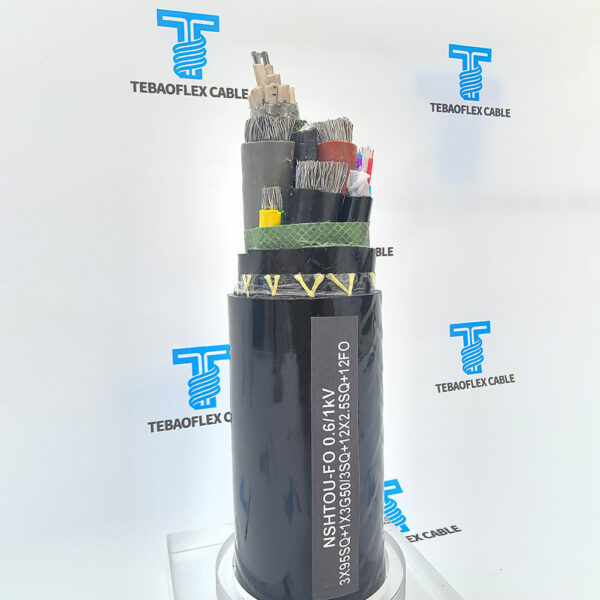
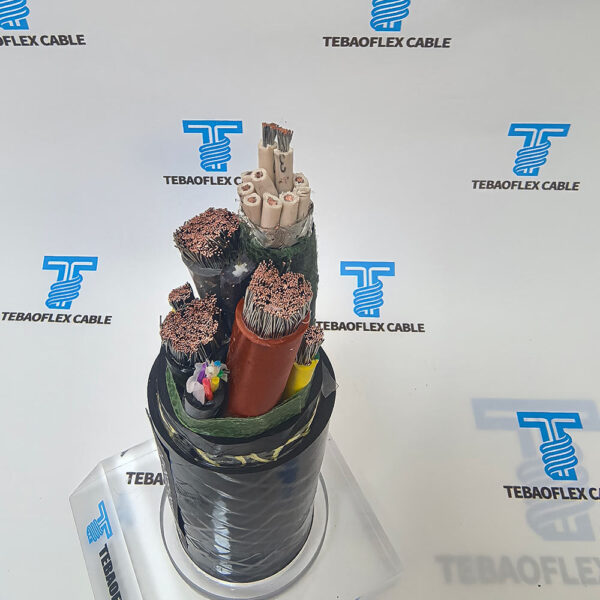
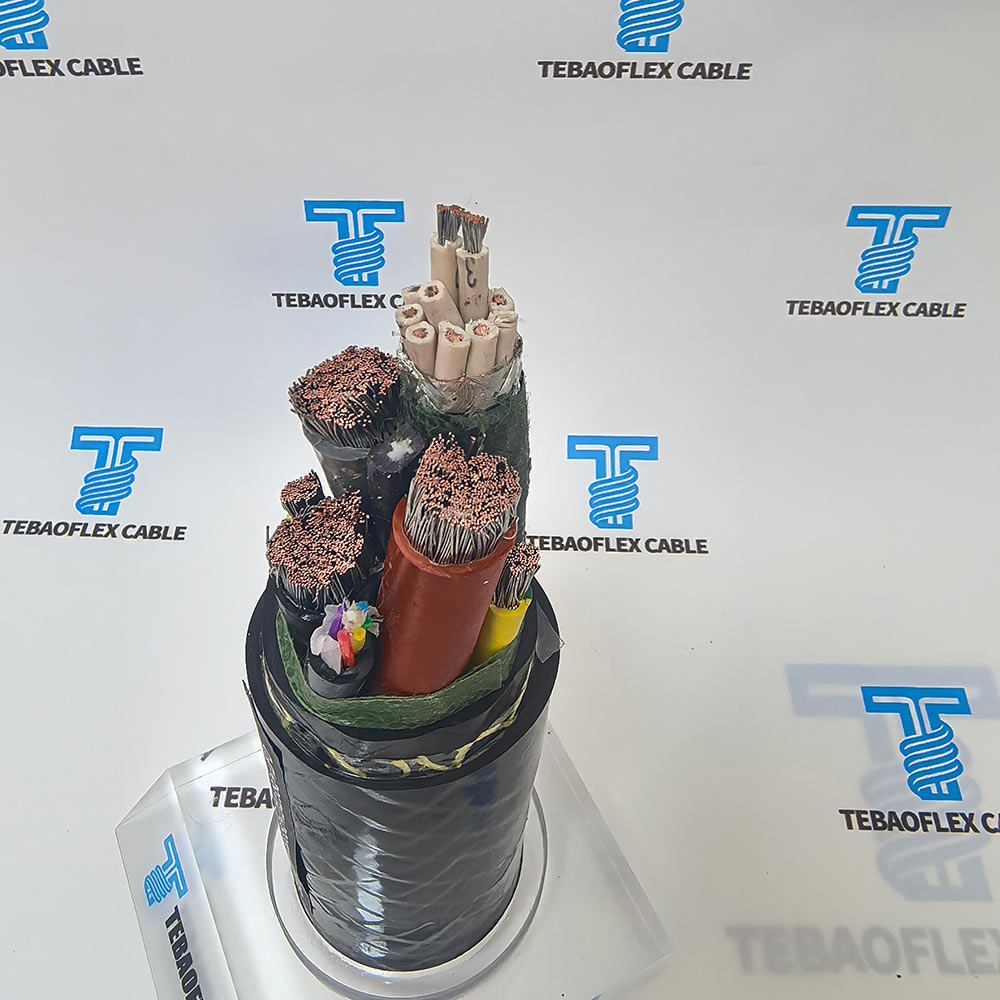
The construction combines flexible tinned copper conductors, EPR rubber insulation, an internal rubber jacket, reinforcing braid and a heavy-duty rubber sheath. This makes the cable suitable for repeated winding, pulling, bending and guided movement in outdoor industrial conditions where abrasion, moisture, oil, UV exposure and torsion must be checked before ordering.
Why a reeling cable uses tinned rather than bare copper strands, and what the coating costs in resistance, is explained in tinned copper vs bare copper for reeling and mining cables, with the IEC 60228 limits for each.
For hoisting and hauling equipment inside a Zone 2 area, the motor, junction boxes and cable glands carry the Ex certification while the reeling cable is selected under IEC 60079-14; our guide to cable requirements in ATEX zones lists the documents to request for such an order.
Use this page when the application is a 0.6/1 kV rubber drum or reeling cable for cranes, hoists, conveyors, hauling systems and port handling machinery. For vertical spreader reels or unusually high hanging load, send the existing cable marking, reel data and operating speed so the correct construction can be confirmed.
A stacker-reclaimer project with this cable type, with cross-section photos, factory acceptance test readings and a trial on the machine’s reel, is documented on the Polish stacker-reclaimer reeling cable case page.
The drum, guide-pulley and static radii on this datasheet are compared with other reeling, festoon and fixed cables in the cable bending radius guide with drum and pulley values, which also shows how to size a drum from the cable diameter.
Construction
NSHTÖU-J uses a reinforced rubber cable structure for low-voltage moving equipment where bending, pulling and torsional stress occur during operation.
| Component | Construction detail |
|---|---|
| Conductor | Flexible tinned copper conductor, Class 5, selected for repeated movement and easier handling. |
| Separator | Separator may be applied where required between conductor and insulation. |
| Insulation | EPR rubber insulation for 0.6/1 kV flexible cable service. |
| Core identification | Colour-coded cores according to common European practice; the J type includes a green-yellow protective conductor. |
| Internal jacket | Synthetic rubber-based compound supporting the assembled cores. |
| Reinforcement | Open polyamide braid to improve resistance against tensile and torsional stress. |
| Outer sheath | Heavy-duty black rubber sheath for abrasion, impact, water, oil, ozone, UV and weather exposure under suitable installation conditions. |
Route geometry and tensile limits for hoisting and hauling duty
On a positively guided route the bending radius is not one number. It changes with the route element, and on drums it also changes with the cable's own diameter.
| Route element | Minimum radius |
|---|---|
| Static, fixed installation | 4 × D |
| On drums, cable diameter up to 20 mm | 5 × D |
| On drums, cable diameter over 20 mm | 6 × D |
| On guide pulleys | 7.5 × D |
| On cable cars | 5 × D |
| Static | 15 N/mm² |
|---|---|
| Dynamic peaks | 25 N/mm² |
Installation rules that decide whether the route works
These four rules come from the reference catalogue for this family and are the ones most often missed when a guided route fails early.
- Connect the cable free of torsion. A twist built in at installation does not relax; it accumulates over every cycle.
- Relieve the tensile stress at the cable ends and conduct it into the tensile elements inside the cable. A gland that grips only the sheath transfers the pull to the wrong place.
- Stationary pulleys bearing two turns of cable have proved well suited for that relief.
- Avoid S-shaped turns wherever possible, both while laying the cable and inside the guidance system itself.
Variant guide for the reference family
Enquiries arrive under several reference designations. Each suffix states which mechanical problem the build solves, and the insulation is common to all of them: an ozone- and suncheck-resistant EPR compound of type 3GI3, so no additional protection of the cores is needed at the connection ends.
| Reference build | What it adds | Duty it suits |
|---|---|---|
| K, the standard build | Class 5 fine stranded tinned copper, 3GI3 EPR insulation, inner sheath of GM1b on signalling, control and small power sizes and 5GM3 otherwise, torsion protection by counterwound taping or fibre-glass braiding, black 5GM3 CSP outer sheath | Frequent reeling and unreeling, and routes constantly deflected over pulleys. |
| KS | Heavy-duty 5GM5 outer sheath with a vulcanized fibre-glass anti-twist braid | The same routes where sheath wear, not electrical rating, sets the service life. |
| KT | A central steel rope for strain relief | Larger self-supporting lengths. |
| KV | Steel-reinforced conductors; 5GM5 sheath optional, as on KT | High-speed cable cars. |
| TROMMELFLEX-K reference | A central plastic or textile filler, cores twisted at short lay with textile tape over each layer, a textile torsion braid, 5GM3 inner and outer sheaths | Drum reeling with simultaneous pull, torsion or forced guidance. Tested to DIN VDE 0250 Part 814, fire behaviour to IEC 60332-1 (EN 50265-2-1), oil resistance to EN 60811-2-1 with ASTM No. 2 for 24 h at 100 °C, core marking to DIN VDE 0293 Part 308. |
Core identification follows the usual convention for the family: up to five cores are colour coded, and beyond that they are black with numbers. Dimensional data for the KS, KT and KV builds is quoted on request rather than tabulated.
For the low-temperature and high-dynamic variant slot, including the TROMMELFLEX KSM-S reference, see (N)SHTÖU 0.6/1 kV reeling cable. For LHD duty with an optional central support element see NSHTOEU LHD mining reeling cable.
Reference note: for enquiries marked TENAX-K, TENAX-KS, TENAX-KT, TENAX-KV or TROMMELFLEX-K, TEBAOFLEX manufactures to the NSHTÖU-J designation and the construction shown, and is not affiliated with the trademark holder.
Applications
NSHTÖU-J is used where a low-voltage rubber cable is repeatedly wound, unwound, pulled or deflected during equipment movement.

- Hoisting and hauling equipment.
- Overhead cranes, gantry cranes and port handling machinery.
- Conveyors and material-handling systems.
- Drum cable, trailing cable and guided reeling applications.
- Building machinery and mobile industrial equipment.
- Outdoor installations in dry, damp or wet working areas.
- RG/RG-D style low-voltage rubber reeling cable replacement review.
- RXG/RXG-D style heavy-duty motorized reel enquiries where tensile load and torsion require checking.
Vertical spreader reels, long hanging routes, very high acceleration and water-contact applications should be reviewed separately before confirming NSHTÖU-J as the final construction.
Reference designation cross-reference
This reeling cable appears in the reference catalogues under more than one name, including a separate brand for the same duty.
| Reference designation | TEBAOFLEX designation and build | Rated voltage | What the reference name marks |
|---|---|---|---|
| TENAX-K / NSHTOEU | NSHTÖU-J rubber reeling cable | 0.6/1 kV | The standard reeling build of this family |
| TENAX-KS / NSHTOEU | NSHTÖU-J with glass-fibre braid | 0.6/1 kV | The S marks the glass-fibre braid over the core assembly |
| TROMMELFLEX-K / NSHTOEU | NSHTÖU-J rubber reeling cable | 0.6/1 kV | A second catalogue name for the same reeling duty |
For the full list of reference designations and the TEBAOFLEX build each one maps to, see the mining cable designation cross-reference.
Trademark note: TENAX®, TROMMELFLEX®, FELTOFLEX® and SCHRÄM® are trademarks of their respective owners, and TEBAOFLEX is neither affiliated with those companies nor reselling their cable. What we supply is the equivalent construction: we manufacture to the same VDE type designation and published construction, and every designation listed here can be quoted and supplied as a TEBAOFLEX build. The names appear so that an enquiry written in those terms reaches the matching construction, which is made to the standards and construction confirmed for the order.
Specifications
| Item | Reference value or selection note |
|---|---|
| Rated voltage | 0.6/1 kV |
| Conductor | Flexible tinned copper, Class 5 |
| Insulation | EPR rubber |
| Reinforcement | Polyamide braid between rubber layers |
| Outer sheath | Heavy-duty rubber sheath, black as standard |
| Mobile operating temperature | -25°C to +60°C, subject to installation and handling conditions |
| Lowest fixed installation temperature | Down to -40°C where the cable is not being moved |
| Common core options | Power and control constructions such as 3, 4, 5, 7, 10 and 12 cores according to project requirement |
| Common size examples | Examples include 3 x 1.5 mm² to 3 x 240 mm² and 4 x 1.5 mm² to 4 x 150 mm²; final table depends on the selected specification |
| Movement checks | Reel type, bending radius, cable layers, travel speed, torsion, tensile load and roller contact must be confirmed |
| Ordering data | Voltage, core count, conductor size, length, equipment type, reeling method, environment, marking and document requirements |
Standards
NSHTÖU-J is designed with reference to DIN VDE 0250-814 for heavy-duty rubber reeling cable applications. The published page also uses the international spellings NSHTOU-J and NSHTOEU-J because many procurement systems do not use the German character Ö.
- DIN VDE 0250-814: reference design basis for this low-voltage rubber reeling cable family.
- J type conductor identification: includes a green-yellow protective conductor; O type cables do not include the green-yellow protective conductor.
- Project documentation: test reports, marking, packing and inspection documents should be confirmed at quotation stage.
Do not select the cable from the type name alone. The reeling method, bending radius, speed, tensile load, vertical or horizontal movement and site exposure must be checked against the final datasheet.
Related cable options
Compare these cable options by service combination, movement, load, voltage and transmission requirement.
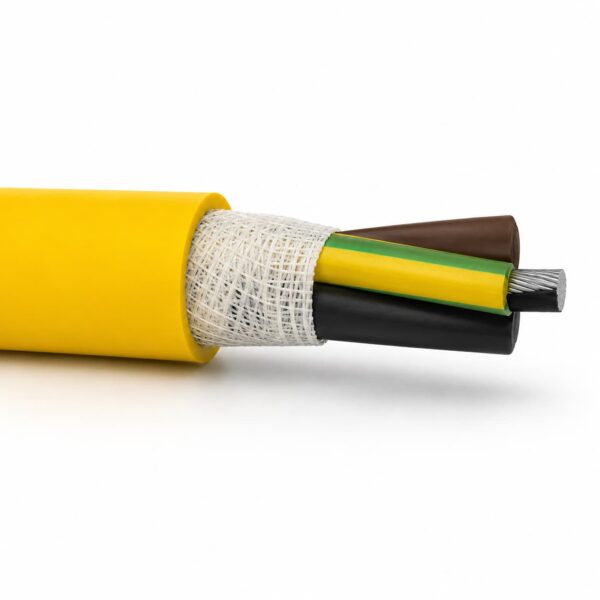
NSHTOU / (N)SHTÖU 0.6/1 kV Low Voltage Reeling Cable
A related cable option for a different application or duty profile.
View product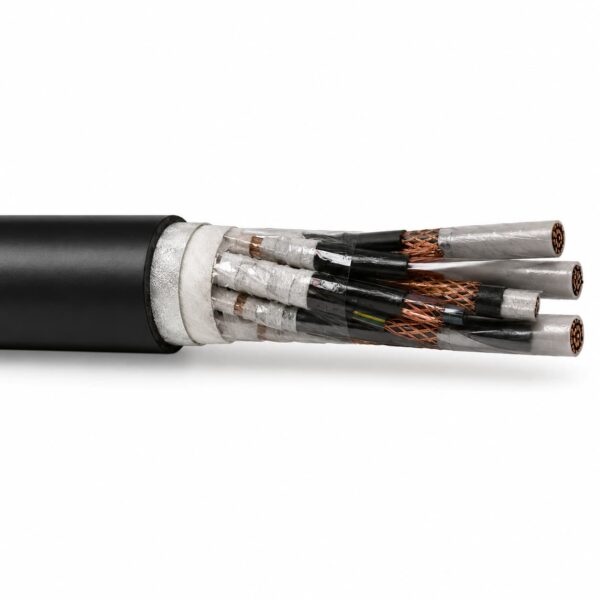
3GSLTOE 0.6/1 kV Spreader Basket Cable
A related cable option for a different application or duty profile.
View product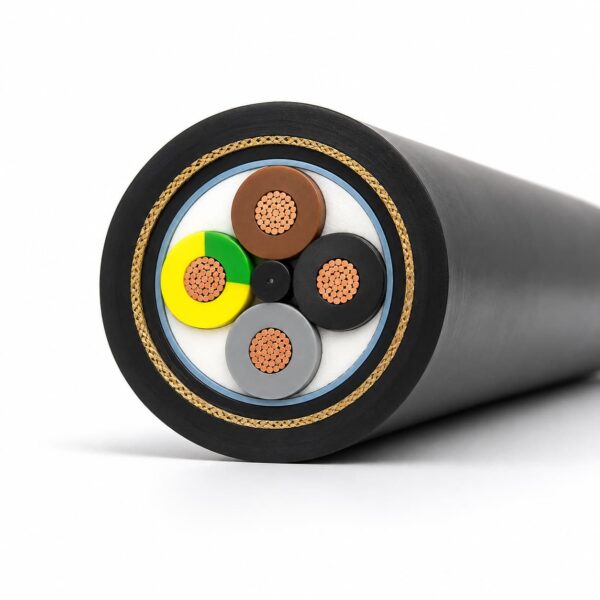
Festoonflex PUR-HF Cable 0.6/1 kV for Cranes and Moving Equipment
A related cable option for a different application or duty profile.
View productRequest a cable recommendation and quotation
Send the required services, cable length, mechanical duty, environment, termination and quantity. Our team will review the application before quoting.
- Include the product name or SKU plus the required cable length and quantity.
- Attach a specification, drawing or data sheet when available.