









NSHTOU / (N)SHTÖU 0.6/1 kV Low Voltage Reeling Cable
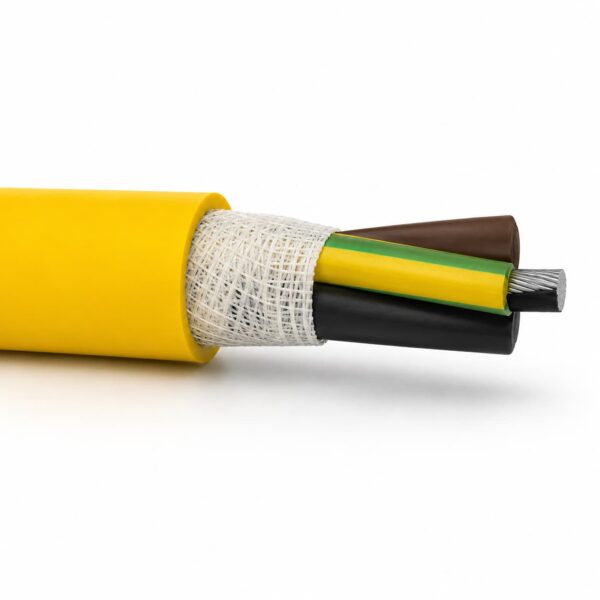
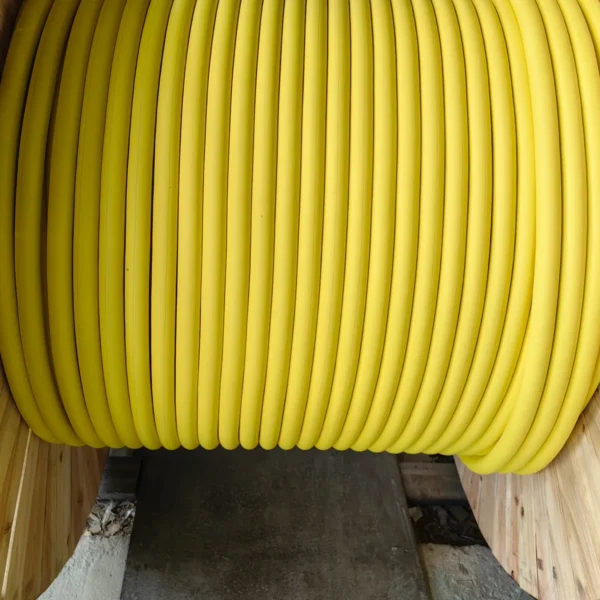
NSHTOU cable, written NSHTÖU in the German VDE code and (N)SHTÖU for builds based on DIN VDE 0250-814, is a 0.6/1 kV heavy-duty rubber reeling cable with an anti-torsion textile braid embedded in the sheath. It is used on motorized and spring cable drums, festoon systems, hoists and cranes, where the cable winds, unwinds and twists in service.
- Voltage: 0.6/1 kV; AC test voltage 3.5 kV
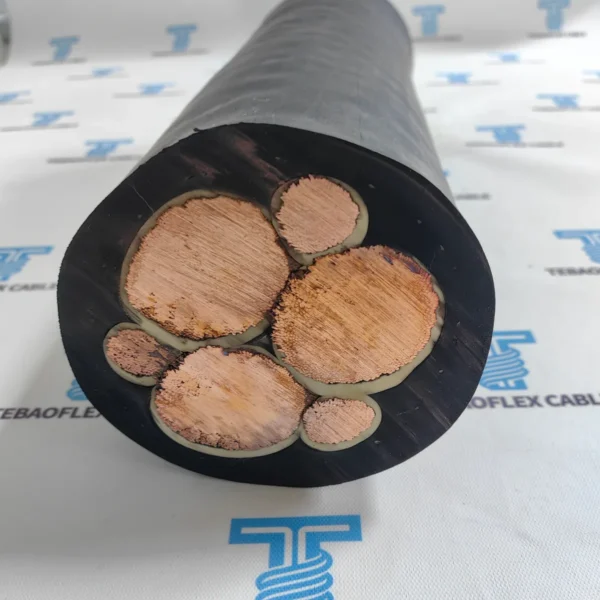
- Conductor: Class 5 tinned copper, 3 × 1.5 to 3 × 240 + 3 × 120/3E mm²
- Insulation and sheaths: 3GI3 insulation, GM1b inner sheath, 5GM3 outer sheath, black or yellow
- Travel speed: festoon up to 240 m/min; horizontal reeling up to 120 m/min
- Temperature: fixed -40°C to +80°C; mobile -25°C to +80°C
- Tensile load: up to 20 N/mm² of conductor cross-section
Send the core arrangement, length, drum type, travel speed and ambient temperature for a technical quotation.
NSHTOU reeling cable for drums and festoon systems
NSHTOU / (N)SHTÖU is a 0.6/1 kV rubber reeling cable for equipment that winds, unwinds or guides the cable while it supplies power. An anti-torsion textile braid within the sheath distinguishes this construction from general rubber flexible cable. This page covers the low-voltage reeling family, its size range and the mechanical checks needed to match a cable to its drum.
Select the core arrangement for the circuit, then check the complete moving route. A cable that carries the required current can still be unsuitable if its diameter does not fit the drum, its allowable pull is exceeded or heat builds up in energized wound layers. The Specifications tab provides the published dimensions and the stated basis for drum-diameter and pulling-force calculations.
- Use the family data for drum and festoon selection; confirm the actual movement and operating conditions.
- Choose the protective-earth arrangement and any control or optical-fibre elements for the ordered construction.
- Keep the electrical rating, cable-management system and termination requirements together when comparing sizes.
For a green-yellow protective conductor, see NSHTÖU-J reeling cable. For an underground loader reel, review NSHTOEU LHD cable.
For high-tensile S-bend guide-roller drums or abrasion-intensive polyurethane reeling, compare these constructions: TROMMELFLEX KSM-S & (N)SHTOEU-SMK Spring & Motorized Drum Reeling Cable (0.6/1 kV) (for aramid-reinforced rubber reeling under multi-directional roller deflection at 0.6/1 kV); (N)12YRD11Y-J/O & (N)12YRDC11Y-J/O 0.6/1 kV High-Tensile PUR Reeling Cable (for halogen-free PUR drum reeling in sharp-edged industrial yards at 0.6/1 kV). Check tensile rating, outer diameter, and sheath compound against your drum specification.
(N)SHTÖU 0.6/1kV Low Voltage Reeling Cable construction
The NSHTOU construction combines flexible conductors, elastomeric insulation and sheaths, and an anti-torsion textile braid. The table identifies the materials for this build; order examples below show distinct core arrangements.
| Conductor | Class 5 stranded tinned copper; plain copper on request |
|---|---|
| Insulation | 3GI3 HEPR-based elastomer |
| Inner Sheath | GM1b elastomer |
| Outer Sheath | 5GM3 heavy-duty special rubber |
| Sheath Colour | Black or yellow |
| Maximum Conductor Temperature | 90°C |
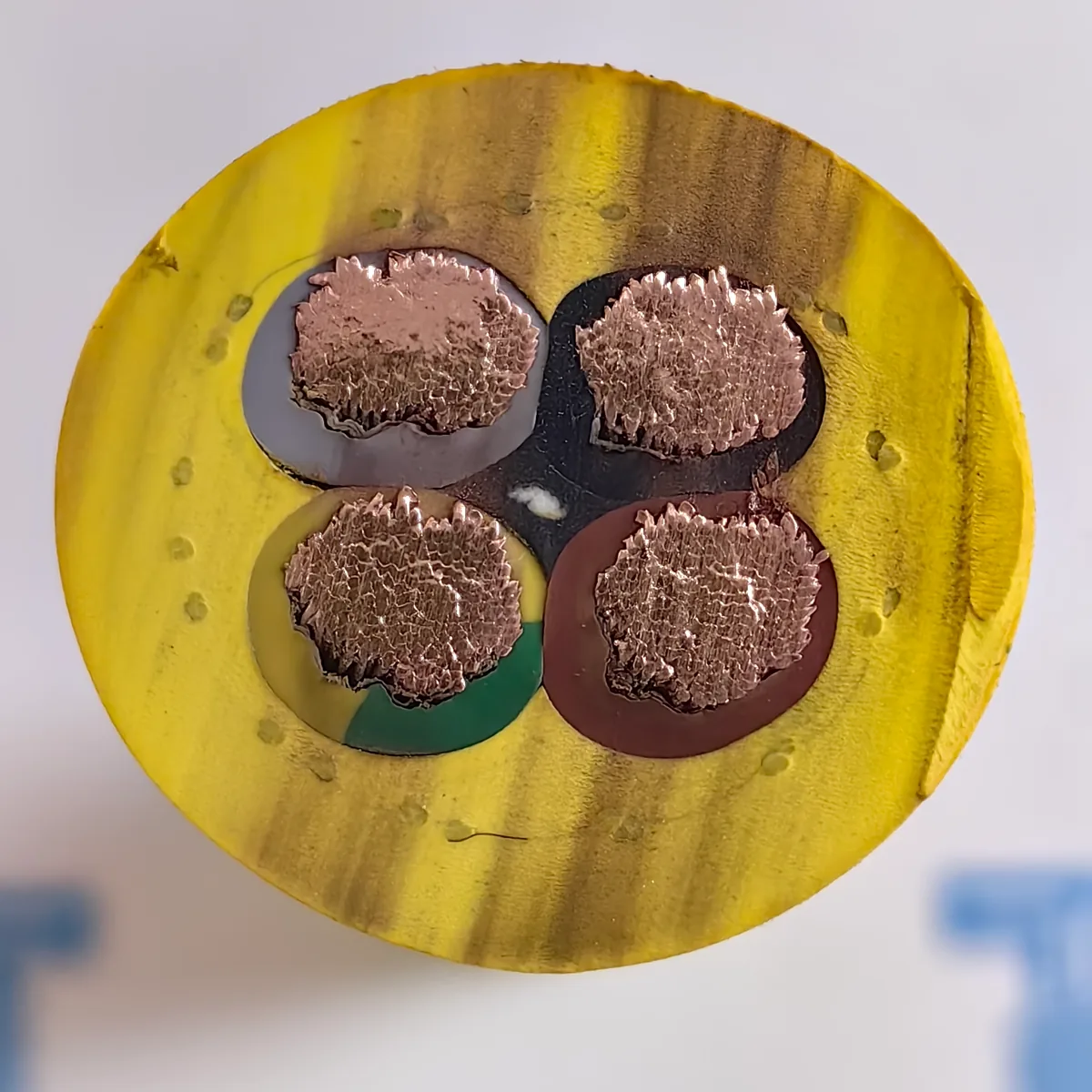
(N)SHTÖU Constructions from TEBAOFLEX Orders and Project Specifications
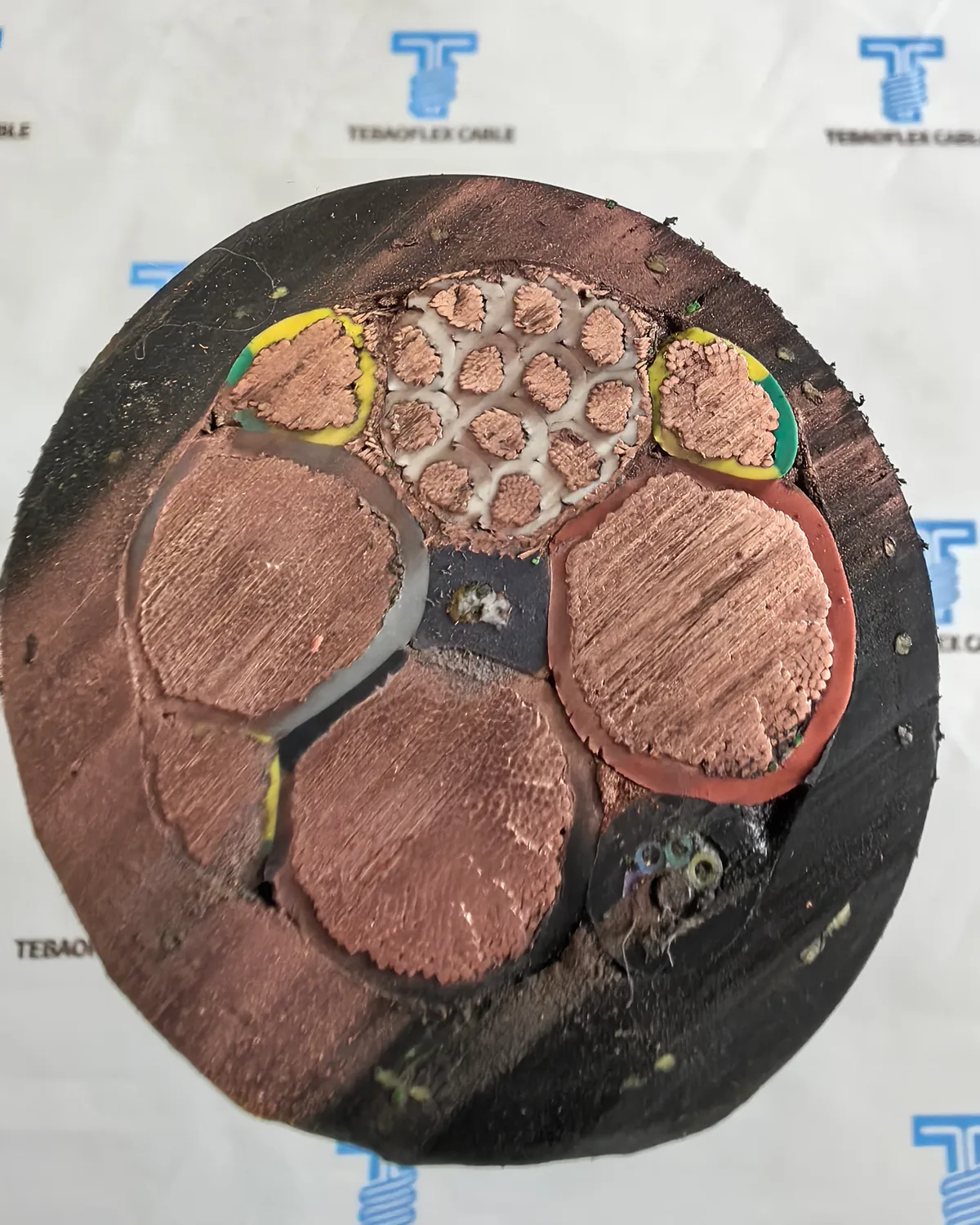
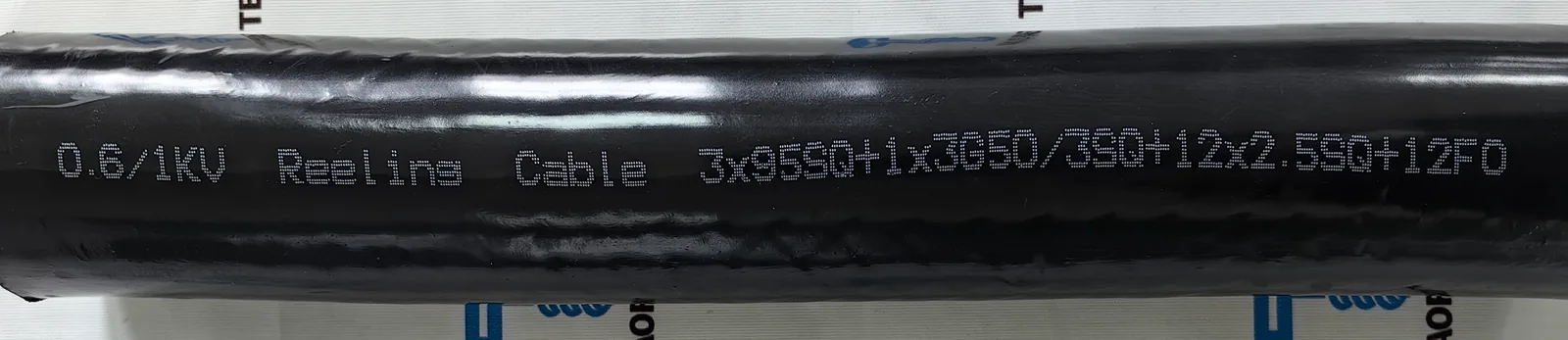
These builds come from TEBAOFLEX factory orders, as printed on the sheath, and from project specifications prepared for customers. Diameter, weight and test values are confirmed on the order datasheet.
| Construction | Rated voltage | Duty | Source |
|---|---|---|---|
| (N)SHTÖU-J 3×185+3×95/3, yellow | 0.6/1 kV | Bucket-wheel stacker-reclaimer reel, Poland | Factory order; stacker-reclaimer case record |
| (N)SHTÖU-J 3×70+3×35/3, yellow | 0.6/1 kV | Bucket-wheel stacker-reclaimer reel, Poland | Factory order; stacker-reclaimer case record |
| (N)SHTÖU-J 3×240+3×120/3 | 0.6/1 kV | Heavy power reeling | Factory order, sheath print |
| NSHTÖU-FO 3×95+1×3G50/3+12×2.5+12FO | 0.6/1 kV | Reeling cable with power, control and 12 optical fibres | Factory order, sheath print |
| (N)SHTÖU 4×16, yellow sheath | — | Crane reeling | Factory order |
| NSHTÖU-J 3×185+2×35+6FO (62.5/125) | 0.6/1 kV | Reclaimer reel in a coal-handling system | Project specification |
| (N)SHTÖU-J 3×10+3×10/3 | 0.6/1 kV | Spreader cable-reel motor supply | Project specification |
| (N)SHTÖU-J 30×2.5 | 0.6/1 kV | Festoon control cable | Project specification |
| (N)SHTÖU-O 6×(2×1), screened | 0.6/1 kV | Festoon intercom cable | Project specification |
The sheath prints and project specifications quoted above write the split protective earth as /3; the TEBAOFLEX tables on this site write the same arrangement as /3E.
(N)SHTÖU 0.6/1kV Low Voltage Reeling Cable applications
Applications
- Motorized and spring-operated reeling drums
- Horizontal reeling systems on cranes and transport machinery
- Festoon systems with controlled cable loops
- Hoists, lifting equipment and material-handling machinery
- Drum and drag-cable service in dry, damp and wet industrial areas
- Mobile power connections exposed to bending, tensile and torsional stresses
Selection Notes for Buyers
Select the conductor cross-section from the required current, route length, voltage-drop limit, ambient temperature, grouping and the applicable DIN VDE 0298-4 current rating. Reeling installations need an additional thermal check because multiple energized cable layers on a drum cannot dissipate heat as effectively as a freely exposed cable.
Mechanical selection should include the minimum drum and guide-roller diameters, the bending radius required by DIN VDE 0298-3, acceleration, travel distance, reversing frequency and maximum pulling force. The travel-speed figures are upper limits for the stated installation modes, not a substitute for checking the complete cable-management system. Keep the working tensile load within 20 N/mm² and do not use the cable as a load-bearing lifting member.
For an RFQ, provide the conductor arrangement, required length, drum orientation, number of cable layers, travel speed, duty cycle, ambient temperature, oil or water exposure, sheath colour and required inspection documents. This information allows the cable dimensions, conductor size and mechanical design to be checked against the actual machine.
Selection checks
Confirm the equipment interface, installation method, route length, movement or flexing duty, environmental exposure, conductor or core requirements and project documentation before final selection.
NSHTOU / (N)SHTÖU Specifications
Values for the (N)SHTÖU 0.6/1 kV construction. Confirm the final core arrangement and dimensions on the order datasheet.
| Parameter | Value |
|---|---|
| Rated voltage U0/U | 0.6/1 kV |
| Maximum operating voltage | AC 0.7/1.2 kV; DC 0.9/1.8 kV |
| AC test voltage | 3.5 kV |
| Conductor | Class 5 stranded tinned copper; plain copper on request |
| Insulation | 3GI3 HEPR-based elastomer |
| Inner sheath | GM1b elastomer |
| Strength member | Anti-torsion textile braid embedded in the sheath |
| Outer sheath | 5GM3 heavy-duty special rubber, black or yellow |
| Ambient temperature | Fixed -40°C to +80°C; mobile -25°C to +80°C |
| Maximum conductor temperature | 90°C |
| Short-circuit conductor temperature | 250°C maximum |
| Minimum bending radius, reeling | 5 × outer diameter up to 20 mm; 6 × outer diameter above 20 mm (DIN VDE 0298-3, Table 3 reference) |
| Maximum tensile load | 20 N/mm² of conductor cross-section |
| Travel speed | Festoon up to 240 m/min; horizontal reeling up to 120 m/min |
| Current rating | DIN VDE 0298-4, reduced for energized drum layers |
| Standards | DIN VDE 0250-814 (construction reference); DIN VDE 0250-1; DIN VDE 0298-3 |
| Flame test methods | VDE 0482-332-1-2; DIN EN 60332-1-2; IEC 60332-1 |
| Oil-resistance test methods | HD/EN/IEC 60811-2-1; DIN VDE 0473-811-2-1 |
NSHTOU Sizes, Weights, Drum Diameter and Maximum Pull
Outer diameter and weight are the published values. The last three columns are calculated by TEBAOFLEX: the nearest AWG or kcmil size, the maximum working pull at 20 N/mm² on the phase conductors, and the smallest drum core diameter at the reeling bend radius above, using the maximum outer diameter. Earth conductors are not counted in the pull value.
| Size (cores × mm²) | Outer diameter min.–max. (mm) | Approx. weight (kg/km) | Nearest AWG / kcmil | Max. pull (N) | Min. drum core Ø (mm) |
|---|---|---|---|---|---|
| NSHTOU 3 × 1.5 | 11.2–14.4 | 236 | 16 AWG | 90 | 144 |
| NSHTOU 3 × 2.5 | 12.6–16.1 | 305 | 14 AWG | 150 | 161 |
| NSHTOU 3 × 4 | 15.3–19.6 | 395 | 12 AWG | 240 | 196 |
| NSHTOU 3 × 6 | 16.4–20.9 | 525 | 10 AWG | 360 | 251 |
| NSHTOU 3 × 10 | 20.2–25.7 | 765 | 8 AWG | 600 | 308 |
| NSHTOU 3 × 16 | 22.5–28.6 | 1080 | 6 AWG | 960 | 343 |
| NSHTOU 3 × 35 | 31.7–40.0 | 2030 | 2 AWG | 2 100 | 480 |
| NSHTOU 3 × 50 | 37.1–46.8 | 2680 | 1/0 AWG | 3 000 | 562 |
| NSHTOU 3 × 70 | 42.5–53.5 | 3530 | 2/0 AWG | 4 200 | 642 |
| NSHTOU 3 × 95 | 48.2–60.6 | 4400 | 3/0 AWG | 5 700 | 727 |
| NSHTOU 3 × 120 | 51.6–64.9 | 5250 | 250 kcmil | 7 200 | 779 |
| NSHTOU 3 × 150 | 56.2–70.7 | 7040 | 300 kcmil | 9 000 | 848 |
| NSHTOU 3 × 185 | 63.3–79.4 | 8320 | 350 kcmil | 11 100 | 953 |
| NSHTOU 3 × 25 + 16 | 30.4–38.4 | 2720 | 3 AWG | 1 500 | 461 |
| NSHTOU 3 × 35 + 16 | 34.0–42.8 | 3010 | 2 AWG | 2 100 | 514 |
| NSHTOU 3 × 50 + 3 × 25/3E | 37.1–46.8 | 2730 | 1/0 AWG | 3 000 | 562 |
| NSHTOU 3 × 50 + 25 | 38.6–48.6 | 3430 | 1/0 AWG | 3 000 | 583 |
| NSHTOU 3 × 70 + 3 × 35/3E | 42.5–53.5 | 3740 | 2/0 AWG | 4 200 | 642 |
| NSHTOU 3 × 70 + 35 | 45.6–57.4 | 4010 | 2/0 AWG | 4 200 | 689 |
| NSHTOU 3 × 95 + 3 × 50/3E | 48.2–60.6 | 4690 | 3/0 AWG | 5 700 | 727 |
| NSHTOU 3 × 95 + 50 | 53.1–66.7 | 5405 | 3/0 AWG | 5 700 | 800 |
| NSHTOU 3 × 120 + 3 × 70/3E | 51.6–64.9 | 6220 | 250 kcmil | 7 200 | 779 |
| NSHTOU 3 × 120 + 70 | 55.5–69.7 | 6818 | 250 kcmil | 7 200 | 836 |
| NSHTOU 3 × 150 + 3 × 70/3E | 56.2–70.7 | 7480 | 300 kcmil | 9 000 | 848 |
| NSHTOU 3 × 150 + 70 | 64.0–80.4 | 9190 | 300 kcmil | 9 000 | 965 |
| NSHTOU 3 × 240 + 3 × 120/3E | 69.9–87.7 | 11760 | 500 kcmil | 14 400 | 1 052 |
NSHTÖU vs NSHTÖU-J, NSHTÖU-FO, NSSHÖU and H07RN-F
| Designation | What changes | Choose it when |
|---|---|---|
| (N)SHTÖU (this page) | 0.6/1 kV reeling cable with an anti-torsion braid | The cable winds on a drum or runs in a festoon and must resist torsion |
| NSHTÖU-J | Same family with a green-yellow earth core | The protective conductor must run inside the reeling cable |
| NSHTÖU-FO | Adds optical fibres to the power and control cores | Power and data must share one drum |
| (N)SSHÖU | Heavy rubber cable for special mechanical load, without the reeling strength member | The route is dragged, trailing or fixed rather than wound on a motorized drum |
| H07RN-F | 450/750 V general rubber flexible cable without an anti-torsion braid | Light mobile duty at 450/750 V |
| NSHTOEU LHD | Reeling cable build for load-haul-dump mining machines | The drum is on an underground LHD loader |
Sizing an NSHTOU Reeling Drum: Bend Radius and Pull Force
Two numbers decide whether a drum and its guide rollers suit an NSHTOU size. The minimum drum core diameter is twice the minimum bending radius: TEBAOFLEX specifies 5 × outer diameter for cables up to 20 mm and 6 × outer diameter above 20 mm in reeling duty, with DIN VDE 0298-3, Table 3 as the installation reference. The maximum pulling force is the tensile limit of 20 N/mm² multiplied by the conductor cross-section.
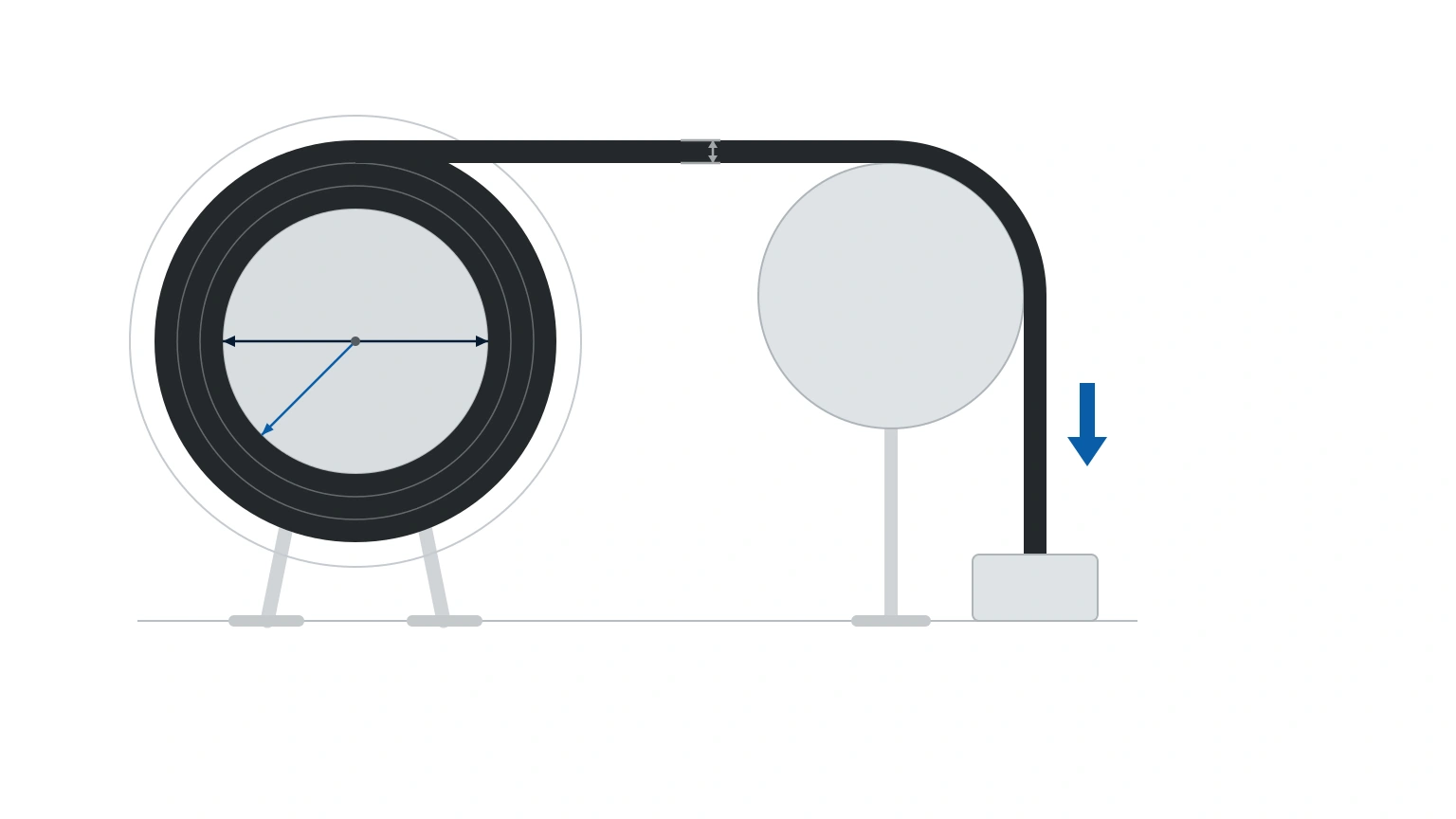
Example: NSHTOU 3 × 95 has an outer diameter of up to 60.6 mm, so its bending radius is 6 × 60.6 = 364 mm and the drum core needs at least 727 mm. Its three 95 mm² phase conductors (285 mm²) allow 285 × 20 = 5,700 N of working pull. The Specifications tab gives both values for every size.
Current rating follows DIN VDE 0298-4 and must be reduced for energized layers on the drum, because wound layers cannot shed heat like a cable in free air. Give the number of layers and the duty cycle with the enquiry.
(N)SHTÖU 0.6/1kV Low Voltage Reeling Cable standards and compliance
Construction, installation and test references for the NSHTOU reeling cable are listed below.
- Minimum Bending Radius According to DIN VDE 0298-3, Table 3
- Current-Carrying Capacity According to DIN VDE 0298-4
- Construction DIN VDE 0250-814
- General Requirements DIN VDE 0250-1
- Guide to Use DIN VDE 0298-3
- Electrical Tests DIN VDE 0472-501, 502, 503, 508
- Non-Electrical Tests DIN VDE 0472-401, 402, 602, 303, 615
- Tests Under Fire Conditions DIN VDE 0472-803, 804
- Flame Test Methods VDE 0482-332-1-2; DIN EN 60332-1-2; IEC 60332-1
- Oil-Resistance Test Methods HD/EN/IEC 60811-2-1; DIN VDE 0473-811-2-1
Where a project requires a test report, certificate, marking record or inspection release, include that requirement in the quotation request.
NSHTOU Cable: What (N)SHTÖU Means
NSHTOU is the keyboard spelling of NSHTÖU, the German VDE designation for a 0.6/1 kV heavy-duty rubber reeling cable with a strength member in the sheath. TEBAOFLEX builds it as (N)SHTÖU, a construction with reference to DIN VDE 0250-814: Class 5 tinned copper, 3GI3 insulation, GM1b inner sheath, an anti-torsion textile braid and a 5GM3 outer sheath. Buyers also write it NSHTOEU or (N)SHTOEU.
The designation is a VDE type code and reads letter by letter:
- N – built to a VDE type; (N) – with reference to VDE
- SH – heavy mechanical load
- T – strength member (Tragorgan), here the anti-torsion braid
- Ö – oil-resistant sheath
- U – flame-resistant
- -J / -O – with / without a green-yellow protective earth core
Every position of the code is explained in our guide to reading a VDE cable designation.
NSHTOU Cable FAQ
What does NSHTOU stand for?
NSHTOU is the keyboard spelling of NSHTÖU, a German VDE type code: N for a VDE standard type, SH for heavy mechanical load, T for the strength member (the anti-torsion braid), Ö for an oil-resistant sheath and U for flame resistance. It identifies a 0.6/1 kV rubber reeling cable for cable drums and festoons.
Are NSHTOU, NSHTÖU and NSHTOEU the same cable?
Yes. Ö is written O or OE when the umlaut is not available, so NSHTOU, NSHTOEU and NSHTÖU name the same designation. (N)SHTÖU marks a construction with reference to DIN VDE 0250-814, which is how TEBAOFLEX designates this cable.
What is the difference between NSHTÖU-J and NSHTÖU-O?
-J means the cable includes a green-yellow protective earth core; -O means it has no protective earth core. Choose -J when the protective conductor must run inside the reeling cable.
Related cable options
Compare these cable options by service combination, movement, load, voltage and transmission requirement.
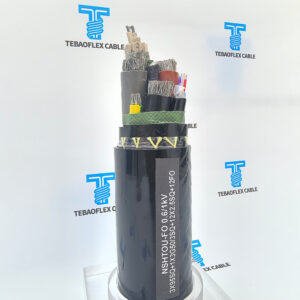
NSHTÖU-J Rubber Reeling Cable 0.6/1 kV for Hoisting and Hauling Equipment
A related cable option for a different application or duty profile.
View product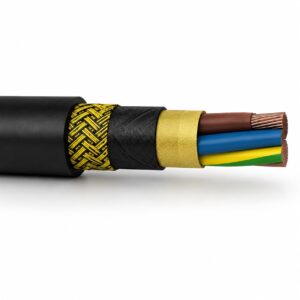
NSHTOEU 0.6/1kV LHD Mining Reeling Cable
A related cable option for a different application or duty profile.
View productRequest a cable recommendation and quotation
Send the required services, cable length, mechanical duty, environment, termination and quantity. Our team will review the application before quoting.
- Include the product name or SKU plus the required cable length and quantity.
- Attach a specification, drawing or data sheet when available.