


Many industrial and mining cables use a VDE/DIN-style short code, but the format is not universal. For VDE 0250-style strings, read the functional positions from left to right, then verify the code against the governing standard and product record.
First identify the code family and its governing standard. Then split the string into its functional parts: relationship to the standard, insulation material, cable description, special construction, sheath material and protective conductor. Finally add the voltage, core arrangement, cross-section and duty from the product record.
For example, NSGAFÖU is commonly grouped as N + SG + AF + ö + u: VDE type, special rubber, fine-stranded single core, oil-resistant and flame-resistant properties. The grouping is meaningful only within the applicable designation legend; it is not a universal decoder for every cable family.
Technical review: 20 August 2026. The guide is a selection aid; confirm the exact product standard, edition and order-specific documents before approval or installation.
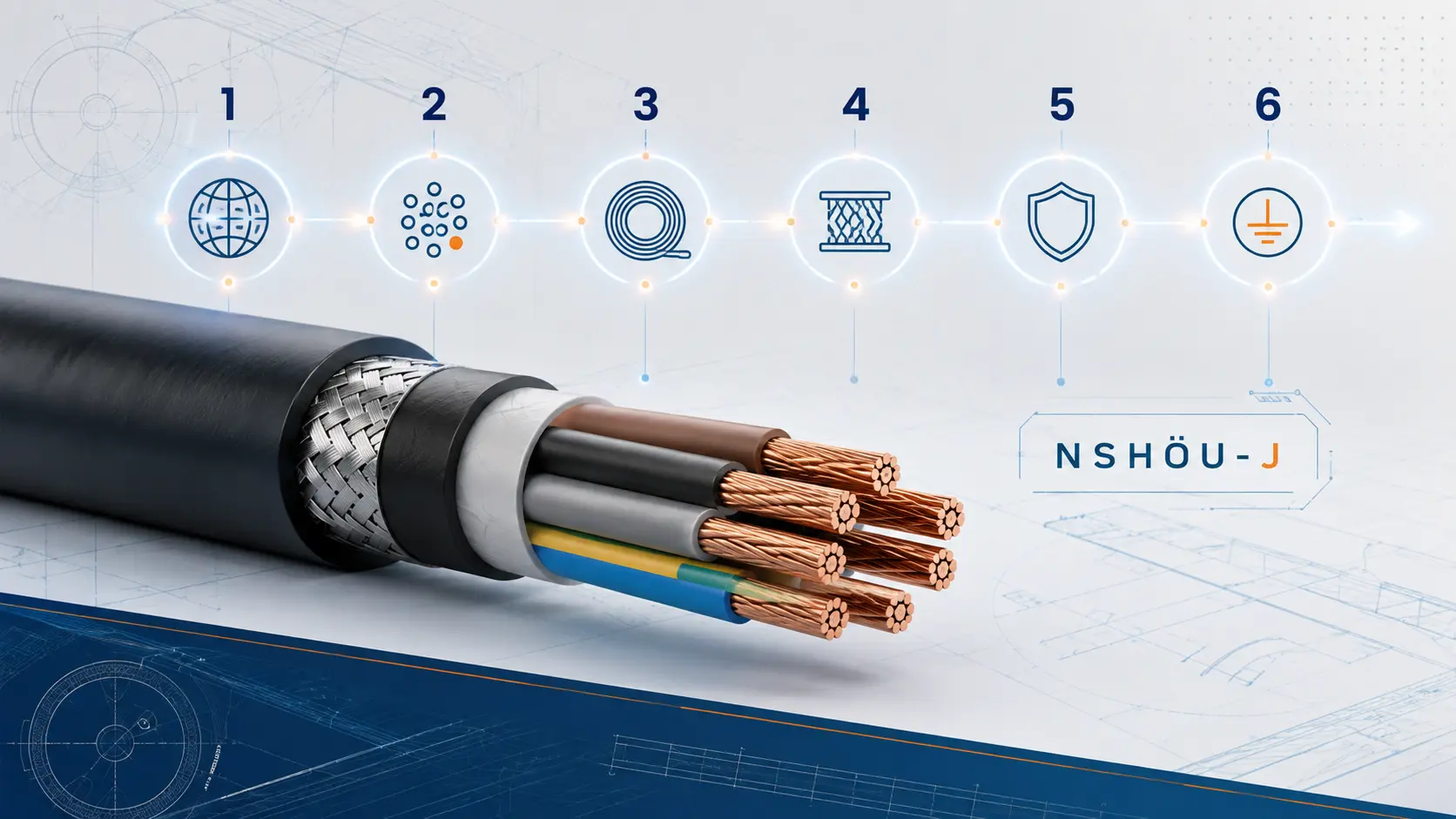
VDE Cable Designation: Six Positions Explained
| Position | What it fixes | Codes |
|---|---|---|
| 1 | Relationship to the standard | N built to a VDE type · (N) or X with reference to VDE |
| 2 | Insulation material | G elastomer · SG special rubber (elastomer) · 2G silicone · 3G EPR · 4G EVA · 5G polychloroprene · Y PVC · 2X XLPE · 11Y PUR · HX LSOH |
| 3 | Cable description | A single core · AF single core, fine stranded · F flexible · FL flat · LH light mechanical load · MH medium mechanical load · SH heavy mechanical load · SSH special mechanical load · S control cable · SL control / welding · Si silicone · GL glass fibre |
| 4 | Special construction | T strength member (Tragorgan) · ö oil-resistant · u flame-resistant · w heat- and weather-resistant · C screen · S steel wire armour · FE fire-resistant |
| 5 | Sheath material | Same code set as position 2 |
| 6 | Protective conductor | -J with green/yellow earth core · -O without |
4-Step Decoding Method
- Identify the family. Decide whether the marking follows a VDE 0250-style power-cable legend, a harmonized designation such as H05VV5-F, or another national/type system.
- Protect multi-character tokens. Read
SSH,SH,AF,SGandFEas possible tokens before assigning a single letter. - Map each token by position. The same
Scan mean a control cable in one position and steel-wire armouring in another. - Complete the specification. Add voltage, core count, cross-section, movement, environment, approval and documentation requirements. A short code alone is not a quotation-ready cable specification.
Common VDE Cable Designation Mistakes
SH and SSH are single tokens — “heavy” and “special” mechanical load. NSHÖU reads N + SH + ö + u, not N + S + H + ö + u. This is a common misreading.
S has two meanings depending on position. S means a control cable in position 3 but steel wire armour in position 4. Which meaning applies is decided by where the letter sits in the string, not by the letter itself.
Some letters used in medium-voltage mining strings are not defined in the published VDE legend. The E and W in (N)TSCGEWÖU, for example, are not in the code sets above. Where a code is not defined by the standard, it is left unassigned — we do not invent a meaning to fill the gap.
Worked Examples: VDE Cable Codes Decoded
| Designation | Reading |
|---|---|
| (N)SSHÖU | (N) with reference to VDE · SSH special mechanical load · ö oil-resistant sheath · u flame-resistant |
| NSHTÖU-J | Context example: a heavy-duty/reeling cable family with the -J protective-conductor suffix. Confirm the internal token grouping against the governing VDE legend for the exact construction; do not expand every letter by position alone. |
| NSGAFÖU | N VDE type · SG special rubber (elastomer) · AF single core, fine stranded · ö oil-resistant · u flame-resistant — built to DIN VDE 0250-602 |
How to use a VDE Cable Designation in an RFQ
A designation is a compact way to name a construction; on its own it does not tell a manufacturer how much cable to ship or which certification it has to carry. When you send a designation to quote, add:
- Rated voltage U₀/U (e.g. 0.6/1 kV or 14/25 kV)
- Core arrangement — power cores × cross-section, and any earth or pilot / ground-check cores
- Duty — fixed, trailing, reeling, festoon or torsion
- Standard or approval the project requires (VDE, DIN, IEC, MSHA, NEK, class society)
- Length per drum and total quantity
Related references:
Which VDE code system does this guide cover?
This article covers the VDE 0250-style power-cable legend used for the examples and tables above. It should not be used as a universal decoder for harmonized cable designations or for North American, Australian or other national type systems.
DIN VDE 0292:2021-08 is a separate designation system for harmonized power cables and cords under the EN 50525 series, EN 50214, EN 50618 and EN 50620. That is why a code such as H05VV5-F has a different sequence of voltage, insulation, sheath and conductor-form elements. Check the governing product standard before interpreting any abbreviation.
Have a designation you need to replace?
Send the designation, the rated voltage, the core schedule and the standard the project requires. A photo of the sheath print or drum label is enough to start. We come back with the matching construction and a price.