


Reading a temperature rating before you compare quotes
Three suppliers quote you a 200 °C wire. One means the compound survived a 100,000-hour ageing programme, one means the conductor may run at 200 °C, and one means a style number on a certificate that does not cover field installation at all. High temp wire insulation is where most cross-border sourcing goes wrong, because the number on the datasheet is the output of a test method, and the test method is rarely printed next to it.
High temp wire insulation at a glance
- What it is
- Insulation that holds its electrical and mechanical properties above 90 °C continuously. The commercial band runs from 105 °C to 250 °C for polymer hook-up wire, with mineral constructions carrying on to 450 °C and beyond.
- The five polymer families
- Silicone rubber, FEP, PFA, PTFE and cross-linked polyolefin (XLPE/XLPO). Above the fluoropolymer ceiling the answer stops being a polymer at all and becomes mica tape with a glass braid.
- What the rating means
- A service-life statement produced by a thermal endurance programme — temperature index under IEC 60216, or relative thermal index under UL 746B. It is not the temperature at which the wire fails.
- What usually fails first
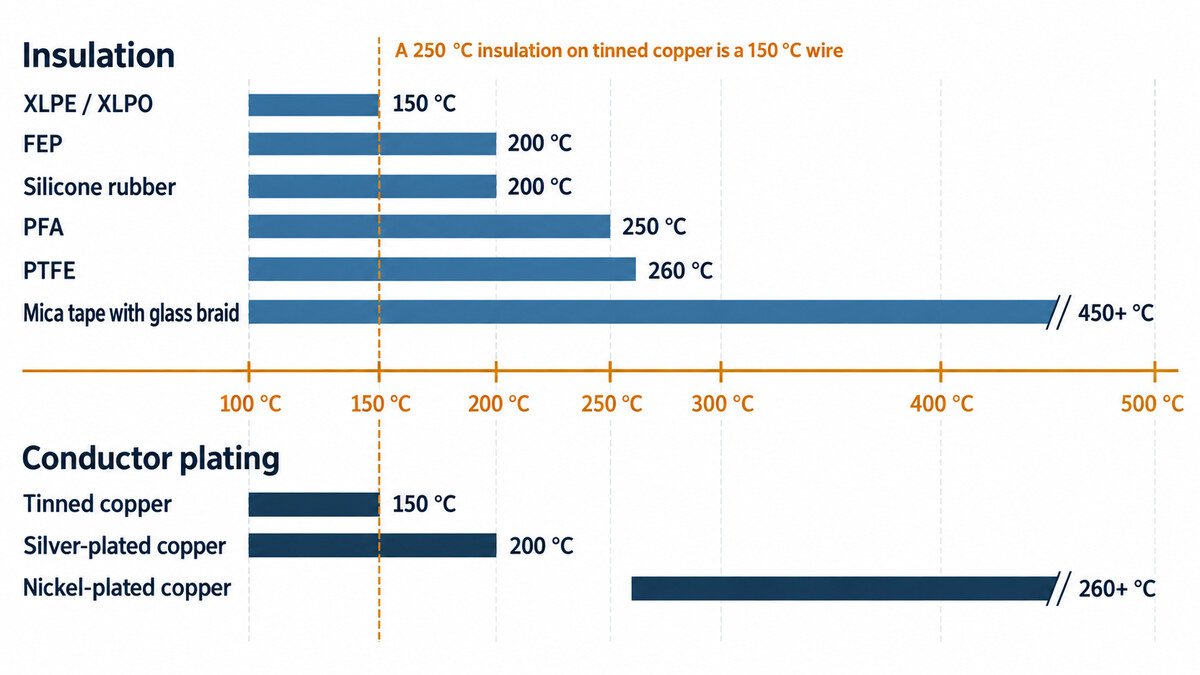
- The conductor plating or the mechanical duty, ahead of the insulation. Tin stops being a useful oxidation barrier around 150 °C, so a 250 °C insulation on tinned copper is a 150 °C wire wearing an optimistic label.
- What it is not
- A number you can compare across regions without knowing which system produced it. UL, EN and IEC rate different things, and a UL AWM style number carries installation limits that have nothing to do with temperature.
The insulation families, and where each one actually stops
Every supplier’s material page lists the same top temperatures. The number that decides your specification is usually the second one: the property that runs out first in your particular installation. A silicone wire rated 200 °C will survive 200 °C indefinitely and still fail in eight months if it is dragged across a steel edge, because silicone’s weakness was never heat.
| Family | Typical continuous rating | What runs out first | Choose this when |
|---|---|---|---|
| Silicone rubber | 150–200 °C, specialty grades to 250 °C | Tear and abrasion resistance | The wire has to stay flexible while hot — motor and generator leads, oven looms, anything that moves at temperature |
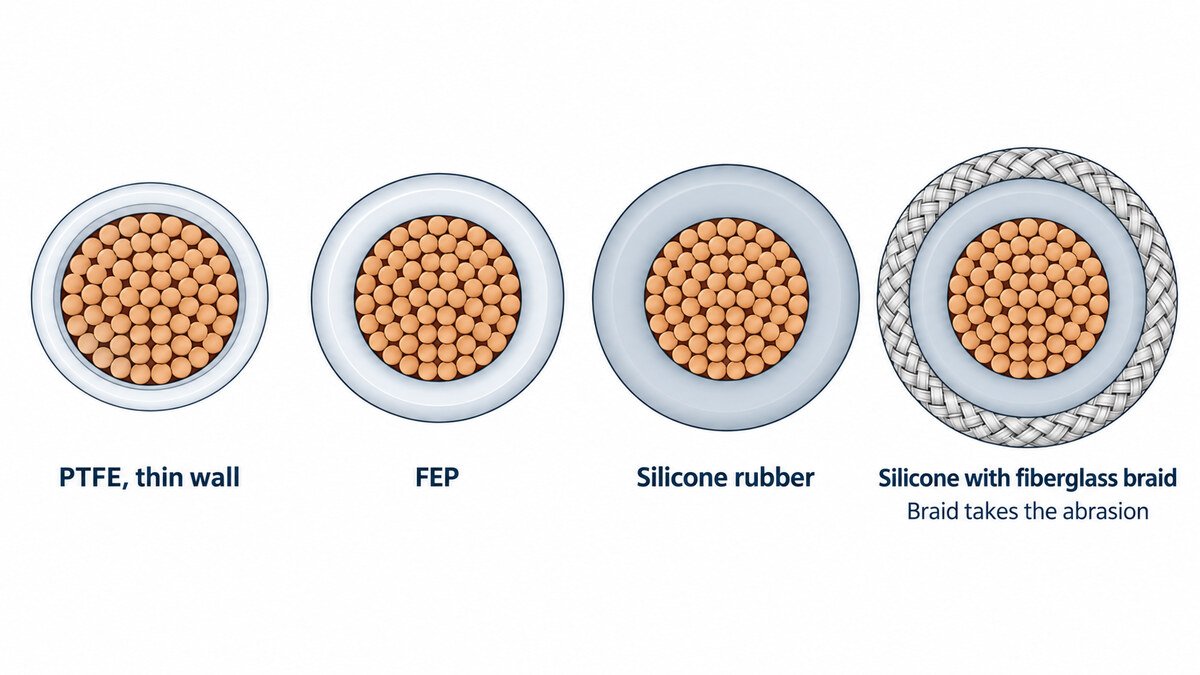
| Silicone with fiberglass braid | 200 °C | Braid binder and handling stiffness | Heat and rubbing arrive together — furnace decks, kiln walkways, looms that drag on steel structure |
| FEP | 200 °C | Softening and creep near the top of the range | Thin-wall instrument, sensor and lighting wiring at or below 200 °C, where colour range and cost matter |
| PFA | 250 °C | Conductor plating, then cost | Heater and thermocouple leads needing a uniform wall that strips cleanly across hundreds of terminations |
| PTFE | 260 °C, commonly published as 250 °C on AWM styles | Stiffness and minimum bend radius | Wall thickness, chemical attack or dielectric strength decides the design and the loom is essentially static |
| Mica tape with glass braid (MGT type) | 450 °C to UL styles; around 538 °C on non-UL builds | Flexibility — it is a fixed-install product | The duty is genuinely above the fluoropolymer ceiling: furnace internals, kiln control wiring, industrial oven cavities |
| XLPE / XLPO | 90–150 °C | The temperature itself | Halogen-free, low-smoke behaviour and a thin tough wall matter more than the top temperature |
Two families in that table are frequently swapped by mistake. PTFE and PFA share the chemistry and roughly the temperature, so buyers treat them as interchangeable; the difference shows up on the production line, where PFA is melt-processable and produces a smoother, more uniform wall, while PTFE is tape-wrapped and sintered. FEP is the value option one step down, and it is the right answer far more often than its 200 °C ceiling suggests, because most instrument wiring never sees more than 150 °C.
What does a temperature rating on wire insulation actually promise?
A temperature rating on wire insulation is a service-life statement, not a failure threshold. Under IEC 60216 the material is aged at several elevated temperatures until a defined property drops to an end point, and the results are extrapolated on an Arrhenius relationship to give a temperature index. UL 746B produces a relative thermal index the same way.
Two consequences follow, and both matter when you are comparing quotes rather than designing a machine.
The first is that the number carries a time with it. A UL relative thermal index is the temperature at which the material still retains roughly half of a measured property after about 100,000 hours of hot-air ageing. Run the wire ten degrees hotter and you do not get a fault; you get a shorter life, on a curve that IEC 60216-8 describes with an explicit halving interval. Whether that matters depends entirely on whether the equipment is meant to last three years or twenty.
The second is that the rating is property-specific. UL 746B distinguishes an electrical index from a mechanical-with-impact index and a mechanical-without-impact index, and they are not the same temperature. A compound can hold its dielectric performance at a temperature where its mechanical strength has already halved, which is exactly the failure people describe as “the insulation went crumbly but it was still passing megger tests”.
Practical test for a datasheet. If a supplier quotes a temperature without naming the standard behind it, ask which one it is. A rating derived under IEC 60216 and a rating copied from a raw material supplier’s brochure are different levels of evidence, and only one of them describes the finished wire.
The conductor plating is the hidden ceiling
Insulation gets all the attention in a high temperature specification, and the copper underneath quietly decides the answer. Plating on a copper conductor is an oxidation barrier and a solderability aid, and each plating metal has a temperature at which it stops doing that job. Above it the copper oxidises, the oxide creeps along the strands, and terminations that passed at commissioning start running hot two years later.
| Plating | Commonly published ceiling | Why it stops there | Where it belongs |
|---|---|---|---|
| Tinned copper | Around 150 °C | Tin’s melting point is low and it stops working as an oxidation barrier well before the insulation is troubled | The 105 °C to 150 °C band — most silicone, FEP and XLPO constructions |
| Silver-plated copper | 200 °C, published to 250 °C by some makers | Silver resists oxidation far better than tin, and the practical limit becomes migration and cost | Thin-wall PTFE and PFA looms in the 200 °C class, aerospace and instrument wiring |
| Nickel-plated copper | From around 260 °C, rising with plating thickness | Nickel is harder and its oxidation-critical temperature is far higher; heavy platings are used well above 400 °C | 250 °C PFA and PTFE, and every mica-glass construction |
Those figures are industry-published values and they move with plating thickness, so treat them as the shape of the problem rather than as limits to design to. The procurement point stands regardless of the exact number: a quotation that names the insulation and its temperature, and says nothing about the conductor, has not answered the question. Two wires described identically as “250 °C PFA, 600 V” are different products if one is on tinned copper.
This is the single most common mismatch we see on incoming enquiries, and it is easy to check. Ask for the conductor specification in the same line as the insulation, every time.
Why 200 °C on a UL datasheet is not 200 °C on an EN datasheet
Buyers sourcing across regions collect quotations written under different rating systems and then compare the temperature column as though it were one scale. It is not. Each system rates a different object, and the paperwork you need at the far end differs accordingly.
| System | What the number describes | How it appears | Ask for |
|---|---|---|---|
| UL 758 AWM (US and Canada) | A style-specific rating that fixes insulation, temperature and voltage in one token, with dry ratings and sometimes a separate wet rating | UL 3135, 200 °C, 600 V | The style sheet, and confirmation that the style sits on the maker’s own UL file |
| EN 50525 and harmonised types (Europe) | Maximum conductor operating temperature for the cable type, with a separate short-circuit temperature | H05S-K, 300/500 V, conductor 180 °C, short circuit 200 °C | The harmonised type designation and the standard part it is built to |
| IEC 60245 and IEC 60227 (international) | Rated conductor temperature for the cable type | 60245 IEC 66 | The type reference and the applicable part |
| IEC 60216 and UL 746B (material level) | Thermal endurance of the compound itself: temperature index, relative thermal index, halving interval | Not printed on the cable | The underlying material data, when the duty sits close to the limit |
A worked example makes the gap concrete. European silicone single-core to H05S-K is built with EI2 silicone insulation and rated 180 °C at the conductor, with 200 °C permitted under short-circuit conditions. A UL 3135 silicone hook-up wire is rated 200 °C continuous. Read the columns side by side and the American wire looks hotter by twenty degrees. Both are ordinary silicone; the systems simply define and verify the number differently, and the short-circuit figure on the European sheet is doing part of the work the UL rating does on its own.
None of this makes one system better. It makes the comparison invalid unless you normalise it first, which is why our own high temperature wire style index and material matrix lists the UL AWM style alongside the European type reference rather than choosing one.
What does UL AWM mean on a wire, and what does it not permit?
UL AWM stands for Appliance Wiring Material, evaluated under UL 758 as a Recognized Component rather than a Listed product. AWM carries no NEC wire type designation and is not evaluated for field installation. It belongs inside a complete Listed end product, and each style’s usage statement carries its own end-use limitations.
For a procurement team this has three practical consequences.
- An AWM style number answers what the construction is rated for. It never answers whether you may install the wire in the field, and no supplier can convert it into that permission.
- The style is only as good as the file it sits on. Any manufacturer can build to the geometry of a style; the certificate that matters names the styles evaluated under that manufacturer’s own file and follow-up service.
- Approval in one region proves nothing about another. A UL or cUL certificate does not create European conformity, and a VDE approval does not create North American acceptance.
The check takes one email. Ask any supplier, including us, to send the certificate covering the specific style you are buying, and read the scope line rather than the logo. If a supplier declines, that answer is itself informative.
What goes over the insulation decides whether it survives the room
By the time a wire is installed, the insulation is rarely the layer taking the punishment. In a furnace bay the loom rubs against structural steel; in a motor terminal box it is pulled and re-dressed at every service; in a chemical plant something eventually drips on it. The insulation temperature rating is silent on all of that.
Silicone is the clearest case. It stays flexible at 200 °C better than any fluoropolymer, and it has poor tear and abrasion resistance, which is why so much of the high-temperature market is silicone wearing a coated fiberglass braid. The braid takes the wear, and the silicone underneath is left to do the job it is good at. Our fiberglass braided silicone wire in UL 3122 and 3513 constructions exists for exactly that reason, in sizes from AWG 20 up to 400 MCM.
The opposite trade shows up with PTFE. Thin wall is the whole point of a fluoropolymer loom, and a construction that fits forty ways into a shell built for twenty-four is also a construction with very little material between the conductor and a sharp edge. Where the loom is static and enclosed that is a good trade. Where anything moves, it is not.
Limits you cannot design around
Three boundaries in high temperature wiring are not engineering trade-offs, and they need stating plainly.
Fluoropolymer decomposition is an operator safety issue, not only a material one. PTFE begins measurable thermal decomposition around 380 °C. Pyrolysis products released between roughly 300 °C and 450 °C cause polymer fume fever, a flu-like syndrome with onset several hours after exposure, and above 450 °C the decomposition products can cause acute lung injury. Any process that heats fluoropolymer insulation — soldering, hot-blade stripping, heat guns, an over-temperature excursion in service — requires ventilation and a written control, and this applies to PTFE, PFA and FEP alike.
Silicone’s ash behaviour is not a fire rating. Silicone burns to a silica ash that remains non-conductive, which is a genuine and useful property. It is not the same as circuit integrity under fire, which is established by testing to a named standard with a stated duration and voltage. If a specification calls for fire survival, it needs the test, not the material property.
Mica-glass construction is a fixed-installation product. The mineral tape that gets it to 450 °C also makes it stiff, and repeated flexing damages the tape layer in ways that are not visible from outside. Where a hot circuit also has to move, the answer is a lower-temperature flexible construction with the heat engineered away from it, and reconsidering the routing is usually cheaper than reconsidering the wire.
Specify it in six lines so three quotes are comparable
Most high temperature enquiries arrive with the material named and the duty missing, which produces three quotations that cannot be compared with each other. Six lines fix that.
- Conductor hot spot. The temperature the conductor reaches at that point in the machine, at full load, in the worst ambient you operate in. Say if the figure is estimated rather than measured, so the margin can be set deliberately.
- Continuous versus excursion. How hot, how long, how often. A wire that sees 250 °C for ninety seconds during a burner light-off is a different specification from one that soaks at 250 °C all shift.
- Voltage, working and test. Rated working voltage plus any type-test voltage you are held to. On high-voltage grades the test voltage often drives the wall thickness more than the working voltage does.
- Movement. Static loom, occasional maintenance flex, or continuous motion. This decides Class 5 against Class 6 stranding and silicone against fluoropolymer before any other consideration.
- Contact and chemistry. What the wire touches: steel edges, oil, solvent, coolant, weld spatter, UV. This is what decides whether a braid or an extruded jacket goes over the insulation.
- Approval and market. The UL AWM style, harmonised type, or customer specification you must show, and the country it has to satisfy.
Add length and packaging and the quotation can usually be written without a follow-up email.
What buyers ask before the first order
Can we order a trial length before committing to a production run?
TEBAOFLEX’s minimum order quantity is 50 m, and it is the same for standard and customised constructions, as of September 2026. Samples are supplied free with freight paid by the customer. Confirm the current sample length and terms with the sales team when you request one, because they depend on the construction.
How long does a high temperature wire order take?
Lead time runs from 7 to 45 working days as of September 2026, depending on the construction, material availability and the level of customisation. The applicable figure is confirmed in writing on the quotation for your specific item, and it is a range rather than a commitment until that confirmation exists.
Does your certification cover my market?
Read the scope line of the certificate rather than the mark. TEBAOFLEX holds UL, cUL and VDE certification, with the exact scopes listed in the next section. Those scopes cover particular cable families and are not a blanket approval for the whole catalogue. For a named UL AWM style, ask us to confirm it against our file first.
Can you build to our own drawing or print our brand on it?
OEM and ODM work is available, including printing customer branding and company information on the cable jacket, the reel and the packaging. Packaging options cover steel, steel-wooden and full wooden drums plus export plastic packing. Structural customisation is assessed case by case against the specification you send.
What we can document, and what we cannot
Everything below is verifiable, and it is deliberately bounded. Anything a supplier will not bound is worth a second look.
TEBAOFLEX has manufactured special and rubber-sheathed industrial cable at its own plant in Taicang, Jiangsu since 14 October 2014. The site covers more than 20,000 m² with 15,000 m² of workshop and warehouse, running 12 automated lines that cover compound mixing, extrusion, braided screening, cabling and packaging, and 8 testing sets spanning incoming material through to finished product. The engineering team numbers over 30, 10 of them with more than fifteen years in cable, holding over 20 patents. Annual capacity is approximately 150,000 km, and product has been exported to more than 20 countries, with concentrations in African copper and cobalt operations, South American copper and iron, and Southeast Asian nickel, coal and mobile heavy equipment. All figures are as of September 2026.
| Approval | Scope as certified | Certificate | Market |
|---|---|---|---|
| UL | ZJCZ Flexible Cord, evaluated to UL 62 Ed. 20 | UL-US-2449012-4, report E542560-20241225, issued 27 December 2024 | United States |
| cUL | ZJCZ7 Flexible Cord Certified for Canada, evaluated to CSA C22.2 No. 49 Ed. 15 | UL-CA-2437036-5, same report | Canada |
| VDE Marks Approval | Cross-linked elastomer insulated flexible cables to DIN EN 50525-2-21 (VDE 0285-525-2-21):2012-01 and EN 50525-2-21:2011 | 40060056, issued 28 March 2025 | Germany and EU |
Those three certificates cover flexible cord and cross-linked elastomer flexible cable families. They are not an approval for every construction we build, and we will not present them as one. Constructions outside those scopes are designed and tested against the applicable IEC, EN, DIN VDE, ICEA, NEMA and UL AWM style requirements, which is a different and weaker statement than certification — deliberately so, because the distinction is the whole subject of this article.
If your specification depends on an approval we do not hold for that construction, we will tell you before the order rather than after it.
Send the style number, or just the hot spot and the machine. Our engineers reply with a construction, the conductor specification alongside the insulation, and the certificate scope that applies to it. Ask an engineer to review your high temperature specification.
Related TEBAOFLEX references
- High temperature cable category — the full range by construction, from SiHF silicone through PFA equipment wire.
- High temperature wire style index — the material, temperature and voltage matrix with UL AWM style numbers.
- Silicone hook-up wire, 105 °C to 250 °C — the 3135 and 3512 motor-lead group and the styles around it.
- PTFE hook-up wire styles and dimensions — thin-wall constructions to 250 °C, including the mineral-filled 1570 on nickel-plated copper.
- PFA hook-up wire for heaters and thermocouples — the 1726, 1727 and 10362 family at 250 °C.
- FEP hook-up wire for instrument and lighting circuits — 150 °C and 200 °C styles.
- Intemp 250 BS G210 PFA equipment wire — the 250 °C equipment wire built to a British aerospace specification.
- SiF 180 single-core silicone cable — the European harmonised route at 180 °C conductor temperature.
Sources and method
Temperature indices and ageing method: IEC 60216-1 and IEC 60216-8 (thermal endurance properties, temperature index, relative temperature index and halving interval); UL 746B for relative thermal index and its electrical, mechanical-with-impact and mechanical-without-impact sub-categories. Appliance Wiring Material status and field-wiring limitations: UL 758 and UL’s own wire and cable marking and application guidance. European conductor temperatures: EN 50525 series type designations and published manufacturer datasheets for H05S-K silicone single core with EI2 insulation. Conductor plating ceilings and insulation family ratings are industry-published values compiled from multiple wire manufacturers’ technical literature; they vary with plating thickness, wall thickness and construction, and are given here to show the shape of the constraint rather than as design limits. Fluoropolymer decomposition temperatures and the polymer fume fever exposure range are drawn from published occupational health and material safety literature.
Company figures, certificate numbers and commercial terms are TEBAOFLEX first-party data as of September 2026. Certificate scopes are quoted from the certificates themselves. Where a construction falls outside a held certification, this article says so rather than implying coverage.