

Home › Solutions › Medium-Voltage Mining Trailing Cables & Couplers
Mining · Medium voltage · Built to specification
Medium-Voltage Mining Trailing Cables & Couplers
TEBAOFLEX manufactures medium-voltage rubber trailing cables — cables de arrastre — for mobile mining equipment, and supplies the matching three-core couplers as one system, built to your cable schedule. We work directly with mine operators and with importers and distributors who buy by the drum for resale.
- Voltage class
- Up to 14/25 kV (~26 kV)
- Core arrangement
- Power + earth + pilot
- System
- Cable + coupler together
- Basis
- Built to your designation
Send your cable schedule for a quote → See the mining cable range
Reading a designation like (N)TMCETMPU 3×70+2×35E+1×16P mm², 14/25 kV
Mining buyers usually specify a trailing cable by a designation string rather than a description. Here is what one common medium-voltage designation encodes, taken apart:
| Element | What it tells you |
|---|---|
| (N) | Built to a VDE-based standard construction — the leading N marks the harmonised type. |
| 3 × 70 mm² | Three power cores, 70 mm² each — the three phases. |
| 2 × 35E mm² | Two earth cores (E), 35 mm² each, for the protective-earth return. |
| 1 × 16P mm² | One pilot / ground-check core (P), 16 mm² — the monitoring conductor that trips the machine before a fault can reach an operator. |
| 14 / 25 kV | Rated voltage U₀/U: 14 kV conductor-to-earth, 25 kV between conductors — a ~26 kV medium-voltage class. |
| T·M·C·E·T·M·P·U | The letter string encodes the copper screen (C), the earth core (E), the pilot core (P) and the underground / mobile duty (U). The full VDE letter key is on our cable designation and standard index. |
A brand name such as ELCOFIRM-MT is one manufacturer’s label for a cable of this type. The designation itself — (N)TMCETMPU and its relatives — is a generic VDE-style construction, not proprietary. Send us the rated voltage, the core schedule (power / earth / pilot) and the length, and we build to the same specification. If you are replacing a cable already in service, the designation on the sheath print and a photo of the drum label are enough for us to quote an equivalent.
The cable and the coupler are one system
On mobile mining equipment the cable and its coupler fail or survive together, so we supply both from one source rather than leaving the connector to chance. A medium-voltage trailing coupler is not just a plug — it has to carry four things across a disconnect that gets pulled apart and re-mated in dirt and water:
What a three-core MV mining coupler has to do
- Power contacts sized to the cores — three main contacts matched to the 3-phase conductor cross-section, so the joint does not run hotter than the cable.
- Earth and pilot continuity — the protective-earth and the ground-check (pilot) circuit must carry through the coupler, so the machine’s earth-continuity monitor still trips if the connection degrades. A coupler that breaks the pilot circuit turns a safety feature into a nuisance that gets bypassed.
- Screen continuity and a clean interface — the copper screen has to be bonded through the housing, and the mating faces kept clean, or the field grading breaks down at exactly the point people put their hands.
- Strain relief anchored to the cable, not the conductors — the clamp grips the sheath and the tensile assembly so that every pull on the coupler goes into the cable body, never into the terminations.
Because the coupler bore is matched to the cable we build, the strain relief, screen bond and pilot path all line up. When a distributor or importer buys the cable and the couplers together, the field crew can terminate, test and re-mate in the field without hunting for a connector that fits.
Field commissioning and HV testing
An MV trailing-cable assembly is only as good as its terminations, so every assembly is proven electrically before it is energised. The photographs below are from TEBAOFLEX field work — terminating the three-core coupler, and running an insulation-resistance / high-voltage test on the finished assembly with a 10 kV tester before the cable is put into service.
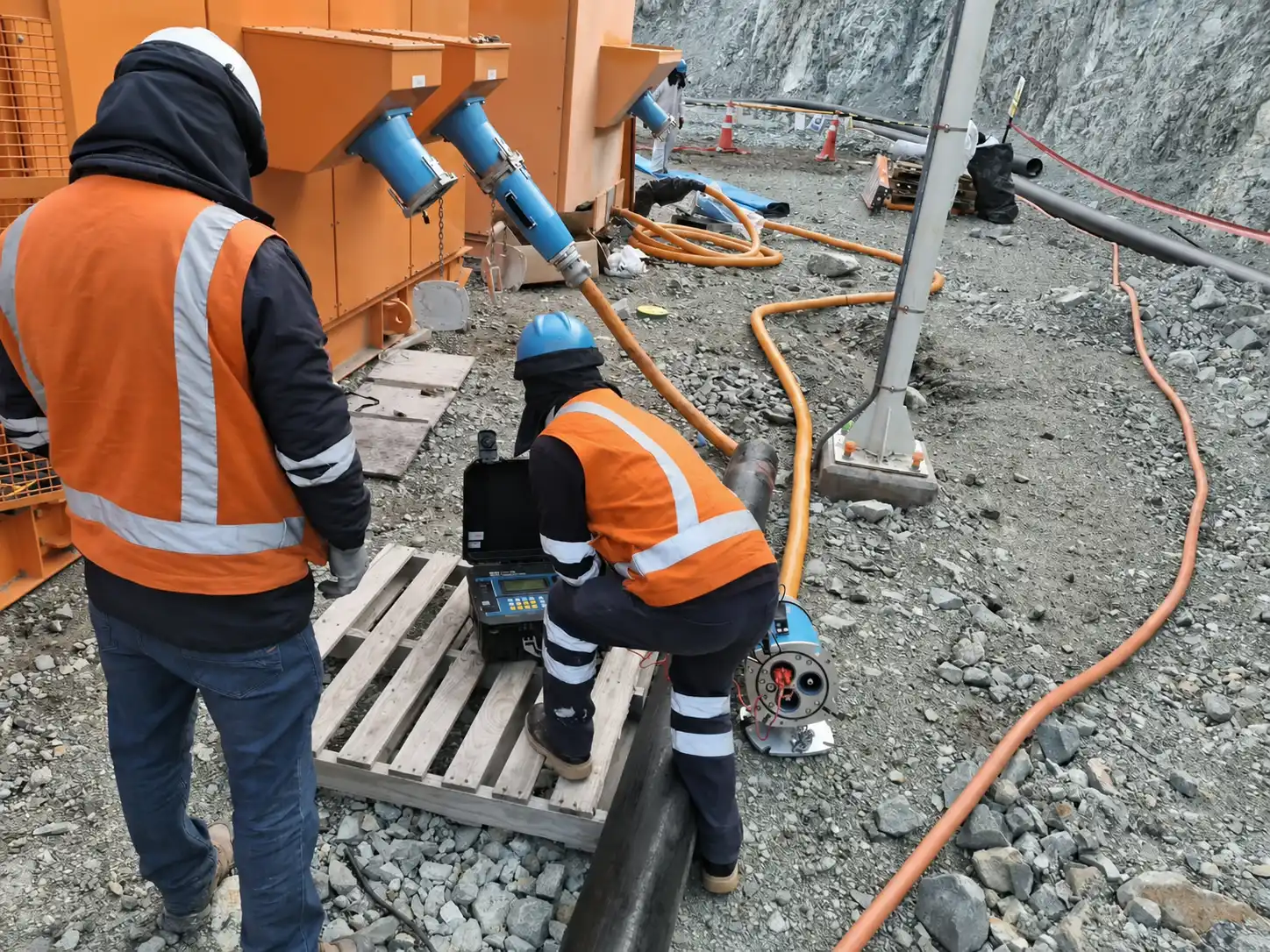
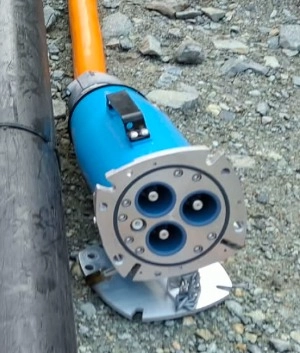
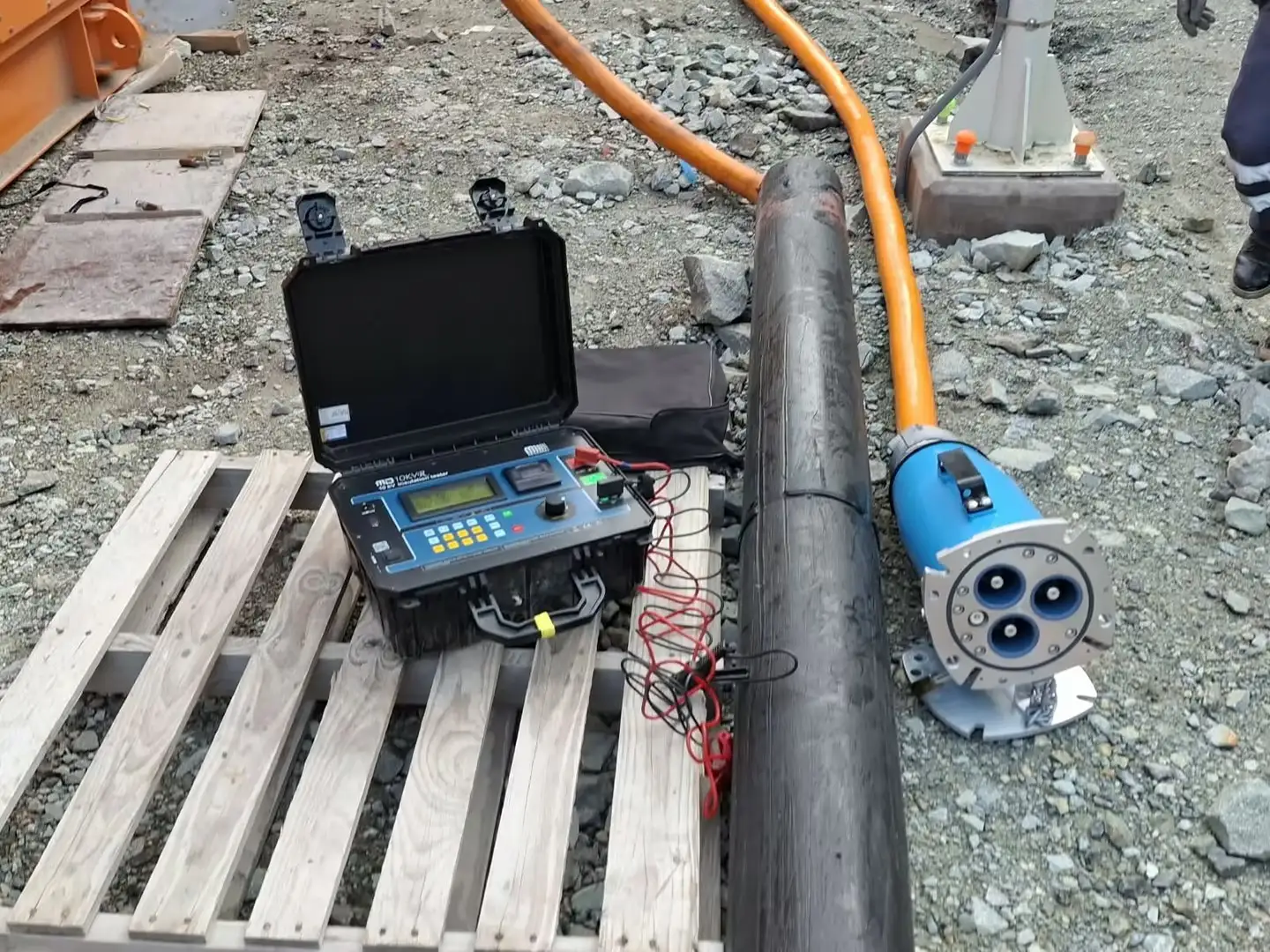
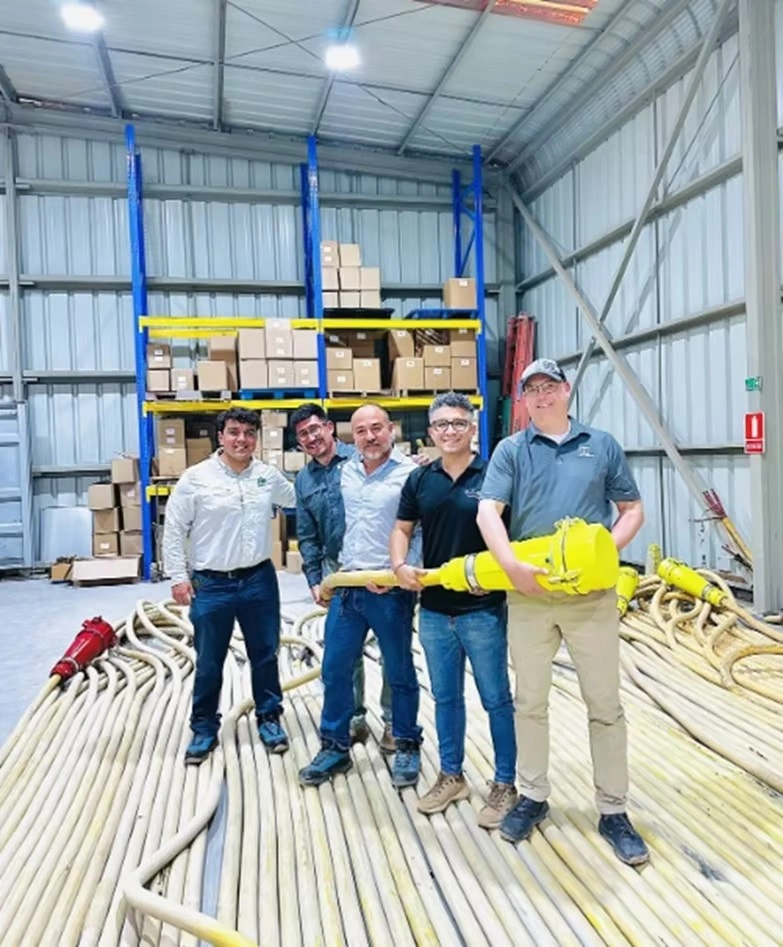
The photographs are TEBAOFLEX field photographs, not the record of one named customer project.
How medium-voltage mining trailing cables fail
Almost every MV trailing-cable failure traces back to one of a short list of mechanisms — and on a coupled cable, the coupler is over-represented in the count.
- Water ingress at the coupler or a repair splice — the joint, not the cable body, is the most common failure point. Once water reaches the screen the insulation resistance collapses; it is why every assembly should be HV-tested before it goes back into service.
- Sheath gouging and tearing — dragged over sharp rock and steel, the outer sheath is breached, and water follows the damage into the screen.
- Loss of ground-check (pilot) continuity — the pilot core breaks before the power cores, causing nuisance trips that get bypassed rather than repaired. A coupler that does not carry the pilot cleanly makes this worse.
- Conductor strand fatigue under tension — cores bent below their minimum radius under pull, on a drum or at the machine gland, break from the inside out with no visible external damage.
- Screen breakdown at the coupler interface — dirty or worn mating faces let the medium-voltage field grading fail exactly where the disconnect is handled.
- Coupler pull-out — where the strain relief is not anchored to the cable’s tensile assembly, every snatch load goes straight into the terminations.
TEBAOFLEX medium-voltage mining trailing & reeling range
We build these to the project schedule; the families below are the usual starting points for a medium-voltage mobile-equipment cable.
- (N)TSCGEWÖU MV reeling cable
- (N)TSKCGEWÖU MV reeling cable
- (N)TMCGCW11Y screened MV cable
- NTSFLCGEWÖU MV flat reeling
- Type MP-GC 15 kV mine feeder
- SHD-GC shielded mining power
- NSSHCGEOEU high-tensile reeling
- NSHTOEU LHD reeling
- Type 260 armoured screened
- NTSCGECEWOU / (N)TSCGECEWÖU 3.6/6 to 12/20 kV reeling and pump cable
Full range: mining & tunneling cables. To choose between drum and drag duty, see reeling cable vs trailing cable and the medium voltage mining cable selection guide; for the full step-by-step method use the 8-step mining cable selection guide. If the duty is drum-based, start from reeling cable solutions.
What we need to quote — and to match your coupler
- Rated voltage U₀/U (e.g. 14/25 kV)
- Power cores × cross-section (e.g. 3 × 70 mm²)
- Earth cores × cross-section (e.g. 2 × 35 mm²)
- Pilot / ground-check core (e.g. 1 × 16 mm²)
- Screen — individual or collective, copper
- Sheath compound — CR/PCP or PUR
- Duty — trailing (dragged) or reeling (drum)
- Drum diameter, if reeling
- Coupler / connector type needed, or the one you already use to match
- Standard or approval required
- Length per drum and total quantity
- Destination country
A photo of the sheath print or the drum label of your current cable, plus the coupler in the machine, is usually enough for us to come back with an equivalent build and a matching coupler.
Frequently asked questions
Can you supply an equivalent to (N)TMCETMPU or an ELCOFIRM-MT cable?
Yes. (N)TMCETMPU is a generic VDE-style medium-voltage mining trailing-cable construction, not a proprietary product, and ELCOFIRM-MT is one manufacturer’s brand name for a cable of that type. Send us the rated voltage and the core schedule — power, earth and pilot cross-sections — and we build to the same specification. A photo of the sheath print or drum label of your current cable is enough to start.
Do you supply the couplers with the cable?
Yes. We supply the three-core coupler as part of the system, with the bore matched to the cable we build so the strain relief, screen bond and pilot path line up. Supplying both from one source is what lets a field crew terminate, test and re-mate without hunting for a connector that fits.
What voltage classes do you build?
From low-voltage flexible mining cable up to a medium-voltage 14/25 kV (~26 kV) class, and to other ratings on the project schedule. The screen, earth and pilot arrangement is defined per order.
Do you sell to importers and distributors who buy by the drum for resale?
Yes. We work directly with importers and distributors as well as with mine operators. Quote by length per drum and total quantity, tell us the destination country for the applicable approvals, and we supply cable and couplers together.
How do I match a coupler I already use on the machine?
Send photos of the coupler and of the machine gland it mates to, plus the cable it terminates. We match the bore, the contact configuration and the earth/pilot arrangement so the new assembly drops into the existing system.
Send your cable schedule for a quote
Tell us the voltage class, the core schedule (power / earth / pilot), the duty (trailing or reeling), the coupler you need or already use, the length per drum and total quantity, and the destination country. If you are replacing a cable in service, a photo of the sheath print or drum label is enough to start. We quote the cable and the couplers together.