









Mining cable care
Mining trailing cables usually fail from one of four causes: excessive tension, mechanical damage, current overload or a poor splice. Each cause leaves different evidence on the cable, so the damage tells you what to change on the route, the reel or the repair before you fit the same cable again. The four causes are the grouping used in Prysmian’s underground mining cable care guide. The Queensland mines inspectorate alone received 90 reports of damage to high-voltage trailing cables on draglines and shovels in 2014 and 2015.
What does the damage on a trailing cable tell you?
Damage on a trailing cable usually points to its cause, so start with the cable itself before changing anything. The table links what you can see to the likely cause and the first thing to check. It draws on the care guide, the Queensland mine safety bulletins and an MSHA bulletin about overheating on cable reels.
| What you see | Likely cause | Check first |
|---|---|---|
| Cable necked down like an hourglass, jacket creeping back from a temporary splice, grounding conductor pulled in two | Excessive tension | Reel tension, tie point, how much cable is pulled at once |
| Cable corkscrewed, earth conductors damaged | Over-tensioning | Dragging method and the length towed in one pull |
| Short section crushed or flattened, cuts, gouges or punctures | Runover, pinching or falling rock | Crossings, the route near machines, swing paths |
| Cable grooved or unevenly worn | Abrasion | Sheaves, guides, the surface the cable is dragged over |
| Blistered jacket, bottom reel layer hard or cracked, tinned wires blue-black, smell of hot cable | Overheating | Layers left on the reel, current, conductor size |
| Bare conductors in a temporary splice, open grounding or ground-check conductor, kinked cable | Poor splice or termination | Splice method, conductor lengths, the insulation build-up |
| Pin holes in the sheath, water or dirt inside, plug failing after rain | Punctured sheath or water entry | Sharp objects on the route, plug seals, plugs left on the ground |
Do not assume an undamaged-looking cable is sound after an impact. The care guide notes that mechanical damage only sometimes causes an instant failure: components are usually just injured and fail later, which makes the original cause hard to find. Queensland’s earlier bulletin also records arcing through a hole in the sheath at the site of a repair, on a 6.6 kV cable where the protection did not trip.
What causes mechanical damage to a trailing cable?
Machines and rocks are the main sources in inspectors’ reports. Under Queensland Mines Safety Bulletin 153, the 90 reports in 2014 and 2015 split into 64 incidents on draglines and 26 on electric shovels. Rocks falling from buckets and spoil dumps rose from four incidents in 2014 to ten in 2015, eight of them at draglines, which the bulletin puts at 30 % of reported dragline cable incidents. Cable tractor damage fell from sixteen incidents to six, still 14 % of the 2015 total.
The incidents in that bulletin show how ordinary the causes are: a dozer picking up a cable loop in poor visibility, a cable tractor clamp closing on a badly positioned 22 kV cable, a shovel’s cable tower touching the cable while relocating, and a dozer track plate entering the opening at the top of a steel crossover. Other sources it lists are graders, light vehicles, trucks with raised bodies, dragline shoes set down on the cable, and termites or borers.
Underground, the care guide names cutting, crushing, punctures and abrasion among the most common sources of failure, including cable pinched between equipment and the rib, roof or floor. In US coal mines, 30 CFR 75.606 requires trailing cables to be adequately protected from damage by mobile equipment. The MSHA Program Policy Manual reads that as keeping cables away from roadways and haulageways. Where a cable has to cross one, it should be securely supported from the roof, laid in a trench cut into the roof or floor, or carried under a substantial bridge.
On the surface, the same logic applies. WorkSafe Western Australia says this may need protective berms and visible markers, and Queensland asks for defined crossing methods and heights, adequately sized rock drains and vehicle crossings, and protection where a machine has to swing over the cable. A tougher jacket slows wear but does not fix an unmanaged crossing, so treat abrasion-resistant jacket selection as a second step after the route.
How does excessive tension damage a trailing cable?
Tension stretches the copper permanently while the rubber springs back. The individual wires are forced into compression and shear, so they break more easily when the cable bends. The conductors end up wavy inside the cable and fail early. Prysmian’s Australian mining cable guide adds that stretched insulation gets thinner, so it ruptures more easily when crushed against the strands in a runover. A jacket under tension is also much easier to cut or tear, so tension makes mechanical damage more likely.
Shuttle cars see this most, because back-spooling tension usually exceeds the recommended limit while the bending radius is often below it. The care guide suggests these controls:
- Avoid back-spooling if possible. If not, keep the tie point as far from the haulageway as you can and tram slowly past it.
- Set the hydraulic tension on the reel so that about 10 feet (3 m) of cable lifts off the floor when the machine starts to tram.
- Fit shock absorbers at tie points.
- When moving a cable, pull it in several loops and not as one long length.
How much tension can a trailing cable take?
A trailing cable can usually take 15 to 20 N/mm² of power conductor cross-section, depending on the source. IEC 60204-1 sets 15 N/mm² of copper for flexible cables on machines up to 1,000 V AC, and the Australian guide uses 20 N/mm² for trailing duty. Only the power conductors count: earths, pilots and shields do not. For a specific cable, the data sheet of that cable decides.
The Australian guide also calculates the longest length that can be dragged from that pull:
Length in metres = allowable pull in newtons ÷ (0.5 × cable mass in kg/m × 10)
The 0.5 is its coefficient of friction. The table applies both limits to a Type G-GC 3/C 4/0 AWG cable at 5.92 kg/m, with about 322 mm² of power conductor.
| Tensile limit | Allowable pull | Longest drag length |
|---|---|---|
| 15 N/mm², IEC 60204-1 | about 4,820 N | about 163 m |
| 20 N/mm², Australian guide | about 6,430 N | about 217 m |
Treat these as ceilings and not targets: Queensland’s reports include cables that caught on rocks and tore. A cable on a reel has further limits, which our reeling cable selection guide works through.
Why do trailing cables overheat on the reel?
Layers on a reel trap the heat that a cable would otherwise lose to the air. MSHA Program Information Bulletin P10-20 describes the problem on permissible machines: it is most noticeable when three or four layers stay on the reel for long periods and only come off when the machine works farthest from the anchor point. The conductor passes the 90 °C rating of most modern trailing cables, the insulation degrades, and the jacket can melt and crack. The first warning may be the smell.
The same bulletin quotes the Insulated Cable Engineers Association factors for layered cable. They are shown here applied to a 3/C 4/0 AWG Type G-GC cable at the 287 A we list for 40 °C ambient:
| Layers on the reel | Factor | Derated current |
|---|---|---|
| 1 | 0.85 | about 244 A |
| 2 | 0.65 | about 187 A |
| 3 | 0.45 | about 129 A |
| 4 | 0.35 | about 100 A |
These factors assume continuous current, which is not how a machine with on and off duty runs. MSHA therefore does not apply them when it evaluates a cable. It compares the average duty cycle current with the unwound rating, and it assumes layers come off the reel from time to time so the whole length can cool. If the layers never come off, that assumption no longer holds. MSHA lists four remedies: fit the largest cable size the machine’s approval covers, raise the operating voltage so the same power draws less current, take all but the last layer off the reel and tie the excess off near the anchor point, or apply the derating factors. Its own example shows the scale of the last remedy: a 1/0 AWG cable would have to become 500 MCM at four layers.
Size matters more than the ampere figures suggest. In a worked example for a continuous miner in US Bureau of Mines Information Circular 9278, cutting at 373 A took a 2/0 AWG Type G-GC cable to 108 °C at the insulation-jacket interface and a 4/0 AWG cable to 65 °C. The calculated thermal life was 513 shifts against 6,237 shifts, about twelve times longer. The authors caution that this has to be compared with real service life. If mechanical abuse ends a cable long before heat does, a smaller cable with a suitable thermal margin may be justified.
What are the rules for splicing a trailing cable?
Trailing cable splice rules depend on the jurisdiction, and US underground coal mines have detailed ones. Outside that scope, follow your local regulation and the cable maker’s instructions.
| Jurisdiction and type | Rule |
|---|---|
| US underground coal, temporary splice, 30 CFR 75.603 | One temporary splice in any trailing cable, and that cable may be used only for the next 24 hours. None within 25 feet (7.6 m) of the machine, except on cable reel equipment. It must be mechanically strong and well insulated, and a cable with exposed wires or a splice that heats or sparks under load must not be used. |
| US underground coal, MSHA policy on temporary splices | Each power, grounding and ground-check conductor is spliced individually, and the outer jacket is replaced with flame-resistant material as thick as the original. Joining a severed grounding conductor counts as a splice. Re-insulating torn insulation does not, unless a conductor is severed. |
| US underground coal, permanent splice, 30 CFR 75.604 | Mechanically strong, with adequate conductivity and flexibility, effectively insulated and sealed against moisture, vulcanized or otherwise treated for flame resistance and bonding to the jacket, using MSHA-accepted or approved kits without substituting parts. |
| US surface, low-voltage trailing cable, 30 CFR 77.906 | Splices must provide continuity of all components. |
| Queensland surface mines, Bulletin 153 | Repairs and testing by competent persons to AS/NZS 1747, with a repair history for each cable and defined temporary repair measures. |
Even a compliant splice is a weak point. The care guide says plainly that no splice is as good as a new cable, and that resistance to fatigue is the hardest property to achieve. It traces most unsatisfactory splices to a few faults:
- A grounding or ground-check conductor cut shorter than the power conductors, so it takes the load first. The guide suggests making smaller conductors about ¼ in (6 mm) longer.
- Slack in one or more conductors, so the load is not shared evenly.
- Gaps, voids or soft spots in the insulation tape, or semi-conducting residue left on the insulation surface.
- A shield termination that damages the factory insulation or leaves inward-pointing projections.
- A splice too bulky to pass through the cable guides and over the sheaves.
- An outer covering that lets water into the cable.
Bulletin 153 records the consequence: a dozer towing a 22 kV cable stand stretched the cable until it pulled apart at a repair joint.
How often should trailing cables be inspected?
Regulators set different intervals, and only a few are specific. In US underground coal, 30 CFR 75.512-2 requires electric equipment examinations at least weekly, and 75.512 requires records. In Western Australia, routine earth continuity testing is every three months for surface operations and every month for quarries, dredges and underground mines. Queensland does not set a number in Bulletin 153. It asks surface mines to run a trailing cable management system that includes:
- In-situ visual inspection by machine operators, who are also the people most exposed to an energised cable.
- Regular testing with kept records, and a defined life cycle for each cable application.
- A unique identifier for each cable, plug and substation outlet, and a repair history for each cable.
- Regular inspection of cable accessories such as reeling devices.
- Defined rules for when a protection relay can be reset and the cable re-energised after a fault.
Records are what turn inspection into prevention. The care guide asks for the installation date, each removal for repair and the cause of each failure, because that shows where maintenance is most urgent and whether a change worked.
Should you repair or replace a damaged trailing cable?
Whether to repair or replace a damaged trailing cable depends on what failed and on the rules that apply at your site. Nothing cited here sets a universal limit on the number of repairs or the years of service, so your own records have to supply that limit. Some cases are clearer:
- Cut or crushed but still running. Repair it even if there has been no blowout, as the care guide advises, because the damaged section may fail later.
- Jacket melted or cracked by heat on the reel. MSHA says the entire length should be replaced and the heating addressed.
- Temporary splice in place. Replace it with a permanent splice as soon as possible. In US underground coal, the 24-hour limit decides this for you.
- Repeated failure of the same kind. Change the cause before the cable: the route for runovers, the reel setting for tension, the layers or size for heat.
Two habits make these decisions easier. Keep a spare cable, so a damaged length can come out for a proper repair and not a rushed one. Reverse the cable ends when it is removed for permanent splices, so the same section does not stay on the reel.
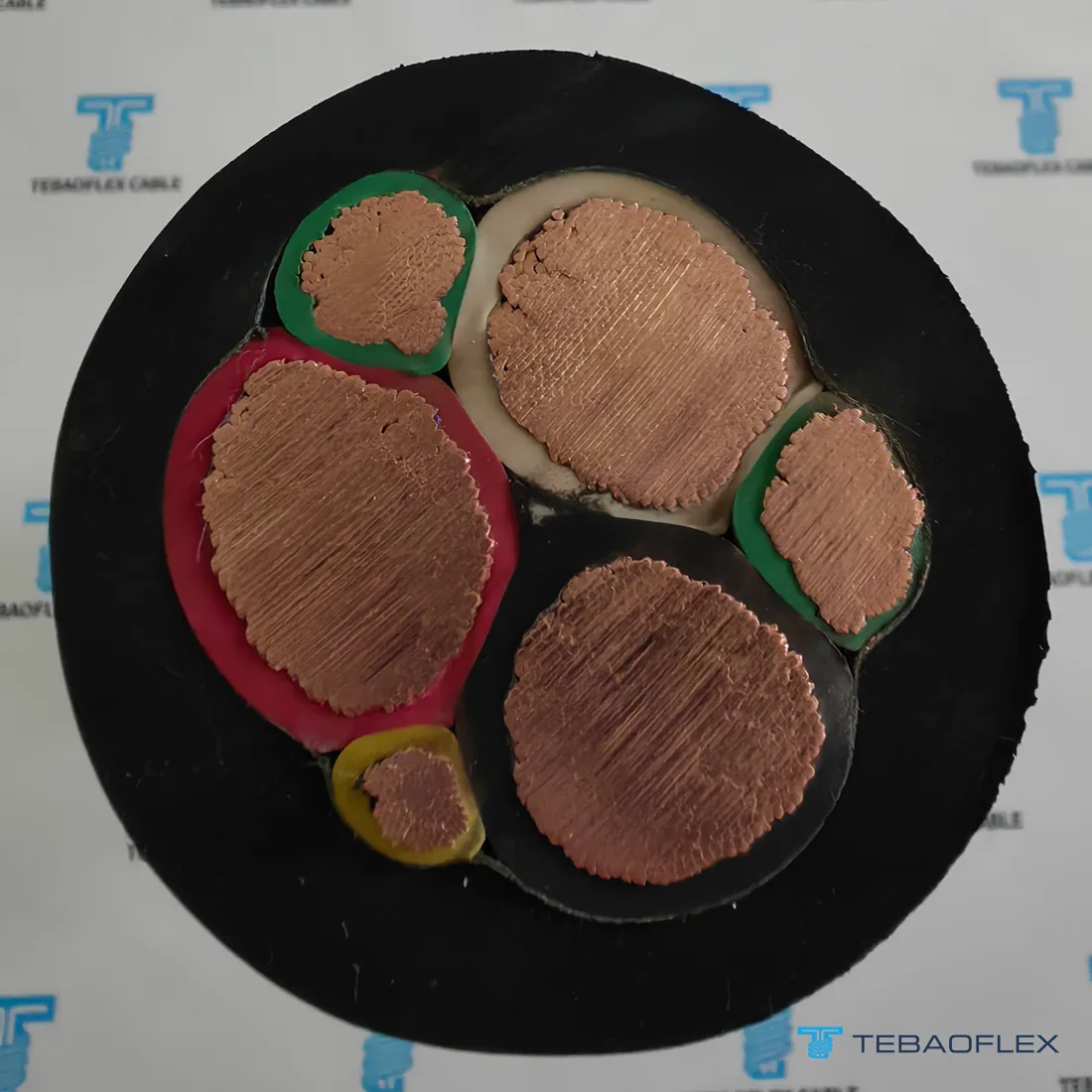
If the evidence points to the cable and not the route, the construction can change. Our SHD-GC mining cable and our Type 241.1 cable are starting points for portable duty under North American and Australian designations, and a reel-fed machine needs the checks in our comparison of reeling and trailing cable.
What should you send for a cable review?
A useful review needs the failed cable’s history as well as its designation. These are the details to include:
- Photos of the damage, the cut end and the printed marking on the sheath.
- The machine, voltage, average and peak current, and whether the cable is on a reel or dragged.
- Cable length, how many layers stay on the reel, and the reel tension setting if there is one.
- The route: crossings, tie points, floor or ground conditions, water and any guides or sheaves.
- The failure record: installation date, repairs, and the cause of each failure as far as you know it.
With this information the cable can be checked against the real duty. As of August 2026, the minimum order is 50 m for standard and customised constructions alike, and lead time runs from 7 to 45 working days depending on product type, stock position and customisation. Send your cable specification for review.
Questions
Why do mining trailing cables fail?
Mining trailing cables usually fail from excessive tension, mechanical damage such as runovers and rock strikes, current overload, or poor splices and terminations. Several often combine, because a cable under tension or running hot is easier to cut or crush.
What does a damaged trailing cable look like?
A damaged trailing cable may be necked like an hourglass, flattened over a short section, cut or gouged, or blistered and cracked. Corkscrewing, kinks, an open ground-check conductor and jacket pulling back from a splice are also signs. Some damage shows nothing until the cable fails later.
What is the maximum pulling tension on a trailing cable?
The maximum pulling tension on a trailing cable is usually 15 to 20 N/mm² of power conductor cross-section. IEC 60204-1 sets 15 N/mm² of copper, and Prysmian’s Australian mining cable guide uses 20 N/mm² for trailing duty. A 3/C 4/0 AWG cable with about 322 mm² of power conductor therefore has an allowable pull of about 4,820 to 6,430 N. The data sheet decides for a specific cable.
How many temporary splices are allowed in a trailing cable?
In US underground coal mines, 30 CFR 75.603 allows one temporary splice in any trailing cable, and the cable may be used only for the next 24 hours. The splice cannot be within 25 feet of the machine, except on cable reel equipment. Other jurisdictions set their own rules.
How often must a trailing cable be examined?
In US underground coal mines, electric equipment examinations are required at least weekly under 30 CFR 75.512-2. Western Australia sets routine earth continuity tests every three months for surface operations and monthly for quarries, dredges and underground mines. Machine operators should also check the cable visually in place.
Why does a cable overheat on the reel when its rating looks adequate?
A cable overheats on the reel because the layers trap heat, and the normal rating assumes a cable that is not wound. MSHA finds the problem most noticeable when three or four layers stay on the reel for long periods. Removing excess layers or using a larger cable reduces the heating.
How long does a mining trailing cable last?
There is no single figure, because a mining trailing cable’s life depends on the machine, the route and the handling. Mechanical abuse can end a cable long before heat does. Queensland asks mines to define a life cycle for each application and to measure it from their own records.