


Type 209 Mining Cable Guide
Select Type 209 by the full voltage suffix first, then validate conductor size, screen and pilot arrangement, movement duty, bend data, environment and the required AS/NZS edition. Type 209.1, 209.3, 209.6 and 209.11 identify different voltage grades; they do not replace an application calculation or approval review.
Match the system voltage.
Define trailing, feeder or reel motion.
Confirm screen, pilot and termination.
Name the standard and edition.
Type 209 mining cable selection: the quick answer
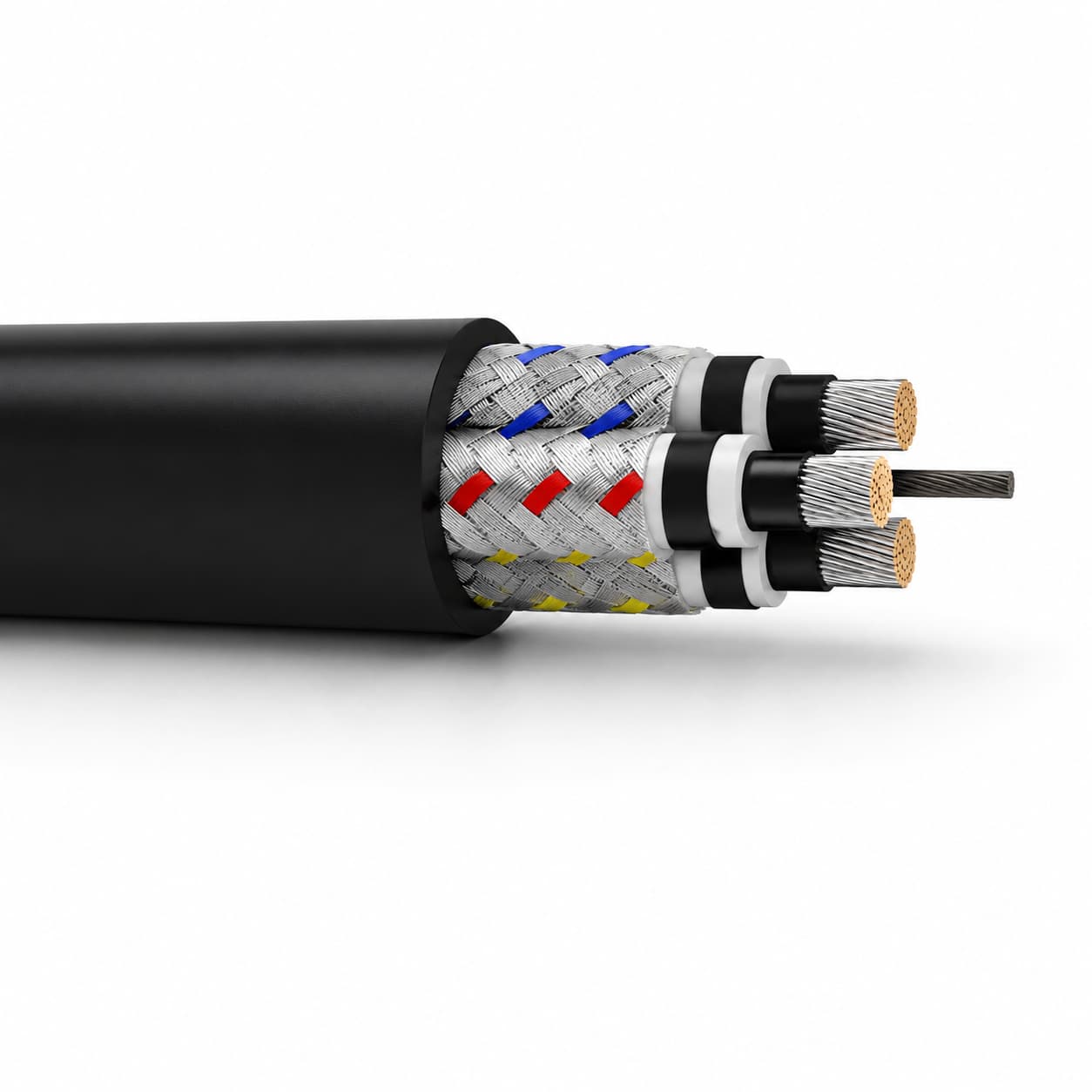
Use Type 209 when the project calls for this AS/NZS mining-cable family and the proposed construction fits the machine duty. The current TEBAOFLEX Type 209 product record lists a flexible, copper-screened, three-power-core cable with a central pilot, EPR insulation and a heavy-duty PCP outer sheath in 1.1 kV, 3.3 kV, 6.6 kV and 11 kV grades.
The suffix is only the first filter. Before approval, confirm current, conductor area, circuit length, movement pattern, minimum bend radius, screen and pilot function, termination, environment, cable marking, test documents and the standard edition named by the project.
What does Type 209 identify?
Type 209 identifies a screened elastomeric mining-cable construction, not one fixed conductor size. In the current TEBAOFLEX record, three screened power cores are laid around a central pilot on a cradle separator. The record lists tinned annealed copper conductors, EPR type R-EP-90 insulation, a tinned copper/polyamide braid screen and a black HD-85-PCP thermosetting outer sheath.
The same record describes the family for flexible feeder and trailing service on mining machinery, with smaller sizes referenced for drills and hand-held tools. That intended-use statement still needs to be matched to the actual route. A cable can be electrically suitable and mechanically unhappy; the machine decides which details matter after the voltage label.
Where the only duty is a 1.1 kV hand-held boring machine or drill, the Type 210 flexible rubber mining cable is the narrower option to compare, with three individually screened power cores grouped around a pilot core.
Choose Type 209.1, 209.3, 209.6 or 209.11 by system voltage
The Type 209 suffix separates the voltage grades shown in the current TEBAOFLEX product family. It does not specify conductor area, ampacity, voltage drop or cable length.
| Designation | Voltage shown by TEBAOFLEX | What to confirm next |
|---|---|---|
| Type 209.1 | 1.1 kV | System voltage, load, conductor area, separator/screen details and pilot circuit |
| Type 209.3 | 3.3 kV | System voltage, field-control layers, termination, conductor area and cable dimensions |
| Type 209.6 | 6.6 kV | System and equipment rating, screen/earthing arrangement, termination and route mechanics |
| Type 209.11 | 11 kV | Complete MV circuit study, protection, screen, pilot, accessories, bend data and approval documents |
Have a qualified electrical professional calculate conductor size from the actual current, installation, ambient conditions, voltage drop, starting duty and fault requirements. Do not select a conductor area from another supplier’s dimensional table and assume it describes the TEBAOFLEX offer.
Read the Type 209 construction as one system
Each layer solves a different problem, so compare the complete proposed cross section rather than one preferred material.
| Component | Current TEBAOFLEX product record | Selection consequence |
|---|---|---|
| Power conductors | Tinned annealed copper wires; three power cores | Confirm conductor area, resistance, current duty and termination range |
| Conductor/insulation screen | Layer arrangement changes between 1.1 kV and the higher voltage versions | Confirm the exact suffix, field-control design and accessory compatibility |
| Insulation | EPR type R-EP-90 | Validate rated temperature and electrical tests against the project edition |
| Composite screen | Tinned copper/polyamide braid | Confirm electrical function, screen area, fault duty and termination method |
| Central pilot | EPR-covered flexible stranded tinned copper conductor | Define whether the system uses it for monitoring or control; do not assign its function from the name alone |
| Outer sheath | Black HD-85-PCP thermosetting compound | Request the applicable oil, flame, water, UV, ozone, abrasion and mechanical test evidence |
The product record lists a -25 degrees C to +90 degrees C range and resistance to water, flame propagation, UV, sunlight, ozone and oil. Treat these as product-family statements. The quotation should name the exact test methods, conditions and acceptance values required for the project.
Eight checks before specifying Type 209 mining cable
Record the tender wording, jurisdiction, mine requirements and whether AS/NZS 1802:2018 or another contractual edition applies.
Use the circuit and equipment ratings to choose the Type 209 voltage grade; nearby voltage labels are not a substitution rule.
Provide load current, route length, starting duty, ambient and installation conditions, voltage-drop limit and fault information.
State whether the cable trails, moves through a handler, bends during relocation or repeatedly winds onto a powered drum.
Give the protection schematic, pilot voltage/function, screen termination and earth-fault requirements.
Provide the minimum permitted bend radius, sheave or drum diameter, tension, reverse bends, torsion, hanging length and run-over exposure.
Name water or immersion conditions, oils and chemicals, UV, temperature, abrasion, crushing, impact and flame requirements.
Confirm outside diameter, mass, glands/couplers, termination kit, drum length, marking, test plan, certificates and deviations before production.
Do not treat trailing and reeling duty as interchangeable
The TEBAOFLEX Type 209 record describes flexible feeder and trailing applications. A powered reel adds repeated bending under tension, layer pressure, acceleration and possible torsion. If the machine winds the cable during normal operation, send the reel geometry and duty cycle for a specific reeling review instead of assuming that a flexible mining cable is automatically suitable.
WorkSafe Western Australia distinguishes trailing and reeling cables in its mining electrical guidance. For a practical application comparison, use the TEBAOFLEX reeling cable vs trailing cable guide.
Type 209 vs Type 61A, Type 66 and Type 611
These names belong to different specification paths and should not be presented as direct equivalents. The table below is a procurement screening aid based on current TEBAOFLEX product records, not a substitution approval.
| Cable name | Path stated on TEBAOFLEX page | Voltage shown | First difference to check |
|---|---|---|---|
| Type 209 | AS/NZS 1802 family | 1.1, 3.3, 6.6 or 11 kV by suffix | Required AS/NZS edition, central pilot, braid screen and exact suffix construction |
| Type 61A | SANS 1520-1 product path | 640/1100 V | Named conductor size, three-pilot arrangement, sheath and stated non-reeling duty |
| Type 66 | SANS 1520-2 product path | 3.8/6.6 kV | Screened-core design, pilots/ECC option, sheath, dimensions and accessories |
| Type 611 | SANS 1520-2 product path | 6.35/11 kV | Screened-core design, pilots/ECC option, termination and project documents |
If an alternative is proposed, require a clause-by-clause datasheet and deviation schedule covering voltage designation, conductor areas, screens, pilots/earth conductors, materials, dimensions, bend data, tests, marking and accessories. Obtain written approval from the responsible engineer or customer before manufacture.
Documents to request with a Type 209 offer
Request a completed datasheet and cross-section drawing for the exact suffix and conductor size. The document pack should state the standard and edition, dimensional tolerances, conductor and screen data, pilot arrangement, materials, routine/type test plan, cable marking, drum schedule, termination compatibility and every deviation from the tender.
For a useful review, send the machine, rated voltage, operating current or required conductor area, route and cable length, movement pattern, bend/reel data, environment, protection schematic, required standard/edition, quantity and delivery country. Submit the completed Type 209 cable schedule for technical quotation review.
Frequently asked questions
What is a Type 209 mining cable?
Type 209 is a screened elastomeric mining-cable family. The current TEBAOFLEX record describes three screened power cores around a central pilot, with tinned copper conductors, EPR insulation, a copper/polyamide braid screen and a heavy-duty PCP outer sheath.
What do Type 209.1, 209.3, 209.6 and 209.11 mean?
They identify the 1.1 kV, 3.3 kV, 6.6 kV and 11 kV grades shown in the TEBAOFLEX Type 209 family. Conductor size, dimensions, bend limits and accessories still need separate confirmation.
Can Type 209 mining cable be used on a powered reel?
Do not assume so from flexibility alone. If the cable repeatedly winds onto a drum, the supplier and responsible engineer should validate drum diameter, layers, speed, tension, torsion, reverse bending and the proposed construction for reeling duty.
Is Type 66 equivalent to Type 209.6?
No equivalence follows from a similar voltage class. Type 66 and Type 209 come from different specification paths, so compare the exact voltage designation, conductor and core arrangement, screens, pilots or ECC, sheath, dimensions, tests, accessories and required documents.
What information is needed for a Type 209 quotation?
Provide the full Type 209 suffix, system voltage, current or conductor area, cable and route length, machine, movement, bend or reel data, screen and pilot function, environment, accessories, required standard and edition, test documents, quantity and delivery country.
Sources and editorial scope
This guide uses the current TEBAOFLEX product records for product-specific facts and standards/regulator pages for scope and edition checks. It is a selection aid, not a certificate, approved substitution or engineering calculation.
Continue the selection process
Use the related routes after the application and protection system are defined.