









A festoon system is a mechanical cable-management assembly that suspends flexible power, control, and signal cables in draped loops from wheeled trolleys travelling along a fixed overhead track, I-beam, or tensioned wire rope. As an overhead crane bridge, hoist trolley, port gantry, or transfer car moves back and forth, the trolley string extends and compresses the cable loops in a controlled path so the conductors never drag across the structure or absorb direct pulling forces.
Specifying a reliable festoon system requires matching two distinct halves of the installation: the mechanical carrier hardware (rails, trolleys, tow arm, and end clamp) and the flexible festoon cables suspended inside the saddles. TEBAOFLEX manufactures the flexible flat and round industrial cables used in crane and port festoon systems rather than the tracks, rails, or trolley hardware.
How a festoon system works and its core components
A festoon system works by dividing the total cable run into uniform hanging loops supported by rolling cable trolleys between a fixed feed point and the moving machine. When the crane trolley or bridge travels away from the power feed, the lead trolley pulls the loop train out along the rail; when the machine returns, bumpers on the trolleys stack the carriages into a compact parking zone at the fixed end.
Six mechanical and electrical components define a complete crane festoon system layout:
- Track or guide rail: A C-rail profile, structural I-beam, square bar, or tensioned steel wire rope mounted parallel to the crane bridge or runway span to carry the dead weight of the trolleys and cable package.
- Fixed end clamp: The stationary anchor at the power-supply end of the rail that secures the first cable loop and transitions the flexible festoon cables to the junction box.
- Intermediate cable trolleys: Free-rolling four-wheel or two-wheel carriages equipped with contoured cable saddles or clips that carry one hanging loop each along the active travel path.
- Tow trolley and tow arm: The lead carriage at the moving end of the loop string, pushed and pulled by a rigid tow arm bolted to the travelling hoist or crane bridge so tractive forces pass into the trolley frame rather than the cable conductors.
- Loop clamps and restraining tow ropes: Spacer clamps attached near the bottom of deep or outdoor loops keep multiple cables from separating in crosswinds, while auxiliary steel tow ropes connect trolley frames on spans over 30 m (Conductix-Wampfler Program 0210/0215 manual, 2018) so acceleration forces do not stretch the electrical jackets.
- Flexible festoon cables: Purpose-built flat or round industrial cables engineered with fine-wire copper stranding per IEC 60228:2023 and elastomer, PVC, or polyurethane sheaths that tolerate repetitive bending cycles over the trolley saddles.
Enclosing the conductors inside continuous flexible cable sheaths also addresses workplace contact and contamination rules. Under US federal crane rules in OSHA 29 CFR 1910.179, electrical equipment on overhead and gantry cranes must be located or enclosed so live parts are not exposed to accidental contact under normal operating conditions and remain protected from dirt, grease, oil, and moisture. Because a festoon system routes continuous insulated cables from the fixed junction box to the moving terminal box without sliding shoes or open collector bars, plant engineers select festooning for dusty foundries, outdoor yards, damp washdown bays, and hazardous-area crane designs.
Festoon system vs conductor bar, cable reel, and energy chain
Comparing a festoon system against a conductor bar, a motorized cable reel, and an energy chain clarifies which mobile electrification method fits a given runway length, travel speed, and circuit schedule. None of the four systems replaces the others across every crane axis.
| Electrification method | Best-fit travel distance and axis | Circuit and media capacity | Key mechanical tradeoff to check |
|---|---|---|---|
| Festoon system (C-track, I-beam, square rail, or wire rope) | Short to medium linear travel on crane bridges, hoist trolleys, and transfer cars | Carries power, control, screened VFD motor leads, encoder pairs, fiber or bus cables, and air or water hoses in one loop package | Requires vertical headroom for hanging loop depth and horizontal storage length at the parked end; one festoon track serves only one moving bridge |
| Shrouded conductor bar (busbar rail) | Long building runways and multi-bridge crane bays | Supplies 3-phase power and ground through sliding collector shoes; separate wireless or slotted-waveguide links are needed for high-channel data | Collector shoes wear mechanically and require scheduled replacement; sliding contacts are unsuitable for explosive atmospheres or heavy conductive mill dust |
| Spring or motorized cable reel | Long gantry travel, vertical spreader drops, and floor transfer carts where hanging loops would snag | Winds a single reinforced round reeling cable (power only, or composite power plus control and fiber cores) onto a drum | Drum tension and torsion require a round reeling cable with an internal anti-twisting braid rather than a flat festoon cable |
| Energy chain (drag chain / cable track) | Short to medium high-acceleration axes on automated cranes, machine tools, and tight-headroom beams | Guides separated round power, servo, feedback, and fluid lines inside articulated polymer or steel links inside a guide trough | Higher structural trough cost on long crane spans; cables must be chain-rated round constructions that slide freely along the neutral bending axis |
Festoon systems remain the standard choice on overhead crane bridges (cross-travel) and moderate-span monorails because a trolley loop package can carry power cores, pendant or radio control leads, encoder feedback, and pneumatic lines together without sliding electrical contacts or slip rings. Where a runway carries two or more independent crane bridges, or where low ceiling headroom prevents loops from hanging below the girder, engineers pair a runway conductor bar or motorized crane reeling cable with a bridge-mounted festoon system.
C-track, I-beam, square-rail, and wire-rope festoon tracks
Selecting between C-track, I-beam, square-rail, and wire-rope festoon tracks establishes the trolley load limit, maximum travel speed, and saddle geometry that the cable package must match. Hardware catalogs from manufacturers such as Conductix-Wampfler, Vahle, and Hubbell Gleason group festoon tracks into four structural profiles:
- Wire-rope (cable-supported) festoon systems: Trolleys roll along a tensioned galvanized or PVC-coated steel wire rope anchored between end brackets. Hardware guides scope wire-rope festoons to short indoor spans under 23 m (75 ft), light single or dual cables, and low travel speeds up to 20–60 m/min (Conductix-Wampfler Program 0240 catalog, 2018) because rope sag increases with cable weight.
- C-track (enclosed C-rail) festoon systems: Four-wheel trolleys run inside a cold-rolled galvanized or stainless-steel C-channel that shields the rollers from dust and ice. Standard and heavy-duty C-track systems support trolley loads from 10 kg to 32 kg at running speeds from 40 m/min to 152 m/min (Conductix-Wampfler Insul-8 catalog, 2016), making C-track the dominant choice for indoor workshop cranes, bridge cross-travel, and conveyor transfer lines.
- Square-rail (diamond-track) festoon systems: Trolleys with V-grooved rollers ride on a solid or tubular square bar oriented on its diagonal so mill scale and foundry dust fall off the running surfaces. Square rails can be bent into horizontal curves and switches for monorail hoists and dirty outdoor plants.
- I-beam (running-flange) festoon systems: Heavy steel-wheeled trolleys ride along the lower flange of a structural I-beam or H-beam. Because I-beam carriages carry 100 kg to 136 kg (300 lb) per trolley at speeds up to 122–240 m/min (Hubbell Gleason PDQ 300 manual, 2018), steel mills, shipyards, and container ports use I-beam festoons to carry multi-layer flat cable stacks or heavy round power and VFD cables.
Flat vs round festoon cables: geometry, stacking, and bending plane
Choosing between flat festoon cables and round festoon cables depends on the bending plane of the track, the required bend radius at the trolley saddle, and the total cross-section of the circuit schedule. Both geometries appear across TEBAOFLEX’s port and festoon cables range, and each obeys distinct mechanical rules.
Why flat festoon cables dominate C-track and compact loops
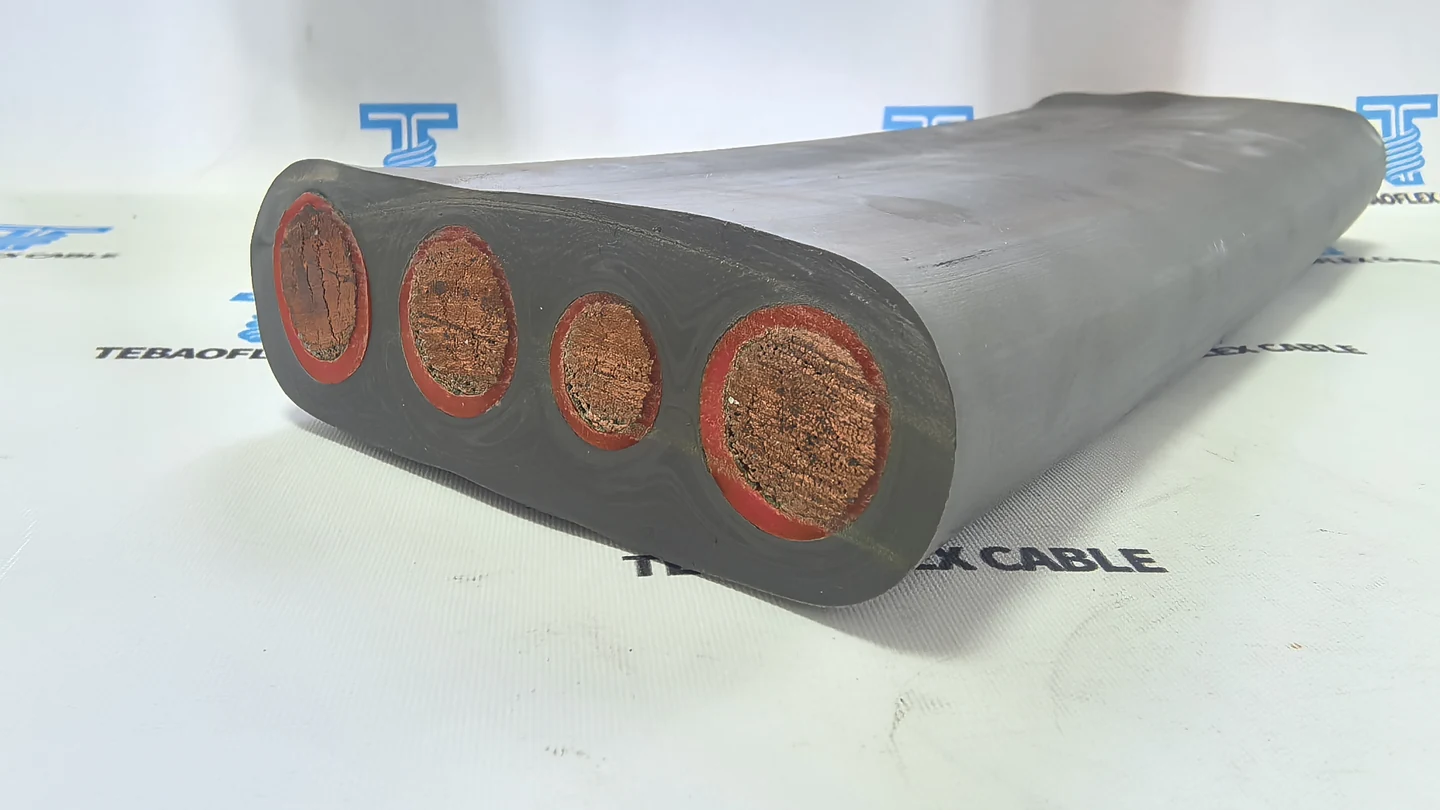
Flat festoon cables arrange insulated cores—or parallel core bundles—side by side in a single horizontal row under a rectangular outer jacket. Because the cable bends across its thin minor axis ($D$, cable thickness) rather than its full width, a flat cable achieves a tight minimum bending radius in one plane and stacks neatly in multiple layers inside a rectangular trolley saddle window.
For a flat cable the radius is stated on its thickness and holds in one plane only. How that figure compares with drum, guide-pulley and fixed-installation radii, and how each is calculated from the cable diameter, is explained in our guide to cable minimum bending radius, with datasheet values by duty.
European standard BS EN 50214:2024 covers the construction and test methods for flat, flexible PVC or halogen-free insulated and sheathed cables rated 300/500 V and 450/750 V for lifts and for travelling cranes and hoists, while heavy rubber flat festoon cables follow DIN VDE 0250-809. Both construction families are engineered strictly for bending in one plane only: a flat festoon cable must never be twisted axially or routed around horizontal track curves that force edgewise bending.
To prevent layered flat cables from pinching or corkscrewing on the track, hardware installation manuals (Conductix-Wampfler BAL0200-0004-E manual, 2018) specify four stacking rules:
- Place the largest copper cross-sections at the top of the stack: Heavy power cables sit directly against the trolley saddle contour to absorb tractive forces and dissipate heat.
- Give upper layers slightly less slack than lower layers: Graduating the loop arc stops the inner power cable from pressing down onto lighter control cables at the bottom of the loop.
- Clamp only the uppermost cable layer in flat saddle clamps: Lower control and signal cables should retain clearance inside the clamp window so individual layers can shift slightly as the loop opens and closes.
- Keep loop lengths uniform and twist-free: Pay flat cable off the delivery drum tangentially without axial twist, and keep loop length variation within $\pm 50\text{ mm}$ (Conductix-Wampfler BAL0200-0004-E manual, 2018) across the trolley train.
When round festoon cables are required
Round festoon cables strand insulated cores symmetrically around a central filler or cradle separator, enclosed by an inner sheath and a heavy elastomer or polyurethane outer jacket per DIN VDE 0250-814 or JIS C 3327. Engineers specify round festoon cables instead of flat cables in four situations:
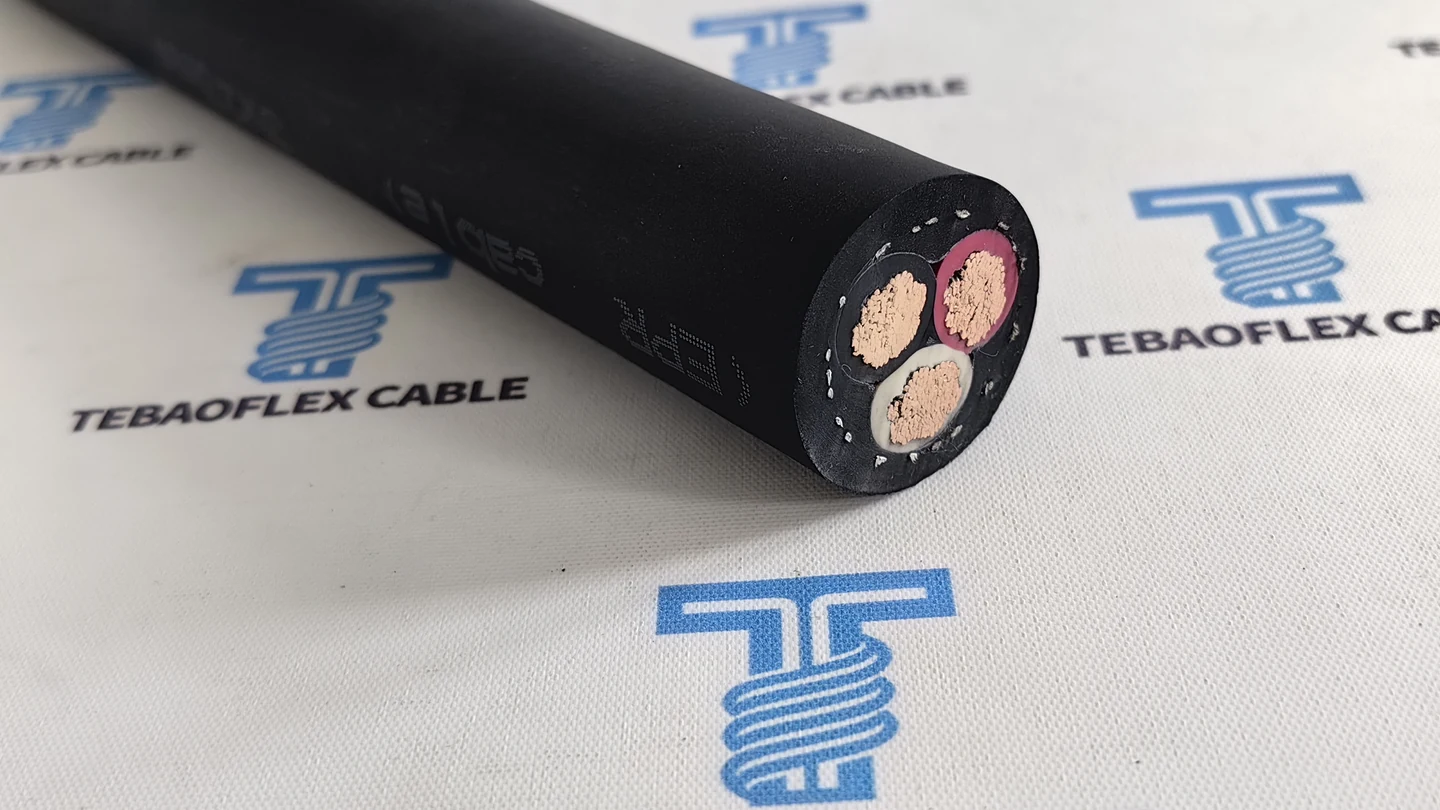
- Higher voltage and large power cross-sections: When crane main power requires
0.6/1 kVratings or conductor sizes up to150–250 mm²that exceed standard flat-cable mould widths. - Symmetrical VFD motor screening: Frequency-converter drives up to
690 V ACbenefit from a round 3+3 split-earth geometry (3 main phase cores + 3 symmetrical PE cores) enclosed by a concentric tinned-copper braid screen (> 80%coverage). - Curved monorail tracks and outdoor crosswinds: Where square-rail or monorail tracks include horizontal curves, or where strong port crosswinds swing deep loops out of a single vertical plane, round cables tolerate multi-plane deflection far better than flat profiles.
- High-speed I-beam festoons: Round rubber festoon cables built to
DIN VDE 0250-814support trolley travel speeds up to240 m/minand dynamic tensile loads up to20 N/mm²when clamped in contoured round-cable collars or multi-tier clips.
Matching festoon cable constructions to crane and port duty
Selecting the exact cable family requires matching voltage class, sheath compound, ambient temperature range, and electromagnetic screening to the crane’s working environment. The table below compares TEBAOFLEX’s principal festoon cable routes using verified specifications from each product datasheet.
| TEBAOFLEX cable family | Geometry & voltage rating | Insulation & outer sheath | Flexing temperature & bend reference | Primary crane / festoon duty |
|---|---|---|---|---|
NGFLGOEU flat festoon cable (DIN VDE 0250-809) | Flat, 300/500 V (up to 600 V listed) | 3GI3 EPR insulation; black 5GM3 polychloroprene (PCP) rubber sheath | -35 °C to +80 °C (+90 °C max conductor); one-plane bending; festoon speed up to 180 m/min | Heavy indoor and outdoor C-track or I-beam crane festoons exposed to oil, UV, ozone, and cold weather |
| KYFLY PVC flat festoon cable | Flat, 300/500 V | Special PVC core insulation; black special PVC outer sheath | -25 °C to +70 °C mobile (-35 °C fixed); 10 × D minimum bend radius | Standard indoor overhead cranes, hoists, and material-handling C-track festoons |
| KYFLCY EMC flat festoon cable & KYFLTFCY suspension flat cable | Flat screened, 300/500 V (450/750 V from 1.5 mm² on KYFLCY) | PVC insulation, copper braid screen, black PVC sheath (KYFLTFCY adds dual steel support ropes) | -25 °C to +70 °C mobile; 10 × D normal (15 × D low temp) | EMC-sensitive crane control, hoist drives, and conveyor festoons (KYFLTFCY where integrated strain-bearing steel elements are required) |
(N)GRDGOEU round festoon cable (DIN VDE 0250-814) | Round unscreened, 0.6/1 kV | 3GI3 EPR insulation, inner elastomer layer, black 5GM3 PCP rubber outer sheath | -35 °C to +80 °C mobile; 20 N/mm² tensile rating; festoon speed up to 240 m/min | Heavy I-beam crane festoons, port gantries, and high-speed power/control loops |
(N)GRDGCGOEU-J screened festoon cable (DIN VDE 0250-814) | Round EMC screened, 0.6/1 kV (VFD motors up to 690 V AC) | 3GI3 EPR, GM1b inner sheath, > 80% tinned-copper braid, black 5GM3 PCP sheath | -35 °C to +80 °C mobile; 3+3 split PE from 16 mm²; festoon speed up to 240 m/min | Frequency-converter (VFD) hoist, trolley, and gantry drive motors requiring low-impedance 360° EMC gland termination |
Festoonflex PUR-HF cable (PUR-HF / C-PUR-HF) | Round unscreened or screened (~85% tinned-copper braid), 0.6/1 kV | Halogen-free polyester insulation, textile self-support layer, black PUR-HF sheath | -40 °C to +80 °C moving; 6 × OD moving bend radius; speed up to 210 m/min | Cold-climate outdoor cranes, high-abrasion festoon loops, and hybrid festoon-to-chain crane installations |
600V 2PNCT mobile crane cable & 2PNCT festoon cable solutions (JIS C 3327) | Round, AC 600 V (1–16 cores, 0.75–250 mm²) | EP rubber insulation and chloroprene rubber (CR) outer sheath | Max conductor +80 °C; matched 2PNCT-B, 2PNCT-BS (PG), and KNPEV-SB (T-Link) set | Container cranes, RTGs, RMGs, and bulk unloaders built to Japanese port crane circuit schedules |
Flat rubber vs flat PVC in hot, cold, and oily bays
In indoor machine halls with moderate ambient temperatures, a PVC flat cable such as KYFLY provides a compact profile for C-track trolleys, while KYFLCY adds copper braid screening over the core groups to isolate control signals from nearby motor conductors. However, thermoplastic PVC stiffens noticeably in sub-zero outdoor winters and softens near radiant heat sources.
Where a festoon system operates outdoors below -10 °C, near steel-mill heat, or in oil-mist environments, thermoset rubber flat cables such as NGFLGOEU use 3GI3 ethylene-propylene rubber (EPR) core insulation and a black 5GM3 polychloroprene (PCP) jacket per DIN VDE 0250-809 to maintain flexibility from -35 °C to +80 °C at conductor temperatures up to +90 °C. In TEBAOFLEX’s published Egyptian steel plant oxy-cutting car flat cable case, 400 m of 4-core flat cable (4×16 mm² and 4×25 mm²) was supplied for a steel-mill oxy-cutting car whose cyclic back-and-forth travel along a fixed track mirrors festoon flexing under heat, scale dust, and mechanical vibration.
Coordinating power, VFD, encoder, and bus cables on port cranes
Modern ship-to-shore (STS) cranes, rail-mounted gantries (RMGs), and automated stacking cranes rarely carry a single cable loop. A high-speed port crane festoon package combines main 0.6/1 kV or AC 600 V motor feeders, multi-core control cables, pulse-generator (PG) speed-encoder pairs, and high-speed PLC bus cables inside the same trolley saddles (JIS C 3327, 2024).
On European-standard cranes driven by variable-frequency converters, (N)GRDGCGOEU-J screened festoon cables per DIN VDE 0250-814 combine a 3+3 split protective-earth core layout from 16 mm² upward with an overall tinned-copper braid (> 80% optical coverage) so high-frequency common-mode currents return safely through 360° EMC cable glands without coupling into adjacent encoder loops. On Japanese-standard port cranes, TEBAOFLEX’s coordinated 2PNCT festoon packages (JIS C 3327) match 2PNCT-B power and control cables with individually paired and shielded 2PNCT-BS PG encoder cables and KNPEV-SB T-Link communication cables so every circuit in the trolley stack bends and ages at a compatible rate.
Loop depth, saddle diameter, and preventing cable twist
Sizing the cable length and trolley saddle diameter correctly prevents the two most common field failures in a festoon system: conductor strand breakage at the saddle crown and sideways loop twisting (“corkscrewing”) during crane acceleration.
How loop depth, trolley spacing, and saddle radius interact
In festoon engineering manuals (Conductix-Wampfler Program 0240 catalog, 2018), three geometric dimensions govern the cable order length and bending stress:
- Loop depth ($LD$ or $h$): The vertical distance from the track centerline to the bottom of the hanging loop when the trolleys are parked. Standard industrial overhead crane festoons commonly use loop depths between
0.9 m and 1.8 m(3 ft to 6 ft), balancing vertical clearance beneath the crane girder against the number of trolleys required. Deeper loops reduce trolley count and parked storage length ($ST$), whereas shallower loops keep cables clear of work zones and reduce pendulum swing on fast cranes. - Trolley saddle diameter ($d_a$): The curved support contour of the trolley shoe must equal or exceed twice the cable’s minimum dynamic bending radius ($d_a \ge 2 \times R_{\min}$). When multiple cables share a trolley, the thickest power cable—or the screened cable with the largest multiplier, such as
10 × DonKYFLCYperBS EN 50214or6 × ODonFestoonflex PUR-HF—sets the minimum saddle diameter for the entire trolley series. - Cable length allowance factor ($f$): Because the cable must follow the curved saddle arcs and hang in catenary loops even at full crane extension, total system cable length ($L_{\text{Syst}}$) equals the sum of active working travel ($WT$) and parked storage length ($ST$) multiplied by a cable factor of
1.10 to 1.20(Conductix-Wampfler Program 0240 catalog, 2018), plus the fixed hook-up tails at both junction boxes. Pulling trolleys completely flat removes the loop arc and transfers destructive tensile load directly onto the copper conductors.
Inside the cable, conductor stranding per IEC 60228 works together with saddle geometry. For example, TEBAOFLEX’s NGFLGOEU flat festoon cable (DIN VDE 0250-809) uses extra-finely stranded Class 6 copper conductors up to 25 mm² where thin flat profiles flex over smaller C-track saddles, and finely stranded Class 5 copper from 35 mm² upward where larger saddle diameters are standard on heavy I-beam trolleys.
Four checks to prevent festoon cable twisting
When maintenance teams report that flat or round festoon loops flip sideways, bind trolleys, or tangle in wind, the root cause usually traces back to mechanical torsional stress locked into the loop train:
- Unreel tangentially during installation: Never pull festoon cable over the flange of a stationary coil or drum like a spring; mount the drum on a spindle and unroll straight into the track plane so zero installation twist enters the loops.
- Match cable diameters within round-cable clips: In round-cable trolleys, hardware manuals (Hubbell Gleason PDQ 300 manual, 2018) warn that clamping widely different cable outside diameters in the same saddle allows smaller cables to slip and rotate during deceleration.
- Leave clamp-window play on multi-layer flat stacks: Over-tightening a flat clamp bar across three or four stacked cables locks the layers together; because the outer arc of a bend is longer than the inner arc, locked layers buckle and force the loop to twist sideways.
- Add loop clamps or tow ropes on fast or outdoor spans: When travel speed exceeds standard workshop duty or outdoor crosswinds blow loops out of plane, intermediate loop clamps and restraining tow ropes keep the loops aligned vertically under the track.
What to specify when ordering festoon system cables
Preparing a complete technical specification before requesting a quote ensures that the supplied festoon cable matches both the electrical drive system and the existing or planned trolley hardware. Include these five parameter groups in your engineering enquiry:
- Circuit schedule and conductor geometry: Rated voltage (
300/500 V,450/750 V,600 V, or0.6/1 kV), core count, nominal cross-section inmm²orAWG, protective-earth arrangement (standard core or3+3 split PEfor VFD drives), and whether flat or round profile is required. - Screening and signal separation: Whether the cable feeds a frequency-converter motor requiring an overall tinned-copper braid (
(N)GRDGCGOEU-J,C-PUR-HF, orKYFLCY), or requires paired shielded encoder/PG (2PNCT-BS) and fieldbus (KNPEV-SB) cores. - Track type, saddle diameter, and loop dimensions: C-track, I-beam, square rail, or wire rope; minimum trolley saddle diameter ($d_a$) and clamp window width/height; loop depth ($LD$); active working travel ($WT$); and total cut length per run.
- Motion and environmental profile: Maximum travel speed (
m/min), acceleration, duty cycle, ambient temperature extremes (-40 °Ccold storage up to+80 °Csteel-mill bays), and exposure to oil, UV sunlight, salt spray, or abrasive dust. - Order length and delivery planning: Total cable quantity and reel lengths. Per TEBAOFLEX’s verified company profile (as of August 2026), the minimum order quantity is
50 mfor both standard and custom cable constructions, with typical production lead times of7–45 working daysdepending on product type and customization.
Contact TEBAOFLEX with your festoon system cable requirements to review flat or round cable constructions, outer dimensions for your trolley saddles, and circuit packages for overhead cranes, hoists, and port machinery.