









DIN VDE 0250-809 / 0250-813 / 0250-814 & JCS crane cable engineering guide
Choosing a flat cable vs round cable on an overhead or port crane is governed by bending-plane geometry and axial torsion rather than operator preference: flat crane cables (NGFLGOEU, (N)GFLCGÖU, 2PNCT-F, (N)TSFLCGEWÖU, F-3PNCT) bend 35 % to 45 % tighter along their minor thickness H (5 × H to 10 × H) in zero-twist C-rail/I-beam festoons and single-slot radial monospiral drums, whereas round aramid-reinforced reeling cables ((N)SHTÖU-J, (N)TSCGEWÖU, PANZERFLEX, 3PNCT-B) are required whenever the cable crosses multi-plane deflection sheaves, turnover roller pits, cylindrical level-wind drums or vertical spreader baskets experiencing ±25°/m to ±100°/m torsion.
Why do bending-axis thickness and axial torsion divide flat crane cables from round crane cables?
Under DIN VDE 0298-3 installation rules for moving crane feeders, flat cables flex exclusively around their minor thickness H with a dynamic bending radius of 5 × H to 10 × H (10 × H to 12 × H above 20 mm thickness) and 0°/m permissible axial torsion, whereas round reeling cables flex omni-directionally at 10 × D to 15 × D while absorbing ±25°/m of axial twist through a short-pitch helical core lay and embedded aramid anti-torsion braid.
That mechanical trade-off explains why neither profile can substitute blindly for the other on a ship-to-shore (STS) quay crane, rail-mounted gantry (RMG) or steelworks bridge crane:
- Single-plane loop compactness favors flat geometry: When 20 to 40 festoon trolleys park together at the end of a crane girder, loop pitch is set by minimum bending diameter (2 × R). Because a 23 mm thick flat power cable bends safely at ~230 mm radius while an equivalent 46 mm round cable needs ~460 mm dynamic radius (detailed in our industrial cable minimum bending radius calculation guide), flat cables cut parked festoon storage length nearly in half.
- Fleet angles and turnover sheaves mandate round geometry: Motorized cylindrical drums wind across a barrel width at fleet angles of ±1° to ±2°, and quay-trench turnover guides bend the cable in two perpendicular planes. A flat web buckles on its outer edge under lateral deflection, whereas a helically laid round cable equalizes tensile and compressive strain across every half-pitch.
Which crane mechanism requires a flat cable vs a round cable?
Across port, intermodal and heavy industrial cranes governed by DIN VDE 0250 and JCS standards, five moving subsystems split cleanly by profile: C-rail/I-beam festoons and narrow single-plane radial monospiral reels favor flat cables, while wide cylindrical level-wind reels, high-speed quay trench reels and vertical gravity spreader baskets require round cables.
| Crane mechanism | Bending & torsion regime | Winning profile | Typical travel speed & pull | Choose this when |
|---|---|---|---|---|
| C-rail & I-beam trolley festoon | Single vertical plane · 0°/m twist · tight parked loop stack | Flat (1+1+1+1 single row) | Up to 120 m/min towed; up to 240 m/min motorized STS boom | Minimum parked trolley storage zone and multi-tier power + control saddle clamping are needed |
| STS boom high-current single-core festoon | Single plane w/ large saddle radius · heavy single-phase loops | Flat multi-core or Round single-core cradle | Up to 240 m/min motorized festoon carriage | Use flat up to 4×95/120 mm²; switch to round single-core 1×150–240 mm² in contoured saddles for extreme hoist currents |
| Narrow radial monospiral crane reel | Single vertical plane · stacked turns · 0°/m twist · ≤ 4.9 kN/m radial crush | Flat (N)TSFLCGEWÖU or F-3PNCT | 60–150 m/min · 15 N/mm² Cu (or reinforced core) | Portal bogie width restricts drum slot to ~35–130 mm and quay guide rollers stay strictly in-plane |
| Cylindrical level-wind & E-RTG gantry reel | Multi-plane rollers, turnover pit & ±1.5° fleet angle · up to ±25°/m twist | Round aramid-braided (N)TSCGEWÖU / (N)SHTÖU-J | 120–300 m/min · 20–30 N/mm² dynamic pull | Long rail travel (250–1,000 m), panzerband quay trenches, S-bends or high acceleration up to 1.2 m/s² |
| Vertical spreader reel & gravity basket | 360° basket coiling or vertical hang · ±50°/m to ±100°/m torsion | Round central-aramid (PANZERFLEX-VS / 3GSLTOE) | 160–240 m/min hoist · 25–30 N/mm² tensile | Twin-lift container spreaders or electro-hydraulic grabs requiring 24G–48G control or hybrid FO |
Why must 4-core flat crane cables use a 1+1+1+1 single-row layout instead of a 2+2 bundle?
Under DIN VDE 0250-809 (NGFLGÖU) and JIS C 3327 flat cabtyre design rules, a four-core flat crane cable aligns all four conductors in a single parallel row (1+1+1+1, or grouped sets separated by elastomer webs on 12C–24C control cables) so every copper core sits on the neutral bending plane. Substituting a 2+2 two-layer core bundle causes premature copper strand fatigue, thermal derating and clamp rejection.
In export inquiries for 600 V 2PNCT-F 3×38+1×16 mm² and 0.6/1 kV NGFLGÖU-J 3×50+1×16 mm² crane cables, buyers comparing low-cost general rubber extrusions against dedicated festoon schedules frequently encounter unmarked 2+2 stacked profiles. Three physical penalties separate 1+1+1+1 from 2+2:
- Neutral-axis strain elimination: In a 1+1+1+1 cross-section, every conductor center lies on the horizontal mid-plane, so flexing over a 200 mm trolley saddle bends individual IEC 60228 Class 5 or Class 6 copper strands symmetrically without stretching an upper core row against a compressed lower row.
- Two-sided convective heat dissipation: Every power conductor in a single-row flat cable transfers I²R heat directly across one insulation wall and one outer sheath wall to ambient air—avoiding the internal thermal blanket created at the center of a four-core bundle.
- Flat saddle clamping stability: Festoon clamp bars apply vertical pressure across a uniform flat top face; a 2+2 ovalized profile rocks sideways inside the saddle under crane trolley acceleration.
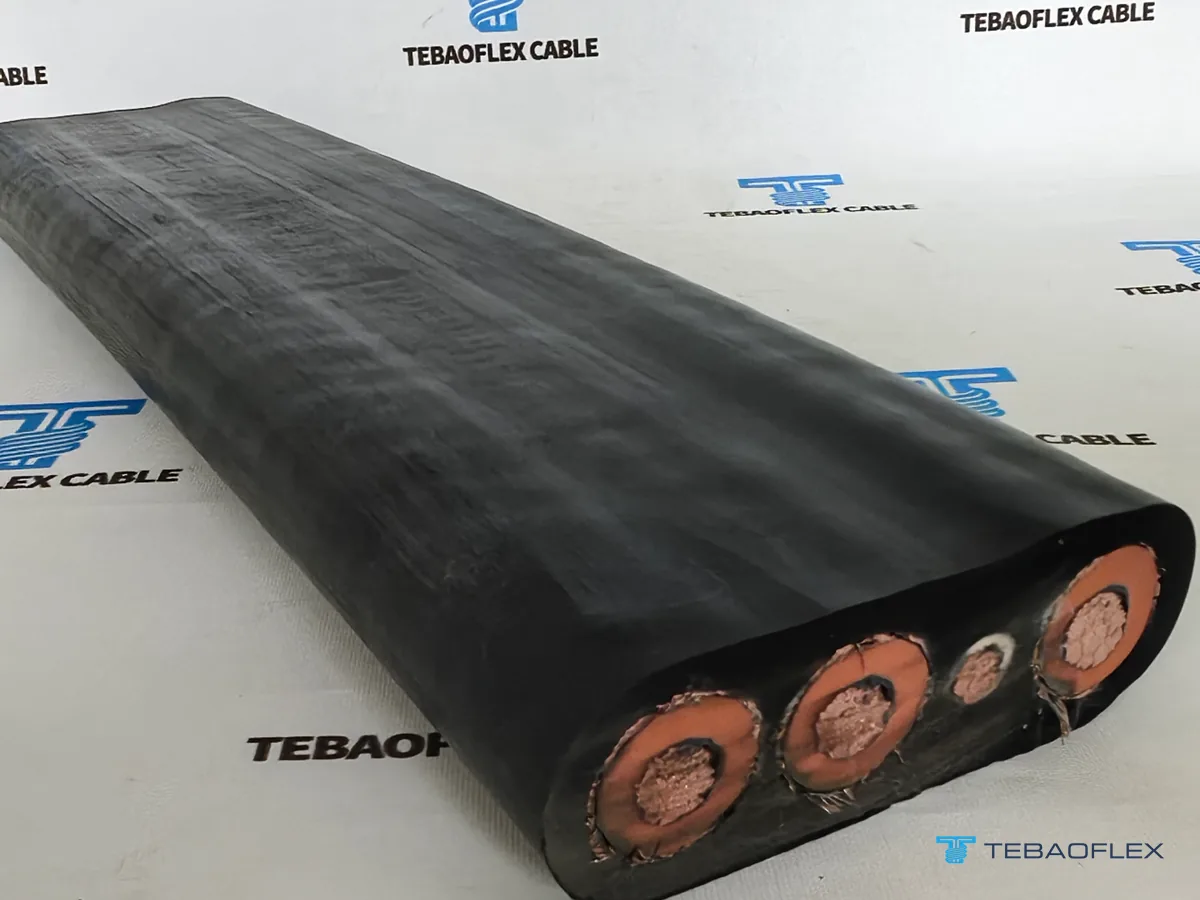
How tight are festoon saddle clamp H × W tolerances on port crane replacement orders?
Existing crane festoon trolleys lock replacement flat cables into a rigid mechanical envelope: cable width W must stay 1.0 to 2.0 mm narrower than the clear distance between saddle side-posts, while thickness H must fall within the elastomer clamp pad compression stroke (typically ±1.5 mm). Overshooting width by even 4 mm prevents installation without replacing every trolley saddle on the boom.
Our 2026 production record for a Ho Chi Minh Port crane NGFLGÖU-J 3×50+1×16 mm² flat festoon tender (235 m uncut) shows how strictly port authorities enforce saddle geometry:
- 66 × 22 mm tender envelope vs 70 mm rejection risk: The port tender fixed the nominal outer profile at 66 × 22 mm to match existing gantry festoon carriages and carried contract penalties if width drifted to 70 mm. By controlling Class 5 tinned-copper stranding pitch, EPR insulation concentricity and 5GM3 polychloroprene extrusion tooling, two independent factory digital-caliper checks recorded 65.06 × 23.36 mm and 65.07 × 23.26 mm—clearing the 66 mm saddle posts cleanly while giving positive vertical clamp grip.
- Verified electrical & tropical current margin: On the same 235 m continuous length (including a 5 m customs testing sample), 20 °C Kelvin bridge DC resistance on the 50 mm² tinned phase cores measured 0.3788 Ω/km against the 0.393 Ω/km IEC 60228 Class 5 tinned ceiling, delivering 193 A continuous rating at 40 °C tropical port ambient (219 A at 30 °C × 0.88 derating factor).
For trolley hardware layout, loop depth calculation and towing-strap placement, pair these cable dimensions with our crane festoon system components and loop sizing guide.

When do motorized crane reels use flat monospiral cables instead of round drum cables?
Motorized crane reels divide by winding geometry: narrow radial monospiral drums stack turns like a clock spring in one slot of width W + 4 to 8 mm using flat (N)TSFLCGEWÖU (DIN VDE 0250-813) or F-3PNCT (JCS, ≤ 4.9 kN/m crush), whereas wide cylindrical level-wind drums and high-speed turnover-pit reels require round aramid-braided (N)TSCGEWÖU or (N)SHTÖU-J built for ±25°/m torsion.
Compare two field port replacements completed by TEBAOFLEX in 2026 to see where the boundary sits in practice:
- Flat radial monospiral drum (zero twist, narrow gantry clearance): In our Hai Phong Port 6.6 kV F-3PNCT 3×50 mm² crane reel replacement, the harbor crane mounted a narrow radial monospiral reel directly above an inline three-roller quay slot with zero horizontal-to-vertical twist. A flat 6.6 kV F-3PNCT construction (tested at 17,000 V AC for 10 minutes and rated for 4,900 N/m lateral sidewall crush) stacked compactly inside the narrow flange gap where a round cable would have climbed turns.
- Round grooved drum & multi-plane path (groove OD window + anti-torsion braid): Conversely, in our Vladivostok Port 6/10 kV (N)TSCGEWÖU+FO 24FO crane reeling replacement, the existing drum machined groove locked finished diameter to a strict 48 to 53 mm window at ≤ 4.35 kg/m and up to 200 m/min travel speed. Holding caliper OD at 51.69 to 52.54 mm with an embedded aramid anti-torsion braid prevented both groove wedging and rotational corkscrewing (diagnosed in our reeling cable corkscrew failure and prevention guide).


Which DIN VDE and JIS designations correspond to each flat and round crane duty?
Matching the crane duty to the exact standard designation avoids cross-quoting fixed tray cables or unreinforced portable cords on dynamic crane spans. Use the verified product routing matrix below to jump straight to dimensional and electrical tables.
| Designation series | Profile & voltage | Governing standard ref. | Core / screen architecture | Choose this when |
|---|---|---|---|---|
| NGFLGÖU-J / PLANOFLEX | Flat · 300/500 V & 0.6/1 kV | DIN VDE 0250-809 | Unscreened 1+1+1+1 power (4G2.5–4G120) or multi-core control (7G1.5–42G2.5) | Standard C-rail and I-beam crane festoon power/control loops without VFD radiated-noise constraints |
| (N)GFLCGÖU-J | Flat · 0.6/1 kV EMC screened | DIN VDE 0250-809 ref. | Individually tinned-copper braided power/signal cores in flat rubber sheath | Inverter-fed (VFD) hoist and trolley motor leads or encoder cables on flat festoons and pancake reels |
| (N)TSFLCGEWÖU & -FO | Flat · 3.6/6 to 12/20 kV | DIN VDE 0250-813 | Triple-extruded semiconductive + 3GI3 EPR + split earth ± 6–24FO optical tube | European-pattern STS/RMG narrow radial monospiral medium-voltage reels |
| 2PNCT-F / H-3PNCT / F-3PNCT | Flat or Round · 600 V to 6.6 kV | JIS C 3327 / JCS 3416 | EPR insulation + single (Grade 2) or cloth-reinforced double (Grade 3) PCP sheath | Japanese- and Asian-built port cranes using 14, 22, 30, 38, 60 or 80 mm² JIS conductor steps |
| (N)SHTÖU-J & PANZERFLEX-L/VS | Round · 0.6/1 kV | DIN VDE 0250-814 | Short-pitch helical cores + inner 5GM3 + aramid anti-torsion braid + outer 5GM5 PCP | Motorized or spring LV drums (20–25 N/mm²) and vertical container spreader baskets (up to 30 N/mm²) |
| (N)TSCGEWÖU & +FO | Round · 3.6/6 to 18/30 kV | DIN VDE 0250-813 | Screened MV EPR cores + split earth (/3E or 2×/2) + aramid anti-torsion braid ± 24FO | Main gantry cylindrical or grooved drums, turnover pits and high-speed E-RTG/STS quay runs |
Open the exact dimensional tables on our NGFLGÖU rubber flat festoon cable page, RONDOFLEX and PLANOFLEX STS crane festoon series, (N)GFLCGÖU 0.6/1 kV EMC screened flat cable schedule, and (N)TSFLCGEWÖU 3.6/6–6/10 kV flat medium-voltage reeling table. For round torsional crane reels and spreaders, compare our (N)SHTÖU-J 0.6/1 kV rubber reeling cable, PANZERFLEX-L and PANZERFLEX-VS port reeling and vertical spreader cable, (N)TSCGEWÖU medium-voltage crane reeling schedule, and 3.3–6.6 kV H-3PNCT and F-3PNCT crane reeling catalogue (alongside our JIS 2PNCT vs 3PNCT crane cable selection guide).
For single-core 0.6/1 kV screened crane trolley jumpers and articulated hinge loops where circular 360-degree EMC compression glands favor a 9.91 mm round polyurethane profile, inspect our Port Klang PUR-C-HF 1×10 mm² halogen-free screened crane cable project.
Pre-RFQ specification checklist for flat festoon and round crane reeling cables
Confirming seven mechanical and electrical parameters before ordering prevents saddle-clamp fouls, monospiral slot jamming and premature conductor fatigue during commissioning.
- Crane mechanism & bending plane: C-rail/I-beam festoon, narrow radial monospiral drum (0°/m twist), cylindrical level-wind drum (fleet angle ±1.5°), or vertical spreader basket/reel.
- Clamp or groove envelope: Clear saddle pocket width × height (mm) for flat festoons, inside flange slot width (mm) for monospiral reels, or machined groove min/max OD (mm) for cylindrical drums.
- Core count, mm² & layout: Phase/earth cross-section (confirm 1+1+1+1 single-row geometry on 4-core flat power cables), screened VFD symmetry if inverter-driven, plus control core or optical fiber counts.
- Voltage class & ambient derating: 300/500 V, 600 V, 0.6/1 kV, or MV 3.3–20 kV, plus maximum ambient temperature (e.g. 40 °C to 50 °C port/steelworks derating) and wound drum layers.
- Travel speed, acceleration & tensile pull: Trolley or gantry speed (m/min), acceleration (m/s²), suspended drop height, and required dynamic pulling force (N).
- Environmental exposure: Coastal salt mist (specify Class 5/6 tinned copper), gearbox oil, −35 °C / −40 °C winter cold flex, or abrasive slag requiring PUR instead of PCP rubber.
- Continuous cut lengths & sample allowance: Exact uncut length per drum (including 10–15 % festoon sag allowance, 2 dead drum wraps, termination tails, and any 5 m customs/testing sample).
As of November 2026, TEBAOFLEX manufactures custom flat festoon and round reeling cables at our Taicang factory from a 50 m minimum order quantity (MOQ), with standard production lead times of 7 to 45 working days depending on extrusion tooling and order schedule. Explore subsystem engineering on our crane and reeling cable solutions hub, browse all families in our port and festoon cables catalogue, or send your saddle clamp dimensions or drum drawing for engineering review.
Frequently asked questions
When should an overhead or port crane use a flat cable instead of a round cable?
Under DIN VDE 0250-809 / 0250-813 and JCS crane cable schedules, select a flat crane cable (such as NGFLGOEU, (N)GFLCGÖU, H-2PNCT / 2PNCT-F, (N)TSFLCGEWÖU or F-3PNCT) whenever the cable flexes strictly in one vertical plane with 0°/m axial twist—specifically C-rail and I-beam festoon trolley loops or narrow single-slot radial monospiral drums. Select a round aramid-reinforced reeling cable whenever the route crosses multi-plane deflection sheaves, turnover pits, gravity spreader baskets or wide cylindrical level-wind drums.
Why do flat crane cables bend tighter than round cables of the same conductor cross-section?
Bending strain in a conductor equals its distance from the neutral bending axis divided by bend radius. Because a true flat cable aligns all cores in one horizontal row, minimum dynamic bending radius is governed by minor cable thickness H (typically 5 × H to 10 × H per DIN VDE 0298-3, or 180 to 250 mm on 18–25 mm thick festoon cables) rather than overall width W, whereas a helical round reeling cable must bend across its full circular diameter D (typically 10 × D to 15 × D, or 450 to 750 mm).
Why is a 1+1+1+1 single-row core layout superior to a 2+2 stacked core layout in flat festoon cables?
In a true 1+1+1+1 single-row flat construction (per DIN VDE 0250-809 and JIS C 3327 flat cabtyre rules), all four insulated conductors sit side by side on the neutral bending plane with direct thermal conduction to both outer sheath faces. A 2+2 stacked bundle doubles minor thickness H, forces upper cores into tension while lower cores buckle in compression over every trolley saddle, traps I²R heat between layers, and jams standard flat festoon clamp pockets.
How close must finished flat cable dimensions stay to existing festoon trolley clamp windows?
Replacement flat festoon cables must fit inside the fixed clear width and jaw stroke of existing C-rail or I-beam saddle clamps with 1 to 2 mm of side clearance and positive elastomer compression. On a 2026 Ho Chi Minh Port crane tender specifying a 66 × 22 mm NGFLGOEU-J 3×50+1×16 mm² pocket, a proposed 70 mm wide build would have fouled the trolley side plates; holding factory caliper dimensions to 65.06 × 23.36 mm and 65.07 × 23.26 mm ensured direct mechanical seating.
Can a flat crane cable be wound onto a wide cylindrical level-wind drum or pulled through a turnover roller guide?
No. Flat crane cables such as NGFLGOEU, (N)TSFLCGEWÖU and F-3PNCT have 0°/m permissible axial torsion and negligible edgewise bending flexibility. Pulling a flat cable across fleet angles exceeding ±1° on a cylindrical drum or twisting it through a 90° horizontal-to-vertical turnover guide buckles the outer edge cores and tears the elastomer web; specify round aramid-braided (N)SHTÖU-J or (N)TSCGEWÖU instead.
Can multiple flat cables be stacked together on one I-beam festoon trolley?
Yes, in C-rail and I-beam crane festoons (governed by DIN VDE 0298-3 loop rules), two or three flat power, screened VFD and multi-core control cables are routinely stacked in separated elastomer clamp tiers on the same trolley saddle—putting the thickest power cable on the outer (largest-radius) saddle tier and smaller control cables below, with a 10 % to 15 % length allowance for loop sag.