



Elastomer & Polyurethane Sheath Engineering · Mining, Cranes & Offshore
Selecting the right heavy-duty cable jacket among CSP (chlorosulfonated polyethylene / CSM), CPE (chlorinated polyethylene), CR (polychloroprene / neoprene) and polyether PUR (polyurethane) determines whether a trailing, reeling or offshore mobile cable survives years of oil drips, salt spray, sunlight and rock drag—or cracks open in months. CSP, CPE and CR are cross-linked thermoset rubber cable jackets that do not melt under overload or hot weld spatter, whereas polyether PUR is a high-modulus thermoplastic jacket offering vastly superior cut-through and notch-tear endurance at a lower thermal ceiling.
How do thermoset CSP, CPE and CR rubbers differ fundamentally from thermoplastic PUR?
Before comparing oil-swell percentages or cold-bend temperatures, engineers must separate vulcanized thermoset elastomers (CSP, CPE and CR) from thermoplastic elastomers (polyether PUR). As outlined in our vulcanized rubber vs TPE cable guide and rubber vs PVC cable comparison, thermoset jackets undergo irreversible chemical cross-linking inside a continuous vulcanization (CV) steam or salt-bath line during manufacture. Once cured, their polymer chains are locked into a three-dimensional network that will not melt, drip or flow even during a conductor short-circuit (+250 °C transient) or direct contact with hot grinding sparks and welding slag.
Polyether polyurethane (PUR / 11Y), by contrast, derives its remarkable mechanical toughness from physical hydrogen-bonded hard segments embedded in flexible polyether soft segments. That architecture delivers two to four times the abrasion and notch-tear resistance of conventional rubbers and lets designers extrude thinner outer walls for compact reeling drums—but because the cross-links are physical rather than covalent, PUR softens and melts when struck by molten metal slag or subjected to sustained surface temperatures above +80 °C to +90 °C.
How do CSP, CPE, CR (neoprene) and PUR compare across key engineering metrics?
No single outer sheath wins every metric simultaneously. The table below consolidates typical industrial cable-compound benchmarks referenced across IEC 60811 sheath test methods, ASTM D471 IRM 902 oil-immersion protocols and regional standards (ICEA S-75-381, UL 62, DIN VDE 0250 and EN 50525-2-21).
| Engineering parameter | CSP / CSM (Chlorosulfonated PE) | CPE (Thermoset Chlorinated PE) | CR / PCP (Polychloroprene / Neoprene) | Polyether PUR (11Y / 11Y-HF) |
|---|---|---|---|---|
| Polymer cure mechanism | Vulcanized thermoset (non-melting) | Cross-linked thermoset (non-melting) | Vulcanized thermoset (non-melting) | Thermoplastic elastomer (melts under slag) |
| Typical continuous jacket temp | −40 °C to +90 °C (select grades +105 °C) | −40 °C to +90 °C | −25 °C / −40 °C to +80 °C / +90 °C | −40 °C to +80 °C (+90 °C fixed) |
| Mineral oil & hydraulic fluid | Excellent (low IRM 902 swell) | Excellent (UL Oil Res I / II capable) | Very good (EN 50525 / VDE oil rated) | Very good to excellent (mineral oils/greases) |
| UV, ozone & coastal salt spray | Best-in-class (saturated backbone) | Very good (strong ozone stability) | Good to very good (double-bond aging slower with carbon black) | Very good (UV-stabilized black polyether) |
| Abrasion & notch-tear strength | Good (standard rubber tear profile) | Good to very good (heavy mining grades) | Very good (5GM5 heavy reeling grade) | Best-in-class (resists cuts, gouges & gravel) |
| Weld spatter & hot slag | Excellent (chars without dripping) | Excellent (chars without dripping) | Excellent (chars without dripping) | Poor to fair (melts on hot metal contact) |
| Halogen-free (LSZH) capability | No (chlorinated + sulfur-bearing) | No (chlorinated polymer backbone) | No (chlorinated polymer backbone) | Yes (available in IEC 60754 LSZH grades) |
| Typical cable standards & families | Offshore HPU leads, DLO heavy jackets, marine power | SOOW, Type G-GC, SHD-GC, MP-GC | H07RN-F, (N)SHTÖU, 2PNCT / 3PNCT | NSHT11Y, PUR-C-HF, ROV tethers |
When is CSP (CSM) genuinely worth the premium over thermoset CPE?
Industrial buyers evaluating a CSP vs CPE cable jacket for coastal ports, offshore platforms and desert hydraulic power units (HPUs) often receive dual quotations offering either compound on the same flexible conductor core. While both compounds pass industrial oil immersion (reviewed in detail in our oil-resistant cable ratings PR I vs PR II guide) and flame tests, their molecular chemistry diverges under prolonged weathering and oxidizing chemical exposure.
CSP incorporates chlorosulfonyl groups onto a fully saturated polyethylene chain. That chemistry eliminates reactive carbon-carbon double bonds, giving CSP exceptional resistance to marine salt fog, tropical UV radiation, severe ozone near high-voltage switchgear, and dilute acids or alkalis—while retaining color stability in high-visibility yellow or orange jackets without rapid surface chalking. Thermoset CPE shares the saturated polyethylene backbone (offering much better ozone resistance than older natural-rubber blends) and delivers comparable hydrocarbon oil resistance at a lower compound cost, which is why CPE dominates North American portable mining cables (Venezuela 2 kV Type G-GC orange aramid-reinforced drill jumbo build) and 600 V SOOW portable power cords.
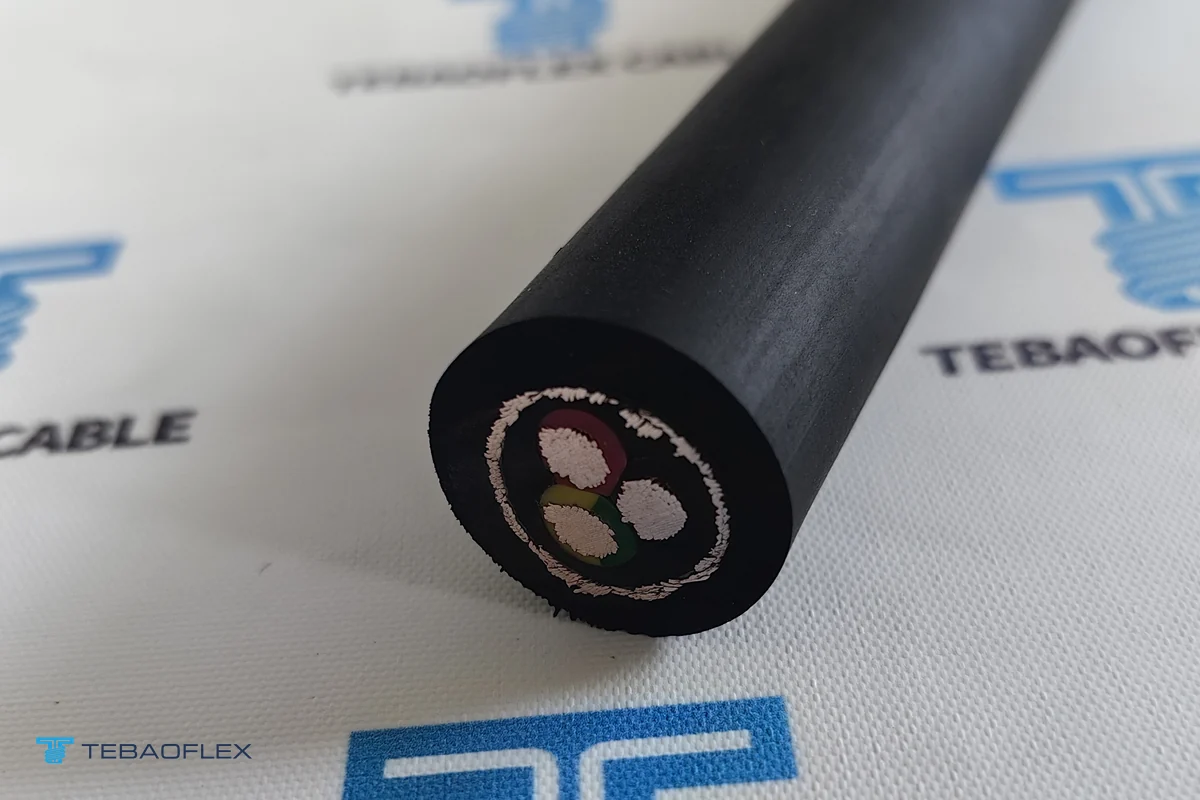
Practical CSP vs CPE rule of thumb: Specify CSP when cables live continuously outdoors on coastal decks, offshore hydraulic skids or corrosive chemical piers where salt spray, direct sun and oxidizing chemicals dictate replacement intervals. Specify thermoset CPE for underground/open-pit mining trailing cables, workshop portable cords and general industrial feeders where heavy-duty oil resistance, cold-weather flexibility and budget efficiency matter most.
How do polychloroprene CR (5GM5) and polyether PUR compare on crane reels and mine floors?
In European and Asian port cranes, stacker-reclaimers and trackless underground mines, the primary outer-jacket decision usually falls between heavy-duty polychloroprene rubber (CR / PCP, DIN VDE 5GM5) and polyether polyurethane (PUR / 11Y). Both survive oil splashes and outdoor weather, yet they behave very differently under mechanical load and drum winding:
- Abrasion and cut-through resistance (PUR wins clearly): On sharp granite mine floors, steel crane guide rollers or drag chains, polyether PUR exhibits markedly lower volume loss under sliding abrasion and resists crack propagation once nicked (compare our abrasion-resistant mining cable guide and Peru TPU/PUR-jacketed 2 kV SHD-GC mining case). That toughness also allows slimmer wall thicknesses when reel-groove outer diameter is tightly constrained, as proven on compact NSHT11Y crane spreader cables and our Port Klang PUR-C-HF screened crane cable delivery.
- High-temperature coiled drum layers & welding sparks (CR / 5GM5 wins clearly): Multi-layer cylindrical crane reels trap heat inside inner cable wraps, and steel-mill or shipyard decks expose sheaths to hot sparks and slag. Vulcanized CR (5GM5) on (N)SHTÖU crane reeling cables and H07RN-F heavy rubber leads never melts on hot steel contact and delivers predictable surface friction so tensioned turns wind evenly without sudden slip-stick grabs.
- Wet hydrolysis & potting compatibility (check polyether vs polyester PUR): Specify polyether-based PUR rather than polyester PUR for marine, wet-mine or submerged duty, because polyester PUR hydrolyzes and degrades in warm damp conditions. For underwater bonding and penetrator seals, also review our polyether PUR vs LDPE subsea tether jacket guide.
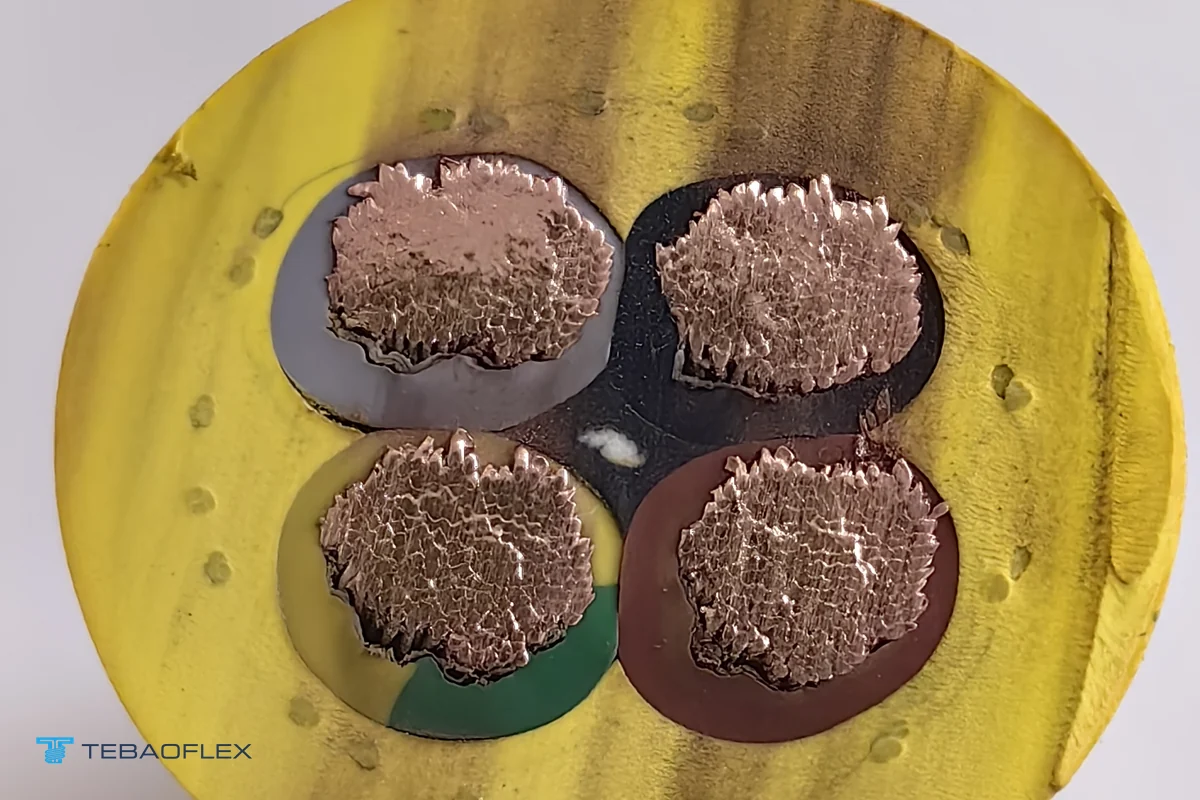
What compliance trap catches buyers specifying CSP, CPE or CR for Zone 2 or shipboard projects?
A frequent procurement bottleneck occurs on offshore rigs, marine vessels and Zone 2 mobile hydraulic skids: an engineer selects a flexible rubber reeling cable with a CSP, CPE or CR jacket for oil and salt-spray durability, only for the end client’s HSE audit to reject it because the compartment mandates low-smoke zero-halogen (LSZH, IEC 60754) and/or fire-survival circuit integrity.
Because chlorine atoms give CSP, CPE and CR their flame retardance and oil resistance, none of those three thermoset rubbers is halogen-free. Furthermore, as detailed in our ATEX Zone 1 and Zone 2 cable requirements guide, bulk cables do not carry standalone Ex equipment certificates—compliance rests on matching the hazardous-area installation standard (IEC 60079-14), correct Ex glands, flame propagation (IEC 60332-3) and, where required offshore, mud-resistant halogen-free thermoset SHF2 sheathing (NEK 606 RFOU vs BFOU guide) or halogen-free flame-retardant polyether PUR (PUR-C-HF).
| Dominant site hazard or project requirement | Primary jacket choice | Jacket to avoid (and why) |
|---|---|---|
| Coastal salt spray, intense UV & open-deck oil drips (non-LSZH) | CSP / CSM thermoset rubber | Standard PVC or unstabilized polyester PUR (cracks / hydrolyzes) |
| North American mining trailing, drill jumbos & portable cords | Thermoset CPE (or TPU/PUR where abrasion dominates) | Thermoplastic PVC (stiffens in cold, melts under short-circuit heat) |
| Multi-layer crane drums, shipyards & welding-spark zones | CR / PCP (5GM5 / EM2) or CSP thermoset rubber | Thermoplastic PUR (melts on hot slag or grinding spatter) |
| Sharp gravel drag, tight reel OD windows & high-cycle festoons | Polyether PUR (11Y / 11Y-HF) | Soft standard rubber where thin walls nick and tear rapidly |
| Enclosed marine cabins, tunnels or offshore LSZH / Zone 2 specs | SHF2-MUD thermoset LSZH or halogen-free PUR (11Y-HF) | CSP, CPE or CR (chlorinated — fails IEC 60754 acid-gas limits) |
What 5 checks lock in the right cable outer jacket before ordering?
Before issuing an RFQ or approving a replacement datasheet, verify five field conditions in sequence so you neither overpay for an unnecessary specialty polymer nor suffer premature jacket failure:
- Check LSZH and fire-survival mandates first: If IEC 60754 halogen-free or IEC 60331 circuit-integrity rules apply, immediately rule out chlorinated CSP, CPE and CR and select halogen-free polyether PUR (11Y-HF) or thermoset SHF2-MUD.
- Check hot-surface, slag and coiled-layer thermal peaks: If weld spatter, foundry radiant heat or deep multi-layer reel heating can exceed +80 °C at the jacket surface, choose cross-linked thermoset CSP, CPE or CR (5GM5) over thermoplastic PUR.
- Measure mechanical abrasion vs reel groove OD limits: If rocks, steel guide rollers or tight drum grooves require a compact, cut-resistant sheath, specify polyether PUR (11Y) with anti-torsion braid reinforcement.
- Screen fluid chemistry beyond generic mineral oil: Confirm exposure to ester-based hydraulic fluids, drilling muds, saltwater mist or acids—CSP handles harsh coastal/chemical atmospheres better than standard CPE, while concentrated acids require fluoropolymer (FEP/PFA) rather than any rubber or PUR.
- Confirm cold-flex minimum and drum length: Verify the coldest ambient bending temperature (−25 °C vs −40 °C) and confirm custom batch requirements—TEBAOFLEX supplies custom CPE, CR, CSP and PUR cables from a 50 m MOQ with 7 to 45 working-day production lead times. Send your operating environment and cable schedule to TEBAOFLEX engineers for a compound and wall-thickness recommendation.
Frequently asked questions
What is the main difference between a CSP (CSM) jacket and a CPE cable jacket?
Both chlorosulfonated polyethylene (CSP / CSM) and chlorinated polyethylene (CPE) are cross-linked thermoset elastomers that resist melting under overload or hot sparks, unlike thermoplastic PVC or TPE. CSP adds sulfonyl chloride cross-linking sites that deliver superior long-term resistance to marine salt spray, UV/ozone weathering, oxidizing chemicals and thermal aging up to +90 °C (and short-term higher excursions), while thermoset CPE offers strong oil resistance, cold-flex performance and flame retardance at a more economical material cost—making CPE the standard jacket on North American SOOW, Type G-GC and SHD-GC cables.
When should engineers specify polyether PUR instead of thermoset CR, CPE or CSP rubber jackets?
Specify polyether-based polyurethane (PUR / 11Y) when mechanical abrasion, notch-tear propagation, mineral hydraulic oils, drag-chain flexing or tight outer-diameter compaction dominate cable life—such as crane spreader reels, festoon lines, offshore ROV tethers and automated port equipment. Avoid PUR where continuous conductor/ambient heat exceeds +80 °C to +90 °C, where weld spatter or hot slag hits the sheath (PUR is thermoplastic and melts on contact), or in hot-wet hydrolytic environments unless an explicitly hydrolysis-stabilized polyether grade is verified.
Why do European crane and mining reeling standards (DIN VDE 0250-814 / EN 50525-2-21) specify CR / PCP (5GM5 / EM2) rubber jackets?
Polychloroprene (CR / PCP, designated 5GM3 or heavy-duty 5GM5 under DIN VDE 0250 and EM2 under EN 50525-2-21) balances elastic recovery, oil and grease resistance, flame retardance, weld-spatter tolerance and predictable reel-winding friction. On cylindrical and monospiral crane reels where multi-layer cable turns rub against steel flanges and heat builds inside coiled layers, thermoset CR/PCP resists thermal softening and maintains consistent drum traction without grabbing.
Are CSP, CPE and CR jackets halogen-free (LSZH)?
No. CSP (chlorosulfonated polyethylene), CPE (chlorinated polyethylene) and CR (polychloroprene) all rely on chlorine in their polymer backbone for intrinsic oil resistance and flame retardance, so they release acidic halogen gases if forced to burn. When enclosed shipboard compartments, subsea/offshore Zone 2 modules or tunnel specifications mandate low-smoke zero-halogen (LSZH / IEC 60754) behavior alongside oil or mud resistance, engineers step to halogen-free SHF2 / SHF2-MUD thermoset elastomers or halogen-free flame-retardant polyether PUR (11Y-HF).
Why does offshore Zone 2 mobile equipment (such as hydraulic power units) often compare CSP vs CPE vs LSZH?
Mobile hydraulic power units (HPUs) operating on open coastal decks face diesel/hydraulic oil drips, salt-spray mist, intense solar UV and mechanical dragging—conditions where thermoset CSP outperforms standard CPE on long-term UV, ozone and salt-fog aging. However, if an offshore operator’s Zone 2 hazardous-area or shipboard fire specification explicitly mandates low-smoke halogen-free and IEC 60331 circuit integrity, neither CSP nor CPE meets LSZH gas limits, requiring a shift to cross-linked LSZH (SHF2 / mica-XLPE-LSZH) or halogen-free PUR.
Can TEBAOFLEX supply the same cable core construction with either CPE, CR, CSP or PUR outer sheathing?
Yes. Depending on the governing standard (ICEA S-75-381, UL 62, DIN VDE 0250, EN 50525-2-21 or IEC 60092) and site environment, TEBAOFLEX manufactures flexible mining, crane reeling, offshore and portable power cables with thermoset CPE, polychloroprene CR (5GM5), CSP/CSM or halogen-free polyether PUR outer sheaths starting from a 50 m MOQ (standard production lead time 7 to 45 working days). Provide your ambient temperature range, fluid/oil exposure, reeling duty and LSZH requirement for compound matching.