







Case 25 · Belarus · Hydrostatic Level Transmitters · F46 (FEP) Vented Capillary Cable
F46 (FEP) 4×0.2 mm² Vented Capillary Shielded Cable for Submersible Level Transmitters in Belarus
A pressure-transmitter manufacturer in Belarus—producing submersible hydrostatic level gauges for aggressive industrial tanks—needed a long-term cable source starting with a 1,000 m trial qualification batch ahead of recurring multi-kilometer volume. The specification combined conflicting material constraints inside a tight 6.9 to 7.3 mm transmitter gland window: four 0.2 mm² tinned-copper signal cores with PE insulation, high-tensile polyamide yarns, a central hollow atmospheric-pressure compensation capillary tube, a tinned-copper braided EMC shield and a chemical-resistant black F46 (FEP) fluoropolymer outer sheath. TEBAOFLEX re-balanced the four signal cores into a 90-degree symmetrical layout, solved the high-temperature FEP-over-PE extrusion thermal barrier without collapsing the 1.60 mm vent bore, and verified finished cable dimensions at 6.99 to 7.11 mm OD with a 0.59 to 0.70 mm FEP jacket wall.
Project at a glance
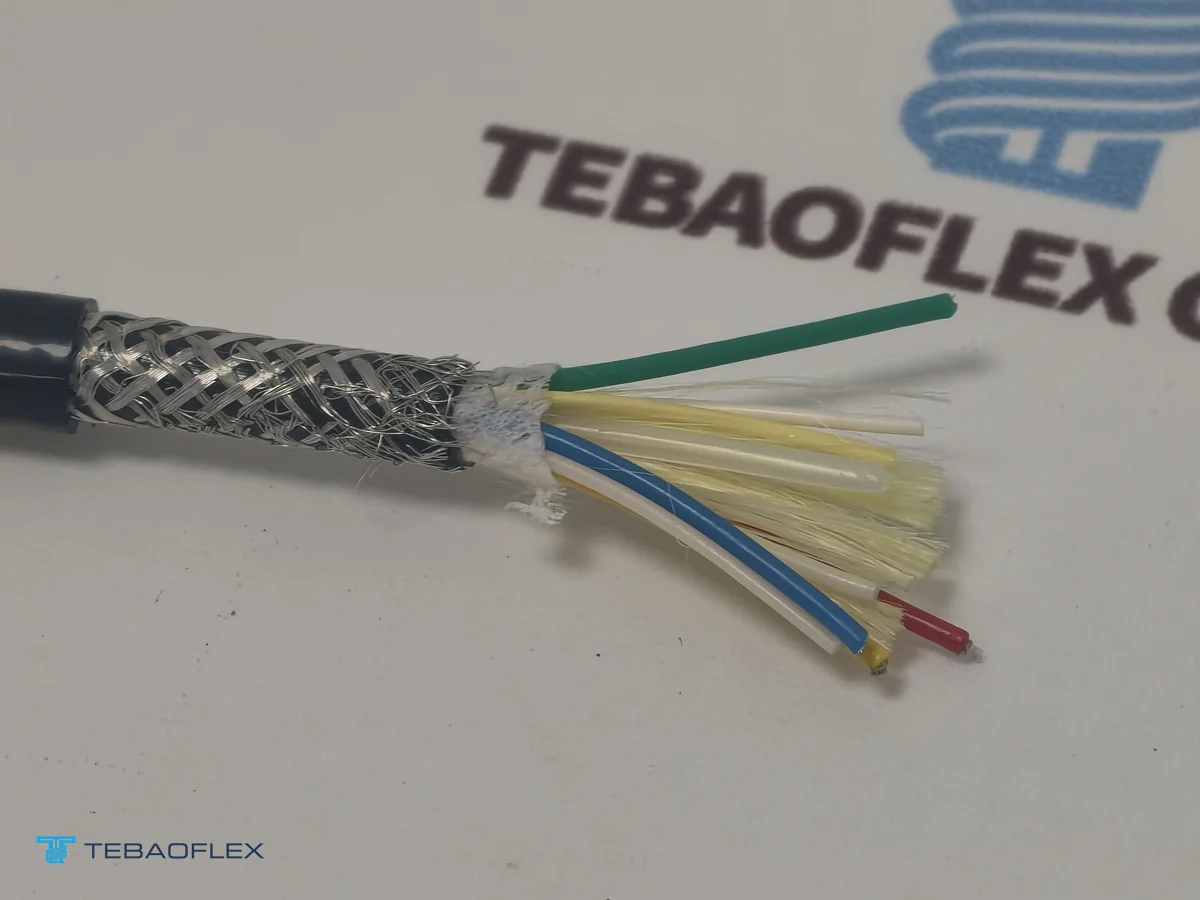
This 1,000 m trial qualification order for a Belarus pressure-transmitter manufacturer delivered a custom 4 × 0.2 mm² shielded vented capillary cable with a central 1.60 mm OD hollow PE vent tube, polyamide tensile fibers, a CuSn braid and a black F46 (FEP) outer sheath verified at 6.99 to 7.11 mm OD.
| Order item | Verified engineering detail |
|---|---|
| Destination & application | Belarus — submersible hydrostatic level transmitters (pressure gauges) operating in corrosive acid, alkali and chemical-vapor tanks |
| Order qualification scope | 1,000 m continuous sequential metre-marked qualification batch (ahead of recurring 10 km program evaluation) |
| Signal conductors | 4 × 0.2 mm² finely stranded tinned copper (CuSn) with colour-coded polyethylene (PE) insulation (yellow, green, blue, red) |
| Atmospheric vent capillary tube | Central hollow PE polymer capillary tube (1.60 mm caliper-verified OD) — flexible, collapse-resistant and vapor-resistant |
| Tensile reinforcement & DFM layout | Four symmetrical polyamide tensile yarn sectors alternating at 90-degree intervals with the four signal cores around the central tube |
| EMC screen & chemical outer sheath | Protective barrier wrapping + woven tinned-copper (CuSn) wire braid + black F46 (FEP) fluorinated ethylene propylene outer sheath |
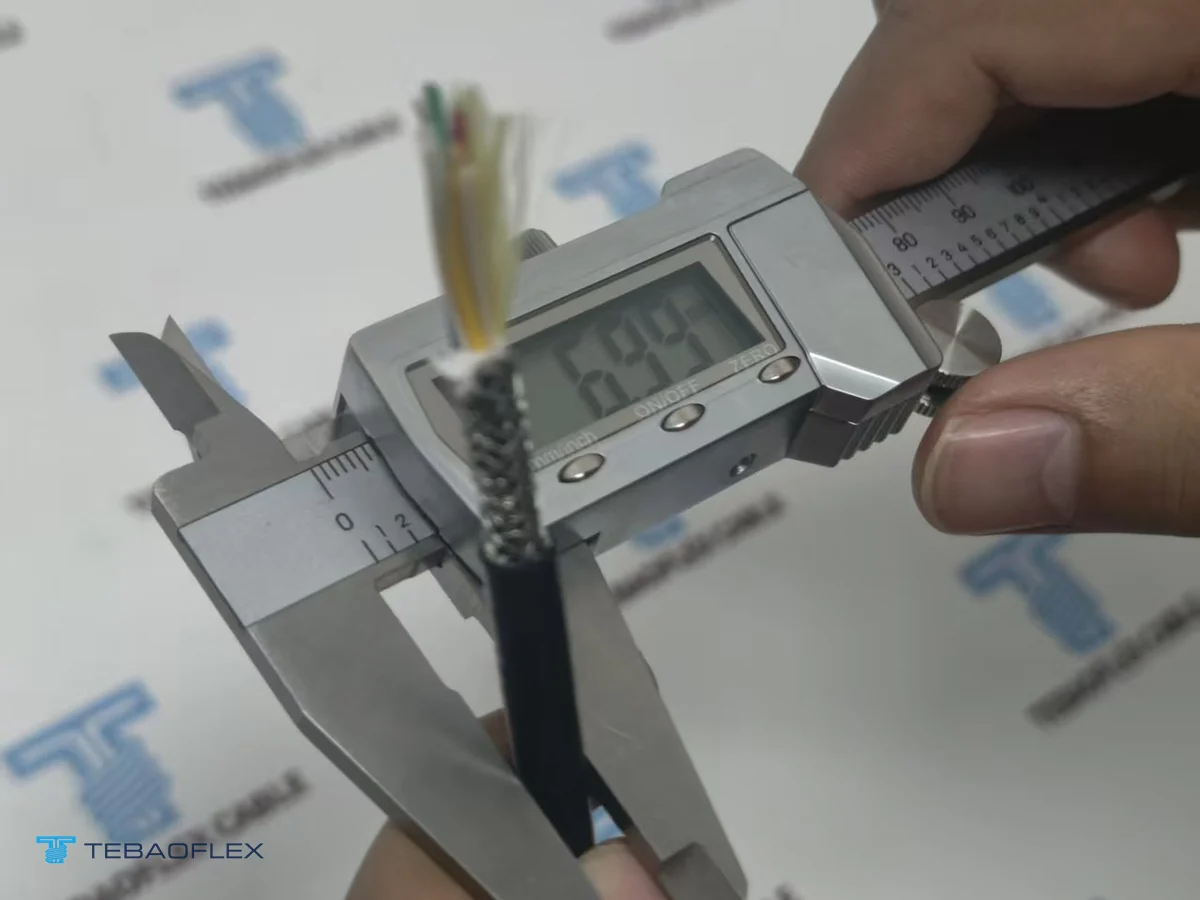
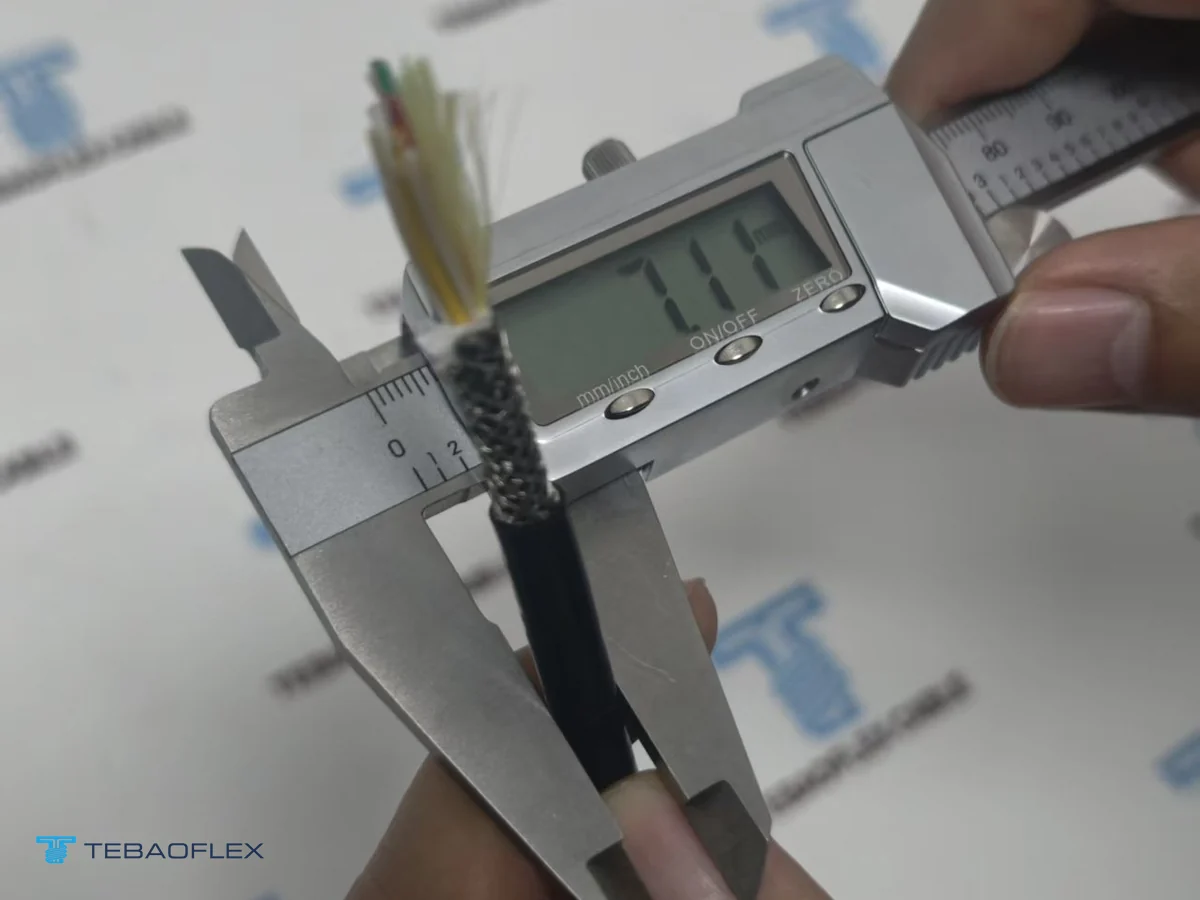
| Verified caliper measurements | Finished OD: 6.99 mm / 7.11 mm (target 6.9–7.3 mm) · FEP outer wall: 0.59–0.70 mm (0.68 mm typical) · Central vent tube OD: 1.60 mm |
| Thermal rating, mass & print | −40 °C to +70 °C operating range · approx. 0.077 kg/m nominal weight · TEBAOFLEX 4×0.2+Capillary Tube Combined Shielded Cable 0001M…1000M |
Why is extruding F46 (FEP) over PE cores and a hollow vent tube a critical factory hurdle?
Fluorinated ethylene propylene (F46 / FEP) requires extrusion melt temperatures above 330 °C, whereas polyethylene (PE) core insulation and hollow PE atmospheric vent tubes soften above 105 °C to 130 °C. Controlled barrier wrapping, rapid crosshead drawdown and immediate water-trough quenching kept the 1.60 mm bore open and round.
Submersible hydrostatic level transmitters installed in acid pickling tanks, caustic neutralization basins and industrial chemical sumps demand two seemingly opposite polymer properties in one slim 7 mm cable. On the outside, the jacket must resist concentrated acids, alkalis and corrosive process vapors without swelling, hardening or leaching plasticizers—a chemical envelope far beyond PVC or standard oil-rated jackets (compared in our industrial oil- and fluid-resistant cable ratings guide). That drives transmitter OEMs to specify fluorinated ethylene propylene (F46 / FEP), the same fluoropolymer family used in our FEP-6Y / FEP-C-6Y screened fluoropolymer control cables, screened FEP/PFA industrial sensor cables and KFFP fluoroplastic instrumentation series.
Inside the cable, however, this Belarus transmitter schedule retained low-capacitance polyethylene (PE) core insulation and a flexible hollow PE atmospheric capillary tube across a −40 °C to +70 °C operating envelope. As detailed in our high-temperature wire insulation ratings guide, FEP melts above 260 °C and extrudes around 330 °C to 380 °C—nearly triple PE’s softening temperature. During pre-production engineering review at our Taicang facility, process engineers resolved this melt-temperature mismatch through three controls:
- Thermal-barrier wrapping + metallic CuSn braid heat sink: Wrapping the core-and-polyamide assembly beneath a dense tinned-copper (CuSn) wire braid (IEC 60228 fine-stranded basis) shields the inner PE components from direct molten-FEP contact while providing full-circumference EMC screening for millivolt or 4–20 mA sensor signals (see our shielded instrumentation cable specification guide).
- Tube-extrusion drawdown control: Applying the black F46 (FEP) jacket via calibrated tubing drawdown rather than high-pressure compression extrusion avoids squeezing the 1.60 mm hollow capillary lumen flat while the tube is warm.
- Immediate post-die cooling: Fast-quench trough cooling right downstream of the fluoropolymer crosshead freezes the 0.59 to 0.70 mm FEP outer wall before conductive heat can penetrate to the central vent channel.
DFM improvement: re-balancing four 0.2 mm² cores and polyamide tensile yarns around the vent tube
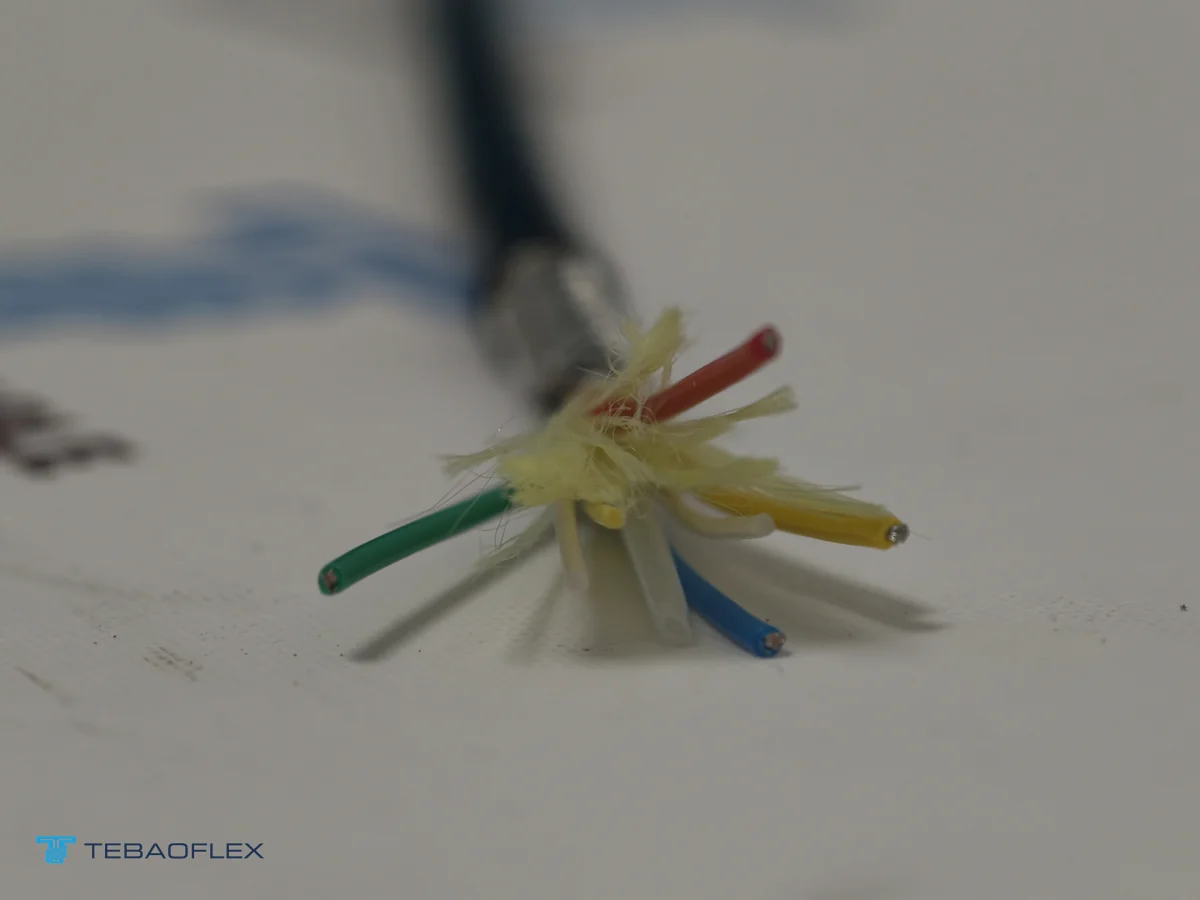
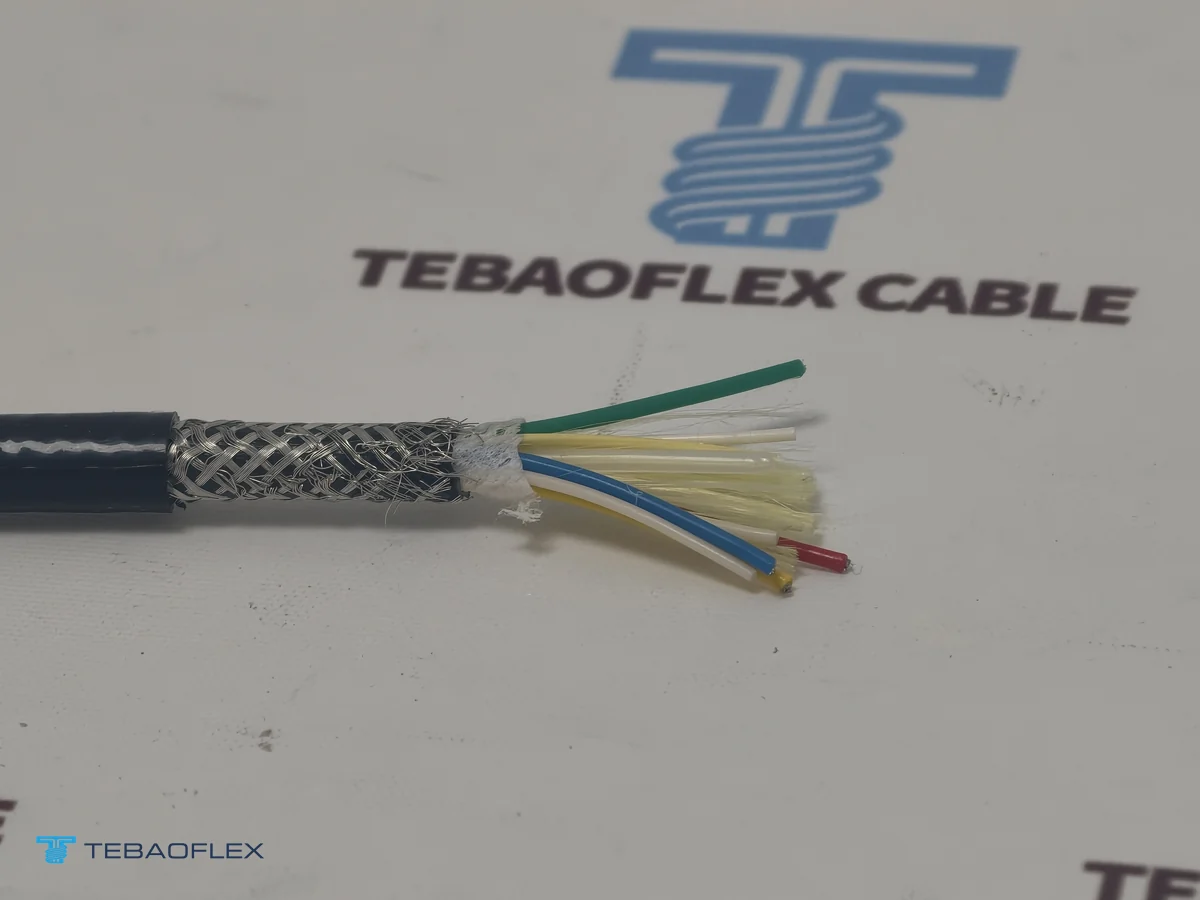
In the buyer’s initial schematic, the yellow and red 0.2 mm² cores sat directly adjacent on one side of the central capillary tube. TEBAOFLEX engineers proposed spacing all four cores symmetrically at 90-degree intervals separated by polyamide tensile yarns so hanging load and gland torque compress the vent tube evenly.
Submersible hydrostatic probes hang freely from their own cable down deep chemical wells and bore pipes, often 10 m to 100 m below the top junction box. If copper signal conductors carry the suspended weight of the stainless-steel or titanium sensor body, fine 0.2 mm² strands work-harden and open-circuit; meanwhile, if radial compression inside the stainless-steel sensor cable gland pushes harder from one side than the other, the thin polymer capillary bore can kink and block barometric equalization.
By alternating the four colour-coded PE cores (yellow, green, blue, red) at 90-degree symmetry with four equal sectors of polyamide tensile cord around the central capillary tube, tensile pull transfers cleanly to the high-modulus strength yarns while every quadrant presents identical crush resistance under the sensor compression gland. How cable outside diameter and jacket modulus interact with submerged sealing glands is examined further in our submerged cable jacket and compression penetrator sizing guide, and related underwater multi-element builds are shown on our submerged sensor and observation composite cable page.
Digital caliper QC: holding 6.99–7.11 mm OD inside the 6.9–7.3 mm transmitter gland window
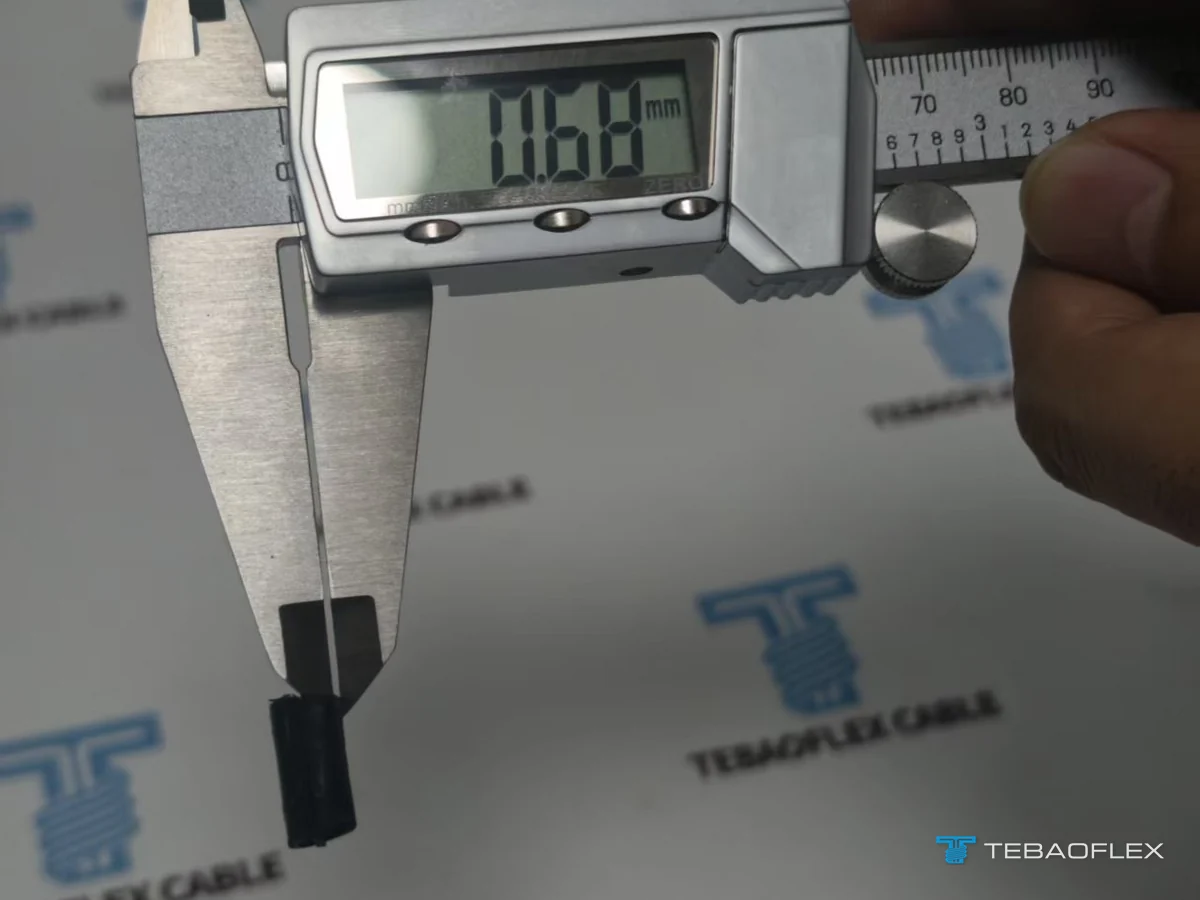
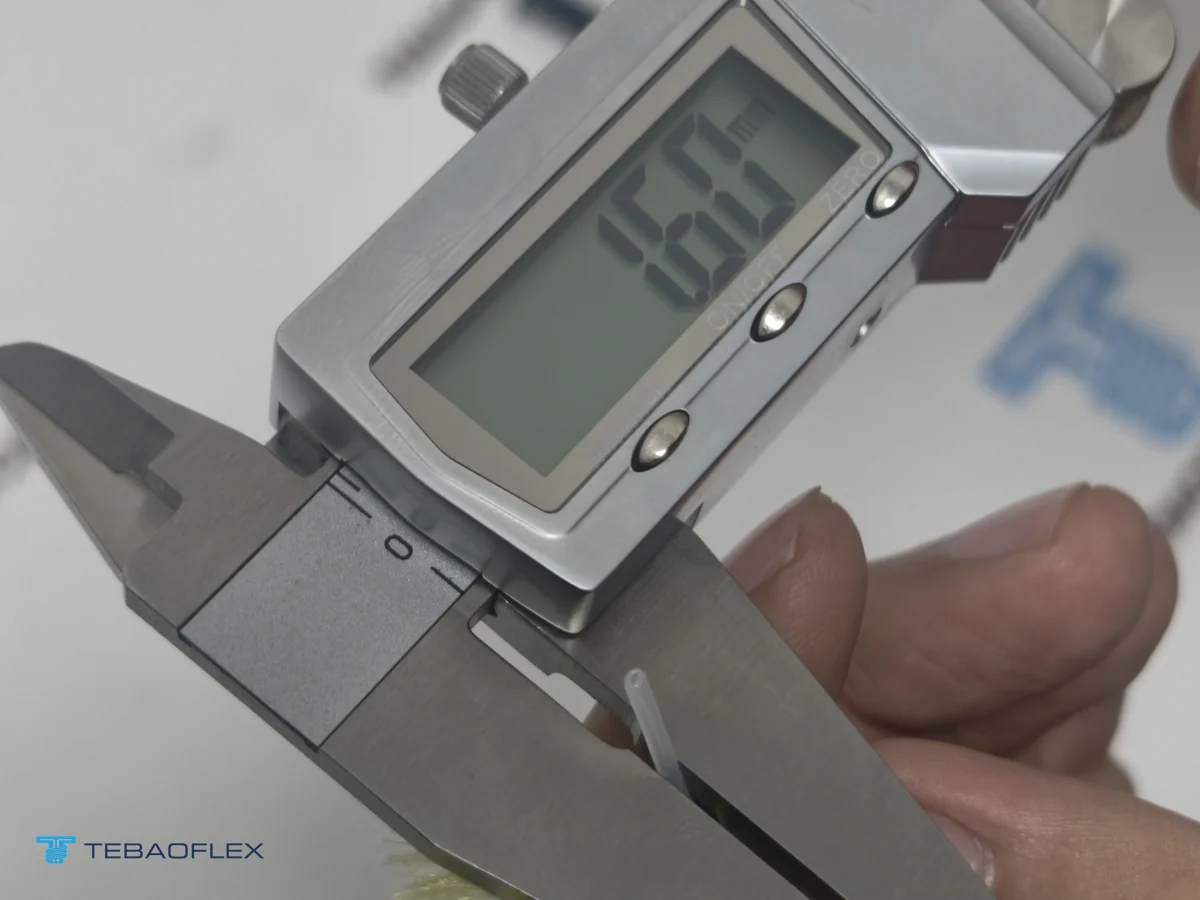
Transmitter cable glands tolerate only ±0.2 mm diameter deviation before losing IP68 immersion seal or failing to assemble. Digital caliper inspection on the finished Belarus batch verified 6.99 mm and 7.11 mm outside diameters, 0.59 to 0.70 mm F46 (FEP) outer-wall thickness and an un-deformed 1.60 mm central capillary tube.
| Inspected dimension / item | Belarus OEM specification | Factory digital-caliper result | Engineering acceptance note |
|---|---|---|---|
| Finished cable outside Ø | 6.9 – 7.3 mm | 6.99 mm / 7.11 mm (two axes) | Centered cleanly inside ±0.2 mm sensor compression-gland seal window |
| F46 (FEP) outer sheath wall | Chemical barrier black FEP | 0.59 mm / 0.68 mm / 0.70 mm | Concentric fluoropolymer barrier against acids, alkalis and vapors |
| Central capillary vent tube OD | Flexible hollow PE vent bore | 1.60 mm OD (open lumen) | Verified circular and un-collapsed after high-temperature FEP extrusion |
| Signal cores & EMC screen | 4 × 0.2 mm² CuSn + CuSn braid | Yellow, green, blue, red (90°) | Symmetrical 4-quadrant lay with polyamide tensile strength fibers |
| Thermal & nominal mass basis | −40 °C to +70 °C · ~0.077 kg/m | 1,000 m qualification batch | Sequential metre printing from 0001M to 1000M for reel-off tracking |
TEBAOFLEX 4×0.2+Capillary Tube Combined Shielded Cable 0001M 0002M…1000M
What to specify when ordering vented capillary hydrostatic level-sensor cables
To match your transmitter body gland and tank chemistry without prototype rework, specify fluid/vapor exposure (PE vs PUR vs F46/FEP jacket), exact finished OD tolerance, conductor count/mm², capillary tube bore/OD and maximum hanging depth.
- Chemical & immersion exposure: clean water/boreholes (PE or polyether PUR jacket) vs acids, alkalis, hydrocarbons or corrosive vapors (F46/FEP or PVDF outer jacket)
- Transmitter cable-gland sealing OD window (for example 6.9 to 7.3 mm or 7.5 ±0.2 mm) and whether potting adhesion primer/etching is required on fluoropolymer sheaths
- Conductor count, cross-section and plating: e.g. 2, 4 or 6 × 0.2 mm² / 0.25 mm² / 0.34 mm² tinned copper (CuSn) plus overall CuSn braid or foil+drain EMC screen
- Capillary vent tube material and dimensions: PE, PP, FEP or PVDF vent tube ID/OD (e.g. 1.60 mm OD) and collapse-pressure depth requirement
- Suspended cable length & tensile member: polyamide or aramid strength yarns for deep wells, plus trial batch vs production drum length (from 50 m MOQ)
As of November 2026, TEBAOFLEX manufactures custom vented capillary, fluoropolymer sensor and instrumentation cables at our Taicang factory from a 50 m minimum order quantity (MOQ), with standard production lead times of 7 to 45 working days depending on fluoropolymer extrusion tooling and batch length. Review fluoropolymer material options on our high-temperature and fluoropolymer wire solutions page or browse our fluoropolymer and high-temperature cables catalogue.
Request a vented capillary sensor cable DFM drawing & quote →
Frequently asked questions on F46 (FEP) vented capillary level-transmitter cables
Why does a submersible hydrostatic level transmitter require a built-in capillary vent tube inside its cable?
Gauge-referenced submersible hydrostatic level sensors measure liquid depth by comparing total pressure at the submerged diaphragm against local atmospheric air pressure. Running an integrated hollow capillary vent tube inside the cable equalizes atmospheric pressure directly behind the sensing diaphragm so barometric weather swings do not introduce false level drift.
Why is an F46 (FEP) outer sheath chosen over PVC or standard polyurethane for corrosive level-sensor service?
In chemical dosing tanks, acid/alkali sumps, leachate wells and industrial effluent basins, chemical vapors and aggressive liquids swell PVC and hydrolyze standard polyurethane jackets. Fluorinated ethylene propylene (F46 / FEP) provides broad chemical inertness against concentrated acids, alkalis and process vapors across −40 °C to +70 °C while keeping a smooth, non-stick surface that resists biological fouling.
What makes extruding an F46 (FEP) jacket over PE-insulated cores and a PE capillary tube technically difficult?
F46 (FEP) melts near 260 °C to 280 °C and is extruded above 330 °C, whereas polyethylene (PE) core insulation and a hollow PE capillary vent tube soften above 105 °C to 130 °C. Without thermal-barrier wrapping, calibrated crosshead drawdown and rapid cooling right after the die, melt heat can deform the PE cores or collapse the 1.60 mm hollow capillary lumen.
Why did TEBAOFLEX adjust the Belarus buyer's core layout from adjacent yellow/red cores to a 90-degree symmetrical layout?
Placing two copper cores side by side on one side of a hollow capillary tube creates an asymmetric cross-section that flexes unevenly and concentrates radial compression onto one wall of the vent bore when tightened inside a transmitter cable gland. Spacing the four 0.2 mm² cores symmetrically at 90-degree intervals separated by four equal polyamide tensile yarn sectors balances both hanging tension and gland compression.
What minimum order quantity and customization options apply to vented capillary level-transmitter cables?
As of November 2026, TEBAOFLEX manufactures custom vented capillary cables with PE, PUR or F46 (FEP) outer jackets and 2 to 6 shielded signal cores from a 50 m minimum order quantity (MOQ), with standard production lead times of 7 to 45 working days depending on fluoropolymer tooling and trial quantity. Supply your transmitter gland OD window, fluid exposure and capillary bore requirements for engineering confirmation.