


0.6/1 kV Mining Cable Guide
Select a 0.6/1kV mining cable by equipment duty, not voltage alone. Start with the machine and cable movement, then confirm current, power and protection cores, screening, route mechanics, environment, terminations and the applicable standard.
Identify the equipment and complete route.
Separate trailing, guiding and reeling.
Define earth, pilot, screen and VFD duty.
Send markings, drawings and failure details.
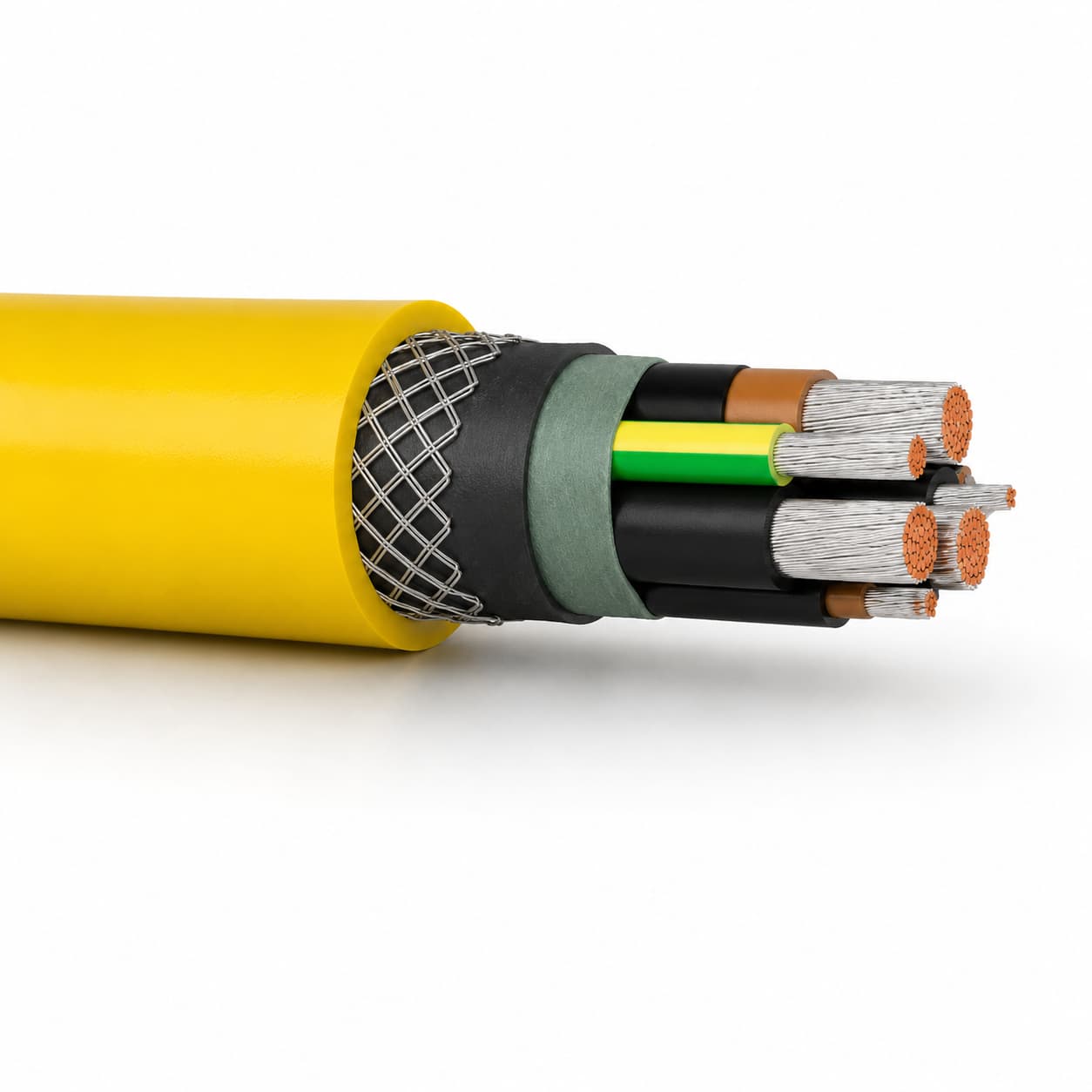
0.6/1kV mining cable selection: the quick equipment map
The voltage rating creates a short-list; the machine duty makes the selection. Use the table to identify a TEBAOFLEX reference family, then validate the exact construction against the equipment manual, protection scheme, route and project requirements.
| Equipment and route | Starting product reference | Decision that still needs to be closed |
|---|---|---|
| Conveyor, shiftable machine, material handling route or pump connection | (N)SHOEU 0.6/1 kV mining rubber cable | Movement frequency, core identification, tensile and torsional load, wet or immersed duty |
| E-loader or load-haul-dump machine with trailing, guide-pulley or severe mobile duty | NTSWOEU e-loader mining cable | Pilot requirement, pulling load, impact/crushing risk, guide geometry and whether a powered reel is involved |
| LHD or scoop loader that repeatedly winds and pays off cable | NSHTOEU LHD mining reeling cable | Reel type, drum and sheave diameters, layers, speed, tension, reverse bending and torsion |
| Coal cutter, shearer, roadheader, drill or other freely trailing underground machine | NSSHKCGEOEU coal-cutter trailing cable | Power size, PE/control arrangement, reinforcement, route protection and mine-specific rules |
| Frequency-converter-fed motor on mining or material-handling equipment | (N)SSHCOEU screened VFD mining cable | Drive-maker instructions, screen bonding, earth arrangement, termination, motor data and movement |
What does 0.6/1 kV mean on a mining cable?
The marking is the U0/U voltage rating: 0.6 kV between a power conductor and earth or screen, and 1 kV between power conductors. It identifies the electrical class, but it does not specify ampacity, conductor area, movement design, pilot function, screen arrangement, mechanical reinforcement or approval.
That distinction matters because two cables can carry the same 0.6/1 kV label and behave very differently on a drum, behind a cutter or through a guide pulley. A voltage match gets the cable through the first selection gate; it does not describe how the construction will survive the route.
Have the responsible electrical professional calculate conductor size from load current, starting or drive duty, route length, voltage drop, installation conditions, ambient temperature and fault requirements. Do not copy a conductor size from an old cable without checking why that cable was selected and how it performed.
Choose the cable from the complete equipment route
Start at the supply point and follow the cable to the machine. Record every section that is fixed, shifted during maintenance, dragged, guided, suspended, reeled or exposed to vehicle crossings. A machine name without its cable route is only half an application.
E-loaders and LHD machines
An e-loader cable may trail on the floor, pass through a handler or guide pulley, or wind onto a powered drum. The current NTSWOEU product record uses Class 6 tinned-copper conductors, EPR insulation, optional pilot cores and a combined copper-steel braid that serves as reinforcement and earth conductor. Those details make it a useful starting point for severe mobile duty, but the actual pulling load, bend geometry and cable handling system still control suitability.
Where the machine reels the cable during normal travel, compare the route with the NSHTOEU reference rather than treating every flexible loader cable as a reeling cable. The current NSHTOEU record adds an anti-torsion braid and lists reel-specific service for LHD equipment.
Coal cutters, shearers, roadheaders and drills
Freely trailing underground equipment makes the PE/control arrangement and reinforcement part of the selection. The current NSSHKCGEOEU product record combines flexible conductors, EPR insulation, PE/control elements and steel-braid reinforcement. Confirm the exact conductor schedule, pilot or control function, route distance, pulling method, mine rules and connection equipment before ordering.
Wiring between control boxes and motors on continuous miners, shuttle cars and road headers is a separate selection; the Mine Feeder Type 1 cable for screened machine wiring covers that duty at 1.1/1.1 kV with PVC insulation and individual or collective screening.
Conveyors, shiftable machines and general flexible power
The current (N)SHOEU product record covers several low-voltage mining, tunneling, conveyor, material-handling and pump-connection routes. That breadth is useful only when the project closes the details: how often the cable moves, whether it twists, how it is supported, what contacts the outer sheath and whether water exposure means splash, temporary flooding or continuous immersion.
Separate trailing, guide-pulley and reeling duty
WorkSafe Western Australia distinguishes trailing and reeling cables because the mechanical cycles are not the same. A trailing cable moves with mobile equipment; a reeling cable repeatedly winds onto and off a drum. A handler or guide-pulley route adds its own bend, tension and alignment conditions.
| Route | Main mechanical questions | Data to send |
|---|---|---|
| Occasionally shifted or flexed | Installation bend, handling tension, support and strain relief | Route drawing, minimum available bend, support points and relocation frequency |
| Freely trailing | Dragging, abrasion, run-over, pulling force, sharp rock and reverse bends | Travel distance, floor condition, crossings, handler details and failure locations |
| Guide-pulley or cable-handler route | Repeated bending, pulley diameter, alignment, sidewall pressure and local crushing | Pulley/sheave drawing, cable speed, angles, tension and entry/exit alignment |
| Powered reel | Drum diameter, layers, fleet angle, acceleration, tension, torsion and spooling control | Reel drawing, paid-out length, cycles per shift, travel speed, pull and winding direction |
Confirm the dynamic minimum bend radius for the proposed cable, not a generic rule of thumb. A reel does not become more generous after the purchase order is placed.
For a deeper route comparison, use the mining reeling cable vs trailing cable guide.
Read the complete mining cable construction
Material names are not a substitute for a cross-section drawing. Compare the complete arrangement of conductors, insulation, earth and pilot elements, screens, fillers, reinforcement, inner sheath and outer sheath.
| Component | Why it changes the decision | What to request |
|---|---|---|
| Power conductors | Stranding affects flexibility; conductor area affects current, voltage drop, heating and termination fit | Material, class, nominal area, resistance and applicable IEC 60228 or project conductor standard |
| Insulation | The insulation system must match rated voltage, conductor temperature, flexing and environmental conditions | Compound designation, thickness, electrical tests and temperature limits for the exact cable |
| Protective earth and pilot/control elements | A protective-earth path and a monitoring/control circuit serve different system functions | Core schedule, cross-sectional areas, colors/markings and the protection schematic |
| Screen | Electrical-stress control and VFD electromagnetic-compatibility functions are not interchangeable assumptions | Screen material and area, bonding method, fault duty, coverage and termination drawing |
| Reinforcement or support element | It may carry tension, limit torsion or protect geometry, but only within the proposed design limits | Braid/support construction, permitted tensile load, torsion and compatible glands or clamps |
| Outer sheath | Compound, thickness and construction influence abrasion, cut, oil, water, ozone, weather and flame performance | Exact compound, thickness, color, named test methods and acceptance values |
When the outer sheath is the layer that keeps failing on a route, reading jacket wear patterns before you respec covers the compound comparison and the failure-pattern diagnosis in more depth than this sheath row allows.
Do not infer a certification from a material label such as EPR, PCP or 5GM5. The cable marking, standard edition, test plan and acceptance documents must describe the exact offered construction.
Wet routes, pump connections and VFD motors need separate checks
Wet is not automatically submersible
A cable exposed to washdown, mine water or temporary flooding does not automatically qualify for continuous immersion. For a pump connection, state whether the cable enters water, the maximum depth, water chemistry, temperature, pressure, movement, support method and termination arrangement. The current TEBAOFLEX product records list different water-use limits across cable families, so the limit must be confirmed for the exact construction in the quotation.
Pump circuits above the 0.6/1 kV scope of this guide need their own construction; for permanently submerged medium-voltage pump motors, the TMP-NTSWOEU submersible pump cable uses a butyl rubber GM1b inner sheath with particularly low water absorption.
A VFD cable is part of a drive system
For a variable-frequency-drive (VFD) motor, the drive, motor, cable screen, protective earth, bonding and terminations work as one electromagnetic-compatibility and protection system. The current (N)SSHCOEU product record provides a screened 0.6/1 kV starting point, but the drive and motor manufacturers’ installation instructions still govern the bonding and termination details.
What a drive output asks of the cable itself, from low-capacitance insulation and the earth-core layout to a screen bonded all round at both ends, is set out in our guide to what VFD cable is and how it is built.
Use the old cable failure to improve the replacement
The damaged cable is useful evidence when its markings, route and failure location are recorded. Photograph the complete cable path and the damage before disposal, then note when the symptom appears: traveling, starting, reeling, cleaning, after a splice or under a particular load.
| Observed symptom | Questions to investigate | Selection consequence |
|---|---|---|
| Cuts, gouges or exposed reinforcement | Sharp rock, crossings, handler edges, sheave alignment, dragging distance and sheath contact | Review route protection, handler geometry, sheath construction and inspection frequency |
| Flat spots or local crushing | Vehicle run-over, clamp pressure, reel-layer pressure, jammed guides or undersized sheaves | Correct the mechanical cause before expecting a different cable alone to solve it |
| Corkscrewing, twisting or uneven spooling | Reel direction, fleet angle, tension control, torsion, cable installation and drum alignment | Review reeling construction, anti-torsion features and the complete reel system |
| Broken conductors with limited jacket damage | Repeated bending, bend radius, tension, vibration, termination flex point and conductor class | Check dynamic bend data, strain relief, support and movement frequency |
| Hot or discolored termination | Connection condition, conductor size, load, voltage drop, protection and accessory compatibility | Stop treating the issue as a jacket problem; require an electrical and termination review |
| Moisture near an end or splice | Immersion, pressure, sealing, capillary path, repair history and termination method | Review the wet-duty specification and approved termination/repair process |
Resources Safety and Health Queensland recommends documented inspection, testing, handling and maintenance practices for surface trailing cables. Follow the applicable site procedure and remove unsafe cable from service for qualified assessment.
0.6/1 kV mining cable RFQ checklist
A useful quotation begins with application data, not only a cable name. Send the following information so the offered construction can be reviewed against the duty.
Provide the machine make/model, supply point, route drawing and every fixed or moving section.
Include U0/U voltage, frequency, operating current or required conductor area, starting duty, protection and allowable voltage drop.
List power cores, protective earth, pilot/control cores, screen function, monitoring circuit and markings.
State trailing distance, reel/handler use, travel and cable speed, cycles per shift, acceleration and reverse bends.
Send minimum available bend, drum/sheave diameters, reel layers, fleet angle, hanging length, tension and support points.
Name water or immersion, oils, chemicals, temperature, UV, ozone, abrasion, crushing, impact and flame requirements.
Attach legible marking photos, cross-section or datasheet, failure photos, location and service history.
List couplers, glands, clamps, terminations, strain relief, reel connector and dimensional limits.
State the required standard/edition, approval path, test plan, certificates, inspection and marking requirements.
Provide individual lengths, quantity, drum limits, destination country and required delivery documentation.
When these fields are ready, submit the 0.6/1 kV mining cable schedule for technical quotation review.
Standards, approval and safety boundary
The applicable requirement depends on the country, mine type, equipment, voltage, installation and contract. A VDE-style cable designation, flame statement or supplier datasheet does not by itself prove acceptance for a mine.
For US underground coal applications, the current 30 CFR Part 75, Subpart G requirements address trailing-cable protection, handling, splicing and related electrical controls. Other jurisdictions use different standards and approval paths. Confirm the current rules with the responsible engineer, mine authority and equipment documentation.
This guide is not an installation, energization or repair procedure. Cable work must follow the site’s isolation, lockout, grounding, testing and approved repair requirements and be performed by qualified personnel.
Frequently asked questions
What does 0.6/1 kV mean on a cable?
It is the U0/U voltage rating: 0.6 kV between a power conductor and earth or screen, and 1 kV between power conductors. It does not state conductor size, ampacity, movement design, core arrangement or approval.
Is every 0.6/1 kV rubber cable a mining cable?
No. A rubber insulation or sheath and a matching voltage rating do not define trailing or reeling capability, protective-earth and pilot arrangements, screens, reinforcement, flame performance or mine acceptance.
Which cable should be used for an e-loader or LHD?
Start with the route. NTSWOEU is a reference for severe e-loader duty, while NSHTOEU is a reel-specific LHD reference. The final choice depends on whether the cable trails, passes through a handler or repeatedly reels, plus load, geometry, tension, pilot and environmental requirements.
What is the difference between a trailing cable and a reeling cable?
A trailing cable moves with mobile equipment, often along the ground or through a handler. A reeling cable repeatedly winds onto and pays off a drum, adding cyclic bending, layer pressure, tension and possible torsion that must be considered in the cable and reel system.
Does a mining pump cable have to be submersible?
Only when the actual installation includes continuous immersion or another specified submerged duty. State the depth, temperature, water chemistry, pressure, movement, support and termination so the exact cable limit can be checked.
Does a VFD motor require a screened mining cable?
Follow the drive and motor manufacturers' instructions and the project EMC/protection design. A screened cable such as the (N)SSHCOEU reference may be appropriate, but the screen, protective earth, bonding and terminations must be designed as a system.
Sources and editorial scope
This guide uses current TEBAOFLEX product records for product-specific facts and regulator or standards pages for scope and safety boundaries. It is a selection aid, not a certificate, approved substitution, ampacity calculation or compliance decision.
- TEBAOFLEX (N)SHOEU 0.6/1 kV mining rubber cable record
- TEBAOFLEX NTSWOEU e-loader mining cable record
- TEBAOFLEX NSHTOEU LHD reeling cable record
- TEBAOFLEX NSSHKCGEOEU coal-cutter trailing cable record
- TEBAOFLEX (N)SSHCOEU screened VFD mining cable record
- WorkSafe Western Australia: trailing and reeling cable guidance
- Resources Safety and Health Queensland: surface trailing-cable management
- IEC 60228 conductor scope
Compare relevant 0.6/1 kV product records
Use these pages after the machine, route and protection system are defined.