


Reading an oil resistance rating before you specify it
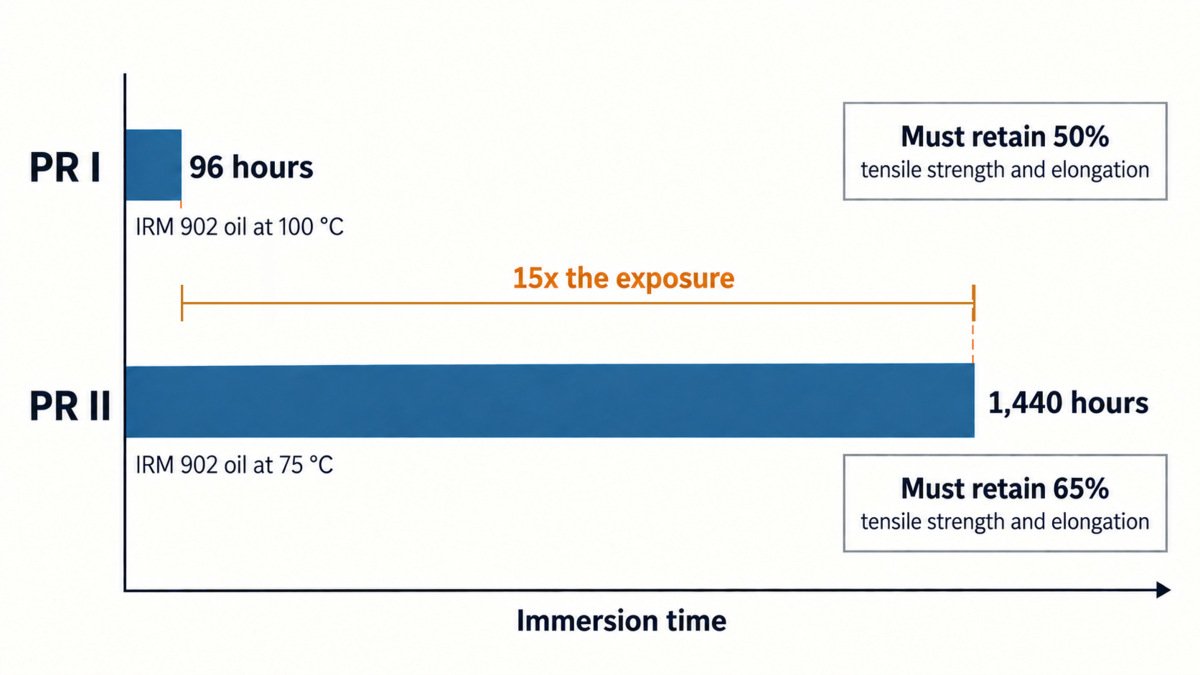
Two cables both marked “oil resistant” can be 15 times apart in the exposure they were actually proved against. UL PR I is a 96-hour immersion. UL PR II is 1,440 hours, and it has to hold a higher share of its strength afterwards. A datasheet that just says oil resistant, with no rating behind it, has not told you which of those two it passed — or whether it was tested at all.
Oil resistant cable at a glance
- What it means
- A jacket or insulation compound that keeps its mechanical properties after contact with petroleum-based fluids. It is a rated property, not a material category: the rating names a test the compound survived, not a promise about your particular oil.
- The two UL ratings
- PR I and PR II, defined through UL 44 and UL 83 and marked on the cable. Both immerse the sample in IRM 902 reference oil; they differ in duration, temperature and the share of strength that has to survive.
- The gap between them
- 96 hours against 1,440 hours, with the pass mark rising from 50 % to 65 % retained tensile strength and elongation. Two axes get harder at once, which is why the two marks are not simply “good” and “better”.
- What actually fails
- The plasticisers in the compound. Oil breaks them down and is absorbed in their place; the jacket swells, then hardens. A hardened jacket can look perfectly sound and still have lost the flexibility the installation depends on.
- What it is not
- A licence for permanent immersion. These are optional tests written for equipment that may meet oil, not for cable whose whole service life is spent in it.
Why “oil resistant” alone is not a specification
Nearly every flexible cable sold into an industrial environment claims oil resistance somewhere on its datasheet. The claim costs the manufacturer nothing, because on its own it commits to nothing measurable. There is no threshold implied, no duration, no fluid named, and no criterion for what counts as surviving.
That matters because the question a buyer is really asking has three parts, and the phrase answers none of them. Which oil. For how long. And how much degradation is acceptable before the cable is considered to have failed. Two suppliers can both write oil resistant in the same font on the same line of the same table and mean wildly different things by it.
The fix is to stop asking for oil resistance and start asking for a rating. In the North American system that means PR I or PR II, marked on the cable itself. Once a rating is on the enquiry, the vague claim becomes a test result you can compare across quotations.
What is the difference between PR I and PR II?
PR I and PR II are the two optional oil resistance ratings in UL 44 and UL 83. PR I immerses the sample in IRM 902 oil for 96 hours at 100 °C and requires 50 % retained tensile strength and elongation. PR II runs 60 days at 75 °C and requires 65 %.
| PR I | PR II | |
|---|---|---|
| Rating carried on the cable | Oil resistance at 60 °C | Oil resistance at 75 °C |
| Immersion fluid | IRM 902 reference oil | IRM 902 reference oil |
| Immersion condition | 96 hours at 100 °C | 60 days (1,440 hours) at 75 °C |
| Pass criterion | Retain ≥ 50 % of tensile strength and elongation | Retain ≥ 65 % of tensile strength and elongation |
| Product standard | UL 44 / UL 83 | UL 44 / UL 83 |
| Choose this when | Oil arrives occasionally — splash, drips, a spill that gets wiped up, oil met during installation rather than in service | Oil is part of the working environment — continuous splashing, machine tool coolant, a route that runs through a lubricated zone |
The two temperatures in each rating are not the same number
This is where specifications go wrong, and it is worth slowing down for. The temperature in the name of the rating is the service temperature the mark is granted for. The temperature in the test is the condition the sample was immersed at. For PR II they coincide at 75 °C. For PR I they do not: the mark covers service at 60 °C, but the test is run at 100 °C to compress the ageing into four days.
Read only the rating names and the two marks look 15 °C apart. Read the test conditions and the real distance appears: fifteen times the exposure, plus a pass mark raised by fifteen percentage points. A compound can clear PR I comfortably and have no realistic chance at PR II.
What oil actually does to a jacket
Insulating and jacketing compounds contain plasticisers, and those plasticisers are most of the reason the material resists absorbing anything. Sustained oil contact breaks them down. Oil is then absorbed into the space they occupied, and the compound fatigues from the inside.
The visible sequence runs in two stages, and the second one is the dangerous one. First the jacket swells, which is easy to spot because the cable no longer fits its gland or its clip. Then it hardens, and hardening destroys elongation. A hardened cable can pass a visual inspection, sit quietly in a tray, and split the first time somebody flexes it during maintenance.
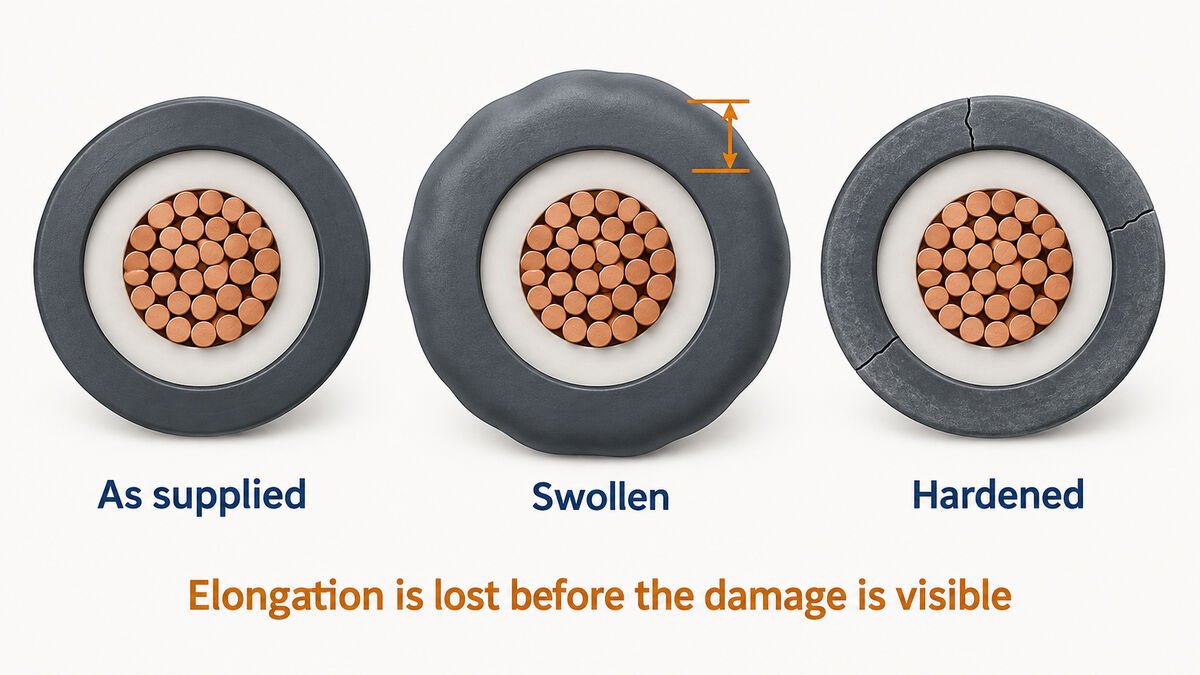
This is why the pass criterion is retained elongation and not appearance. The property that oil takes away is exactly the property that visual inspection cannot see, which is also why a cable that has been in oil for two years should be assessed on how it bends, not on how it looks.
GR I and GR II: the tier nobody asks for
GR I and GR II are the gasoline-and-oil ratings in the same two standards. A cable earns one by first passing the corresponding oil test, then spending a further 30 days immersed in water saturated with equal volumes of iso-octane and toluene — ASTM Reference Fuel C — at 23 ± 1 °C, and still retaining 65 % of tensile strength and elongation.
Two things follow from that construction. A GR mark always implies the oil test underneath it, so a cable marked GR II has cleared PR II as well. That same logic is why portable cord carries two O’s rather than one: the second O in SOOW extends oil resistance from the jacket to the insulation underneath it. And because fuel attacks compounds differently from lubricating oil, a cable perfectly happy in a gearbox mist may still be the wrong choice at a refuelling point or in a vehicle workshop.
If the environment contains fuel rather than lubricant, ask for the GR mark by name. It is not implied by any amount of oil resistance.
IRM 902 is not the fluid on your site
Every number above comes from immersion in IRM 902, a standardised reference oil. Standardisation is what makes results comparable between suppliers, and it is also the limit of what those results tell you.
Your plant does not run on reference oil. It runs on a specific hydraulic fluid, a specific cutting fluid, a specific gear oil, and increasingly on synthetic esters and biodiesel blends chosen for environmental reasons rather than for compatibility with cable jackets. Phosphate ester hydraulic fluids in particular are aggressive towards compounds that shrug off mineral oil.
A PR II mark is evidence, not a guarantee against your fluid. Where the fluid is unusual, or where failure would be expensive, name the actual product on the enquiry and ask whether compatibility data exists for it. Sometimes the honest answer is that a sample immersion is the only way to know.
The same caution applies at the other end of the scale. These are optional tests, written to reassure buyers whose cable might encounter oil in an industrial building. They were not written to qualify a cable for a working life spent submerged, and a PR I or PR II mark should not be read as permission for that.
Choosing the compound, and what it costs you elsewhere
Oil resistance is a property of the compound, so the practical question is which compound to put on the outside of the cable. The honest complication is that every compound that is good at resisting oil is paying for it somewhere else, and the somewhere else is usually cold flexibility, price, or how the cable behaves when it is dragged.
| Compound | Oil behaviour | What you give up | Choose this when |
|---|---|---|---|
| Nitrile-based rubber (NBR blends) | The reference point for oil service; built for sustained contact | Cost, and a narrower cold-temperature window than polyurethane | Oil is continuous rather than occasional and the cable still has to stay flexible |
| CPE (chlorinated polyethylene) | Good resistance to oil combined with genuine weather and ozone durability | Heavier wall for the same protection; stiffer in the cold than PUR | Oil arrives alongside sunlight, ozone and outdoor exposure — mine sites, yards, port equipment |
| TPU / PUR (polyurethane) | Holds up well against oil while staying flexible at low temperature | Price, and hydrolysis sensitivity in hot, permanently wet conditions | Oil plus movement plus cold, in cable chains, drag chains and reeling routes |
| Neoprene / polychloroprene (CR) | Long-established, moderate oil resistance with good flame behaviour | Bulk, weight, and it will not match nitrile for sustained immersion | Welding, portable power and general heavy-duty rubber cable service |
| PVC | Depends entirely on the formulation; ordinary grades harden and lose plasticiser | Little, because it is the cheapest option — provided the grade is genuinely oil-rated | Occasional light contact only, and only where the datasheet names a rating rather than an adjective |
The compound names in that table overlap with the ones that decide abrasion life, and the rankings are not the same. A jacket chosen purely for oil can wear through faster on a drag route than one chosen for abrasion would, and the reverse is equally true. Where the cable is pulled, dragged or reeled as well as oiled, read that trade separately in how CPE, TPU/PUR and PVC compare for abrasion duty and specify against whichever exposure will end the cable’s life first.
Temperature multiplies everything above
Oil attacks faster when it is hot, which is why both UL tests are run at elevated temperature rather than at room temperature. Nothing in a PR I or PR II mark tells you how the compound behaves at a temperature above the one the mark covers.
That is worth checking against the rest of the specification, because a cable is frequently chosen for a temperature rating and then installed where oil is present too. The two ratings are established by different tests, on different criteria, and neither implies the other. For how a temperature rating is established and what it actually promises, see what a 200 °C insulation rating actually guarantees.
Writing the oil requirement into an enquiry
Five lines are enough to turn a vague requirement into something every supplier has to answer the same way.
- Name the rating, not the adjective. Write PR I or PR II, or state the equivalent you work to. “Oil resistant” on a purchase specification will be answered with “oil resistant” on a quotation, and nobody will have learned anything.
- Name the fluid. Give the actual hydraulic fluid, coolant or lubricant, especially where it is a synthetic ester, a phosphate ester or a bio-based oil.
- Say whether contact is occasional or continuous. This is the difference between the two ratings, and it is the one thing a supplier cannot infer from a drawing.
- Give the temperature at the oil. Not the ambient temperature of the building — the temperature of the surface or the fluid the cable is against.
- State the other exposures in the same sentence. Abrasion, cold, sunlight and flame requirements all constrain the compound, and a jacket chosen for oil alone may fail one of them.
- Ask what documentation is issued. Whether you need the mark on the cable, a test record, or a third-party report changes what has to be arranged before production.
What buyers ask before the first order
Can we order a trial length before committing?
Yes. The minimum order quantity is 50 m and applies to custom constructions as well as standard ones, so a trial run does not require a different commercial arrangement (as of August 2026). Samples are provided free of charge with freight paid by the customer.
How long does production take?
Lead time runs 7 to 45 working days as of August 2026, depending on product type, stock position and how much of the construction is customised. It is a range rather than a promise; a written quotation from the sales team is what fixes the date for a specific order.
Can the jacket compound be changed on an existing construction?
Often, and this is a common request when a cable is being moved into an oilier environment than it was originally bought for. Send the existing type designation together with the fluid and the contact pattern, and the engineering team can say whether a compound change is enough or whether the construction has to change with it.
What documentation can be issued with the order?
State the documentation requirement before production rather than after the cable is on the drum. Conductor, insulation, dimensional and flame test records can be arranged where a project calls for them, and any third-party inspection, witness testing, drum schedule or custom marking needs to be agreed in advance of the production run.
What we can document, and what we cannot
TEBAOFLEX has manufactured flexible and special cable in Taicang, Jiangsu since October 2014, on twelve automated lines covering compounding, extrusion, braided screening, cabling and packing, with eight test sets running from incoming material to finished drum.
On approvals, the useful thing is to be precise about scope rather than broad about impressions. The archived certificates cover flexible cord: UL to UL 62 (ZJCZ, certificate UL-US-2449012-4), cUL to CSA C22.2 No. 49 (ZJCZ7, certificate UL-CA-2437036-5), and a VDE Marks approval to DIN EN 50525-2-21 for cross-linked elastomer insulated flexible cables (certificate 40060056). Those are the scopes as issued.
An oil resistance rating is a per-construction question, not a company-level one. Send the rating you need with the enquiry and we will confirm what can be marked and what documentation can be issued for that specific construction before you commit to an order.
Where oil-rated constructions sit in the range
Oil resistance runs across several product families rather than belonging to one, so the starting point depends on what else the cable has to survive.
- H07RN-F heavy-duty rubber flexible cable and the wet-duty H07RN8-F for portable power and general industrial routes.
- SOOW 600 V portable power cable with an EPDM insulation and CPE jacket, where oil arrives with outdoor exposure.
- WCT welding cable for arc welder secondary leads, and the wider industrial cable range.
- Mining and tunnelling cables, where oil is usually the least of the jacket’s problems, and marine and offshore cables for fuel and hydraulic exposure at sea.
- For cable selected around the oil and gas industry rather than around the property itself, start from the oil and gas cable selection guide, which works by circuit duty and environment instead of by compound.
Send the fluid, the contact pattern and the temperature at the oil — not just “oil resistant” — and our engineers will confirm the rating and the compound that fit before you order. Talk to an engineer about an oil-duty construction.
Sources and review status
- UL 44 and UL 83 oil and gasoline resistance test parameters, pass criteria and marking — Encore Wire Codes & Standards technical document, Chemical Exposure (Oil & Gasoline) Tests, 18 June 2021, Table 1.
- IRM 902 as the replacement designation for ASTM No. 2 oil — ASTM D5964, Standard Practice for Rubber IRM 901, IRM 902 and IRM 903 Replacement Oils.
- UL 2556 defines the immersion and tensile test methods that UL 44, UL 83 and UL 1277 reference for the markings described above.
- ASTM D471, Standard Test Method for Rubber Property — Effect of Liquids, and IEC 60811-2-1, which specifies mineral oil immersion methods for elastomeric compounds, are the general test frameworks behind non-UL oil resistance claims. Their specific immersion conditions are not reproduced here.
- Commercial terms cited with an as-of date are drawn from the internal company profile verified 17 August 2026.