


UL 62 portable cord designations
SOOW, SJOOW and SEOOW are all UL 62 portable cords, and the letters tell you the three things that actually differ: voltage, compound and what resists oil. SOOW is a 600 V rubber cord, SJOOW is the same idea at 300 V, and SEOOW swaps the rubber for a thermoplastic elastomer that stays workable far colder. Everything else in the designation is shared.
The three cords at a glance
- SOOW
- 600 V extra-hard-usage portable cord with thermoset rubber insulation and jacket, both oil resistant, rated for weather and water. The default choice for industrial portable power.
- SJOOW
- The same construction at a 300 V junior-service rating. Slimmer and lighter at the same conductor size, which is the point of it.
- SEOOW
- 600 V like SOOW, but insulation and jacket are thermoplastic elastomer instead of rubber. The reason to pick it is temperature, not electrical performance.
If you only remember one thing: the J changes the voltage, the E changes the compound, and neither changes the ampacity. Everything below is the detail behind that sentence.
What do the letters in SOOW actually mean?
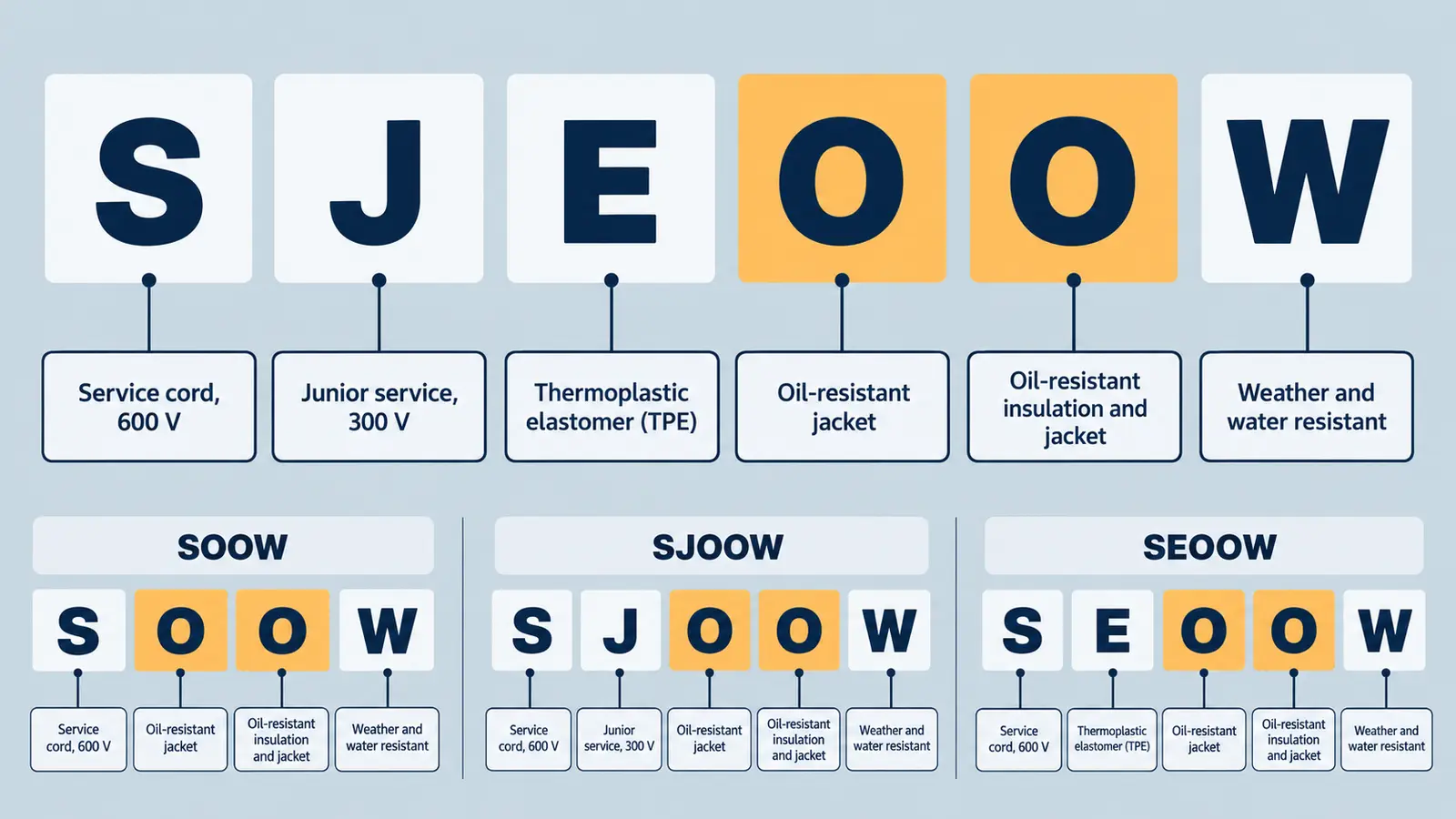
Each letter in a UL 62 portable cord designation states one property, read left to right. S is service cord at 600 V, J makes it 300 V junior service, E means thermoplastic elastomer, T means thermoplastic, O means oil resistant, a second O extends that to the insulation, and W adds weather and water resistance.
| Letter | Meaning | What it changes for you |
|---|---|---|
| S | Service cord, 600 V | The base rating everything else modifies |
| J | Junior service, 300 V | Lower rating, smaller overall diameter |
| E | Thermoplastic elastomer (TPE) | Wider temperature range, lighter handling |
| T | Thermoplastic (PVC) | Stiffer, generally the budget compound |
| O | Oil-resistant jacket | Survives oil contact on the outside |
| OO | Oil-resistant insulation and jacket | Survives oil that has already got past the jacket |
| W | Weather and water resistant | Rated for outdoor and sunlight exposure |
Read that way, SJOOW decodes without a catalogue: service cord, junior 300 V, oil-resistant insulation, oil-resistant jacket, weather resistant. The system is more useful than it looks, which is fortunate, because nobody prints a legend on the reel.
SOOW vs SJOOW: what changes when the J appears?
The J changes the voltage rating from 600 V to 300 V, and nothing else in the designation. SJOOW uses the same oil-resistant rubber insulation and jacket, the same weather rating and the same stranded copper as SOOW. Because 300 V needs less insulation wall, SJOOW comes out slimmer and lighter at the same conductor size.
That slimness is the actual reason to specify it. A hand tool lead in SJOOW coils easily and does not fight the operator; the same lead in SOOW is heavier than the tool deserves. The trade is headroom — a 300 V cord has none to spare on a 480 V circuit, and no amount of oil resistance changes that.
Our own SJOOW 300 V junior-service cord runs 18 through 10 AWG, which is where junior-service duty realistically lives, while the SOOW 600 V portable cord covers 18 AWG right through to 2 AWG. Both are built under the same UL 62 certification, so the choice really is just voltage and handling.
SEOOW vs SOOW: rubber or thermoplastic elastomer?
SEOOW and SOOW are both 600 V oil-resistant weather-rated portable cords, and the difference is the compound. SOOW uses thermoset rubber, typically EPDM insulation under a CPE jacket, rated −40 °C to +90 °C. SEOOW uses thermoplastic elastomer for both, with published ratings of −50 °C to +105 °C. The compound decides temperature, not current.
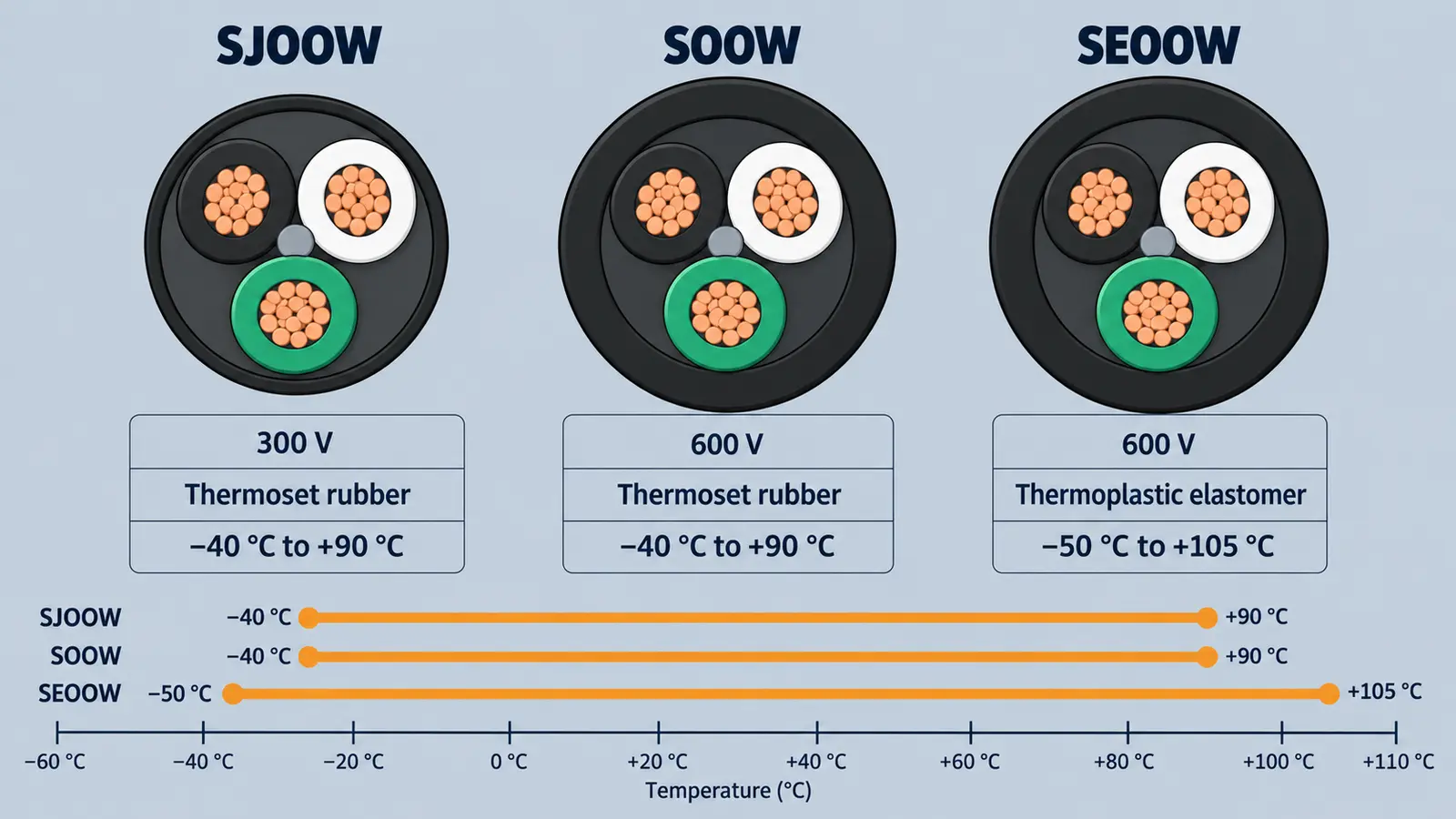
In practice the decision is made by the environment, not the electrics. A cord that lives outdoors through a northern winter, or that gets coiled and uncoiled next to something hot, is a SEOOW argument. A cord that spends its life in a temperate workshop is not — rubber is tougher against abrasion and cutting, and there is no prize for buying temperature range you never reach.
One thing SEOOW does not buy you is amps. Ampacity for a flexible cord is set by the code table for the cord type and the installation conditions, not by how far the compound can stretch its temperature limits. The ampacity figures below apply to all three cords alike.
Is SEEOW the same cable as SEOOW?
SEEOW is not a UL 62 designation. It is a common misspelling of SEOOW, with the E doubled instead of the O. Treat a drawing or purchase order that says SEEOW as SEOOW, then confirm it, because ordering against the misspelling risks receiving SEOW, which is oil resistant on the jacket only.
It is worth catching, because that one letter is the difference between a jacket that resists oil and a cable that also resists oil which has already found its way inside.
What happened to plain SO, SOW, SJO and SJOW?
SO, SOW, SJO and SJOW all remain valid UL 62 designations, but the market has consolidated onto the double-O weather-rated versions. SO carries an oil-resistant jacket without oil-resistant insulation, and SOW adds weather resistance. Most distributors now stock SOOW and supply it against orders written for SO, since SOOW meets every property the older designation asks for.
This is why searching for “SO cable” tends to land you on a SOOW product page and why the two names get used interchangeably in conversation. The reverse substitution is not safe: SOOW satisfies an SO specification, but an SO cord does not satisfy a specification that asked for oil-resistant insulation.
Which one should you specify?
Specify on voltage first, then temperature, then handling. Take the voltage from the circuit rather than the tool, take the temperature from the coldest morning the cord will see, and let handling decide only when the first two leave you a genuine choice. The table below is the short version.
| Type | Voltage | Compound | Published temperature range | Choose this when |
|---|---|---|---|---|
| SJOOW | 300 V | Thermoset rubber | −40 °C to +90 °C | Hand tools, small motors and extension assemblies on 120/240 V circuits, where a slim, light cord matters more than headroom |
| SOOW | 600 V | Thermoset rubber | −40 °C to +90 °C | General industrial portable power, machinery leads and temporary distribution in moderate climates — the default unless something argues otherwise |
| SEOOW | 600 V | Thermoplastic elastomer | −50 °C to +105 °C | Outdoor service through hard winters, cold stores, or runs beside heat sources where a rubber cord would stiffen or age faster |
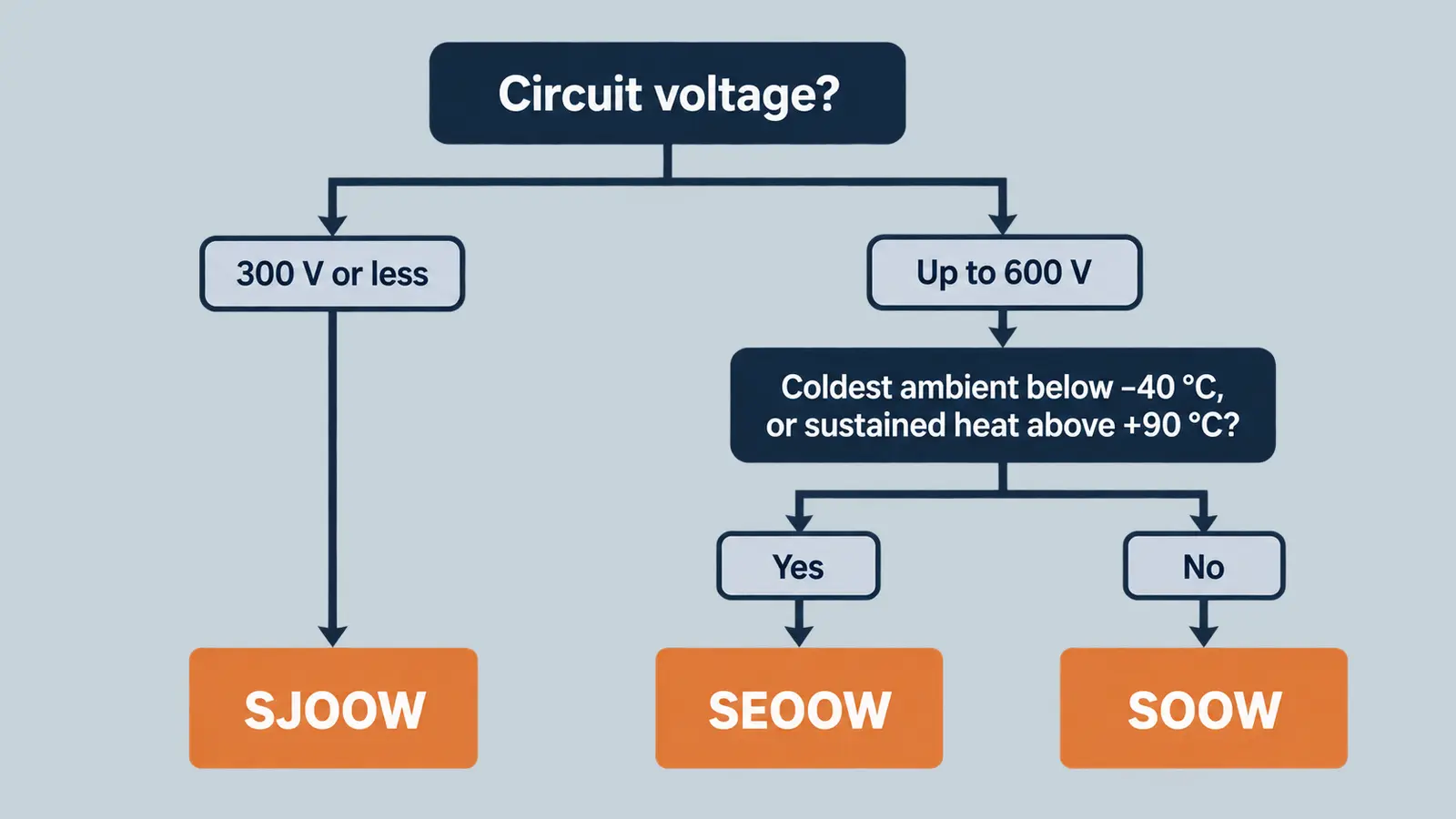
Two rules keep this decision honest. Do not specify 300 V for a 480 V circuit because the cord is easier to coil, and do not pay for −50 °C on a cord that never leaves a heated building.
How much current does each size carry?
Ampacity for these cords comes from NFPA 70 (NEC) Table 400.5(A)(1) at a 30 °C ambient, and the same values apply to SOOW, SJOOW and SEOOW within each type’s size range. Read the columns by the number of current-carrying conductors, not by the number of cores in the cord.
An equipment grounding conductor does not count as current-carrying, and neither does a neutral that carries only the unbalanced current of an otherwise balanced circuit.
| Conductor size | 2 current-carrying conductors | 3 current-carrying conductors |
|---|---|---|
| 18 AWG | 10 A | 7 A |
| 16 AWG | 13 A | 10 A |
| 14 AWG | 18 A | 15 A |
| 12 AWG | 25 A | 20 A |
| 10 AWG | 30 A | 25 A |
| 8 AWG | 40 A | 35 A |
| 6 AWG | 55 A | 45 A |
| 4 AWG | 70 A | 60 A |
| 2 AWG | 95 A | 80 A |
Where four to six conductors carry current, NEC 400.5 reduces each conductor to 80 percent of the tabulated value — a 12 AWG build with four current-carrying conductors works out at 16 A rather than 20 A. A hotter ambient requires the correction factors in the same article. These are code values for the cord type, not a performance claim for any particular cable, and the code edition adopted in your jurisdiction governs.
Where portable cord stops
UL 62 portable cord runs to 2 AWG, and NEC Table 400.5(A)(1) ends at the same size. Above 2 AWG the correct product is not a larger SOOW but Type W portable power cable, which is built to a different standard and rated to 2000 V.
The other boundary is more often crossed by accident. Welding cable is flexible, tough and abrasion resistant, which makes it tempting as a general-purpose cord — but a UL 1276 welding lead is not approved for that use unless it carries an additional listing, as the welding cable size chart sets out. Portable cord and welding lead are not interchangeable in either direction.
Buying questions worth settling early
Which certification actually covers these cords?
TEBAOFLEX holds UL certification under UL 62, category ZJCZ Flexible Cord, certificate UL-US-2449012-4, and Canadian certification to CSA C22.2 No. 49 under category ZJCZ7, certificate UL-CA-2437036-5, both issued 2024-12-27 and maintained under Follow-Up Service. Product may be supplied bearing the UL Mark. Nothing here should be read as an MSHA approval or as a listing beyond those two certificates.
What is the minimum order for a trial length?
The minimum order quantity is 50 m as of August 2026, and that figure is the same for standard and customised builds, so a trial length does not carry a penalty. Confirm the current minimum with the sales team when you enquire, since it is reviewed periodically.
How long does a build take?
Standard lead time runs 7 to 45 working days as of August 2026, depending on product type, stock position and how much of the build is customised. Confirm current timing with the engineering team before you commit it to a shutdown window.
Questions
What is SOOW cable used for?
SOOW cable is used for 600 V portable power: machinery leads, heavy tools, battery chargers, portable lighting and temporary power distribution, indoors and out. Its oil-resistant insulation and jacket suit workshop and plant floors, and the weather rating covers outdoor and sunlight exposure.
Is SOOW cable the same as SOOW wire?
Yes — SOOW cable, SOOW cord and SOOW wire all refer to the same UL 62 portable cord. “Cord” is the term the standard uses, while “cable” and “wire” are how buyers and electricians usually say it. None of the three implies a different construction.
Can SJOOW be used outdoors?
Yes. The W in SJOOW means the cord is rated for weather and water exposure, so outdoor use is within its design intent at 300 V. What outdoor use does not change is the voltage limit: a 300 V cord stays a 300 V cord regardless of where it is run.
Specifying one for a real job
Pick the voltage from the circuit, the compound from the coldest morning the cord will see, and the size from the ampacity table above with the conductor count you actually intend to load. If two of those three point in different directions, that is the conversation worth having before the reel is cut.
Send the AWG size, conductor count, run length, load current and the certification your market requires, and the engineering team will confirm the build and current lead time.