








Cable materials
A rubber cable has insulation and a sheath of vulcanised elastomer: after extrusion the compound is cured into permanent cross-links, so it cannot melt again. A TPE cable uses a thermoplastic elastomer, which behaves like rubber in service but softens when heated and can be melted and re-shaped. Both stretch and recover, so they look and feel alike. Neither is better for every job, but they are not interchangeable either. The reliable way to tell them apart is the cable designation and the hot set test, a test the standards apply only to cross-linked compounds.
What is the difference between rubber and TPE cable?
When you compare TPE vs rubber cable, the difference is cross-linking. In a rubber cable the insulation and sheath are vulcanised: the compound is extruded onto the cable and then cured, so that the elastomer forms permanent cross-links. That is how IEC 60245-1, the standard for rubber-insulated cables up to 450/750 V, defines a rubber compound. Once cured, it can soften a little with heat but it cannot melt and flow again.
A thermoplastic elastomer is defined in ISO 18064 as a polymer or blend that has properties similar to vulcanised rubber at its service temperature, but can be processed and reprocessed at elevated temperature like a thermoplastic. Its elasticity comes from hard segments or a thermoplastic phase that soften again when heated, so the same compound can be melted down and extruded a second time. The insulating rubbers themselves, such as the ethylene propylene rubber explained in our EPR insulation guide, are cross-linked compounds of this first kind.
Which thermoplastic elastomers are used in cables?
ISO 18064 sorts thermoplastic elastomers into seven families by chemistry. Four of them are described below; the others (TPA, TPC and the unclassified TPZ) follow the same rule: rubber-like in use, melt-processable when hot.
| TPE family | What ISO 18064 says it is | What it means for a cable buyer |
|---|---|---|
| TPU | Thermoplastic polyurethane elastomer: alternating hard and soft segments with urethane links | The material behind most PUR jackets. Used on reeling, festoon and mining cables for abrasion and tear resistance, in some constructions over rubber insulation |
| TPO | Olefinic block copolymer, or a polyolefin blended with rubber that has little or no cross-linking | The rubber phase has little or no cross-linking, so it is not vulcanised rubber |
| TPV | A thermoplastic blended with rubber that is cross-linked by dynamic vulcanisation during mixing | It contains vulcanised rubber particles, yet the compound as a whole still melts like a thermoplastic. “Contains rubber” is not the same as a vulcanised rubber cable |
| TPS | Styrenic block copolymer: polystyrene end segments and a polydiene or hydrogenated polydiene middle segment | Rated by the cable standard it is made to, like any other TPE |
How does a cable name show rubber or TPE?
Read the designation before the material description, because the designation is what the cable has to meet. In North America the cord letters carry it. NEC Table 400.4 lists Types SE, SEO, SEOW and SEOOW with thermoplastic elastomer insulation and outer covering, and the NEC ampacity table groups them with the thermoplastic cords, while S, SO, SJOOW and SOOW are grouped as thermoset. A T, as in SJTOW, marks a thermoplastic such as PVC. Our SOOW vs SJOOW vs SEOOW guide goes through each letter.
In the European harmonised system, EN 50525-2-21 covers flexible cables whose insulation is a cross-linked elastomeric compound, with an elastomer or a TPU sheath. The R and N in H07RN-F stand for rubber insulation and a polychloroprene rubber sheath, so the whole cable is vulcanised; the BQ types keep the rubber insulation and add a polyurethane sheath.
| Designation | Insulation | Sheath or jacket | Rubber or TPE? |
|---|---|---|---|
| H07RN-F (EN 50525-2-21) | EI 4 cross-linked rubber | EM 2 polychloroprene-type rubber | Rubber throughout |
| H07BQ-F (EN 50525-2-21) | Cross-linked ethylene propylene rubber | Polyurethane (TPU) | Rubber insulation, TPE sheath |
| SOOW (UL 62) | Thermoset; EPDM in our construction | Thermoset; CPE in our construction | Rubber throughout |
| SEOOW (UL 62) | Thermoplastic elastomer | Thermoplastic elastomer | TPE throughout |
| SJTOW (UL 62) | Thermoplastic, usually PVC | Thermoplastic, usually PVC | Neither: a PVC cord |
| SHD-GC with TPU jacket | EPR | TPU | Rubber insulation, TPE jacket |
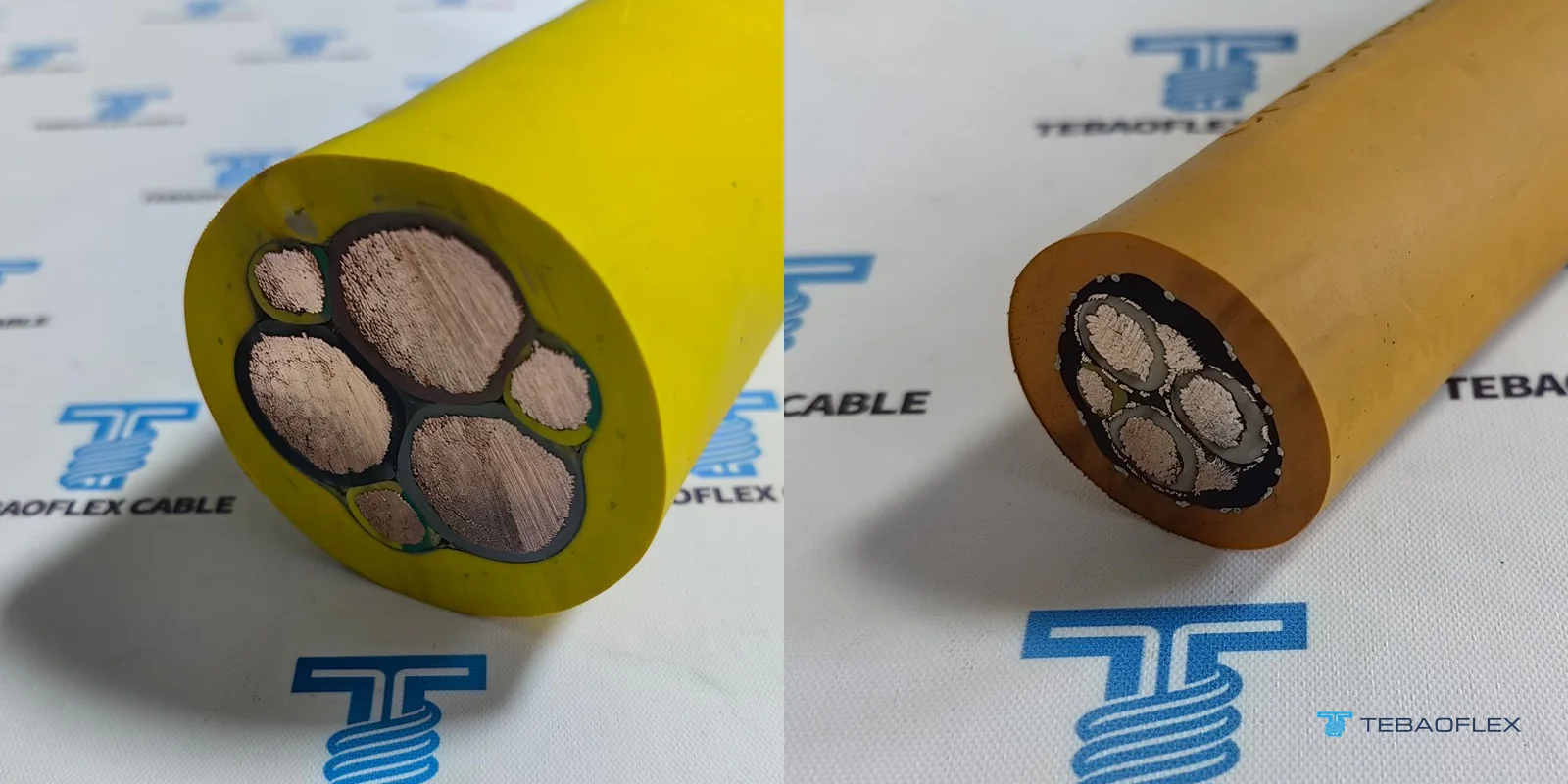
A cable can therefore be rubber inside and TPE outside, and that is a sound construction when the order names it. Our SHD-GC order for a distributor in Peru was built exactly that way, with EPR insulation under an orange TPU jacket. The problem is a cable sold as H07RN-F, SOOW or simply “rubber” whose insulation or sheath is not cross-linked. For the comparison with PVC rather than TPE, see rubber cable vs PVC cable.
How can you check that a cable is vulcanised rubber?
Two recent enquiries turned on this question: a reseller in Kenya buying 2 kV DLO cable and H07RN-F for a drilling rig, and an events power company in Chile asking for single-core 120 mm² EPR/CPE cable for generator feeds. In both, our sales engineer used production video to show the buyer how a vulcanised rubber cable is made. Video is only one piece of evidence; these are the checks a buyer can rely on, strongest first.
- The designation and standard on the sheath and the datasheet. If the order says H07RN-F to EN 50525-2-21 or SOOW to UL 62, a thermoplastic insulation or sheath does not meet it. Agree the sheath marking text before production and check it on arrival.
- The hot set result in the test report. The hot set test of IEC 60811-507 applies to cross-linked compounds: a test piece cut from the insulation or sheath is hung with a weight in a hot oven, then its elongation under load and its permanent set after cooling are measured. IS 6380, for example, tests its rubber insulations under 20 N/cm² at 200 °C or 250 °C, depending on the compound, and allows at most 175 % elongation under load and 15 % permanent set. A compound with no cross-links has nothing to hold it at those temperatures, which is why the standards test thermoplastics with a different method, the pressure test at high temperature of IEC 60811-508. Ask for the hot set result on both the insulation and the sheath. It is a sample test, made at a set frequency rather than on every drum; our guide to routine, sample and type tests in a cable factory acceptance test explains how to write it into an order.
- Production evidence. In the production videos we send buyers, rubber compound goes to the extruder as sheet or strip from the mixing line, and the cable then passes through a curing stage before it is wound. A TPE, like PVC, is fed as granules and only needs cooling. Granules on their own prove little, because some rubber compounds are granulated too, but a cable that is never cured after extrusion cannot be vulcanised.
- A heat check on an offcut. A quick workshop check is to touch a hot soldering iron to a cut-off piece of sheath: a thermoplastic softens and smears, while a vulcanised compound does not melt and eventually chars. It is a quick indication, not evidence for acceptance. Blends such as TPV and heavily filled compounds can blur the result, and only the test report shows what the standard requires.
Is rubber cable better than TPE for heat and overloads?
Rubber’s lasting advantage is that it does not melt. Cable standards credit cross-linked insulation with a higher short-circuit temperature: the Indian elastomer-cable standard IS 9968-1:1988 allows 200 °C under short circuit for general-service rubber insulation and 250 °C for heat-resisting rubber, against 160 °C for PVC insulation in IS 1554-1:1988, and it notes that these limits come from the intrinsic properties of the insulating materials. The same reasoning favours a vulcanised sheath where a cable can touch hot surfaces, catch welding spatter or be pressed hard while it is warm.
That does not make a TPE a low-rated material. Its continuous rating depends on the compound and the cable standard it is made to, and TPE cords such as SEOOW are listed for the same 600 V portable duties as rubber cords. Compare the temperature rating marked on the cable and stated in its standard, not the material name, and be wary of any blanket figure for “TPE” or “rubber” as a class.
Rubber or TPE: which should you specify?
Specify vulcanised rubber where a cable can get hot or overloaded, or where the designation itself requires rubber, as H07RN-F and SOOW do. Specify a TPU or other TPE jacket where abrasion and tearing on dragged, reeled or moving cable matter most. In both cases, write the material into the order so that it cannot be substituted.
| Duty | Usual choice | Why | Confirm |
|---|---|---|---|
| Mining cable dragged behind machines, reeled or run over | Rubber insulation with a TPU jacket, or a thermoset CPE jacket | TPU resists abrasion and tearing; CPE is the usual choice where oil, heat and weather dominate | Jacket compound named in the order, as on our SHD-GC cable page |
| Hot surroundings, overload risk, welding areas | Vulcanised rubber insulation and sheath | Cross-linked compounds do not melt and carry higher short-circuit limits | Temperature rating and hot set result |
| Portable power to European harmonised standards | H07RN-F | The designation requires rubber insulation and a rubber sheath | H07RN-F and EN 50525-2-21 in the sheath marking |
| North American portable cord | SOOW (thermoset) or SEOOW (TPE) | Both are 600 V oil-resistant cords for wet locations; the compound differs | The letter the job specification calls for |
| Festoon systems and moving crane equipment | PUR (TPU) jacketed cable | Abrasion resistance under repeated movement | Movement type and speed, as for our Festoonflex PUR-HF crane cable |
What to put in the enquiry
- The designation and the standard, for example H07RN-F to EN 50525-2-21, SOOW to UL 62 or SHD-GC to ICEA S-75-381.
- The insulation and jacket compounds by name where they matter (EPR, polychloroprene, CPE, TPU), and the words “cross-linked (thermoset)” if a thermoplastic jacket is not acceptable.
- Hot set results for the insulation and the sheath in the test report, together with the other sample tests.
- The sheath marking text, so the cable can be checked against the order when it arrives.
To have a construction proposed, send the designation or standard, conductor sizes, length and the duty: reeling, dragging, fixed, or hot surroundings. As of August 2026, the minimum order is 50 m for standard and customised constructions alike, and lead time runs from 7 to 45 working days depending on product type, stock position and customisation. Send your cable specification for review.
Questions
Is TPE the same as rubber?
No. A thermoplastic elastomer behaves like vulcanised rubber at its service temperature, but it is a thermoplastic: it softens when heated and can be melted and processed again. The rubber in a rubber cable is vulcanised, and its cross-links stop it melting.
Is TPE cable better than rubber cable?
Neither is better everywhere. TPU jackets are chosen for abrasion and tear resistance on cables that are dragged and reeled; vulcanised rubber is chosen where the cable can get hot, because cross-linked compounds do not melt and are given higher short-circuit temperatures. Compare the ratings marked on the cable for the job.
Is a PUR cable a rubber cable?
No. A PUR jacket is usually a thermoplastic polyurethane, which ISO 18064 classes as a TPU. A cable can still have rubber insulation under a PUR jacket, as in the H07BQ-F types of EN 50525-2-21 or an SHD-GC cable with a TPU jacket.
How can I tell if a cable is rubber or TPE?
To tell whether a cable is rubber or TPE, check the designation and standard printed on the sheath, then ask for the hot set result: the hot set test applies to cross-linked compounds, while thermoplastics are tested with a pressure test at high temperature. A hot soldering iron on an offcut gives a quick indication but is not proof.
Does H07RN-F use TPE?
No. H07RN-F to EN 50525-2-21 has cross-linked rubber insulation (EI 4) and a cross-linked polychloroprene-type sheath (EM 2). A cable with a thermoplastic sheath sold as H07RN-F does not meet the designation.