









Flexible cable materials
Rubber cable and PVC cable differ less in heat rating than in what they can survive. A rubber cord such as H07RN-F keeps flexing down to about −25 °C, has an oil- and ozone-tested sheath and is used outdoors, on building sites and on moving equipment. A PVC cord such as H05VV-F is smaller, lighter and cheaper, but it is a light-duty indoor cable that our datasheet rates for flexing only down to −5 °C. Contrary to a common belief, ordinary H07RN-F is rated 60 °C at the conductor and H05VV-F 70 °C (EN 50525-2-21 and EN 50525-2-11); rubber runs hotter only in EPR, EVA or silicone versions.
Rubber vs PVC cable at a glance
The two harmonised flexible cords most often compared are H07RN-F rubber cable and H05VV-F PVC flexible cable. Choose rubber when the cable moves, lies outdoors, meets oil or works in the cold; choose PVC for light, dry, indoor connections where its smaller size and lower price are an advantage.
| Property | Rubber: H07RN-F | PVC: H05VV-F |
|---|---|---|
| Material type | Thermoset: cross-linked rubber insulation (EI 4) and a polychloroprene-type sheath (EM 2) | Thermoplastic: PVC insulation (TI 2) and PVC sheath (TM 2) |
| Rated voltage | 450/750 V | 300/500 V |
| Maximum conductor temperature | 60 °C | 70 °C |
| Lowest flexing temperature | −25 °C | −5 °C |
| Bending radius in movement | 4 to 6 × D, depending on diameter | 7.5 × D |
| Oil and ozone | Sheath tested for oil and ozone resistance | General-purpose PVC sheath, no ozone test |
| Where it is used | Indoors and outdoors: building sites, workshops, agricultural and industrial equipment | Indoors only: small appliances and light, protected connections |
| Water | Wet locations; immersion calls for H07RN8-F | Dry indoor locations |
| Fire | Flame-retardant to IEC 60332-1-2; contains chlorine | Flame-retardant to IEC 60332-1-2; contains chlorine |
| 3G2.5 mm² outer diameter and weight | 12 mm, 230 kg/km | 9.9 mm, about 156 kg/km |
| Price per metre | Higher | Lower |
What counts as a rubber cable?
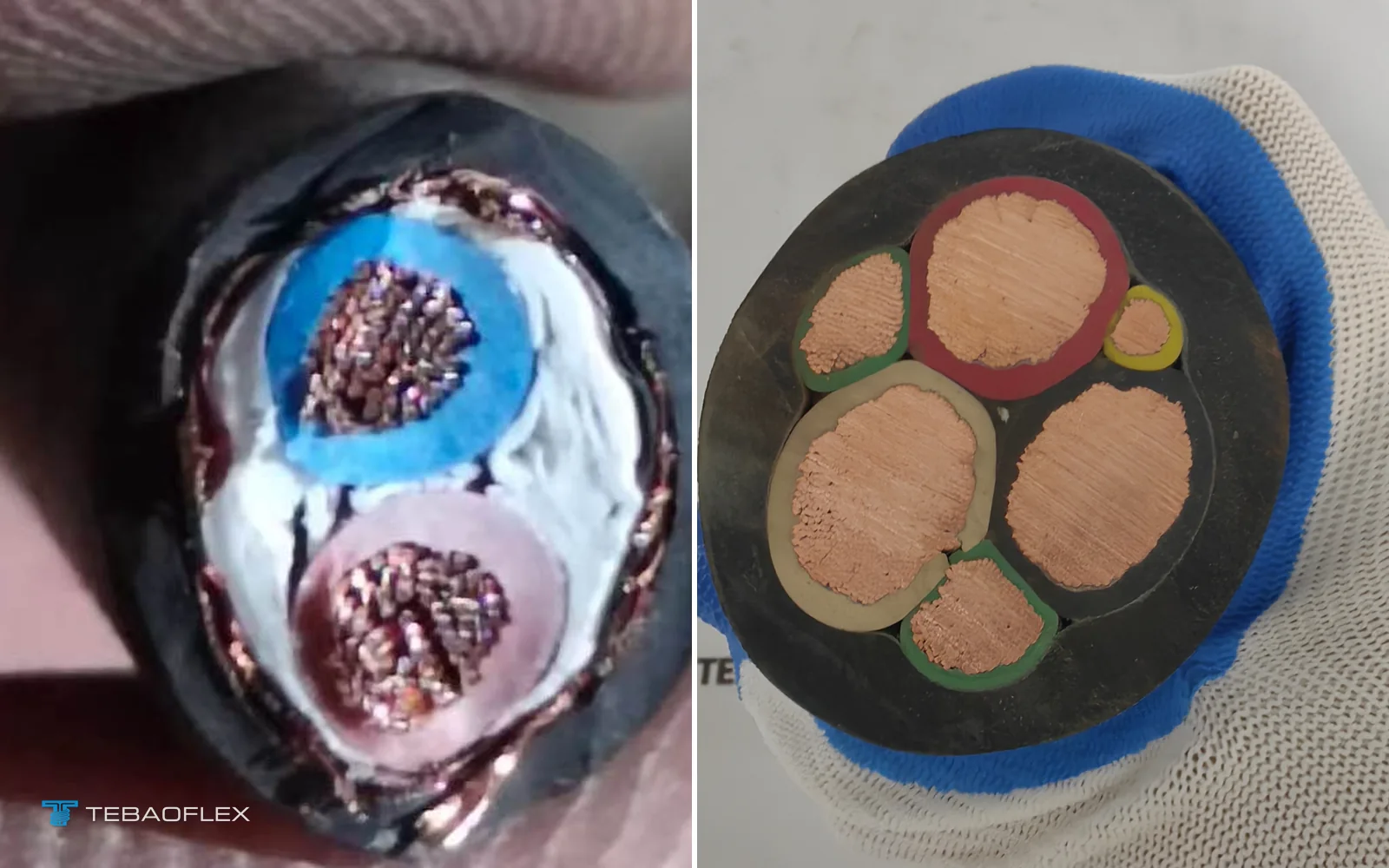
A rubber cable is one whose insulation, sheath or both are made of a cross-linked elastomer. Cross-linking (vulcanising) ties the polymer chains together, so the material stays elastic, does not melt when heated and recovers after it is bent. PVC is a thermoplastic: it is flexible because of plasticisers, it softens as it warms up and it stiffens as it cools.
In cable standards, “rubber” is not one compound. IEC 60245-1 covers rubber-insulated cables up to 450/750 V and IEC 60227-1 covers PVC-insulated cables, and both define compounds by the tests they pass, not by a recipe. The elastomers you will meet in flexible cables are:
- General rubber (EI 4), the insulation of H07RN-F, rated 60 °C.
- EPR or EPDM, an ethylene-propylene rubber used for 90 °C insulation in festoon, reeling, mining and North American cords; see our guide to EPR insulation.
- Polychloroprene (CR), the classic tough, oil-resistant sheath, marked N in harmonised designations.
- Chlorinated polyethylene (CPE), a common jacket on SOOW cords and mining cables.
- Nitrile (NBR), EVA and silicone, for oil, heat or high-temperature duty; silicone insulation is rated 180 °C.
Insulation and sheath are chosen separately. SOOW cord has EPDM insulation under a CPE jacket, our NGFLGOEU rubber flat festoon cable has EPR insulation under a chloroprene sheath, and some harmonised types put a polyurethane sheath over rubber cores. So read both layers before calling a cable “rubber” or “PVC”.
How to read the designation
Harmonised European codes (HD 361) spell the materials out. In H07RN-F, H means harmonised, 07 means 450/750 V, R is rubber insulation, N is a polychloroprene sheath and F is a fine-stranded flexible conductor. In H05VV-F, 05 means 300/500 V and the two V letters are PVC insulation and PVC sheath. North American cord names work differently. SO, SOOW and SJOOW are thermoset rubber cords. A T in the name, as in SJT or SJTOW, marks a thermoplastic construction, and an E marks a thermoplastic elastomer, as explained in our SOOW vs SJOOW vs SEOOW guide. OSHA’s reading of the NEC groups S, ST, SO and STO as hard-service cords and SJ, SJO, SJT and SJTO as junior hard-service cords, whatever the material.
Is rubber cable rated for higher temperatures than PVC?
Not as a class. EN 50525-2-21 rates ordinary rubber flexible cables such as H07RN-F at 60 °C at the conductor, while EN 50525-2-11 rates H05VV-F at 70 °C. Rubber only overtakes PVC in its heat-resistant versions: EPR-insulated types are rated 90 °C, EVA types 110 °C and silicone 180 °C.
The compound tables tell the same story. EN 50363-1 lists the rubber insulation EI 4 at 60 °C, EPR-type EI 7 at 90 °C and silicone EI 2 at 180 °C. EN 50363-3 lists the flexible PVC insulation TI 2 at 70 °C and the heat-resistant PVC TI 3 at 90 °C. Heat-resistant PVC cables exist too, such as tri-rated H05V2-K / H07V2-K panel wire rated 90 °C.
North America is no different. Our SOOW datasheet gives a reference range of −40 to +90 °C for the thermoset cord, while some thermoplastic SJTOW cords are listed at 105 °C dry. The real temperature difference between rubber and PVC is at the cold end, as the chart shows.
Which cable stays flexible in the cold and on moving equipment?
Ordinary rubber cable does. Our H07RN-F datasheet allows flexing from −25 °C and our NGFLGOEU rubber festoon cable from −35 °C, while the H05VV-F PVC cord is rated for flexing only from −5 °C (−40 °C when it lies still). The lower limits come from manufacturers’ datasheets, not from the harmonised standards, so compare the figures of the cable you are buying.
That does not mean PVC cannot move. Special PVC grades are built for motion within their limits:
- KYFLY PVC flat festoon cable flexes in one plane from −25 °C on cranes and hoists.
- C800 PVC reeling cable runs on spring reels from −10 °C with an 8 × D dynamic bending radius.
- H05VVH6-F flat lift traveling cable is a PVC cable made to hang and travel in an elevator shaft, flexing from −5 °C.
Rubber also takes tighter bends. Our H07RN-F datasheet gives 4 to 6 × D in movement depending on the cable diameter, against 7.5 × D for H05VV-F when flexed. Other manufacturers publish different multipliers, and EN 50565-1 gives the harmonised guidance, so use the figure from the cable’s own datasheet when you size pulleys, drums and loops.
To turn a multiplier into a radius for an actual cable, and for the NEC and European rules behind those figures, see how to calculate a cable bending radius, which includes worked examples for H07RN-F and Type W.
No standard publishes a flex-life ranking of rubber against PVC. Each harmonised type has to pass its own flexing, bending and kink tests, which are now collected in IEC 63294, and cycle counts from one maker’s test do not transfer to another’s cable.
Oil, ozone, outdoor use, water and abrasion
The sheath decides most of this. Cross-linked sheaths such as the EM 2 compound on H07RN-F are tested for mineral-oil resistance (IEC 60811-404) and for ozone cracking (IEC 60811-403), the test applied to cross-linked compounds. That is why H07RN-F is used outdoors, on building sites and with farm and industrial machinery, while our H05VV-F datasheet is clear that it is not for outdoor installation.
Oil-resistant PVC sheathing compounds do exist (TM 5 in EN 50363-4-1) and suit control cables inside machines, but they do not turn a light PVC cord into an outdoor or site cable.
For water, separate wet locations from immersion. H07RN-F handles damp and wet locations; for cables that run under water, EN 50525-2-21 has a separate water-resistant type, H07RN8-F for submersible pumps, which our datasheet rates for fresh water up to 10 m deep and 40 °C.
Rubber sheaths for heavy duty are chosen for tear and abrasion resistance where cables are dragged over concrete and gravel. The standards check wear with a test rather than rank materials, so if abrasion is the main risk, say so in the enquiry: a thicker or polyurethane sheath may suit better than either basic type.
How do rubber and PVC cables behave in a fire?
Both ordinary types are flame-retardant to IEC 60332-1-2, the single vertical cable test, and both contain chlorine. PVC releases hydrogen chloride when it burns: a peer-reviewed study of burning PVC-insulated copper wire measured about 0.3 g of HCl per gram of wire. Polychloroprene, the N in H07RN-F, is about 40 % chlorine by mass, and CPE jackets are chlorinated by definition, so a rubber cable is not automatically halogen-free.
Being thermoset, a rubber sheath chars instead of melting, which helps where a cable can touch hot surfaces, but that is not a fire rating. If the specification asks for low smoke and zero halogen, order a cable built and tested for it, such as the halogen-free, low-smoke H07ZZ-F type of EN 50525-3-21. Flame retardance, low smoke and circuit integrity are three different tests, as our voice evacuation cable project record explains.
Size, weight and cost
Rubber cable is thicker and heavier than PVC cable for the same cores and cross-section, and PVC cable costs less per metre. Part of the size gap is the voltage class: H07RN-F is a 450/750 V cable with thicker walls than the 300/500 V H05VV-F.
| Size | H07RN-F | H05VV-F |
|---|---|---|
| 3G1.5 mm² | 10 mm, 170 kg/km | 8.0 mm, about 101 kg/km |
| 3G2.5 mm² | 12 mm, 230 kg/km | 9.9 mm, about 156 kg/km |
That price advantage makes PVC the usual choice for appliance leads. Compare prices only between cables that are both rated for the duty: a PVC cord used outside its temperature or outdoor limits is not a cheaper equivalent of a rubber one.
Rubber or PVC cable: which should you choose?
Choose rubber or PVC cable by the duty: rubber for moving, outdoor, oily or cold service, PVC for light, dry, indoor connections. The table below starts from the job, not the material, and lists what to check on the datasheet before ordering.
| Application | Usual choice | Check before ordering |
|---|---|---|
| Appliance lead, light indoor connection | PVC, H05VV-F | No outdoor use, no flexing below −5 °C |
| Power tools, workshops, building sites, temporary power | Rubber, H07RN-F | 60 °C conductor limit, current rating for the size |
| Submersible pumps and immersed cables | Rubber, H07RN8-F | Water type, depth and temperature |
| Crane and hoist festoons, outdoors or in the cold | Rubber, NGFLGOEU | Travel speed, loop length, core layout |
| Indoor festoons in one plane | PVC, KYFLY | Mobile limit −25 °C, number of cores |
| Spring reels on compact machines | PVC, C800 | −10 °C limit, 8 × D on the reel |
| Elevator traveling cable | PVC, H05VVH6-F | Suspended length, number of cores |
| North American portable cords | Rubber, SJOOW (300 V) or SOOW (600 V) | Voltage, AWG, oil and outdoor exposure |
| Mining equipment trailing cables | Rubber, such as Type G-GC | Voltage, ground-check conductor, jacket |
For the rubber family, TEBAOFLEX holds VDE certificate 40060056 for cross-linked elastomer insulated flexible cables to EN 50525-2-21, the standard behind H07RN-F. Its SOOW and SJOOW cords are certified to UL 62 under category ZJCZ (Flexible Cord), certificate UL-US-2449012-4. For the full H07RN-F picture, read our guide to H07RN-F rubber cable.
What to send for a quote
“Rubber cable” or “PVC cable” alone is not enough to quote. Send:
- Designation or construction, if replacing an existing cable
- Voltage, number of cores and cross-section
- Duty: fixed, occasional movement, festoon, reel or drag
- Lowest and highest ambient temperature at the site
- Exposure: outdoors, oil, water, abrasion
- Fire requirements, if any: flame retardance, low smoke and zero halogen
- Length per cut and total quantity
As of August 2026, the minimum order is 50 m for standard and customised constructions alike, and lead time runs from 7 to 45 working days depending on product type, stock position and customisation. Send the duty and site data to have the right cable proposed; the written quotation states the construction and the lead time.
Questions
Is rubber cable better than PVC cable?
Rubber cable is better for moving, outdoor, oily and cold duty; PVC cable is better value for light, dry, indoor connections. Ordinary rubber is not better on heat: H07RN-F is rated 60 °C at the conductor against 70 °C for H05VV-F (EN 50525-2-21 and EN 50525-2-11).
Can PVC cable be used outdoors?
Standard H05VV-F PVC cord is not for outdoor installation. For outdoor and site use, choose a rubber cord such as H07RN-F, or a cable whose own standard and datasheet allow outdoor use.
Is rubber cable waterproof?
H07RN-F suits damp and wet locations but is not an immersion cable. For cables that run under water, use the water-resistant H07RN8-F type, which our datasheet rates for fresh water up to 10 m deep and 40 °C.
Is rubber cable halogen-free?
Not necessarily. Polychloroprene (CR) and CPE sheaths contain chlorine, as PVC does. A halogen-free, low-smoke cable is a separate construction, such as the H07ZZ-F type of EN 50525-3-21.
What do R, N and V mean in H07RN-F and H05VV-F?
R is rubber insulation, N is a polychloroprene sheath and V is PVC, so H07RN-F is a rubber cable with a chloroprene sheath and H05VV-F has PVC insulation and a PVC sheath. The 07 and 05 give the voltage class: 450/750 V and 300/500 V.