







Case 26 · United Arab Emirates · Port & Heavy Crane Reeling · Compact 27.0 mm NSHT11Y + CAN-BUS
NSHT11Y 0.6/1 kV 37×2.5 mm² + CAN-BUS Crane Reeling Cable Engineered to 27.0 mm OD in the UAE
A UAE industrial equipment supplier handling a time-critical crane maintenance replacement initially submitted a fixed-installation 37×2.5 mm² armored control cable specification before project review revealed the true operating duty: a continuously reeling crane cable integrating 37 control and power conductors alongside a shielded CAN-BUS twisted pair inside a hard 27 mm maximum outer-diameter space envelope. Standard dual-sheath calculations landed near 30 mm—too large for the existing crane sheaves and entry glands—and even the initial unjacketed core bundle measured 25.9 mm. TEBAOFLEX redesigned the concentric core lay, bedding geometry and compacted black PUR outer jacket to deliver a 200 m CIF Jebel Ali batch verified across three digital caliper axes at 27.01 mm, 26.95 mm and 26.93 mm.

Project at a glance
This 200 m made-to-order UAE crane replacement delivered a 0.6/1 kV NSHT11Y-type hybrid reeling cable combining 37 × 2.5 mm² flexible cores with a PE-insulated, ≥ 80 % tinned-copper braided 2 × 0.24 mm² CAN-BUS pair, engineered down from 30 mm to caliper-verified 26.93–27.01 mm OD for CIF Jebel Ali shipment.
| Order parameter | Verified project detail |
|---|---|
| Destination & application | United Arab Emirates (CIF Jebel Ali Port) — dynamic port/heavy crane reeling replacement combining multi-circuit control with fieldbus telemetry |
| Order quantity & schedule | 200 m custom continuous length · ~20 days factory production + ~20 days ocean transit (~40 days total to Jebel Ali) |
| Initial vs final cable family | Clarified from fixed 37C×2.5 mm² Class 2 XLPE/PVC/SWA/PVC to dynamic reeling NSHT11Y 0.6/1 kV hybrid power-control + CAN-BUS construction |
| Power & control cores | 37 × 2.5 mm² fine-stranded flexible copper conductors (IEC 60228 flexible class basis) including yellow-green protective earth core |
| Integrated fieldbus element | 1 × CAN-BUS twisted pair (2 × 0.24 mm²), polyethylene (PE) core insulation, ≥ 80 % optical-coverage tinned-copper wire braid screen |
| Mechanical reinforcement & jacket | Central tensile support member + high-fill concentric lay + compacted black abrasion- and oil-resistant polyurethane (PUR) outer sheath |
| Outer diameter engineering | Hard buyer ceiling: 27.0 mm max · Standard design: ~30.0 mm · First revision: 29.0 mm · Final DFM target: 27 ± 0.5 mm |
| Factory digital caliper QC | Verified across three independent axes at 27.01 mm, 26.95 mm and 26.93 mm — uniform roundness directly inside the 27.0 mm clearance window |
Why did the UAE crane inquiry pivot from fixed 37×2.5 SWA armored control cable to NSHT11Y + CAN-BUS?
Fixed 37×2.5 mm² Class 2 XLPE/PVC/SWA armored control cables cannot survive continuous bending on a crane drum and lack an impedance-controlled, braided CAN-BUS data pair. Identifying dynamic reeling duty before production avoided premature armor fatigue and bus communication dropouts.
Spare-part inquiries from crane contractors and procurement desks frequently start from incomplete bill-of-material lines. In this UAE project, the first request specified 200 m of 37-core 2.5 mm² Class 2 copper / XLPE / PVC / steel-wire-armored (SWA) / PVC control cable—a standard static plant distribution cable. Follow-up technical verification with the buyer’s end customer uncovered the true specification on the crane: a continuously reeling 0.6/1 kV hybrid cable integrating 37 × 2.5 mm² control conductors together with a PE-insulated, ≥ 80 % tinned-copper braided CAN-BUS pair (2 × 0.24 mm²).
Installing a fixed Class 2 SWA cable onto a motor-driven crane reel creates immediate mechanical failure modes. As explained in our reeling cable replacement identification guide and reeling cable selection guide, heavy steel wire armor resists tight bending, separates into corkscrew loops under cyclic tension (see reeling cable corkscrew failure causes), and work-hardens coarse 7-strand Class 2 copper until conductors fracture inside the insulation. Switching to a flexible NSHT11Y-series polyurethane crane reeling construction with fine-stranded IEC 60228 copper, tensile reinforcement and a shielded CAN-BUS twisted pair solved both mechanical fatigue and serial-bus noise immunity—matching the multi-circuit design discipline applied across our port and container crane cable packages and reeling cable solutions.
| Engineering criterion | Initial RFQ: Fixed 37C×2.5 XLPE/PVC/SWA | Delivered UAE build: NSHT11Y 37×2.5 + CAN-BUS |
|---|---|---|
| Intended mechanical duty | Fixed trays, ducts and direct burial only; fails rapidly on reels or guide sheaves | Continuous crane reeling and dynamic flexing over sheaves and drums |
| Conductor stranding | IEC 60228 Class 2 (7-wire rigid/semi-rigid) prone to bending fatigue | Fine-stranded flexible copper engineered for cyclic bending endurance |
| Data / fieldbus telemetry | None — 37 identical control cores with no controlled-impedance shielded pair | Integrated 2×0.24 mm² PE-insulated CAN-BUS pair with ≥ 80 % CuSn wire braid |
| Mechanical armor / tension | Rigid galvanized steel wire armor (SWA) adding mass and bending stiffness | Central tensile support element + compact concentric lay + tough black PUR sheath |
| Outer diameter envelope | Oversized and rigid for compact crane sheaves and entry glands | Compacted to 27 ± 0.5 mm nominal (caliper-verified 26.93–27.01 mm) |
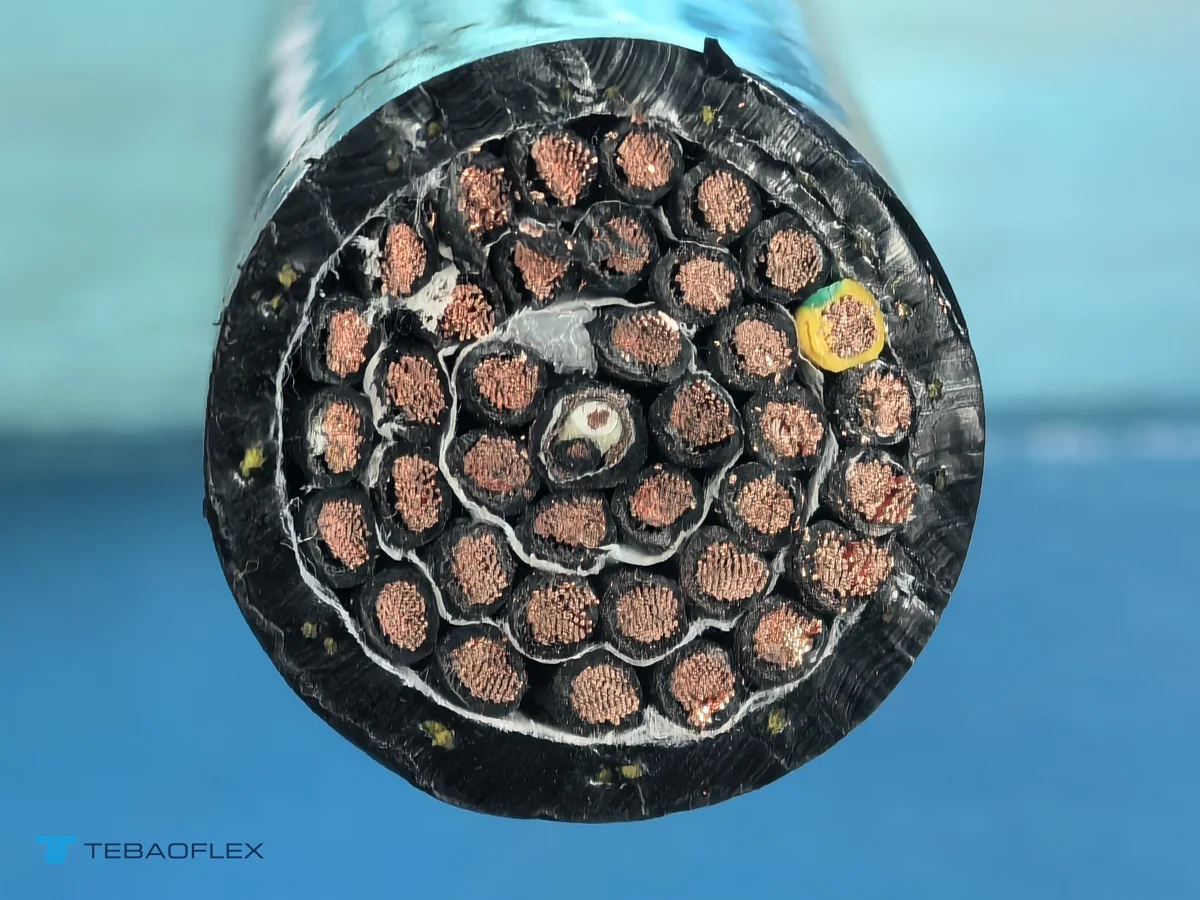
How did TEBAOFLEX compact a 37×2.5 mm² + CAN-BUS cable from 30 mm down to 27.0 mm OD?
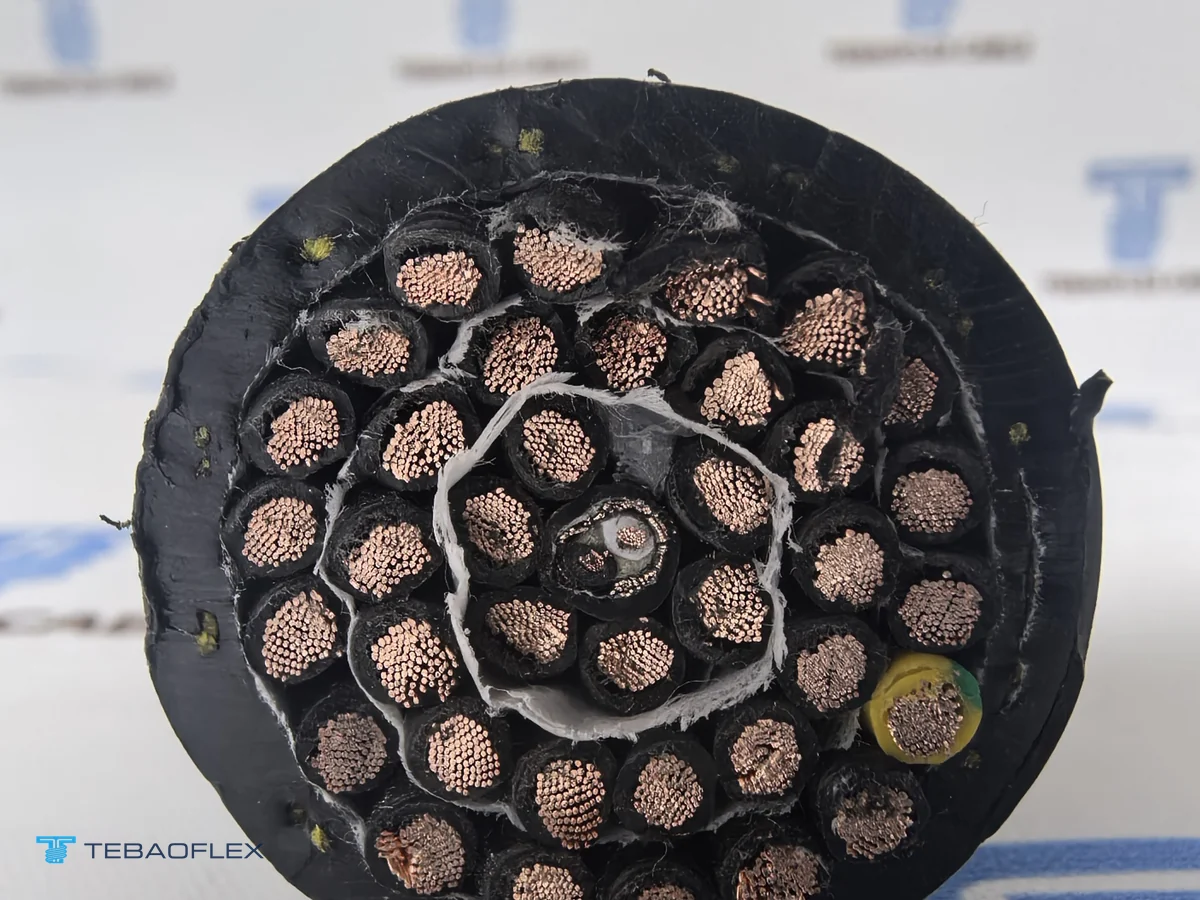
Because the initial unjacketed core bundle already measured 25.9 mm, hitting the crane’s 27.0 mm outer-diameter ceiling required re-optimizing concentric core stranding, tightening inter-layer fill factors around the central tensile member and CAN-BUS pair, and extruding a thin, high-modulus PUR jacket verified at 26.93–27.01 mm.
Once the buyer confirmed the hybrid NSHT11Y + CAN-BUS architecture, a tight geometric constraint surfaced directly from the crane maintenance site: the cable routing space, guide sheaves and entry gland accepted a hard maximum outer diameter of 27.0 mm. Exceeding that limit meant the cable simply would not seat inside the existing crane hardware without costly mechanical re-machining.
Packing 37 insulated 2.5 mm² flexible conductors, a shielded CAN-BUS twisted pair, tensile reinforcement and a protective reeling sheath into 27.0 mm pushes near the physical geometric boundary of copper cross-section packing:
- Step 1 — Standard dual-sheath baseline (~30.0 mm): A conventional double-sheathed reeling build (inner elastomer bedding + anti-torsion mesh + heavy outer jacket) calculated to at least 30.0 mm OD—3.0 mm over the crane’s clearance envelope.
- Step 2 — First internal revision (29.0 mm ceiling): Revising bedding thickness brought the estimate down to 29.0 mm, but the unjacketed laid-up core bundle alone still measured 25.9 mm, leaving barely 0.55 mm per side if the core geometry stayed unchanged.
- Step 3 — High-fill concentric redesign (27 ± 0.5 mm): Rather than compromising conductor cross-section or stripping out the CAN-BUS shield, factory cable engineers tightened concentric layer lay lengths, balanced the integrated PE-insulated braided CAN-BUS element cleanly inside the inner core ring so no radial bulge formed, minimized separator-tape buildup and applied a dense, high-tear-strength black polyurethane (PUR) outer sheath—achieving a finished nominal OD of 27.0 mm while retaining the 0.6/1 kV voltage rating and ≥ 80 % tinned-copper bus braid.
For comparison on how high-density composite layouts behave on other port cranes, see our fiber-optic composite reeling cable specification guide (covering 48–53 mm drum groove windows on 6/10 kV + 24FO Vladivostok port cranes), our Port Klang PUR-C-HF screened crane cable case, and our PROFIBUS L2 crane festoon and torsion bus cable family.

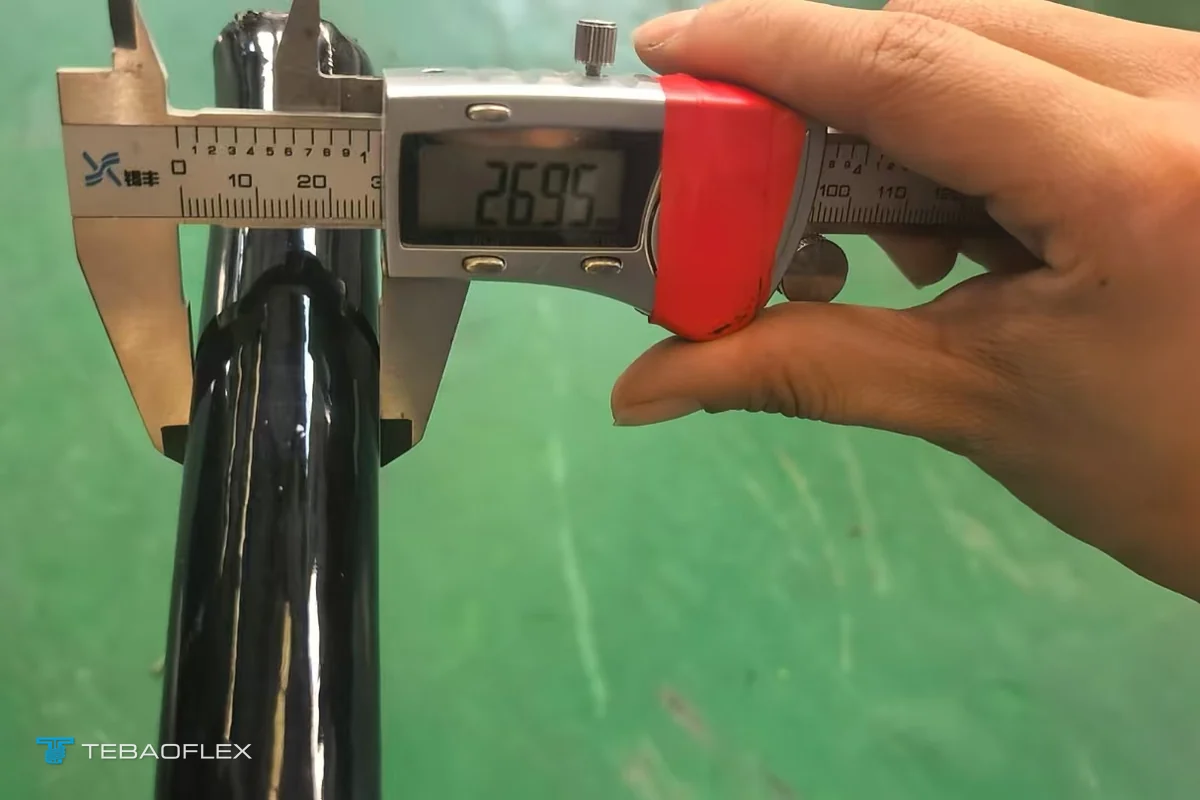
What did digital caliper inspection verify on the finished 200 m production batch?
Three independent factory digital vernier caliper measurements across the finished black PUR jacket recorded 27.01 mm, 26.95 mm and 26.93 mm—a total spread of just 0.08 mm right on the 27.0 mm target.
When an outer diameter sits right against a crane hardware clearance ceiling, a single nominal datasheet figure is not enough—even 0.8 mm of ovality or jacket eccentricity can cause binding in a tight gland seal or pinching between stacked reel turns. Before dispatch of the 200 m batch, TEBAOFLEX quality inspectors verified finished diameter across multiple axes using a calibrated digital vernier caliper:
- Axis 1 reading: 27.01 mm (within +0.01 mm of nominal 27.0 mm and well inside 27 ± 0.5 mm).
- Axis 2 reading: 26.95 mm (−0.05 mm from nominal, confirming zero radial swelling across the embedded CAN-BUS pair).
- Axis 3 reading: 26.93 mm (−0.07 mm from nominal; total ovality across all three readings is only 0.08 mm).


What procurement documentation and schedule lessons apply to urgent UAE crane cable orders?
Custom multi-core hybrid crane cables are rarely held as ex-stock inventory in Dubai; planning ~20 days for factory manufacturing plus ~20 days for Shanghai-to-Jebel Ali ocean transit (~40 days CIF) and preparing vendor onboarding certificates upfront avoids costly crane downtime.
High-core-count hybrid crane cables combining 37 power/control cores with a shielded CAN-BUS twisted pair are almost never stocked locally in regional Middle East depots. In this UAE order, the buyer initially asked whether 200 m was available ex-stock in Dubai and also evaluated longer-lead European or Turkish mills before locking in TEBAOFLEX’s ~20-day production window plus ~20-day sea freight to Jebel Ali Port (approximately 40 days total on CIF Jebel Ali terms, covering production, China export customs clearance, ocean freight and marine insurance, with destination import clearance handled by the UAE consignee).
For EPCs, port operators and crane service contractors qualifying a direct cable manufacturer, preparing five verification items at the RFQ stage prevents multi-week delays during purchase-order issuance:
- Confirm dynamic vs fixed duty first: State explicitly whether the cable winds on a cylindrical/monospiral reel, rides a festoon trolley (compare flat vs round crane cable selection) or runs in fixed conduit—never quote fixed SWA armor for a moving reel.
- Lock the hard OD & gland clearance ceiling: Measure existing reel groove width, guide roller radius and gland bore (as shown by this project’s 27.0 mm cap) before approving a datasheet.
- Specify fieldbus electrical geometry: Confirm bus type (CAN-BUS 120 Ω, PROFIBUS L2 150 Ω or fiber optics), conductor gauge, PE insulation and minimum braid coverage (≥ 80 % CuSn).
- Align Incoterms & transit lead time early: Clarify FOB Shanghai vs CIF Jebel Ali responsibilities and account for both custom production (typically 7 to 45 working days across TEBAOFLEX’s 50 m MOQ range) and ocean transit.
- Exchange vendor onboarding records upfront: Request business license / Unified Social Credit Code, ISO 9001 manufacturing quality management certification and routine factory inspection reports at quotation approval so PO release is immediate.
For standard non-bus elastomer or polyurethane crane circuits alongside hybrid bus lines, explore our (N)SHTÖU 0.6/1 kV crane reeling cables and PUR-C-HF EMC screened festoon and crane cables, or submit your crane cable drawing and OD limits to TEBAOFLEX engineers for a custom DFM review.
Frequently asked questions
Why cannot a fixed 37×2.5 mm² XLPE/PVC/SWA armored control cable replace an NSHT11Y crane reeling cable?
Armored XLPE/PVC/SWA control cables use semi-rigid Class 2 stranded copper conductors and galvanized steel wire armor designed solely for fixed trays or buried trenches. Winding an SWA cable onto a crane reel or passing it over guide sheaves causes rapid conductor work-hardening, armor birdcaging and jacket cracking, whereas NSHT11Y combines fine-stranded flexible conductors, tensile reinforcement and a high-abrasion TPE/PUR outer sheath engineered for continuous reeling.
How did TEBAOFLEX compress a 37×2.5 mm² plus CAN-BUS reeling cable from 30 mm down to 27.0 mm OD?
An initial standard dual-sheath calculation produced roughly 30 mm OD (with a 25.9 mm unjacketed bundle). Engineering revised the concentric stranding pitch, eliminated excess bedding voids around the central strength member and screened CAN-BUS pair, and applied a thin-wall, high-modulus black polyurethane outer sheath—bringing finished caliper readings to 26.93 mm, 26.95 mm and 27.01 mm within the 27 ± 0.5 mm tolerance.
How is the integrated CAN-BUS pair protected against interference from 37 adjacent power and control cores?
The integrated 2×0.24 mm² CAN-BUS twisted pair uses low-loss polyethylene (PE) insulation to maintain stable characteristic impedance and is individually enclosed in a tinned-copper wire braid with at least 80 % optical coverage. Embedding the shielded pair symmetrically inside the concentric core assembly protects its pair geometry from radial crushing on the reel while blocking switching noise from surrounding 2.5 mm² circuits.
What measurements and documents should UAE or Middle East crane buyers confirm before ordering a custom-OD reeling replacement?
Provide the strict maximum outer diameter dictated by existing reel grooves, cable glands and guide rollers, the exact core count and integrated bus/data pair construction, required length per drum (such as 200 m continuous), port destination (e.g., CIF Jebel Ali), and any vendor onboarding records such as business license and ISO 9001 quality management certificates.
What is the typical production and sea-transit lead time for a 200 m custom NSHT11Y + CAN-BUS crane cable to Jebel Ali, UAE?
Custom multi-core hybrid crane cables are built to order rather than held as local depot inventory. For this 200 m UAE replacement batch, factory manufacturing took approximately 20 days and ocean freight from Shanghai to Jebel Ali Port added roughly 20 days—about 40 days door-to-port overall (within TEBAOFLEX’s standard 7 to 45 working-day production schedule from a 50 m MOQ).