









Class K stranding is a fine-wire conductor designation used in North American specifications. In ASTM B172 rope-lay construction, Class K uses nominal 30 AWG component wires; IEC Classes 5 and 6 follow different definitions and are not automatic equivalents.
For welding leads, rubber power cables, reeling cables and drag-chain wiring, specify the conductor class, then check the complete cable duty and terminals separately. A finer-wire conductor does not, by itself, establish a smaller permitted bending radius or a longer cable life.
Read the conductor construction before comparing classes
A conductor is the current-carrying metal assembly. An individual wire is one component of that assembly; a bunch or member is a group of wires. Insulation surrounds the conductor to form an insulated core, while a multicore cable combines several cores with its other specified layers.
Those distinctions matter when reading a strand description. An overall conductor size in AWG or mm² is different from the size of each component wire. A drawing may also show several bunch-stranded members assembled into a rope-lay conductor, rather than one undivided bundle.

Ask for the actual construction description when the distinction affects an order. The words “fine-stranded” and “extra flexible” are useful descriptions, but they do not replace a declared standard and class.
IEC conductor Classes 1, 2, 5 and 6
IEC 60228 distinguishes solid and stranded conductors for fixed-installation cables from flexible conductors for cables and cords. Its current classification defines Class 6 by smaller individual wires than Class 5 at the same nominal cross-section. The conductor requirements include individual-wire diameter and resistance limits; they are not a complete cable movement specification. See IEC 60228:2023.
| IEC class | Conductor description | Selection implication |
|---|---|---|
| Class 1 | Solid conductor | Check the specified fixed-installation cable and connection requirements |
| Class 2 | Stranded conductor | Several wires do not automatically make a conductor a flexible Class 5 or 6 construction |
| Class 5 | Flexible conductor | Verify the selected size’s conductor requirements and the complete cable duty |
| Class 6 | Flexible conductor with smaller individual wires than Class 5 at the same nominal cross-section | Confirm the actual construction; do not infer a cable-carrier rating or a service-life figure |
Classes 5 and 6 can also be used in fixed installations. The standard does not prescribe one universal strand count for every conductor of a given nominal size. A supplier’s wire schedule must be checked against the applicable requirements, rather than treated as the only possible construction.
The class also does not establish the copper finish. Plain and metal-coated copper are separate specification choices. The tinned copper vs bare copper guide explains that material decision; a silver-coloured photograph alone is not a conductor-finish certificate.
Class B, Class K and Class M: identify the ASTM construction
North American letter classes need their governing construction standard. ASTM B8 covers concentric-lay copper conductors, including Class B. ASTM B174 covers bunch-stranded copper, while ASTM B172 covers rope-lay conductors assembled from bunch-stranded members.
Class K and Class M are not descriptions of an overall conductor gauge. ASTM B172 identifies Class M with nominal 34 AWG component wires, finer than the 30 AWG wires identified for Class K. These are individual-wire sizes, not the complete conductor’s AWG size and not a universal total strand count.
Two conductors described as Class K can therefore still require different size-specific wire schedules and construction details. Confirm whether the order calls for a bunch-stranded or rope-lay assembly, the applicable standard and the actual conductor size. Do not copy a strand-count row from a different cable construction into the enquiry.
Class B, K and M are also not a single numerical quality scale. A class designation becomes useful when it is attached to the conductor construction and application the buyer actually requires.
Is Class K equivalent to IEC Class 5?
No automatic equivalence is established by the labels. Class K and IEC Class 5 belong to different specification systems; the same caution applies to Class M and IEC Class 6. A particular conductor may meet more than one specification, but that requires evidence for the selected construction.
An AWG-to-mm² area comparison does not resolve the difference. Check the nominal size, component-wire construction, copper finish and applicable conductor requirements against each specification being claimed. A quotation stating both classes should identify what supports both declarations.
This is especially important when replacing an imported cable. Matching the approximate conductor area, jacket colour and word “flexible” leaves the conductor specification, completed cable duty and terminal acceptance unresolved.
Apply the classes to the industrial cable application
Use the actual product description as the starting point. TEBAOFLEX’s current product pages illustrate several different conductor declarations; they do not assign one class to every welding, rubber or moving cable.
| Application and product route | Published conductor description | What to confirm for the order |
|---|---|---|
| WCT welding cable | Stranded annealed copper; the page does not declare K, M, 5 or 6 | Actual wire schedule, governing specification, conductor size and welding-lead duty |
| SOOW portable power cord | Class K reference | Selected size, bunch or rope-lay arrangement, governing construction standard and cord requirements |
| H07RN-F rubber flexible cable | Class 5 reference to EN/IEC 60228 | Ordered size, copper finish, installation conditions and permitted movement |
| NTSCGEWOU crane reeling cable | Class 5 reference | Reel and pulley geometry, tension, torsion, core arrangement and the complete sheath system |
| Servo encoder feedback cable | Class 6 reference for the stated feedback constructions | Signal configuration, screening, cable-carrier conditions and the exact selected variant |
For welding enquiries, do not translate the application name directly into Class K. The H01N2-D / H01N2-E welding cable page describes different flexibility types, but its D/E suffixes should not be used as an assumed Class 5/Class 6 conversion. Request the specified conductor construction for the actual lead.
The SOOW example also needs its size-specific construction. Its public description distinguishes bunch-stranded and rope-lay arrangements; the Class K label alone does not settle which arrangement or standard applies to the selected size.
For drag-chain wiring, the feedback example is a signal-cable route. It does not establish suitability for a servo motor’s power circuit, or show that every drag-chain cable must use Class 6.
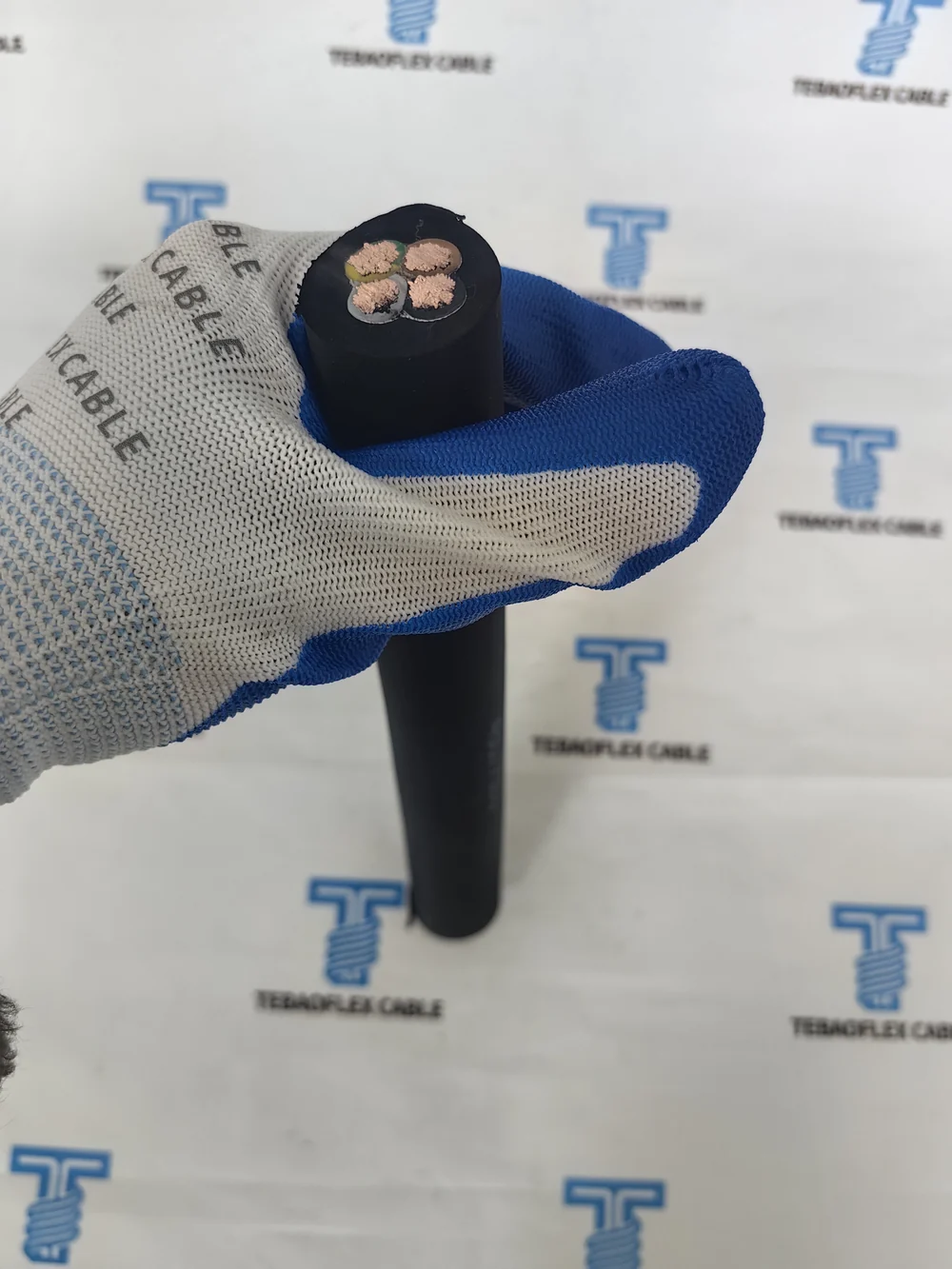
A conductor class is not a continuous-flex rating
Class 5 or Class 6 does not, by itself, specify a completed cable’s travel speed, torsional duty, permitted bending radius or number of movement cycles. The construction and the stated application conditions must be evaluated together.
The product examples above show why this matters: a purpose-built reeling cable can declare Class 5, while a particular drag-chain feedback construction declares Class 6. These are different cable designs and duties, rather than evidence that one class can replace the other everywhere.
For a moving route, check the core lay-up, insulation, separators, reinforcement, screen and sheath alongside the conductor. Then compare the actual route with the cable’s declared conditions. Reeling, festoon movement, cable-carrier travel and torsion are different requirements.
Read the cable minimum bending radius guide when specifying the route. Keep fixed and moving limits separate, and use the correct finished cable diameter. A finer conductor wire does not authorize a tighter bend than the cable’s specification permits.
Match fine-stranded conductors to their terminals
The connector or terminal must accept the actual conductor class and size. A conductor fitting inside a lug or terminal opening does not establish that the combination is suitable.
Current UL 486E equipment-wiring terminal requirements recognize specified conductor configurations and additional configurations through marking. Where a ferrule or adapter is used, check its evaluated wire range and installation method together with the receiving terminal’s ratings and instructions.
UL 486F covers bare and covered ferrules, including specified fine-stranded conductor applications. That does not make every ferrule suitable for every terminal. Follow the selected combination’s requirements for preparation, strip length, tooling and installation.
For a replacement welding lead, portable cord or machine cable, include the terminal details in the enquiry. Do not reduce the check to conductor area alone, or assume that changing the end preparation resolves an incompatible conductor class.
Write an enquiry that keeps size, class and duty together
A useful conductor specification states the overall size and the strand class separately. “4/0 AWG” is a conductor-size designation; “30 AWG component wires” describes individual wires. Likewise, an mm² size is not the finished cable’s outside diameter. Preserve those distinctions when transferring an equipment drawing into a purchase request.
Include:
- Conductor size and circuit: AWG, kcmil or mm², core count, protective conductors and any signal pairs.
- Standard and class: the requested conductor standard and edition, class and any required dual specification.
- Material and construction: plain or coated copper, wire schedule, bunch/member arrangement and any conductor-diameter constraint.
- Complete cable requirements: insulation, sheath, screening, rated voltage and temperature conditions.
- Mechanical duty: fixed, handled, trailing, reeling or cable-carrier use, including the relevant route and movement data.
- Connections: connector or terminal model, accepted conductor class and size, and the applicable preparation and tooling instructions.
Send TEBAOFLEX the conductor specification and equipment duty for the welding lead, rubber power cable, reeling cable or drag-chain circuit. Keeping those requirements together gives the team a useful basis for checking the construction instead of choosing from a class label alone.