









Mining cable drum dimensions govern far more than warehouse storage—they determine whether a heavy trailing or reeling cable arrives at the mine site without internal conductor kinking, why an ISO 668 20GP ocean container hits its physical 4-reel floor-space limit at 4 large reels (~9.0–9.2 metric tons gross weight) long before reaching its 18–20 ton road weight limit, and whether an emergency replacement reel can fit inside a wide-body air-cargo bay or underground mine shaft cage. When mining procurement teams and electrical engineers prepare drum sizing alongside container loading geometry, split air-plus-sea dispatch schedules, and a 6-item customs technical datasheet (Ficha Técnica), they eliminate port clearance holds, prevent container space waste, and protect critical heading and open-pit production schedules.
Whether you are importing 2 kV–25 kV SHD-GC and 2 kV Type G-GC trailing cables to Peru or Mexico, shipping AS/NZS 1802 / 2802 Type 241 / 275 feeders to Australia, or routing DIN VDE 0250 (N)SHTOEU-J and (N)TSCGEWOEU reeling cables to underground hard-rock operations, this engineering and logistics guide details the exact drum-sizing formulas, 20GP vs 40GP container loading layouts, emergency split air-sea protocols, and customs documentation checklists verified across real mining and tunneling cable export shipments.
Mining Cable Drum Dimensions: Flange, Barrel and Traverse Sizing Formula
Selecting export mining cable drum dimensions begins with a non-negotiable mechanical boundary: the minimum static storage bending radius of the cable. Unlike standard PVC building wire that can be coiled onto compact wooden spools, heavy-duty elastomer mining cables—such as SHD-GC 2 kV–25 kV shielded mining power cables, Type G-GC 2000 V ground-check cables, and Type 241SF 1.1–11 kV flexible mining cables—incorporate rope-lay stranded copper conductors, semiconductive stress-control screens, metallic composite braids, and thick thermoset EPR/CPE or PCP walls. Winding these constructions onto an undersized drum barrel forces the inner turns below their minimum bending radius, creating permanent bird-caging of the copper strands, eccentric compression of the EPR insulation, and buckling of the ground-check pilot core before the cable is ever energized.
1. Minimum Barrel Diameter (d_b) by Cable Standard and Voltage Class
Under international mining cable standards—including ICEA S-75-381 / NEMA WC 58 for North and Latin American portable mining cables, AS/NZS 1802 and AS/NZS 2802 for Australian trailing and reeling cables, and DIN VDE 0298-3 for European elastomer reeling feeders—the minimum drum barrel diameter (d_b) must satisfy:
- Unscreened Low-Voltage Flexible Mining Cables (≤ 2,000 V, Type W, Type G-GC, (N)SHTOEU-J, OD ≤ 40 mm): Minimum storage barrel diameter d_b ≥ 12 × D_c (corresponding to a static bending radius of 6 × D_c, where D_c is the measured overall cable diameter in mm).
- Large-Diameter Low-Voltage & Screened Flexible Mining Cables (Type G-GC with OD > 40 mm, 2 kV SHD-GC, AS/NZS Type 241 / 245): Minimum storage barrel diameter d_b ≥ 16 × D_c to 20 × D_c (static bending radius 8 × D_c to 10 × D_c).
- Medium-Voltage Shielded Trailing & Reeling Cables (5 kV–25 kV SHD-GC, 3.6/6 kV–12/20 kV (N)TSCGEWOEU, AS/NZS Type 275 / 441 / 450): Minimum storage barrel diameter d_b ≥ 20 × D_c to 24 × D_c (static bending radius 10 × D_c to 12 × D_c) to prevent interfacial shear between the extruded semiconductive screen and the primary EPR dielectric.
For example, a 2 kV SHD-GC 3×4 AWG + 2×8 AWG + 1×10 AWG cable with a factory-verified nominal outer diameter of 37.2 mm requires a minimum drum barrel diameter of 16 × 37.2 mm = 595 mm (≥ 600–800 mm standard barrel hub). Step up to a 15 kV SHD-GC 3×2/0 AWG trailing feeder with an outer diameter of 68.5 mm, and the drum barrel alone must be at least 20 × 68.5 mm = 1,370 mm—which immediately forces the outer flange diameter (D_f) into the 2,000 mm to 2,200 mm class.
2. Engineering Formula for Wound Cable Length per Drum
Once the minimum barrel diameter (d_b, in mm) is locked, factory packaging engineers calculate the maximum continuous length (L, in meters) that can be wound onto a drum with flange diameter D_f (mm), internal traverse width between flanges W (mm), and mandatory radial top clearance m (mm, set at 50 mm to 75 mm so the outermost cable layer sits recessed inside the flange rim, protected from forklift blades and wooden lagging nails):
- Turns per Layer (n_t): n_t = floor((W / D_c) × 0.95), where the 0.95 lay-packing factor accounts for realistic helical cross-over tolerances during tensioned factory spooling.
- Permissible Radial Winding Layers (n_L): n_L = floor((D_f − d_b − 2m) / (2 × D_c)).
- Total Wound Cable Capacity (L): L = π × n_t × n_L × (d_b + n_L × D_c) × 0.001 meters.
3. Export Drum Constructions: All-Wooden, Steel-Wooden Composite & All-Steel Drums
To match diverse ocean, air, and high-altitude mountain road conditions, TEBAOFLEX supplies three engineered drum structures combined with moisture-barrier and mechanical protection systems:
- All-Wooden Fumigated/Heat-Treated Drums (PN 800 to PN 1400): Constructed from kiln-dried, heat-treated timber stamped with the international IPPC / ISPM-15 HT phytosanitary mark. Ideal for lower-tare air-freight spools (100–200 m), underground communication cables, or shaft-cage-constrained mine deliveries where gross reel weight must stay below 1,200 kg.
- Heavy Steel-Wooden Composite Drums (PN 1400 to PN 2200): The workhorse for international mining power cable exports. An internal structural steel hub, steel spindle bushing, and radial steel tie-rods carry 2,000 kg to 4,500 kg of copper and rubber mass without barrel collapse, while thick multi-ply ISPM-15 HT timber flanges and full-circumference wooden lagging (battens strapped with tensioned steel bands) shield the cable from port crane hooks and rock impact.
- All-Steel Reusable Drums (PN 1600 to PN 2400): Corrugated or welded structural steel reels specified when the mine site mounts the shipping drum directly onto a motorized pay-off stand for high-tension shaft lowering or continuous haul-road laying.
- Moisture & Handling Protection: Every export drum is lined internally with eco-friendly export plastic wrap, sealed at both cable ends with heat-shrink moisture caps, closed externally with full wooden lagging (or heavy polymer wrapping), and mounted on a heavy timber under-drum pallet skid (cradle base) so site forklifts can lift the reel from underneath without touching the cable flanges.
| Standard Drum Code (Flange D_f) | Barrel Diameter d_b (mm) | Internal Traverse W (mm) | External Overall Width W_ext (mm) | Drum Construction & Tare Weight (kg) | Typical Cable OD Range (D_c) | Typical Wound Capacity per Drum (m) |
|---|---|---|---|---|---|---|
| PN 1000 (1,000 mm) | 500 mm | 600 mm | 720 mm | All-Wooden (ISPM-15 HT) · 65–85 kg | 16 – 35 mm | 100 – 350 m (Emergency air spool / branch cut) |
| PN 1250 (1,250 mm) | 630 mm | 750 mm | 890 mm | All-Wooden or Steel-Wooden · 115–150 kg | 22 – 40 mm | 250 – 500 m (LV jumper / shaft-cage cut) |
| PN 1400 (1,400 mm) | 710 mm | 850 mm | 1,010 mm | Steel-Wooden Composite · 170–210 kg | 28 – 45 mm | 300 – 600 m (Type G-GC / (N)SHTOEU-J) |
| PN 1600 (1,600 mm) | 800 mm | 950 mm | 1,130 mm | Steel-Wooden Composite · 240–290 kg | 32 – 52 mm | 400 – 750 m (2 kV SHD-GC / Type 241SF) |
| PN 1800 (1,800 mm) | 950 mm | 1,050 mm | 1,240 mm | Heavy Steel-Wooden · 320–380 kg | 36 – 60 mm | 500 – 850 m (2–8 kV SHD-GC / (N)TSCGEWOEU) |
| PN 2000 (2,000 mm) | 1,100 mm | 1,100 mm | 1,300 mm | Heavy Steel-Wooden · 410–480 kg | 42 – 68 mm | 500 – 1,000 m (Standard 20GP full-width reel) |
| PN 2200 (2,200 mm) | 1,250 mm | 1,150 mm | 1,360 mm | Heavy Steel-Wooden / Steel · 520–620 kg | 50 – 78 mm | 450 – 850 m (15–25 kV SHD-GC / MV reeling) |
20GP Cable Drum Capacity: Why a 20GP Container Stops at 4 Reels (~9.2 Tons)
One of the most frequent surprises in international mining cable procurement occurs when a buyer calculates ocean freight based on container payload weight alone. A standard 20-foot general purpose (20GP) container built to ISO 668 freight container dimensional standards carries a maximum structural payload of 24,000–28,000 kg (typically capped at 18,000–20,000 kg net cargo weight by port highway axle regulations in Peru, Chile, Mexico, and South Africa). Consequently, a buyer ordering 9,000 kg (~9.0–9.2 metric tons) of 2 kV SHD-GC and Type G-GC mining cable naturally assumes the entire order occupies less than half of a 20GP container.
In reality, 20gp cable drum capacity for heavy mining cables is governed by floor-footprint geometry and door clearance, not payload tonnage. In confirmed TEBAOFLEX export shipments to Peru (Port of Callao) and Mexico (Port of Manzanillo), 4 heavy steel-wooden drums weighing ~9.0–9.2 metric tons in total completely fill a 20GP container from front bulkhead to rear doors—leaving zero floor space for a fifth large reel despite having nearly 10 metric tons of unused weight capacity.
The 3 Dimensional Bottlenecks Inside an ISO 668 20GP Container
To understand why 4 large reels represent the hard physical ceiling of a 20GP container, compare the internal envelope of a standard 20GP box (5,898 mm internal length × 2,352 mm internal width × 2,393 mm internal height, with a rear door opening of 2,340 mm width × 2,280 mm height) against PN 1600 to PN 2200 mining cable drums:
- No Two-Abreast Loading Across the 2,352 mm Width: Cable drums must be loaded and transported standing upright on their flanges (rolling axis horizontal), never laid flat on their side flanges (which crushes the bottom cable layers under ocean pitch and roll forces). Whether a large drum (D_f = 1,600–2,200 mm, external width W_ext = 1,130–1,360 mm) is oriented with its flange parallel to the container side walls or perpendicular across the container width, two drums cannot fit side by side (2 × 1,600 mm = 3,200 mm > 2,352 mm if loaded rolling-fore-and-aft; or 2 × 1,240 mm = 2,480 mm > 2,352 mm if loaded axle-parallel). Every large drum therefore occupies the full usable width of the container.
- No Double-Stacking Under the 2,280 mm Door Header: Even a medium-sized PN 1250 (1,250 mm flange) drum cannot be stacked two-high (2 × 1,250 mm = 2,500 mm > 2,280 mm door clearance), and heavy PN 1800–2200 drums (2,000–2,600 kg each) cannot be safely top-stacked on circular wooden flanges without structural steel racking. Thus, container loading is strictly single-tier (1 layer high).
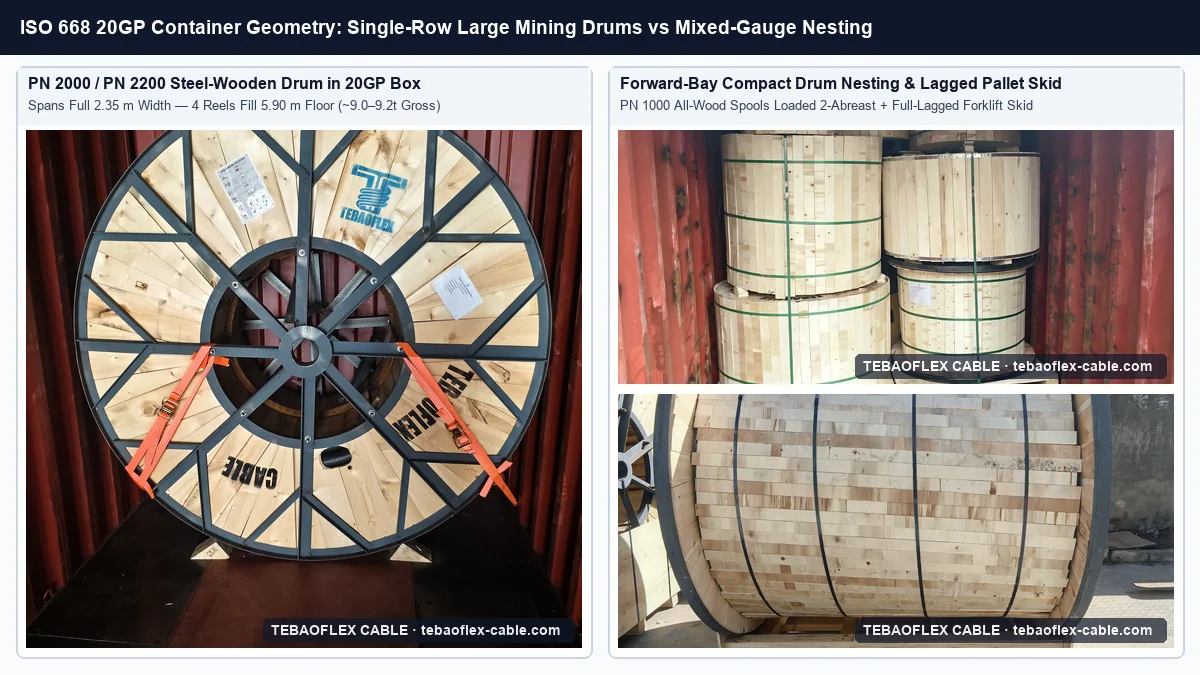
- Single-Row Longitudinal Floor Limit (5,898 mm Internal Length): When PN 1800 to PN 2200 drums are loaded in a single longitudinal row with their flanges oriented across the 2,352 mm container width (cross-wise / eye-to-side on under-drum fork skids so forklifts can drive straight into the container doors), each drum plus its timber chocking cradle and lashing clearance consumes 1,350 mm to 1,450 mm of container length. Four drums require 4 × 1,420 mm = 5,680 mm out of the 5,898 mm internal length—filling 96% of the container floor at a typical gross weight of 9.0–9.2 metric tons (e.g., 4 reels × 2,250–2,300 kg gross).
Compare how PN 1000 through PN 2200 drums fit inside 20GP, 40GP, and 40HQ containers in our factory loading photographs below, followed by the container capacity reference table:
| Container Type & ISO 668 Internal Envelope (L × W × H, Door H) | Drum Flange Class (D_f) | External Drum Width (W_ext) | Loading Orientation & Tiering | Max Reels per Container | Typical Gross Cargo Weight (Metric Tons) | Primary Limiting Factor |
|---|---|---|---|---|---|---|
| 20GP (5.90 × 2.35 × 2.39 m, Door 2.28 m) | PN 1000 (1,000 mm) | 720 mm | 2-abreast × 2-tier (with deck bracing) or 14 floor reels | 14 – 20 reels | 8.5 – 14.0 t | Floor length & safe stacking height |
| 20GP (5.90 × 2.35 × 2.39 m, Door 2.28 m) | PN 1400 (1,400 mm) | 1,010 mm | Single-tier, 2-abreast (axle parallel) or 5 cross-wise | 5 – 8 reels | 7.5 – 11.5 t | Container internal width (2.35 m) |
| 20GP (5.90 × 2.35 × 2.39 m, Door 2.28 m) | PN 1800 – PN 2000 (1,800–2,000 mm) | 1,240 – 1,300 mm | Single-tier, single row (1-wide × 4-long) on skids | 4 reels max | 8.8 – 9.6 t (~9.2 t typical) | Floor length (5.90 m) & width (2.35 m) |
| 20GP (5.90 × 2.35 × 2.39 m, Door 2.28 m) | PN 2200 (2,200 mm) | 1,360 mm | Single-tier, single row (1-wide × 4-long), 80 mm door margin | 4 reels max | 9.2 – 11.5 t | Door height (2.28 m) & floor length |
| 40GP (12.03 × 2.35 × 2.39 m, Door 2.28 m) | PN 1800 – PN 2000 (1,800–2,000 mm) | 1,240 – 1,300 mm | Single-tier, single row (1-wide × 8 to 9-long) on skids | 8 – 9 reels | 18.0 – 21.5 t | Matches floor length (12.03 m) to road weight limit |
| 40HQ (12.03 × 2.35 × 2.69 m, Door 2.58 m) | PN 2200 – PN 2400 (2,200–2,400 mm) | 1,360 – 1,420 mm | Single-tier, single row (1-wide × 8 to 9-long) | 8 – 9 reels | 19.5 – 23.0 t | High-cube 2.58 m door clears 2,400 mm MV drums |
Optimizing Cable Reel Container Loading to Cut Ocean Freight Cost per Meter
Once procurement and engineering teams recognize that a 20GP container hits its geometric volume limit at 4 large drums (~9.0–9.2 metric tons), they can apply three practical cable reel container loading optimizations before factory spooling begins—substantially lowering the landed ocean freight cost per meter of cable delivered to the mine.
1. Maximize Unit Length per Drum Within the Radial Flange Margin (+250 to +300 m per Reel)
In a real Latin American mining order comprising multiple reels of 2 kV SHD-GC and Type G-GC power cable, the customer’s initial requisition specified 4 reels at 500 m per reel, totaling 2,000 m and ~9.1 metric tons gross weight inside a 20GP container. Because those 4 steel-wooden drums (PN 1800 / PN 2000) already consumed the entire 5.90 m container floor length, shipping the container as-is left roughly 10 metric tons of paid container weight capacity unused, while the outer cable layer on two of the drums sat 140 mm below the flange rim (well below the mandatory 50–75 mm radial clearance).
By recalculating the winding layers (n_L) on the exact same PN 2000 drum size (or stepping a PN 1800 drum to PN 2000, which still fits 4 reels across the 5.90 m floor length because the external traverse width W_ext remains 1,300 mm), the buyer was able to wind an additional 250 m to 300 m of cable onto each drum—shipping 2,800–3,000 m (~12.5–13.4 metric tons) inside the exact same 20GP container. Because ocean container freight is billed per box (flat rate per 20GP) rather than per ton below the road payload cap, adding 250–300 m per reel reduced the ocean freight cost per meter by 28%–33%.
2. Consolidate Multi-Gauge Mine Orders into a 40GP or 40HQ Container (8–9 Large Reels)
When a mine expansion or annual maintenance tender requires 6 to 9 large drums of medium-voltage and low-voltage trailing cables (for example, combining SHD-GC 2 kV–25 kV shovel feeders with underground trackless mining cables for LHD scooptrams and drill jumbos), booking two separate 20GP containers (4 + 4 reels) doubles port terminal handling charges (THC), customs broker entry fees, and inland flat-bed drayage costs.
Upgrading to a single 40GP (12,032 mm internal length) or 40HQ (2,585 mm door height) container doubles the longitudinal floor track from 5.90 m to 12.03 m. This allows 8 to 9 heavy PN 1800–2200 steel-wooden drums (~18.5–21.5 metric tons total gross weight) to load in a single row—simultaneously hitting 95%+ of both the container floor length and the highway payload weight limit, while cutting ocean and port handling cost per drum by 30%–40%.
3. Nest Compact Auxiliary & Monitoring Spools Alongside Main Power Drums
Underground mine projects frequently order heavy trailing power feeders alongside smaller-diameter monitoring, sensor, and communication lines—such as P1209 accessor trunk cables for underground mine monitoring and underground mine leaky feeder coaxial communication cables. Because these 10–22 mm OD auxiliary cables wind onto compact PN 800 or PN 1000 all-wooden drums (720 mm external width), two or three compact spools can be loaded side-by-side (2 × 720 mm = 1,440 mm < 2,352 mm) in the remaining 450–800 mm longitudinal nose space at the front bulkhead of a 20GP container alongside 3 or 4 large power drums—eliminating separate LCL (less-than-container-load) consolidation fees and high LCL port unstuffing charges at destination.
Split Air Sea Cable Shipment Strategy for Emergency Mine Shutdowns
When an underground drill jumbo, LHD scooptram, or open-pit blast-hole drill severes its primary trailing or reeling cable without a spare reel in the mine warehouse, every shift of equipment downtime translates into tens of thousands of dollars in deferred ore tonnage. Yet procurement managers face a harsh supply-chain math problem when sourcing custom-engineered mining cables internationally:
- Total End-to-End Ocean Delivery Window (70–85 Calendar Days): Custom manufacturing of multi-core elastomer mining cables (stranding, EPR triple extrusion, metallic screen braiding, vulcanization, and routine HV testing) requires 15–25 working days within TEBAOFLEX’s standard 7–45 working days production window. Add export port drayage and vessel closing (4–6 days), trans-Pacific or Indian Ocean sea transit to Latin American or African ports (30–42 days to Callao, Manzanillo, Antofagasta, or Durban), destination customs clearance (5–10 days), and inland mountain trucking to 3,500–4,800 m Andean or remote bushveld mine sites (5–10 days), and the realistic door-to-mine ocean timeline spans 70 to 85 days.
- The Cost Barrier of Full Air Freight: A full 1,000 m order of 2 kV Type G-GC or SHD-GC power cable weighs 2,200 kg to 3,800 kg including drums. Flying the entire 1,000 m batch by international air cargo can exceed the value of the cable itself.
How the 100 m Air + 900 m Sea Split Dispatch Protocol Solves the Downtime Gap
To resolve this 70–85 day logistics gap on urgent mine replacement orders—such as a closed Mexican mining order for 1,000 m of custom portable power cable—TEBAOFLEX executes a synchronized split air sea cable shipment (multimodal air + ocean dispatch):
- Continuous Production, Split Spooling at the Factory Take-Up Stand: Rather than waiting to spool the entire 1,000 m onto heavy ocean drums, the factory winds the first 100 m (or 150 m—matching a single machine’s immediate replacement reel length above our 50 m MOQ) directly onto a low-tare, ISPM-15 HT all-wooden air-cargo drum (PN 900 or PN 1000, flange height ≤ 1,000–1,100 mm, gross weight ~280–480 kg).
- Immediate Air Dispatch (5–8 Days Port-to-Airport): Keeping the air-freight reel flange height below 1,100 mm (and strictly below the 1,580 mm main-deck/lower-deck contour limit of standard ULD PMC / PAG wide-body passenger and freighter aircraft pallets) allows the 100 m emergency reel to fly on commercial wide-body cargo flights immediately after passing factory HV dielectric and spark testing. The mine receives and installs the 100 m cable within 5 to 8 days of factory completion, bringing the halted heading or drill rig back online more than two months early.
- Concurrent 900 m Ocean Container Dispatch: The remaining 900 m is wound onto heavy-duty steel-wooden drums (e.g., 2 × 450 m or 3 × 300 m), loaded with full wooden lagging and under-drum pallet skids into the scheduled 20GP / 40GP sea container, and shipped by economical ocean freight to replenish the mine’s warehouse stock before the next scheduled maintenance overhaul.
| Dispatch Strategy (1,000 m Mine Cable Order Benchmark) | Air-Freight Portion & Drum Spec | Ocean-Freight Portion & Drum Spec | Time to First Machine Restart at Mine | Total Landed Freight Cost Impact | Best Operational Use Case |
|---|---|---|---|---|---|
| Full Ocean Container (20GP / LCL) | 0 m | 1,000 m on 2 × PN 1800 steel-wooden drums (~2,600 kg gross) | 70 – 85 calendar days (production + sea + customs + inland truck) | 1.0× Baseline (Lowest freight cost per meter) | Planned annual mine maintenance, new stope development, or capital project inventory |
| Split Air + Sea (100 m Air + 900 m Sea) | 100 m on 1 × PN 1000 all-wood HT spool (~310 kg gross, ULD lower-deck compatible) | 900 m on 2 × PN 1600/1800 steel-wooden drums (~2,320 kg gross) | 22 – 30 calendar days total (5–8 days transit after factory test) | ~1.18× – 1.28× Baseline (Only 10% of order pays air tariff) | Unplanned LHD, jumbo, or shovel cable failure with zero spare in mine warehouse |
| Full Air Cargo Charter / Freighter | 1,000 m split across 4–5 × PN 1250 wooden spools (~2,750 kg gross) | 0 m | 22 – 30 calendar days total | 3.2× – 4.8× Baseline (High volumetric/weight air cost across full order) | Only when the entire 1,000 m is a single continuous shaft feeder needed immediately |
Mining Cable Customs Ficha Tecnica: 6 Mandatory Disclosures for Clearance
Even when a container or air-freight spool arrives on schedule at the destination port—such as Callao in Peru (administered by SUNAT — Superintendencia Nacional de Aduanas y de Administración Tributaria) or Manzanillo / Veracruz in Mexico (cleared under Pedimento Aduanal Clave A-1)—shipments frequently suffer 5 to 15 day customs holds and costly port demurrage for a purely documentary reason: an incomplete technical datasheet (Ficha Técnica).
When a commercial invoice or packing list describes the cargo only by its North American or European trade designation—for example, “Mining Cable SHD-GC 2000V 3×4+2×8+1×10 AWG” or “Cable G-GC 3×2 AWG”—customs tariff examiners cannot verify whether the cable falls under Harmonized System (HS) heading 8544.49 (electric conductors for a voltage not exceeding 1,000 V) or 8544.60 (electric conductors for a voltage exceeding 1,000 V), nor can they verify the conductor metal (copper vs aluminum), insulation elastomer (EPR thermoset rubber vs PVC/XLPE), or metallic shielding status required by national electrical import regulations.
The 6 Mandatory Structural Disclosures on Every TEBAOFLEX Customs Ficha Técnica
To ensure first-pass customs clearance (Levante Sin Incidencias in Peru and smooth Reconocimiento Aduanero in Mexico, Chile, Colombia, and Brazil), TEBAOFLEX issues a bilingual (Spanish / English or Portuguese / English) mining cable customs ficha tecnica prior to vessel arrival that explicitly documents all six internal structural layers alongside factory routine test values:
- Conductor Material, Stranding Class & Surface Finish (Material y Cableado del Conductor): Must state high-purity electrolytic annealed copper (Cobre electrolítico recocido), surface finish (tinned copper / cobre estañado per ASTM B33 / B172 Rope-Lay Class I/K or bare/tinned IEC 60228 Class 5 fine-stranded flexible copper per IEC 60228 conductor standards), and exact cross-sectional area in both AWG / kcmil and metric mm² for phase cores, grounding cores, and ground-check pilot cores.
- Primary Insulation Polymer & Nominal Wall Thickness (Compuesto y Espesor del Aislamiento Primario): Must specify the exact thermoset elastomer compound—such as 90 °C Ethylene Propylene Rubber (EPR / Caucho Etileno-Propileno) per ICEA S-75-381, R-EP-90 per AS/NZS 3808, or 3GI3 EPR per DIN VDE 0207-20—together with the nominal radial wall thickness in mm (e.g., 2.80 mm on 2 kV SHD-GC 4 AWG).
- Semiconductive Stress Control & Metallic Shield Coverage (Pantalla Semiconductora y Blindaje Metálico): For shielded cables (SHD-GC, Type 241 / 275, (N)TSCGEWOEU), must declare the extruded semiconductive conductor and insulation screens plus the tinned-copper and polyamide/textile composite braid shield (Blindaje trenzado de cobre estañado e hilo sintético, cobertura ≥ 60%–85%). Crucially, for unshielded 2 kV Type G-GC or Type W cables, the Ficha Técnica must explicitly state “Sin blindaje metálico individual (Unshielded portable power cable with insulated ground-check pilot)” so customs inspectors do not hold the shipment looking for a metallic screen.
- Inner & Outer Sheath Elastomer Compound, Color & Wall Thickness (Cubierta Interna y Externa): Must identify the heavy-duty vulcanized elastomer jacket—such as Thermoset Chlorinated Polyethylene (CPE / Polietileno Clorado) per ICEA S-75-381, Polychloroprene (PCP / Neopreno EM2 / 5GM5), or Polyurethane (PUR 11YM1)—along with the radial wall thickness (mm) and visible outer sheath color (Naranja / Orange, Amarillo / Yellow, Negro / Black).
- Central Cradle, Interstitial Fillers & Embedded Anti-Torsion Braid (Núcleo Central, Rellenos y Malla Antitorsión): Details the non-hygroscopic elastomeric central cradle profile, the symmetrical placement of the two uninsulated/covered interstitial grounding conductors (2 × tierras simétricas) and the insulated ground-check pilot (1 × piloto GC), plus the open-weave polyamide/aramid anti-torsion braid (Malla trenzada antitorsión vulcanizada entre cubierta interna y externa) on reeling constructions.
- Governing Standard, Rated Voltage (U0/U) & Factory Routine Test Values (Norma de Fabricación, Tensión Nominal y Pruebas de Rutina): States the governing engineering standard (ICEA S-75-381 / NEMA WC 58, AS/NZS 1802 / 2802, DIN VDE 0250-813 / 814), the exact rated voltage (e.g., 2,000 V or 8.7/15 kV—confirming HS 8544.60 vs 0.6/1 kV under HS 8544.49), nominal overall outer diameter (OD in mm), linear net weight (kg/km), maximum 20 °C DC conductor resistance (Ω/km), and factory 5-minute AC high-voltage withstand test voltage (kV).
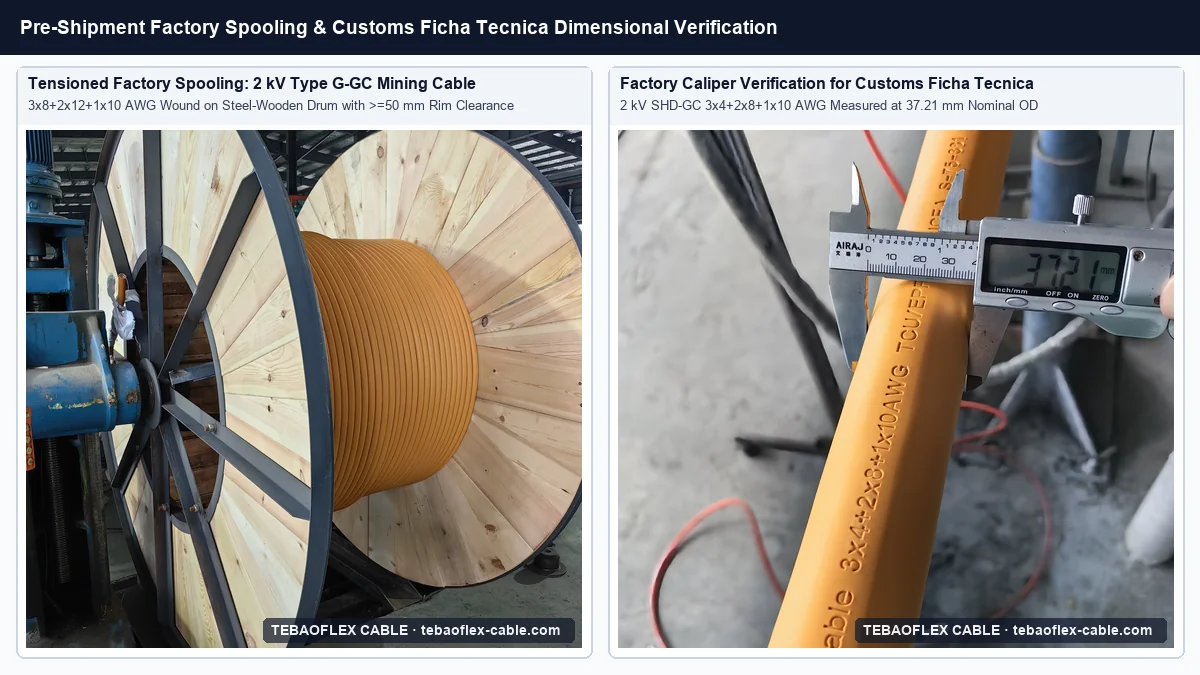
When inspecting an unmarked low-voltage (0.6/1 kV or 600 V) or medium-voltage (2 kV to 15 kV) mining shipment before customs declaration and site receiving, our factory inspection workflow pairs caliper OD verification with full 6-layer Ficha Técnica documentation:
| Customs Ficha Técnica Disclosure Item | Spanish / Portuguese Customs Term | Example 1: 2 kV Type G-GC 3×2 AWG + 2×6 + 1×8 AWG | Example 2: 2 kV SHD-GC 3×4 AWG + 2×8 + 1×10 AWG | Example 3: 0.6/1 kV (N)SHTOEU-J 4×50 mm² Reeling |
|---|---|---|---|---|
| 1. Conductors (Phases + Earths + Pilot) | Conductores de Fase, Tierra y Piloto | Tinned Cu ASTM B33/B172 Rope-Lay: 3 × 33.6 mm² (2 AWG) + 2 × 13.3 mm² (6 AWG Earth) + 1 × 8.37 mm² (8 AWG GC) | Tinned Cu ASTM B33/B172 Rope-Lay: 3 × 21.2 mm² (4 AWG) + 2 × 8.37 mm² (8 AWG Earth) + 1 × 5.26 mm² (10 AWG GC) | Tinned Cu IEC 60228 Class 5: 3 × 50 mm² Phases + 3 × 25/3 mm² Split Interstitial Earths |
| 2. Primary Insulation & Thickness | Aislamiento Primario y Espesor | 90 °C EPR (Ethylene Propylene Rubber), nominal wall 2.03 mm (0.080 in), Black/White/Red | 90 °C EPR (ICEA S-75-381), nominal wall 2.79 mm (0.110 in) over semiconductive conductor screen | 90 °C 3GI3 EPR (DIN VDE 0207-20), nominal wall 1.4 mm, Brown/Black/Grey + Green/Yellow |
| 3. Metallic Shield / Screen Coverage | Pantalla Semiconductora y Blindaje | Unshielded (Sin blindaje metálico; equipped with insulated 8 AWG Ground-Check pilot core) | Extruded semicon insulation screen + Tinned-Cu / Textile composite braid shield (≥ 60%–85% coverage) | Unscreened LV reeling (or tinned-Cu screen on (N)SSHCOEU VFD variant) |
| 4. Inner & Outer Sheath Polymer | Cubierta Interna y Externa | Heavy-duty vulcanized Thermoset CPE (or PCP), nominal wall 3.68 mm, Orange/Black | Single or double-layer vulcanized Thermoset CPE / PCP, nominal wall 4.45 mm, High-Visibility Orange | Inner 5GM3 elastomer + Outer 5GM5 PCP (or 11YM1 PUR), Black/Yellow |
| 5. Cradle, Fillers & Anti-Torsion Braid | Relleno Central y Malla Antitorsión | Elastomeric central cradle + symmetrical interstitial ground/pilot layout + reinforcing twine | Elastomeric separator cradle + 2 interstitial bare/tinned grounds + 1 insulated 10 AWG GC core | Central elastomeric core + vulcanized open-weave polyamide anti-torsion braid (≥ 20 N/mm²) |
| 6. Standard, Voltage, OD & Routine Tests | Norma, Tensión, Diámetro y Pruebas | ICEA S-75-381 · Rated 2,000 V (HS 8544.60) · Nominal OD ~34.8 mm · 20 °C R_DC ≤ 0.539 Ω/km · AC Test 5.0 kV / 5 min | ICEA S-75-381 · Rated 2,000 V (HS 8544.60) · Verified OD 37.2 mm · 20 °C R_DC ≤ 0.856 Ω/km · AC Test 6.0 kV / 5 min | DIN VDE 0250-814 · Rated 0.6/1 kV (HS 8544.49) · Nominal OD ~36.5 mm · 20 °C R_DC ≤ 0.393 Ω/km · AC Test 3.5 kV / 5 min |
Pre-Shipment Factory Routine Testing & Mine-Site Arrival Inspection Protocol
A customs Ficha Técnica and container packing list are only as reliable as the physical cable wound on the drums. When mining cables travel 10,000–18,000 km across ocean basins and up steep mountain switchbacks to high-altitude mine camps, procurement and maintenance engineers need an unbroken chain of verification linking factory routine testing to mine-site receiving inspection.
1. Factory Production Video Tracking & Routine FAT Verification
Before any TEBAOFLEX mining cable drum is lagged and loaded into an ocean container or air pallet, it undergoes four mandatory factory acceptance checks—documented via stamped mill test certificates (Certificado de Calidad / Protocolo de Pruebas) and timestamped production videos shared directly with the buyer’s engineering team:
- 20 °C Conductor DC Resistance Measurement: Every phase, earth, and ground-check pilot core on every production reel is measured on a Kelvin double-bridge at 20 °C (or temperature-corrected per IEC 60228 / ASTM B172) to confirm copper cross-section compliance and low I²R heating losses.
- High-Frequency Spark Testing & 5-Minute AC Dielectric Voltage Withstand: During extrusion, insulation walls pass through inline spark testers (6 kV to 15 kV AC). After final vulcanization and spooling, every completed drum length undergoes a 5-minute power-frequency AC high-voltage withstand test (e.g., 3.5 kV for 0.6/1 kV VDE reeling cables, 5.0–6.0 kV for 2 kV Type G-GC / SHD-GC, and 11 kV to 28 kV for 3.6/6 kV to 15 kV medium-voltage trailing feeders) plus insulation resistance (MΩ·km) measurement.
- Digital Caliper & Optical Projector Dimensional Check: Factory quality inspectors verify insulation wall thickness, inner/outer sheath concentricity, and overall outer diameter (OD) with digital calipers and optical measuring projectors—critical when the cable must pass through fixed-aperture gland entries, level-wind rollers, or Bretby longwall chains (see our aged reeling cable replacement and OD identification guide for why aged field cables measure 5–6 mm thicker than new factory nominal OD).
- Container Stuffing & Chocking Photo Record: Prior to sealing the container with its high-security bolt seal, loading crews photograph every drum’s stenciled shipping marks, ISPM-15 HT phytosanitary stamp, under-drum pallet skid, timber wheel chocks, and ratchet lashing straps.
2. Mine-Site Arrival Inspection: The 3-Step 500 V / 1000 V Megger Check
When the cable drums arrive at the mine warehouse or shaft collar by flatbed truck, electrical maintenance supervisors should execute a 15-minute receiving inspection before removing the cable from the shipping drum:
- Inspect Drum Flanges, Lagging & Heat-Shrink End Caps: Verify that the wooden lagging battens have not been punctured by forklift tines during port transshipment, that the drum was transported upright on its flanges, and that the heat-shrink end caps on both the inner barrel tail (accessible at the side flange slot) and the outer tail are intact and dry.
- Verify Outer Sheath Print Legend & Caliper OD Against the Ficha Técnica: Remove a single lagging batten, measure the unstrained outer diameter with a digital caliper, and confirm the surface print legend (voltage rating, cable designation, core count × gauge, and sequential meter markings).
- Run a 60-Second On-Drum Insulation Resistance (Megger) & Continuity Test: Strip 30 mm at both sealed drum ends and connect a calibrated handheld digital insulation tester (such as a Fluke 1503 or Fluke 1507 set to 500 V DC for pilot cores and 1,000 V DC for ≥ 0.6/1 kV power cores). Measure phase-to-phase and phase-to-earth/shield insulation resistance for 60 seconds (confirming readings in the hundreds of MΩ to GΩ range), and check end-to-end continuity on the ground-check (GC) pilot core and split interstitial earth conductors. Recording these arrival values in the mine maintenance log establishes a clean baseline before the cable is wound onto a mobile drill jumbo, LHD loader, or open-pit shovel reel.
For broader guidance on matching electrical ampacity, ambient temperature derating, and mechanical protection across underground and surface mine machinery, review our 8-step mining cable selection guide and our comparison of underground vs surface mining cables.
Procurement Checklist & Frequently Asked Questions
8-Point Mining Cable Drum, Container & Customs RFQ Checklist
When requesting a quotation, drum drawing, or container-loading plan from TEBAOFLEX’s mining cable engineering team, include these eight parameters so we can optimize both cable construction and landed freight cost:
- Cable Standard, Designation & Rated Voltage: Specify ICEA S-75-381 (SHD-GC, Type G-GC, Type W), AS/NZS 1802 / 2802 (Type 209, 241, 241SF, 245UF, 275, 441), DIN VDE 0250 ((N)SHTOEU-J, (N)TSCGEWOEU), or SANS 1520, together with rated voltage (0.6/1 kV up to 25 kV) and core configuration.
- Total Order Quantity vs Exact Per-Drum Cut Lengths: State both the total meterage and the exact continuous length required on each drum (e.g., 4 × 500 m for surface shovel feeders vs 10 × 100 m cuts for underground LHD scooptrams).
- Mine Shaft Cage, Drift or Reel Stand Dimensional Limits: If drums must be lowered intact down a vertical mine shaft cage or transported through a low-seam drift, specify the maximum permissible flange diameter (D_f), external width (W_ext), and gross lifting weight (kg).
- Preferred Drum Structure & Lagging: Choose between ISPM-15 HT all-wooden drums (for compact/air spools), heavy steel-wooden composite drums (standard ocean export), or all-steel reusable drums, with full wooden lagging and under-drum forklift pallet skids.
- Container Consolidation Target (20GP vs 40GP / 40HQ): Tell us if you want us to calculate the maximum additional meters (e.g., +250–300 m per drum) that can be wound onto 4 reels inside a 20GP container or consolidated into an 8–9 reel 40GP / 40HQ box.
- Emergency Split Air + Sea Dispatch Requirement: If a machine is currently down, specify the minimum immediate length needed by air cargo (e.g., 100 m or 150 m on a PN 1000 wooden spool above our 50 m MOQ) while the balance ships by sea.
- Destination Port & Customs Ficha Técnica Requirements: Confirm the port of discharge (e.g., Callao, Manzanillo, Antofagasta, Durban, Fremantle), required datasheet language (Spanish / English / Portuguese), and whether your customs broker requires all 6 internal structural layer disclosures on the commercial invoice and Ficha Técnica.
- Site Unloading Method: Specify whether your warehouse unloads drums using a forklift under the drum skid (requiring under-drum pallet cradles) or an overhead crane with a spreader beam and steel spindle bar (requiring reinforced steel hub bushings).
Frequently Asked Questions
How many mining cable drums fit inside a standard 20GP ocean container?
A standard ISO 668 20GP container (5.90 m length × 2.35 m width × 2.28 m door height) holds a maximum of 4 large mining cable drums (1,800 mm to 2,200 mm flange diameter) in a single row at ~9.0–9.2 metric tons gross weight, or 14 to 20 compact 1,000 mm drums.
Why does a 20GP container reach capacity at ~9.2 tons of mining cable instead of 20 tons?
Heavy mining cables (SHD-GC, Type G-GC, Type 241, (N)TSCGEWOEU) require 1,600–2,200 mm drum flanges to respect minimum bending radius limits (6×OD to 12×OD). Because two drums exceed the 2.35 m container width and 2.28 m door height, four single-tier drums fill the 5.90 m floor length first.
How can mining buyers reduce ocean freight cost per meter on a 20GP container order?
When four drums already fill the 20GP floor footprint at ~9.0–9.2 tons, buyers can wind an extra 250 m to 300 m per reel within the remaining flange clearance, step up to a 40GP / 40HQ container (8–9 large reels), or nest compact monitoring cable spools in the forward bay.
How does a split air and sea cable shipment work for emergency mine shutdowns?
Because full production plus ocean transit, customs, and inland trucking takes 70–85 days, TEBAOFLEX winds the first 100 m onto a compact ≤1,000 mm ISPM-15 wooden spool for immediate 5–8 day air cargo dispatch to restart the halted machine, while the remaining 900 m ships economically by sea.
What information is required on a mining cable customs Ficha Tecnica for Peru or Mexico?
To prevent customs holds under SUNAT (Peru) or Pedimento Clave A-1 (Mexico), the Ficha Técnica must disclose six items: conductor copper stranding/tinning, primary EPR insulation wall thickness, metallic shield coverage (or unshielded declaration), inner/outer CPE/PCP/PUR sheath specs, central cradle/anti-torsion braid, and rated voltage (U0/U) with standard reference.