


Mining cable designations
In mining cables, type SHD means Shielded Heavy Duty: a portable power cable with an individual metallic shield over every power conductor, built for medium-voltage trailing duty on mobile mining equipment. The letters are not a brand. They come from a published standard, and every one of them exists because a specific regulation demands it.
Last technical review:
Shielded Heavy Duty. Shields sit on each power conductor, not just around the bundle.
GC, CGC, PCG and PC change the grounding and ground-check arrangement, not the shielding.
ANSI/NEMA WC 58 / ICEA S-75-381 defines the family, up to 25,000 volts.
30 CFR Part 75 forces the shields, the ground conductors and the ground-check wire.
What does type SHD mean in mining cables?
Type SHD means Shielded Heavy Duty. It is a portable, medium-voltage power cable in which each power conductor carries its own metallic shield, built to be dragged behind mobile mining equipment. The designation comes from ANSI/NEMA WC 58 / ICEA S-75-381, which covers the SHD family up to 25,000 volts.
| Letter | Stands for | What it means physically |
|---|---|---|
| S | Shielded | A metallic shield is applied over the insulation of every power conductor, individually |
| H | Heavy | Heavy-duty construction: fine-stranded flexible copper, thick insulation, a rugged jacket |
| D | Duty | Completes “Heavy Duty”; the three-conductor round portable construction in the standard |
| -GC | Ground Check | Adds an insulated ground-check (pilot) conductor for continuous ground-continuity monitoring |
| -CGC | Centre Ground Check | Three grounding conductors with the ground-check conductor at the cable centre |
| -PCG | Pilot & Cabled Ground | A pilot conductor plus cabled grounding conductors, used on 2 kV longwall and face equipment |
Read it as two halves. SHD tells you about the insulation and shielding system. Everything after the hyphen tells you about the grounding and monitoring system. Confusing the two halves is the single most common specification error we see on RFQs.
Breaking down the letters one at a time
S is the one that costs money
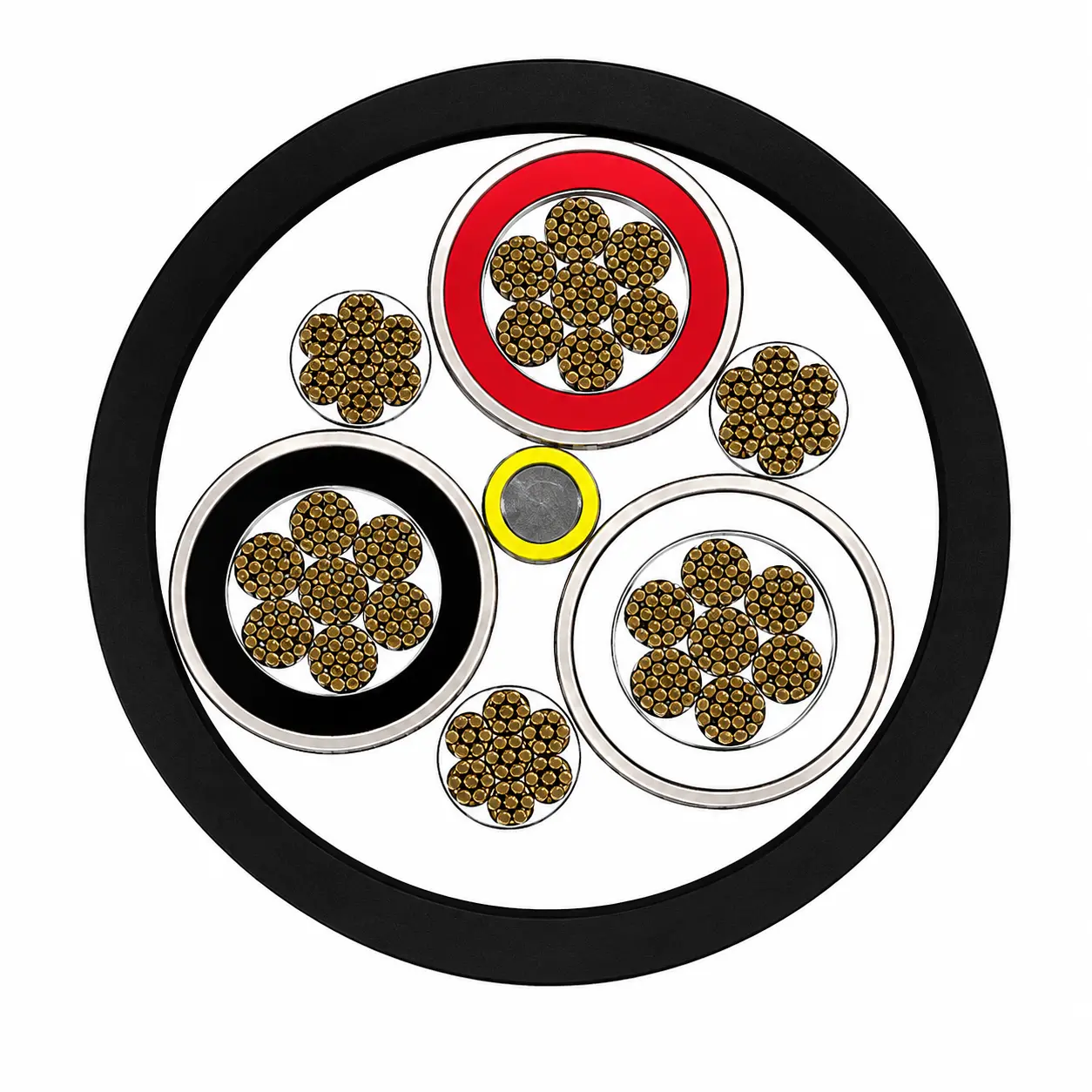
“Shielded” here does not mean an overall braid around the whole cable, the way it does on an instrumentation cable. In an SHD construction each power conductor gets its own semi-conducting layer and metallic shield, so the electric field is confined to a controlled radial path inside each core. Three power conductors means three separate shield systems.
This is why SHD cable is heavier, fatter and more expensive than an unshielded mining cable of the same copper size, and why an unshielded type cannot simply be substituted at medium voltage. Without a shield the field terminates wherever it likes — on the jacket, on a boot, on whoever is handling it.
HD is a mechanical promise, not an electrical one
Heavy Duty describes what the cable survives, not what it insulates. Fine-stranded annealed copper for flex life, a thick elastomeric insulation, and a jacket compound chosen for abrasion, tear, oil and ozone. A trailing cable is pulled across rock, run over by machinery and coiled onto a reel, sometimes all in one shift.
The suffix is where the safety system lives
GC, CGC, PCG and PC do not change the shielding at all. They change how many grounding conductors there are, where they sit, and whether a separate pilot or ground-check conductor is present for the monitoring relay to watch. That is a protection-system decision made by the mine electrical engineer, not a preference.
Which standard actually defines the name
The SHD family is defined in ANSI/NEMA WC 58 / ICEA S-75-381, “Portable and Power Feeder Cables for Use in Mines and Similar Applications”. Section 3.10 of that standard covers the shielded portable types, up to 25,000 volts. The letters are a standard designation, so two compliant cables from two makers should describe the same architecture.
That is worth stressing, because the SERP is full of pages that treat SHD-GC as if it were the only member of the family. It is not. The standard’s own contents list several shielded portable types, and the ones you are most likely to meet are these:
| Standard entry | Type | Construction as titled in the standard |
|---|---|---|
| 3-20 | Type SH | Single-conductor portable power cable, 100 percent insulation level |
| 3-21 | Type SHC-GC | Three-conductor round portable power cable, 2,000 volts or less |
| 3-22 | Type SHD and SHD-GC | Three-conductor round portable power cables, 100 percent insulation level |
| 3-23 | Type SHD-CGC | Three-conductor portable power cable with three grounding conductors |
| 3-26 | Type SHD-PCG | Shielded portable cable with pilot and cabled grounding conductors |
| 3-27 | Type SHD-Flat | Three-conductor flat portable power cable, 2,000 volts or less |
Note what 3-22 does: SHD and SHD-GC share one entry. The base SHD has no ground-check conductor; add the monitoring conductor and you have SHD-GC. That is the whole difference, and it explains why so many buyers use “SHD” loosely when they mean SHD-GC. Nine times out of ten on a modern mine, the cable actually needed is the GC version.
The standard’s published contents and scope is free to read and settles most naming arguments in about two minutes.
Why each letter exists: the regulation behind it
Here is the part almost nobody writes down. In a US underground coal mine the SHD architecture is not a design preference — it is what 30 CFR Part 75 forces you to install. Read the letters as a compliance checklist and the whole naming system suddenly makes sense. North American portable cord works the same way on a smaller scale — the letters in SOOW, SJOOW and SEOOW each state one property, read left to right.
| Rule | What it requires | Which letter it creates |
|---|---|---|
| § 75.804(a) | Metallic shields around each power conductor | The S |
| § 75.804(a) | Ground conductors totalling at least half the power conductor cross-section | The grounding conductors inside every SHD variant |
| § 75.804(a) | An insulated external conductor no smaller than No. 8 AWG, or an insulated internal ground-check conductor | The GC |
| § 75.803 | A fail-safe ground check circuit monitoring grounding continuity, opening the breaker if the ground or pilot check wire breaks | Why the GC conductor must be continuous and monitored |
| § 75.803-1 | Ground-check circuit voltage not exceeding 96 volts | Why the ground-check core is a small, separately insulated conductor |
| § 75.600 | Cables accepted or approved by MSHA as flame resistant | Why the jacket compound is not a free choice |
| § 75.814(e) | Longwall ground-monitor circuits must de-energise if a grounding conductor is severed | Why longwall feeds use the pilot-conductor variants |
The two that matter most are § 75.803 and § 75.804. Between them they explain why a medium-voltage mining cable cannot be an ordinary rubber cable with a thicker jacket: the shields and the ground-check conductor are the machine’s protection system, running inside the cable.
A word on approvals. MSHA acceptance is granted to a specific construction, not to a family name. A cable printed “SHD-GC” is not automatically MSHA-accepted, and TEBAOFLEX does not hold MSHA approval — we build to the ICEA/NEMA construction and say so plainly. If your project requires MSHA acceptance, that is a clause to settle before any commercial discussion, not after.
SHD, SHD-GC, SHD-CGC and SHD-PCG compared
All four are shielded and all four are heavy duty. What separates them is the grounding and monitoring architecture — how many ground conductors, where they sit, and whether a pilot or ground-check core is present.
| Designation | Shielding | Grounding arrangement | Ground-check / pilot | Typical service |
|---|---|---|---|---|
| Type SHD | Individual shield per power conductor | Grounding conductors, no monitoring core | None | Systems where continuity is monitored elsewhere |
| Type SHD-GC | Individual shield per power conductor | Grounding conductors in the interstices | Insulated ground-check conductor | The mainstream medium-voltage trailing cable |
| Type SHD-CGC | Individual shield per power conductor | Three grounding conductors | Ground-check conductor at the cable centre | Where the standard calls for the three-ground layout |
| Type SHD-PCG | Individual shield per power conductor | Cabled grounding conductors | Pilot conductor | 2 kV longwall and face equipment feeds |
If you are choosing between families rather than decoding a name, that is a different job with different inputs — voltage, protection system, movement duty and approvals. Our mining cable selection guide for SHD-GC, Type G-GC and Type W walks that decision instead of this one.
How SHD differs from Type G, G-GC and Type W
The quickest way to place SHD is against the unshielded families it sits above. Shielding and voltage move together: below 2 kV you generally do not need individual shields, above 2 kV you do.
| Cable type | Shielding | Ground monitoring core | Voltage range in the standard |
|---|---|---|---|
| Type W | None | None | 600 V – 2,000 V |
| Type G | None | None | 2,000 V or less (also a 2,001–5,000 V entry) |
| Type G-GC | None | Ground-check conductor | 2,000 V or less |
| Type SHD | Individual shield per power conductor | None | Up to 25,000 V |
| Type SHD-GC | Individual shield per power conductor | Ground-check conductor | Up to 25,000 V |
Two honest cautions about that table. First, the voltage column is what the standard permits, not what any given construction is built to; a real cable is offered at specific classes such as 2, 8, 15 and 25 kV. Second, “Type G” and “Type W” each appear more than once in the standard with different conductor counts and layouts, so the family name alone never finishes a specification.
Where type SHD cable is actually used
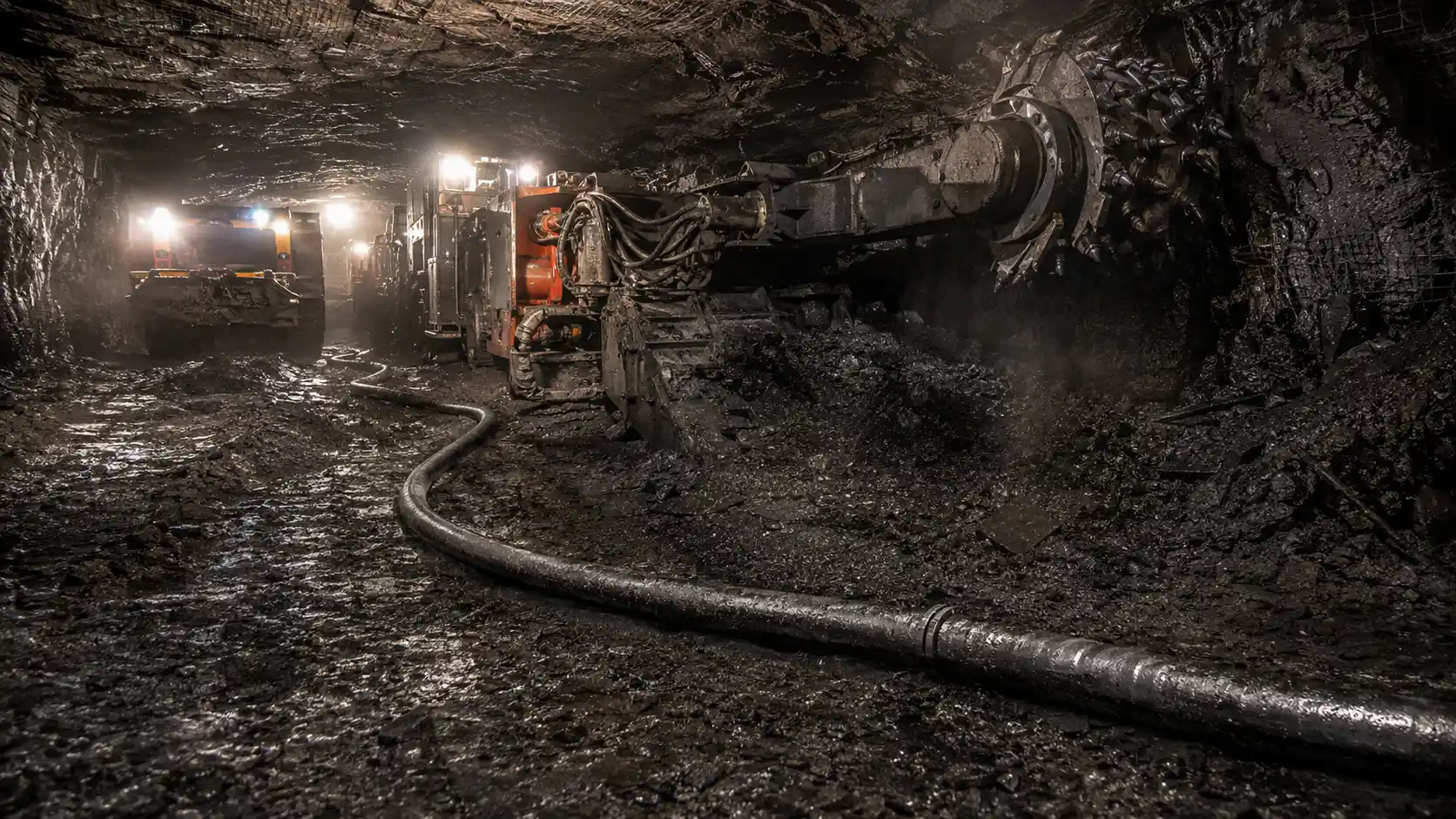
SHD cable is trailing-cable duty: the flexible feed between a substation or power centre and a machine that moves while energised. If the equipment is medium voltage and does not stand still, it is probably on an SHD family cable.
- Electric shovels and draglines — long trailing runs across open-pit benches, dragged and repositioned constantly.
- Continuous miners and loaders — underground face equipment where the ground-check circuit is the crew’s protection.
- Longwall shearers and face conveyors — the duty that drives the pilot-conductor variants and § 75.814(e) monitoring.
- Drills, crushers and mobile conveyors — medium-voltage feeds that get moved as the pit advances.
- Dredging and heavy civil plant — the “and similar applications” half of the standard’s own title.
What all of these share is that the cable is a moving part. It is the only component in the power path that gets walked on, driven over and reeled — which is why the H and the D are in the name at all.
How to read the print legend on a real cable
The jacket print is the shortest route to knowing what you actually have on the reel. A legend on an SHD-family cable normally carries six things, in roughly this order.
- Maker and cable name. Ignore trade names for a moment; they sit alongside the type, not instead of it.
- Type designation. SHD, SHD-GC, SHD-CGC, SHD-PCG. This is the entry you match against the standard.
- Conductor count and size. For example 3/C plus grounds, with an AWG or kcmil size.
- Voltage rating. 2 kV, 5 kV, 8 kV, 15 kV or 25 kV, sometimes with the insulation level.
- Standard reference. ICEA S-75-381 or NEMA WC 58, which tells you the construction is claimed against the standard.
- Approval marking. An MSHA acceptance number if the construction carries one. Its absence is meaningful.
If the print says only “SHD” and your protection relay expects a ground-check circuit, stop. A base SHD has no monitoring conductor to terminate, and no amount of clever termination invents one.
Four ways the designation gets misread
1. Treating SHD and SHD-GC as the same thing
They share a section in the standard but not a conductor count. Ordering “SHD” when the system needs continuity monitoring produces a cable that cannot be commissioned.
2. Reading S as an overall screen
On instrumentation cable, “shielded” usually means one screen around everything. On SHD it means one shield per power conductor. A cable with a single overall braid is not an SHD construction, whatever the seller calls it.
3. Assuming the family name fixes the voltage
The standard permits the SHD family up to 25,000 V. That is a ceiling for the family, not a rating for the cable in front of you. The voltage class is a separate line on the specification.
4. Treating the type designation as an approval
A designation describes construction. MSHA acceptance is granted to a specific product. The two are frequently conflated in tender documents, and it is much cheaper to catch it at enquiry stage than at delivery.
Product references
Once the designation is settled, the next question is construction detail. These records carry the voltage classes, conductor arrangements and dimensional data for each variant.
Frequently asked questions
What does SHD stand for in mining cables?
SHD stands for Shielded Heavy Duty. It designates a portable mining power cable in which every power conductor carries its own metallic shield, built for medium-voltage trailing duty. The designation is defined in ANSI/NEMA WC 58 / ICEA S-75-381, which covers the family up to 25,000 volts.
What does the GC in SHD-GC stand for?
GC stands for ground check. It is an insulated conductor inside the cable that lets a fail-safe monitoring circuit watch grounding continuity continuously. Under 30 CFR § 75.803 the breaker must open if that ground or pilot check wire breaks, so the conductor is a protection component, not an extra.
Is SHD the same as SHD-GC?
No. They share one entry in the standard, but base SHD has no ground-check conductor and SHD-GC does. If your protection system monitors ground continuity, you need the GC version. In practice most modern medium-voltage mining installations specify SHD-GC.
What is the difference between SHD-GC and SHD-CGC?
Both are shielded and both carry a ground-check conductor. SHD-CGC is the standard’s three-grounding-conductor construction, with the ground-check conductor positioned at the cable centre. SHD-GC uses grounding conductors laid in the interstices. It is a grounding-layout difference, not a shielding difference.
What voltage is type SHD cable rated for?
The standard covers the SHD family up to 25,000 volts. Individual constructions are offered at specific classes — commonly 2 kV, 5 kV, 8 kV, 15 kV and 25 kV. The family name never sets the rating on its own; always confirm the voltage class on the print and the datasheet.
Is type SHD cable shielded overall or per conductor?
Per conductor. Each power conductor has its own semi-conducting layer and metallic shield, so the electric field is confined radially within each core. A cable with only one overall braid around the bundle is a different construction and should not be offered as SHD.
Does SHD-GC cable have to be MSHA approved?
In US underground coal mines, 30 CFR § 75.600 requires cables accepted or approved by MSHA as flame resistant. That acceptance attaches to a specific construction, not to the SHD-GC name, so a cable printed SHD-GC is not automatically accepted. Confirm it as a contract clause.
Which standard defines type SHD mining cable?
ANSI/NEMA WC 58 / ICEA S-75-381, “Portable and Power Feeder Cables for Use in Mines and Similar Applications.” Section 3.10 covers the shielded portable types, with separate entries for Type SH, SHC-GC, SHD and SHD-GC, SHD-CGC, SHD-PCG and SHD-Flat.
Sources and editorial scope
- ANSI/NEMA WC 58 / ICEA S-75-381, Portable and Power Feeder Cables for Use in Mines and Similar Applications — contents and scope (NEMA).
- 30 CFR Part 75 Subpart I, Underground High-Voltage Distribution — §§ 75.803, 75.803-1, 75.804, 75.814 (eCFR).
- 30 CFR Part 75 Subpart G, Trailing Cables — §§ 75.600, 75.601, 75.603, 75.604 (eCFR).
Editorial basis
Written from the published contents of ANSI/NEMA WC 58 / ICEA S-75-381 and the current text of 30 CFR Part 75, together with the construction records of cables we manufacture. Reviewed by the TEBAOFLEX cable engineering team — a special-cable factory in production since 2014, certified to UL, cUL and VDE.
Use limit
This article explains a designation. It is not an approval document, a compliance opinion or a substitute for your mine’s electrical engineer. Confirm voltage class, grounding architecture and MSHA acceptance against the specific construction before purchase.