









Selecting a trackless mining cable for underground rubber-tyred mobile machinery is fundamentally different from specifying a fixed shaft feeder or an open-pit shovel cable. In board-and-pillar platinum, chrome, gold, copper-cobalt, and coal workings—as well as hard-rock sublevel stoping and decline development headings—load-haul-dump (LHD) scooptrams, electro-hydraulic drill jumbos, roof bolters, scalers, and shuttle cars manoeuvre freely without rail tracks. Their flexible power cables are continuously wound on and off onboard hydraulic reels, dragged across sharp blasted rock, bent around tight crosscut corners, and exposed to rubber-tyred vehicle traffic in dark, wet haulage ways.
Drawing on real engineering enquiries from underground trackless mines across South Africa, Zambia, the Democratic Republic of the Congo, and Latin America, this guide explains how to match a trackless mining cable to your fleet duty, why mine electrical engineers customize 3×35 mm² and 3×50 mm² earth and pilot core splits, how South African SANS 1520 designations (Type 41, Type 61A, Type 61B, Type 63, Type 66, Type 611, and Type 622) compare with DIN VDE and Australian constructions, when to add co-extruded underground reflective strips, and why pre-cut 100 m reels frequently outperform standard 500 m factory drums underground. You can browse our full range of underground and surface mining & tunneling cables or review our broader underground vs surface mining cable selection guide for cross-application comparisons.
What Makes an Underground Trackless Mining Cable Different from Standard Trailing Cables
In rail-bound underground haulage or fixed longwall faces, cable trajectories are predictable. By contrast, a rubber-tyred trackless fleet operates across multiple headings, crosscuts, and declines during a single shift. Depending on the machine, a trackless mining cable experiences one of two mechanical regimes—or a combination of both:
- Dynamic horizontal drum-reeling duty (LHD scooptrams, shuttle cars, utility vehicles): Electric LHD loaders and shuttle cars anchor their cable at a gate-end box or mid-heading tie-off point and tram back and forth between the muck pile and the ore pass or crusher tip. The onboard hydraulic reel winds and pays out
80 mto250 mof cable under continuous axial tension, reverse bending over guide rollers, and multi-layer drum compression. Without an open-weave anti-torsion reinforcement braid embedded between the inner and outer elastomer sheaths, the insulated cores corkscrew inside the jacket (core birdcaging), snapping pilot wires and phase strands prematurely. - Semi-mobile heading drag and positioning duty (electro-hydraulic drill jumbos, roof bolters, mobile scalers): Face drill jumbos and bolting rigs tram into a heading, pay out their cable from an onboard reel, and rest the cable along the drift floor or on temporary rib hooks while drilling and bolting. Here the dominant hazards are sharp blasted quartz or norite rock abrasion, hydraulic oil and drilling emulsion splashes, and accidental run-over by rubber-tyred haul trucks and LHD loaders.
Regulatory frameworks for underground mobile equipment—including the U.S. Mine Safety and Health Administration (MSHA) 30 CFR Part 75 and Part 57 electrical safety regulations and 30 CFR Part 75 mandatory underground electrical safety standards on eCFR—emphasize two non-negotiable electrical safeguards for underground flexible cables: continuous earth-continuity monitoring via pilot cores so the gate-end contactor trips before a severed core arcs, and individual phase screening (or symmetrical earth paths) to force any internal insulation fault directly to earth. To understand how reeling tension and floor dragging alter internal lay length and reinforcement, see our engineering breakdown of mining reeling cable vs trailing cable constructions and our 0.6/1 kV low-voltage mining cable equipment guide.
| Underground Trackless Machine | Typical Voltage Class | Primary Mechanical Duty | Essential Structural Features | Recommended TEBAOFLEX Cable Families |
|---|---|---|---|---|
| Electric LHD scooptram / underground loader | 0.6/1 kV or 640/1100 V | High-cycle bi-directional horizontal drum reeling & crosscut dragging | Class 5 tinned copper (IEC 60228), EPR insulation, inner elastomer sheath, open-weave anti-torsion braid, PCP or PUR outer sheath | NSHTOEU 0.6/1 kV LHD Reeling Cable, GPM / GPM-RF PUR Reeling Cable, SANS 1520 Type 61A Cable |
| Electro-hydraulic face drill jumbo & production rig | 0.6/1 kV or 640/1100 V (up to 1.1 kV) | Intermittent reel payout, sharp rock floor abrasion, emulsion/oil exposure | High-tear polyurethane (PUR) or heavy-duty PCP jacket, central tensile core or anti-torsion braid, customized earth + dual pilot split | GPM-RF PUR Reeling Cable, POLYFLEX MINE 0.6/1 kV PUR Cable, SANS 1520 Type 41 / Type 61A Cable |
| Roof bolter, cable bolter & mobile scaler | 640/1100 V or 1.1 kV | Heading positioning, tight bend radii, rockfall impact | Composite or semi-conductive phase screens, earth-continuity pilot core, flame-retardant oil-resistant elastomer outer sheath | AS/NZS 1802 Type 241 Mining Cable, SANS 1520 Type 61A / 61B Cable, (N)SHOEU 0.6/1 kV Mining Rubber Cable |
| Underground coal & hard-rock shuttle car | 640/1100 V or 1.1 kV | Rapid back-and-forth reeling between continuous miner/loader and feeder-breaker | Short-pitch core lay, anti-torsion textile reinforcement, tight outer diameter control to fit multi-layer shuttle car reels | AS/NZS 1802 Type 275 Shuttle Car Cable, SANS 1520 Type 61A Cable |
| Trackless section mobile transformer & MV skid | 1.9/3.3 kV to 12.7/22 kV | Semi-mobile decline trailing & periodic section advance | Triple-extruded EPR insulation, tinned copper/nylon composite phase screens, earth + pilot monitoring cores | SANS 1520 Type 63 (1.9/3.3 kV), Type 66 (3.8/6.6 kV), Type 611 (6.35/11 kV), Type 622 (12.7/22 kV) |
Why South African and Hard-Rock Mines Customize 3×35 and 3×50 mm² Earth and Pilot Splits
One of the most frequent procurement bottlenecks in underground trackless mining cable enquiries occurs when a mine’s gate-end box and onboard coupler pinout do not match a generic catalogue cross-section. In European DIN VDE 0250-814 reeling cables such as (N)SHTOEU-J, the protective earth is typically split symmetrically into three interstitial conductors—for example, 3×35+3×16/3 mm², 3×50+3×25/3 mm², or 3×70+3×35/3 mm²—without dedicated pilot cores unless a special control configuration is ordered. Conversely, in many standard factory schedules for 0.6/1 kV trackless cables, a 3×50 mm² core layout is listed as 3×50+2×10+10 mm² (three 50 mm² phase cores, two 10 mm² auxiliary/pilot cores, and one 10 mm² earth core).
However, in recent enquiries from South African and Southern African underground platinum, chrome, and hard-rock mines, engineering teams regularly specify customized earth and pilot combinations to satisfy both half-size protective earth fault capacity and dual pilot/interlock monitoring circuits:
3×50+1×25+2×10 mm²(0.6/1 kVor640/1100 V): Instead of using a10 mm²earth conductor (3×50+2×10+10 mm²), the mine specifies a full half-size1×25 mm²protective earth conductor alongside2×10 mm²pilot/control cores. The25 mm²earth core provides the thermalI²tcapacity required by the mine’s earth-fault protection study over100 mto250 mheading runs, while the two10 mm²pilot cores carry the gate-end earth-continuity loop and remote stop/interlock signal without suffering mechanical breakage under reeling tension.3×35+1×16+2×6 mm²(0.6/1 kVor640/1100 V): For medium-duty drill jumbos, roof bolters, and smaller LHD loaders, mines frequently request three35 mm²flexible tinned copper phase cores, one16 mm²protective earth conductor (approximately half the phase cross-section), and two6 mm²pilot/control cores (3×35+1×16+2×6 mm²), often paired with a high-visibility outer sheath and an underground reflective strip.
All phase, earth, and pilot conductors in these TEBAOFLEX trackless mining cables are stranded from annealed tinned copper wires meeting Class 5 flexibility requirements under IEC 60228:2023 Conductors of insulated cables. Tinning each individual copper filament prevents sulfur tarnishing during high-temperature rubber vulcanization and stops black-copper oxidation when acidic mine water wicks into field coupler terminations.
| Trackless Core Configuration | Phase Cores (mm²) | Earth Core Arrangement (mm²) | Pilot / Control Cores (mm²) | Primary Gate-End & Coupler Use Case |
|---|---|---|---|---|
| 3×35+1×16+2×6 mm² (Custom South African / African Trackless) | 3 × 35 mm² | 1 × 16 mm² (dedicated half-size earth) | 2 × 6 mm² (dual pilot / remote interlock loop) | Single-boom & twin-boom drill jumbos, roof bolters, compact LHD loaders with dual-pilot gate-end monitoring |
| 3×50+1×25+2×10 mm² (Custom South African / African Trackless) | 3 × 50 mm² | 1 × 25 mm² (dedicated half-size earth) | 2 × 10 mm² (heavy-duty dual pilot / control loop) | Twin-boom jumbos, mid-size LHD scooptrams, and trackless section feeders requiring 50% earth fault section |
| 3×50+2×10+10 mm² (Standard 6-Core Trackless Schedule) | 3 × 50 mm² | 1 × 10 mm² | 2 × 10 mm² | General 0.6/1 kV trackless equipment where earth-fault relays are current-limited to 10 mm² earth capacity |
| 3×35+3×16/3 mm² to 3×70+3×35/3 mm² (DIN VDE 0250-814 Symmetrical) | 3 × 35, 50, or 70 mm² | 3 × 16/3, 25/3, or 35/3 mm² (3 interstitial split earths) | Optional integrated control cores on request | European-built LHD scooptrams and VFD-driven underground loaders requiring balanced 3-interstitial earth return |
| 3×50+3×8.5+1×1.26 mm² (AS/NZS 1802 Type 241.1 / Type 275.1) | 3 × 50 mm² | 3 × 8.5 mm² (interstitial earths or phase screens) | 1 × 1.26 mm² (central extensible pilot core) | Australian-standard underground continuous miners, shuttle cars, and bolters with single central pilot diode loop |
South African SANS 1520 Mining Cable Series: Type 41, Type 61A/61B, Type 63, Type 66, Type 611 and Type 622
In South African and Southern African underground mines operating under SANS 1520, flexible rubber trailing and reeling cables are classified by voltage grade (SANS 1520-1 for low-voltage 640/1100 V cables and SANS 1520-2 for medium-voltage 1.9/3.3 kV through 12.7/22 kV cables) and by internal core, screen, and pilot geometry. Specifying the correct SANS 1520 mining cable designation ensures immediate compatibility with South African flameproof and non-flameproof couplers, gate-end protection relays, and mine inspectorate audits.
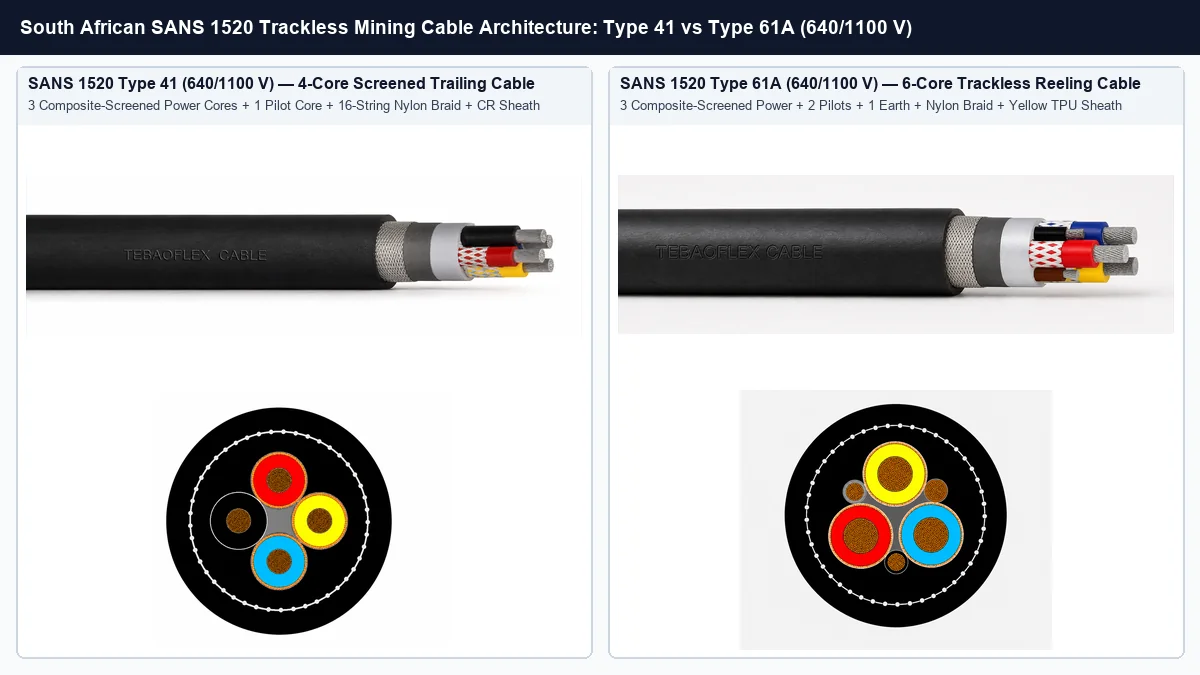
Unlike unscreened portable cords, SANS 1520 trackless mining cables surround each EPR-insulated power core with an individual composite phase screen woven from tinned copper wires and nylon strands (composite screen of tinned copper and nylon). If a sharp rock or pinch point crushes the cable in a haulage drift, the advancing object must contact the grounded tinned-copper/nylon composite screen before reaching a live phase conductor—triggering instantaneous earth-leakage isolation at the gate-end box. Over the laid-up cores and elastomers (CR polychloroprene inner sheath), an open-weave 16-string nylon reinforcement braid locks the inner and outer sheaths together to resist reeling torsion and longitudinal stretch.
- SANS 1520 Type 41 Cable (640/1100 V): A 4-core cradle-centre construction comprising
3individually composite-screened power cores (tinned copper + EPR insulation + tinned-copper/nylon composite screen) plus1unscreened pilot core laid around a profiled elastomer cradle centre, enclosed by aCRinner sheath, open nylon reinforcement braid, and heavy-dutyCRouter sheath. Widely used on low-voltage underground coal and hard-rock trailing equipment where earth return is carried through the three composite phase screens and monitored via the single pilot core. - SANS 1520 Type 61A and Type 61B Cable (640/1100 V): A 6-core trackless trailing and reeling construction featuring
3composite-screened power cores,2unscreened pilot cores, and1unscreened earth core laid around a central elastomer cradle, reinforced with an open nylon braid between the inner sheath and the outer jacket. In TEBAOFLEX manufacturing datasheets,Type 61Autilizes a high-visibility thermoplastic polyurethane (TPU / PUR) outer sheath for superior cut, tear, and rock-abrasion resistance on LHD scooptram and drill jumbo reels, whereasType 61Butilizes a heavy-duty chloroprene rubber (CR / PCP) outer sheath where flame retardance and thermal deformability in coal or hot stopes are prioritized. - SANS 1520 Type 63 Mining Cable (1.9/3.3 kV): Steps up to
1.9/3.3 kVmedium-voltage section equipment (35 mm²to185 mm²), combining3composite-screened EPR power cores (semi-conductive tape + EPR + semi-conductive layer + tinned-copper/nylon composite screen),2pilot cores, and1earth core inside a braid-reinforcedCRinner/outer sheath system (38.2 mmto64.0 mmnominal OD). - SANS 1520 Type 66 / 66-ECC (3.8/6.6 kV), Type 611 / 611-ECC (6.35/11 kV), and Type 622 / 622-ECC (12.7/22 kV): Medium-voltage flexible trailing and reeling feeders for underground mobile transformers, shaft-bottom substations, and large mobile excavation units. Available in standard composite-screened builds (
Type 66,Type 611,Type 622) or with an enlarged earth continuity conductor (66-ECC,611-ECC,622-ECC) laid alongside two pilot cores inside a braid-reinforced heavy-dutyCRjacket.
| SANS 1520 Designation | Rated Voltage (Uo/U) | Core & Screen Architecture | Inner / Reinforcement / Outer Sheath | Typical Nominal OD & Mass Range (TEBAOFLEX Datasheets) |
|---|---|---|---|---|
| SANS 1520 Type 41 | 640 / 1100 V | 3 composite-screened power cores + 1 unscreened pilot core + cradle centre | CR inner sheath + 16-string open nylon braid + CR outer sheath | 16–185 mm²: 32.8–64.7 mm OD; 1,450–8,490 kg/km |
| SANS 1520 Type 61A | 640 / 1100 V | 3 composite-screened power cores + 2 pilot cores + 1 earth core + cradle centre | CR inner sheath + 16-string open nylon braid + yellow/high-vis TPU (PUR) outer sheath | 16–95 mm²: 31.6–52.3 mm OD; 1,500–5,610 kg/km |
| SANS 1520 Type 61B | 640 / 1100 V | 3 composite-screened power cores + 2 pilot cores + 1 earth core + cradle centre | CR inner sheath + 16-string open nylon braid + heavy-duty CR (PCP) outer sheath | 16–95 mm²: 31.6–52.3 mm OD; 1,520–5,640 kg/km |
| SANS 1520 Type 63 | 1.9 / 3.3 kV | 3 semi-con + composite-screened MV power cores + 2 pilot cores + 1 earth core | CR inner sheath + open nylon braid + CR outer sheath | 35–185 mm²: 38.2–64.0 mm OD; 2,250–8,190 kg/km |
| SANS 1520 Type 66 / 66-ECC | 3.8 / 6.6 kV | 3 composite-screened MV power cores + 2 pilots + 1 earth (or ECC) | CR inner sheath + open nylon braid + CR outer sheath | 25–185 mm²: 42.1–68.9 mm OD; 2,530–8,660 kg/km |
| SANS 1520 Type 611 / 611-ECC | 6.35 / 11 kV | 3 composite-screened MV power cores + 2 pilots + 1 earth (or ECC) | CR inner sheath + open nylon braid + CR outer sheath | 25–185 mm²: 46.8–73.6 mm OD; 3,020–9,790 kg/km |
| SANS 1520 Type 622 / 622-ECC | 12.7 / 22 kV | 3 composite-screened MV power cores + 2 pilots + 1 earth (or ECC) | CR inner sheath + open nylon braid + CR outer sheath | 35–150 mm²: 61.3–81.2 mm OD; 4,840–10,120 kg/km |
LHD Scooptram Reeling Cable and Drill Jumbo Options: (N)SHTOEU-J, GPM-RF, POLYFLEX MINE and AS/NZS 1802
When an electric LHD scooptram or hard-rock utility vehicle winds and pays out cable under hydraulic tension, international mines outside the SANS 1520 regime typically standardize on one of three proven trackless reeling architectures: European DIN VDE 0250-814 rubber reeling cables, polyurethane (PUR) anti-torsion reeling cables, or Australian AS/NZS 1802 screened elastomers.

1. DIN VDE 0250-814 (N)SHTOEU-J for High-Tension LHD Scooptram Reels
For tether-powered LHD loaders, mobile mucking units, and heavy drum-reeling machinery, our NSHTOEU 0.6/1 kV LHD Mining Reeling Cable combines 3EPR cross-linked ethylene-propylene insulation with a two-layer 5GM5 polychloroprene (PCP) inner and outer sheath vulcanized around an open-weave anti-torsion aramid/synthetic textile braid. As documented in TEBAOFLEX factory order inspections—such as our yellow-sheathed (N)SHTOEU-J 0.6/1 kV 3×70+3×35/3 and 3×185+3×95/3 builds (measured at 44.45 mm and 63.23 mm outer diameter, verified at 3,657 V AC for a full 5 minutes with insulation resistance >5,000 MΩ at 2.5 kV DC as of October 2026)—the open-weave braid allows the inner and outer rubber layers to vulcanize through the mesh openings into a single non-slipping wall. Where the cable is dragged along the drift floor without dynamic drum reeling, mines can instead specify our non-reeling (N)SHOEU 0.6/1 kV Mining Rubber Flexible Cable.
2. GPM / GPM-RF and POLYFLEX MINE Polyurethane (PUR) Cables for Hard-Rock Drill Jumbos
In hard-rock development headings where blasted granite, quartz, or basalt rapidly shreds conventional rubber jackets, polyurethane (PUR / 11Y) outer sheaths offer dramatically higher tear propagation and cut resistance. Our GPM / GPM-RF 0.6/1 kV PUR Reeling Cable (rated 0.6/1 kV with 1.2 kV maximum system voltage) and POLYFLEX MINE 0.6/1 kV Heavy-Duty PUR Mining Cable are engineered specifically for underground drill jumbo cable applications. In multi-core control and auxiliary reeling configurations such as GPM-RF 24G2.5 0.6/1(1.2) kV, a central strain-bearing aramid/elastomer core works together with a sub-sheath anti-torsion braid and a high-visibility green or yellow PUR jacket to prevent core elongation during high-speed reel recovery.
3. AS/NZS 1802 Type 241.1 and Type 275.1 for Australian-Standard Trackless Fleets
Where mines follow Australian underground safety regulations (AS/NZS 1802), trackless continuous miners, roof bolters, and utility loaders use AS/NZS 1802 Type 241 Mining Cable (Type 241.1 at 1.1 kV, 3 semi-conductive-screened power cores + 3 interstitial tinned copper earth cores + 1 central extensible pilot core, such as 3×50+3×8.5+1×1.26 mm²), while high-speed rubber-tyred shuttle cars use AS/NZS 1802 Type 275.1 Shuttle Car Cable.
Underground Reflective Strip Mining Cable Options and High-Visibility Outer Sheaths
One of the highest-cost operational failures in underground trackless mining is accidental vehicle run-over. In poorly lit declines, crosscuts, and mucking bays, dark or mud-coated cables blend into wet grey rock dust on the haulage floor. When a 40-tonne dump truck or LHD scooptram drives over an energized trailing cable against sharp blasted rock, even an internal composite screen or PUR jacket can suffer localized phase-to-earth crushing.
To reduce run-over incidents, South African and international underground mine buyers increasingly specify a reflective strip mining cable alongside high-contrast outer jacket colours:
- Co-extruded or bonded underground reflective strips: During outer-sheath extrusion and vulcanization, longitudinal or helical high-visibility reflective strips (or photoluminescent / retro-reflective bands) are integrated along the cable exterior. When the headlamp beam of an approaching LHD scooptram, utility vehicle, or drill jumbo sweeps across the drift floor, the reflective strip returns a bright visual line through dust and water spray, alerting the operator before the tyres reach the cable.
- High-visibility yellow, orange, and green outer sheaths: Instead of standard black neoprene (
PCP), underground trackless reeling and trailing cables—including(N)SHTOEU-J,SANS 1520 Type 61A,GPM-RF, andAS/NZS 1802 Type 241.1—can be manufactured with high-visibility yellow, fluorescent green, or orangePCPorPURouter sheaths. - Permanent embossed or contrast-printed meter and spec markings: Clear identification legends (for example,
TEBAOFLEX CABLE GPM-RF 24G2.5 0.6/1(1.2)KVor custom3×35+1×16+2×6 mm²print lines) allow underground electricians to verify voltage grade, core split, and remaining reel length during shift inspections. As of August 2026, TEBAOFLEX supports OEM/ODM outer-sheath colour, reflective strip integration, and custom sheath/drum markings starting from a minimum order quantity (MOQ) of50 m.
100 m vs 500 m Drum Cuts: Shaft Cage Clearances, Gate-End Box Spacing and Splice Prevention
When surface or open-pit mines order trailing cables under SANS 1520 or DIN VDE 0250, 500 m or 1,000 m continuous lengths on large wooden or steel-wood drums are standard. However, in real underground trackless mining enquiries as of October 2026—such as a South African inquiry for 700 m of 3×35+1×16+2×6 mm² reflective-strip cable requested on both 100 m/reel and 500 m/reel options—procurement and shaft-logistics teams must weigh drum geometry against underground handling realities:
- Vertical shaft cage and decline transport clearances: A single
500 mreel of3×50+1×25+2×10 mm²(~44–46 mmOD,~3.8–4.2 kg/m) weighs roughly2.0to2.3 tonnesincluding the timber drum and requires a flange diameter of1,600 mmto1,800 mm. Many older vertical shaft man-and-material cages and underground low-profile cassette carriers cannot accommodate drums wider than1,200 mmto1,350 mmwithout slinging the reel beneath the cage. By contrast, a pre-cut100 m/reeldrum weighs approximately420 kgto500 kgand fits compactly inside standard shaft cages, underground service vehicles, and stope storage bays. - Matching onboard LHD and jumbo reel capacity (
100 mto200 m): Most underground electro-hydraulic drill jumbos, roof bolters, and compact LHD scooptrams hold between90 mand180 mof cable on their onboard hydraulic reel, matching the standard100 mto150 mspacing between underground gate-end distribution boxes. Ordering pre-cut100 m(or machine-specific120 m/150 m) factory reels allows maintenance crews to mount a fresh reel directly at the underground workshop and terminate the coupler without unspooling, measuring, and cutting a500 mmaster drum in a dusty underground drift. - Eliminating underground field splices: Every mid-span vulcanized splice on a dynamic LHD reeling cable creates a stiff diameter bulge that catches on roller guides and concentrates bending stress. Ordering exact machine-length reels (
100 m,125 m,150 m, or200 m) eliminates unnecessary mid-cable splices while keeping spare replacement reels ready for rapid shift changeovers. For broader guidance on matching underground and surface power architecture, see our mining and tunneling cable solutions hub.
| Drum Cut Strategy | Typical Reel Length | Approx. Gross Drum Weight (3×35 to 3×50 mm²) | Primary Operational Advantage | Best Suited Underground Scenario |
|---|---|---|---|---|
| Pre-cut Machine Reels (100 m / reel) | 100 m (or custom 120 m / 150 m per machine reel) | ~350–520 kg per drum | Fits directly into vertical shaft cages; zero underground unspooling or cutting; direct swap onto drill jumbo or LHD reel | Deep vertical-shaft mines (gold, platinum, chrome) and multi-heading drill jumbo / bolter fleets |
| Extended Section Reels (200 m – 250 m / reel) | 200 m – 250 m | ~750–1,100 kg per drum | Matches long-travel electric LHD scooptrams and long decline development headings without mid-span couplers | Ramp-access hard-rock mines with drive-in utility cassette trucks and long-haul electric LHDs |
| Bulk Master Drums (500 m / reel) | 500 m | ~1,800–2,400 kg per drum | Lowest packaging volume per linear meter for surface storehouse stock and variable-length surface-cut feeder drops | Mines with a dedicated surface cable-cutting and coupler-fitting shop that pre-terminates cables before shaft lowering |
How to Specify a Trackless Mining Cable RFQ and Frequently Asked Engineering Questions
At our manufacturing facility at No. 77 Wusongbang Road, Fuqiao Town, Taicang City, Suzhou, Jiangsu Province, China (>20,000 m² total site area including 15,000 m² of production workshops and warehouses, 12 automated production lines across compounding, extrusion, braiding, cabling, and packaging, and an annual capacity of approximately 150,000 km/year as of August 2026), Jiangsu Tebaoflex Special Cable (TEBAOFLEX) manufactures custom and standard trackless mining cables exported to more than 20 countries and regions across Africa, South America, Southeast Asia, Australia, and Europe.
As of August 2026, our minimum order quantity (MOQ) is 50 m for both standard catalogue sizes and customized constructions (including 3×35+1×16+2×6 mm² and 3×50+1×25+2×10 mm² core splits, reflective strips, and custom 100 m or 500 m drum cuts), and our standard production lead time ranges from 7 to 45 working days depending on product type, stock status, and customization requirements (written quotations are subject to sales confirmation). To request a dimensional drawing, maximum outer diameter verification, and itemized quotation for your fleet, submit your parameters via our request-a-quote engineering form with the following checklist:
- Machine type & movement duty: LHD scooptram (continuous bi-directional drum reeling), electro-hydraulic drill jumbo, roof bolter, shuttle car, or semi-mobile section feeder.
- Governing standard & voltage rating:
SANS 1520(Type 41,Type 61A,Type 61B,Type 63,Type 66,Type 611,Type 622at640/1100 Vto12.7/22 kV),DIN VDE 0250-814((N)SHTOEU-J 0.6/1 kV),GPM / GPM-RF 0.6/1(1.2) kV, orAS/NZS 1802(Type 241.1/Type 275.1 1.1 kV). - Exact phase, earth, and pilot core split: Specify whether your gate-end box and coupler require
3×35+1×16+2×6 mm²,3×50+1×25+2×10 mm²,3×50+2×10+10 mm²,3×70+3×35/3 mm², or3×50+3×8.5+1×1.26 mm². - Outer sheath material & visibility options: Heavy-duty
PCP / CRrubber or tear-resistantPUR / TPU, high-visibility yellow/green/orange colour, and whether an underground reflective strip is required. - Drum cut length & packaging: Specify total meterage and individual reel cuts (for example,
7 × 100 mshaft-cage reels vs500 mmaster drums) on fumigated wooden, steel-wood, or steel drums.
Frequently Asked Questions
What is the difference between SANS 1520 Type 41 and Type 61A trackless mining cables?
Under SANS 1520-1 (640/1100 V), both cables use three EPR-insulated power cores with individual tinned-copper/nylon composite screens and a 16-string open nylon reinforcement braid. Type 41 is a 4-core cable (3 screened power cores + 1 pilot core) with a chloroprene (CR) outer sheath that uses the composite screens as the earth path. Type 61A is a 6-core cable (3 screened power cores + 2 pilots + 1 dedicated earth core) with a high-visibility polyurethane (TPU / PUR) jacket (Type 61B uses CR) for heavy-abrasion trackless LHD and jumbo reels.
Why do underground mines specify 3×50+1×25+2×10 mm² instead of 3×50+2×10+10 mm²?
In a standard 3×50+2×10+10 mm² cable (IEC 60228 Class 5 conductors), the protective earth core is only 10 mm² (20% of the 50 mm² phase cross-section). Many South African SANS 1520 and international hard-rock mine electrical standards require the dedicated protective earth conductor in a trailing or reeling cable to equal at least 50% of the phase cross-section (25 mm² for 50 mm² phases, or 16 mm² for 35 mm² phases in 3×35+1×16+2×6 mm²) to carry earth-fault current safely while keeping two 10 mm² (or 6 mm²) pilot cores for dual earth-continuity and interlock monitoring.
Does adding an anti-torsion braid or underground reflective strip increase the cable outer diameter beyond coupler limits?
No, when engineered as part of the original extrusion build. The open-weave anti-torsion nylon or aramid braid is embedded directly inside the elastomer wall between the inner and outer sheaths so both layers vulcanize through the mesh without inflating the nominal outer diameter. Similarly, co-extruded or flush-bonded underground reflective strips are integrated into the outer sheath profile so the finished cable passes smoothly through existing reel guide rollers and flameproof/IP68 coupler glands.