









An underground mining cable is a flame-retardant, earth-screened or pilot-monitored flexible power, control, or communication cable engineered with reference to standards such as AS/NZS 1802, MT/T 818, and BS 6708 to operate inside confined coal seams, hard-rock declines, and vertical mine shafts without propagating fire or exposing personnel to unisolated phase faults. While surface mining cables and open pit mining cable constructions under ICEA S-75-381, AS/NZS 2802, and DIN VDE 0250-813 prioritize ultraviolet weathering stability, high-voltage bench transmission up to 33 kV or 35 kV, and extreme rock-cut resistance under heavy shovel and dragline reels, underground mining cables must prioritize methane and coal-dust ignition prevention, tight-radius cable-handler flexing, low-visibility roadway run-over protection, and symmetrical ground-check monitoring.
Across TEBAOFLEX’s mining and tunneling cables manufacturing program, engineers divide tunnel & underground mining cables and open-pit constructions into three distinct operating environments. Gassy underground coal seams rely on MT/T 818 (MCP, MCPTJ, MYP, MYPT, MYPTJ) and AS/NZS 1802 200-series constructions. Underground hard-rock headings and vertical shafts deploy DIN VDE GPM-RF polyurethane jumbo cables, trackless 3×35 mm² and 3×50 mm² trailing cables, borehole shaft armour, and 2000 V VFD drives. Surface open-pit benches specify ICEA S-75-381 Type SHD-GC and Type G-GC, GB/T 12972 UGF/UGEFP, AS/NZS 2802 400-series, and DIN VDE 0250-813 (N)TSCGEWOEU.
Why underground mining cables and surface mining cables follow different design rules
Selecting between an underground mining cable and a surface open-pit cable starts with the physical hazards of the mine workzone rather than conductor ampacity alone. Regulatory bodies such as the U.S. Mine Safety and Health Administration (MSHA) (which separates underground coal mine electrical rules under 30 CFR Part 75 from surface coal rules under 30 CFR Part 77) and state inspectorates such as the NSW Resources Regulator in Australia enforce strict boundaries between underground coal faces, underground metalliferous drives, and open-cut surface pits.
Five engineering factors separate underground mining cables from surface mining cables:
- Explosive atmosphere and fire propagation control: In gassy underground coal seams, any phase-to-phase arc can ignite methane (
CH4) or suspended coal dust, and burning cable jacketing can fill confined ventilation airways with toxic smoke. A coal mining cable must surround each insulated power core with an individual metallic or semi-conductive earth screen so any rock crush produces a low-energy phase-to-earth fault that trips the gate-end contactor in milliseconds. - Voltage ceiling vs haul-road transmission distance: Underground face machinery (continuous miners, longwall shearers, shuttle cars, roof bolters, and drill jumbos) typically operates at
0.38/0.66 kV,0.6/1 kV,0.66/1.14 kV,1.1/1.1 kV,1.9/3.3 kV,3.3/3.3 kV, or6/10 kV(11 kVmax inAS/NZS 1802). Open-pit electric rope shovels, walking draglines, and bucket-wheel excavators underICEA S-75-381andAS/NZS 2802trail hundreds of meters across exposed benches and require5 kV,8 kV,15 kV,22 kV,25 kV, or33 kVtrailing feeders to control voltage drop. - Bend radius and cable-handler kinematics: Underground roadways and low-seam coal headings force cables through compact onboard monospiral reels, shuttle-car sheaves, and articulated Bretby longwall cable chains (
4 × Dto6 × ODminimum bend radius), built around Class 5 or Class 6 flexible tinned or bare copper stranding aligned with IEC 60228:2023. Surface shovel and dragline cables use thicker medium-voltage insulation walls and require larger6 × ODto12 × ODbending radii. - Solar UV, ambient temperature extremes, and water immersion: Surface mining cables under
GB/T 12972andICEA S-75-381lie exposed on open-pit benches under intense solar ultraviolet radiation (such as high-altitude Andean copper and gold pits above4,000 m), freeze-thaw cycles down to-40 °C, and acid pit-water pooling around submersible dewatering pumps. Underground cables operate out of direct sunlight but face constant warm humidity, hydraulic drilling-oil mist, alkaline shotcrete runoff, and dark haulage roadways. - Vertical self-support vs horizontal bench dragging: Feeding underground substations from surface switchyards requires vertical borehole or shaft suspension cables engineered with reference to
IEC 60502orMT/T 818to support their own deadweight over100–600 mvertical drops, whereas open-pit feeders are dragged horizontally on skids or wound onto mobile drums.
| Engineering parameter | Underground coal mining cable (Longwall & Roadway) | Underground hard-rock & tunnel cable (Jumbo, LHD & Shaft) | Surface / open pit mining cable (Shovel, Dragline & Dewatering) |
|---|---|---|---|
| Primary standards referenced | MT/T 818.3–818.7, AS/NZS 1802 (200-series), AS/NZS 1972, BS 6708 | DIN VDE 0250-812 / 813, AS/NZS 2802 (Type 409 / 412 / 441.1), ICEA S-75-381 | ICEA S-75-381 / NEMA WC 58, AS/NZS 2802 (Class 1 400-series), GB/T 12972, DIN VDE 0250-813 |
| Typical system voltage ($U_0/U$) | 0.38/0.66 kV, 0.66/1.14 kV, 1.1/1.1 kV, 1.9/3.3 kV, 3.6/6 kV, 6/10 kV, 11/11 kV | 0.6/1 (1.2) kV, 1.1/1.1 kV, 600/2000 V, 3.6/6 kV, 6/10 kV | 2000 V (2 kV), 3.3/3.3 kV, 3.6/6 kV, 5 kV, 6/10 kV, 8 kV, 15 kV, 22 kV, 25 kV, 33 kV |
| Phase screening & earth layout | Mandatory individual phase earth screens (composite copper/textile braid or semi-conductive elastomer) + 1 or 3 pilots | Symmetrical 3P + 1E + 2P, 3P + 2E + 1P, or 3P + 3E (for 2 kV VFD); optional phase screens at MV | Tinned copper braid shield over semi-conductive layer (SHD-GC, (N)TSCGEWOEU) or unscreened 2 kV (Type G-GC) |
| Outer sheath compound & visibility | Flame-retardant HD-85-PCP polychloroprene or CPE (C1 / MT/T 386 flame tests) | Tear-resistant PUR / TPU (green/yellow) or elastomer sheath with optional reflective strips for dark headings | UV-stabilized extra-heavy-duty XHD-85-PCP, CPE, or high-abrasion TPU in yellow, orange, or black |
| Dominant mechanical failure mode | Cable-chain flexing fatigue, shuttle-car bidirectional tension, and coal-face crush | Sharp granite/quartz cut-through, hydraulic oil swelling, and LHD tire run-over in low light | High-tension multi-layer drum crushing, blasted bench rock abrasion, and aged sheath thermal swelling |
Coal mining cable & longwall mining cable selection (MCP/MCPTJ, MYP/MYPTJ, AS/NZS 1802)
In underground coal extraction, every mobile cable feeding a shearer, continuous miner, shuttle car, or roadway gate-end box must pair thermoset ethylene-propylene rubber (EPR / R-EP-90) insulation with individual core screening and continuous pilot-circuit monitoring. As covered in our AS/NZS 1802 vs AS/NZS 2802 Australian mining cable guide, Australian underground coal mines standardize on the 200-series (AS/NZS 1802), while coal mines following Chinese MT/T 818 coal-safety specifications deploy the MC (MCP / MCPTJ) and MY (MYP / MYPT / MYPTJ) series.
Longwall shearer cables (MCP / MCPTJ and AS/NZS 1802 Type 245 / 245UF)
A longwall mining cable travels thousands of cycles inside an articulated Bretby-style cable handler mounted along the armored face conveyor (AFC), bending repeatedly around a tight turnaround radius while carrying cutter-drum motor power and multi-channel pilot control signals:
- MCP and MCPTJ coal cutter shearer cable (
0.66/1.14 kVand1.9/3.3 kV,16–185 mm²): Manufactured with reference toMT/T 818.3andMT/T 818.4,MCPand monitoredMCPTJcables combine three flexible tinned/bare copper power cores insulated withEPR, individual copper/textile or semi-conductive phase screens, a dedicated earth core, and4to7multi-core control/pilot conductors (4–10 mm²) laid around a reinforced cradle inside a heavy-duty chlorinated polyethylene (CPE) or neoprene outer sheath. - Type 245UF ultra-flexible mining cable (
1.1/1.1 kVand3.3/3.3 kV,50–150 mm²): Built toAS/NZS 1802for Australian longwall faces,Type 245UFplaces three extensible insulated pilot cores (4.1 mm²) inside the central elastomer cradle surrounded by three ultra-fine-stranded (0.20 mmwire diameter)R-EP-90power cores and three semi-conductive-covered interstitial earth conductors inside an open-weave reinforcedHD-85-PCPsheath (6 × ODminimum bend radius).
Continuous miners, shuttle cars, and MA-certified coal roadway feeders (MYP / MYPT / MYPTJ, Type 240, Type 241, Type 275)
In room-and-pillar headings and longwall gate roads, cable selection separates continuous-miner/bolter trailing duty from high-speed shuttle-car reeling and medium-voltage mobile substation feeds:
- MYP and MYPT screened coal mining cable (
0.38/0.66 kV,0.66/1.14 kV, and1.9/3.3 kV) & MYPTJ monitored MV mining cable (3.6/6 kV,6/6 kV, and6/10 kV): Engineered for underground coal drills, mobile loaders, and gate-road mobile substations. Per TEBAOFLEX’s verified company profile, the factory holds six Chinese Coal Mine Safety Mark (MA) certificates (MIA230337,MIA230338,MIA230339,MIA230340,MIA230341, andMIA230261, valid2023-02-23to2028-02-28) coveringMYP(MT/T 818.5-2009),MYPT(MT/T 818.7-2009), andMYPTJ(MT/T 818.6-2009) across listed cross-sections (4–95 mm²and25–150 mm²). TheseMAapprovals apply specifically to Chinese coal mine jurisdictions and the exact model/cross-section combinations listed on each certificate. - Type 240 underground coal mine cable and Type 241 mining cable (
1.1/1.1 kVto11/11 kV): UnderAS/NZS 1802,Type 240pairs three tinned-copper/nylon composite-screened power cores with three interstitial pilots, whereasType 241uses non-metallic semi-conductive elastomer phase screens, three interstitial earths, and one central pilot (6–300 mm²) for continuous miners, roof bolters, and feeder breakers. - Type 275 shuttle car mining cable (
1.1/1.1 kV,10–95 mm²): Because bidirectional shuttle-car reeling fatigues metallic braid wires,AS/NZS 1802explicitly excludesType 240from shuttle-car reels and designatesType 275.1(3P + 3E + 1 central pilotinside an anti-torsionHD-85-PCPsheath) for high-cycle shuttle-car haulage.
Tunnel & underground mining cables for hard-rock headings, trackless fleets, and vertical shafts
Hard-rock gold, platinum, chromite, copper, and zinc mines—along with civil TBM and drill-and-blast tunnels—operate rubber-tired trackless fleets (hydraulic drill jumbos, scooptrams / LHD loaders, rock bolters, and shotcrete sprayers) over jagged quartz and granite floors flooded with drill water and hydraulic fluid.
Drill jumbos, African trackless 3×35 / 3×50 mm² configurations, and underground reflective strips
On underground hard-rock drill jumbos, roof bolters, and trackless LHD loaders, outer sheath cut-through and low-visibility vehicle run-over cause far more cable replacements than electrical insulation aging. For multi-boom face drilling and tunneling rigs explained in our underground drill jumbo cable solutions, TEBAOFLEX supplies both European DIN VDE polyurethane reeling constructions and customized regional trackless mining builds:
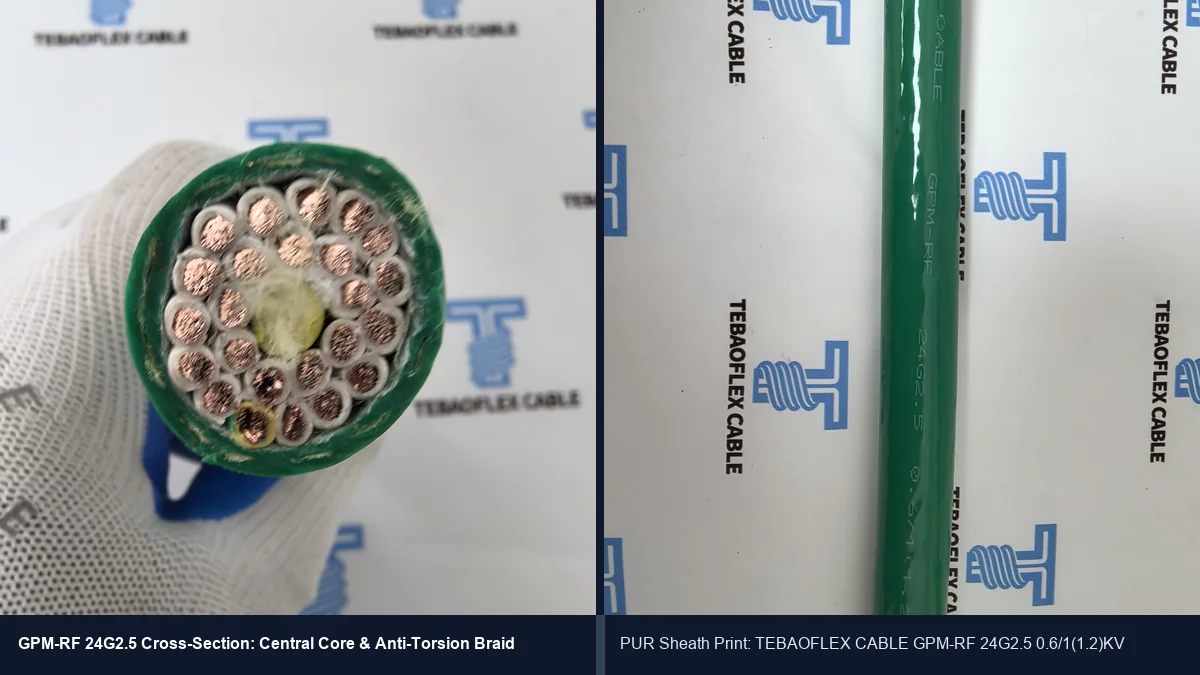
- GPM and GPM-RF PUR reeling cable (
0.6/1 kV, up to1.2 kVmax system voltage): Engineered with fine-stranded copper conductors, high-dielectric elastomer/TPE core insulation, a central aramid/elastomer tensile core, an integrated open-weave anti-torsion reinforcement braid (-RF), and a high-visibility green or yellow halogen-free polyurethane (PUR / TPU) outer jacket (4–50+cores, including control/valve configurations such asGPM-RF 24G2.5 0.6/1(1.2) kVand power+pilot builds up to95 mm²). ThePURjacket resists sharp granite abrasion, drilling emulsion oils, and high-pressure washdowns while keeping overall diameter compact on jumbo cable reels. - South African and African underground trackless mining cable builds (
3×35 mm²and3×50 mm²): In underground platinum, chrome, and gold trackless declines referencingSANS 1520/AS/NZS 1802/DIN VDE 0250practice, maintenance and procurement teams commonly specify0.6/1 kVor1.1/1.1 kVtrailing and reeling cables in sizes such as3×35+1×16+2×6 mm², standard3×50+2×10+10 mm², or customized3×50+1×25+2×10 mm²(upgrading the protective earth to25 mm²alongside two10 mm²pilot/control cores to match local earth-leakage relay settings). Where dark underground roadways create high tire run-over risk, TEBAOFLEX manufactures trackless cables with high-visibility co-extruded or spiral reflective strips along the outer sheath so LHD and dump-truck operators spot the cable immediately under cap-lamp or vehicle headlight beams; see our dedicated trackless mining cable selection guide for full SANS 1520 and LHD/jumbo specifications. - Matching reel lengths to underground gate-end spacing: While standard
IEC 60228/AS/NZS 1802factory drums are commonly wound at500 m/reelto minimize splices, underground trackless operations frequently order pre-cut100 m/reellengths (for example,700 mof35 mm²+300 mof50 mm²split onto100 mflange drums) so electricians can lower individual reels down shaft cages and connect directly between heading distribution boxes without underground cutting.
Drilling masts, 2000 V VFD drives, vertical shaft feeders, and leaky feeder radio coax
Beyond mobile face machines, a complete underground mine electrical network requires specialized cables for vertical power drop, variable-frequency ventilation/hoist drives, and subterranean radio communication:
- 600/2000V drilling mast cable: Extra-flexible elastomer power and control cable engineered for continuous vertical looping on production drill masts and raise-borer derricks without core corkscrewing.
- 2000V mining VFD cable: Symmetrical
3-phase + 3-split-ground(3P + 3E) construction with overall tinned-copper braid / foil EMC shielding (600 V / 1000 V / 2000 V) that contains high-frequency PWM common-mode shaft currents on underground mine ventilation fans, slurry pumps, and overland or drift conveyor drives. - Mine borehole and shaft armoured cable (
0.6/1 kVto35 kV): When dropping medium-voltage power from a surface substation through a vertical borehole or mine shaft into underground distribution switchgear, standard unarmoured cables stretch under their own copper weight. As detailed in our armoured and static mining cable guide, borehole and vertical shaft cables incorporate high-tensile galvanized steel wire armour (SWA/ pliable wire armour) locked over inner bedding to support vertical suspension loads safely. - Mine leaky feeder coaxial cable (
50 Ω/75 Ωradiating coaxial): Because solid rock blocks surface radio waves, underground mines suspend slotted-outer-conductor leaky feeder coaxial trunk cables along main haulage drifts and longwall gate roads to broadcast two-wayVHF/UHFvoice, personnel tracking, and autonomous LHD telemetry.
Where symmetric flexing on portable underground reels or high-bandwidth optical telemetry is required, compare the Type G-CGC 2000 V round portable mining cable (3×8 AWG to 3×500 kcmil with a central ground-check core and three split grounds) and the MSHA loose-tube mining fiber optic cable (6 to 144 fibers in OS2, OM3 or OM4 with aramid yarn and CPE jacket).
| Underground cable model | Voltage rating | Typical core geometry | Sheath & reinforcement architecture | Target underground application |
|---|---|---|---|---|
MCP / MCPTJ (MT/T 818.3/.4) | 0.66/1.14 kV, 1.9/3.3 kV | 3P + 1E + 4–7 control cores (16–185 mm²) | Individual phase screens; elastomeric cradle; CPE / PCP flame-retardant jacket | Underground coal longwall shearer Bretby cable-handler chains |
MYP / MYPT / MYPTJ (MT/T 818.5/.6/.7) | 0.38/0.66 kV to 6/10 kV | 3P + 1E (MYP/MYPT) or 3P + 1E + 1–3 monitor cores (MYPTJ) | Semi-conductive / metallic screens; EPR insulation; CPE sheath (MA certs for Chinese coal mines) | Underground coal mobile machines, face drills, and MV roadway mobile substations |
| AS/NZS 1802 Type 241 / 245UF / 275 | 1.1/1.1 kV to 11/11 kV | 3P + 3E + 1P (241, 275) or 3P + 3E + 3 central pilots (245UF) | R-EP-90 insulation; semi-conductive screens (241, 245UF); HD-85-PCP sheath | Australian-standard continuous miners, longwall shearers (245UF), and shuttle cars (275) |
| GPM / GPM-RF & Trackless Cable | 0.6/1 (1.2) kV, 1.1/1.1 kV | 4–50+ cores (24G2.5) or 3×35+1×16+2×6 / 3×50+1×25+2×10 mm² | Central tensile core + open-weave anti-torsion braid (-RF); PUR / TPU or reflective-strip sheath | Hard-rock drill jumbos, LHD scooptrams, roof bolters, and African trackless declines |
| Mining VFD Cable 2000V | 600 V / 1000 V / 2000 V | 3P + 3 symmetrical split grounds (AWG or mm²) | Cross-linked EPR / XLPE insulation; overall copper braid/tape EMC shield; heavy-duty jacket | Underground VFD ventilation fans, hoists, crusher drives, and drift conveyors |
| Mine Borehole / Shaft Armoured & Leaky Feeder | 0.6/1–35 kV (power); RF (50/75 Ω) | 3C power + earths (shaft); slotted coaxial copper outer conductor (leaky feeder) | Galvanized steel wire armour (shaft); flame-retardant low-smoke halogen-free or PE/PVC jacket | Vertical shaft/borehole substation feeds and underground VHF/UHF radio communication trunks |
Surface mining cables & open pit mining cable selection (SHD-GC, G-GC, UGF, AS/NZS 2802, (N)TSCGEWOEU)
In surface open-pit coal, copper, iron ore, gold, and phosphate mines, mobile cables feed high-powered electric rope shovels, walking draglines, rotary blast-hole drills, mobile in-pit crushers, and deep bench dewatering pumps. Depending on the regional grid standard, engineering teams specify North American ICEA S-75-381 / NEMA WC 58, Chinese GB/T 12972, Australian AS/NZS 2802, or German DIN VDE 0250-813 surface mining cables.
North and South American open-pit shovels, drills, and dewatering (Type SHD-GC and Type G-GC)
Across the Americas—from U.S. and Canadian surface pits to Peruvian, Chilean, and Mexican copper and gold operations—ICEA S-75-381 / NEMA WC 58 governs portable trailing and reeling cables:
- Type SHD-GC 2kV–25kV mining power cable (
2000 V,5 kV,8 kV,15 kV, and25 kV):SHD-GC(Super Heavy Duty — Ground Check) surrounds eachEPR-insulated tinned copper phase conductor (AWGsizes from8 AWGto4/0 AWGand250–500 kcmil) with a semi-conductive stress-control layer and a tinned copper braid shield (often specified as pantalla trenzada de cobre estañado in Latin American mine tenders), accompanied by two uninsulated symmetrical grounding conductors laid in the interstices and one insulated ground-check (GC) pilot conductor (8 AWGor10 AWG). In2 kVopen-pit and contractor fleets, sizes such as3×4 AWG + 2×8 AWG + 1×10 AWG(~37.2 mmnominalOD),3×6 AWG + 2×10 AWG + 1×10 AWG, and3×8 AWG + 2×12 AWG + 1×10 AWGpower mobile drills, auxiliary shovels, and heavy portable skids, while5 kV,8 kV,15 kV(such as3×4/0 AWG + 2×1 AWG + 1×6 AWG), and25 kVSHD-GCfeed primary electric rope shovels and draglines. - Type G-GC 2000V mining cable (
2000 V,8 AWGto500 kcmil): Where2000 Vcircuits do not require individual metallic phase shields,Type G-GCretains the threeEPR-insulated phase conductors, two grounding conductors, and one insulated ground-check conductor inside a heavy-duty double-extruded thermosetCPEor extra-abrasionTPUjacket. Open-pit contractors in Peru and across Latin America widely deploy2 kVType G-GC(3×4+2×8+1×10 AWG,3×6+2×10+1×10 AWG, and3×8+2×12+1×10 AWG) to feed both mobile mining machinery and heavy submersible mine dewatering pumps operating in abrasive pit sumps. - Selecting
EPR/CPEvsEPR/TPUjackets: Standard cross-linked chlorinated polyethylene (CPE) or polychloroprene (PCP) sheaths provide balanced heat, oil, and flame performance. When open-pit haul roads contain sharp blasted silica/porphyry rock or high-velocity water-slurry trenches, upgrading the outer jacket to thermoplastic polyurethane (TPU) increases cut and tear resistance while maintaining low-temperature flexibility.
UGF / UGEFP, AS/NZS 2802 Type 450, and (N)TSCGEWOEU bucket-wheel excavator reeling cables
Outside ICEA jurisdictions, open-pit mines specify three complementary medium- and high-voltage cable families:
- UGF and UGEFP HV mining trailing cable (
3.6/6 kV,6/6 kV, and6/10 kV,16–150 mm²): Built with reference toGB/T 12972,UGF(unscreened outer) andUGEFP(individual semi-conductive/metallic screened phases + insulated earth/monitoring core) are designed specifically for open-pit electric shovels, rotary blast-hole drills, and semi-mobile pit crushers operating down to-40 °C. - Type 450 Class 1 mining cable (
3.3/3.3 kVto33/33 kV,16–300 mm²): UnderAS/NZS 2802,Type 450pairs extra-heavy-dutyClass 1XR-EP-90insulation andXHD-85-PCPpolyaramid-reinforced sheathing with three composite-screened power cores, two interstitial earths (10–70 mm²), and one interstitial pilot (10–70 mm²) for high-voltage open-cut draglines and electric shovels up to33 kV. - (N)TSCGEWOEU medium-voltage reeling cable (
3.6/6 kVto18/30 kV, including12/20 kV): Built with reference toDIN VDE 0250-813(available with integrated24FOfiber-optic cores asNTSCGEWOU+FO),(N)TSCGEWOEUis the standard dynamic drum-reeling cable for open-pit lignite and overburden bucket-wheel excavators (BWE), belt wagons, and stacker-reclaimers.
| Surface mining cable family | Standard reference | Voltage classes | Core & screen construction | Primary open-pit equipment duty |
|---|---|---|---|---|
| Type SHD-GC | ICEA S-75-381 / NEMA WC 58 | 2 kV, 5 kV, 8 kV, 15 kV, 25 kV | 3 EPR phases with semi-cond + tinned copper braid shield + 2 interstitial earths + 1 GC pilot | Open-pit electric rope shovels, walking draglines, rotary blast-hole drills, and MV skids |
| Type G-GC | ICEA S-75-381 / NEMA WC 58 | 2000 V (2 kV) | 3 unscreened EPR phases + 2 interstitial earths + 1 insulated GC ground-check core | 2 kV mobile open-pit machinery, portable crushers, and submersible pit dewatering pumps |
| UGF / UGEFP | GB/T 12972 | 3.6/6 kV, 6/6 kV, 6/10 kV | 3 EPR phases + 1 earth/pilot (UGEFP adds individual phase screening); cold-resistant PCP/CPE sheath | Open-pit electric excavators, blast-hole drills, and cold-climate surface benches (-40 °C) |
| AS/NZS 2802 Type 450 | AS/NZS 2802 (Class 1) | 3.3/3.3 kV to 33/33 kV | 3 XR-EP-90 phases (composite copper/polyester screen) + 2 earths + 1 interstitial pilot; XHD-85-PCP | Australian-standard high-voltage open-cut draglines, electric shovels, and mobile substations |
| (N)TSCGEWOEU / +FO | DIN VDE 0250-813 | 3.6/6 kV to 18/30 kV (12/20 kV) | 3 semi-cond screened phases + split interstitial earths (or +24FO fiber bundle); anti-torsion 5GM5 sheath | Open-pit bucket-wheel excavators (BWE), stacker-reclaimers, and high-tension cable reels |
Field replacement pitfalls: anti-torsion braid, swollen aged-cable OD, and total machine kW
Replacing an existing underground or surface mining cable from field photos or maintenance measurements introduces three engineering traps that TEBAOFLEX application engineers routinely resolve during technical reviews (covered step by step in our reeling cable replacement guide).
1. Why aged 10–15-year-old reeling and trailing cables measure 5–6 mm oversize in OD
When maintenance engineers measure an aged reeling or trailing cable (DIN VDE 0250, ICEA S-75-381, or AS/NZS 1802) that has operated under tension and thermal load for 10 to 15 years (or suffered an overcurrent overheating event), handheld caliper readings on the retired jacket frequently read 5 mm to 6 mm larger than the cable’s original nominal factory outside diameter (OD). Under years of dynamic pulling tension, bending over sheaves, and thermal cycling, inner elastomeric fillers relax, conductor lay pitch loosens slightly, and rubber or PCP/CPE jackets experience permanent compression-set and thermal swelling.
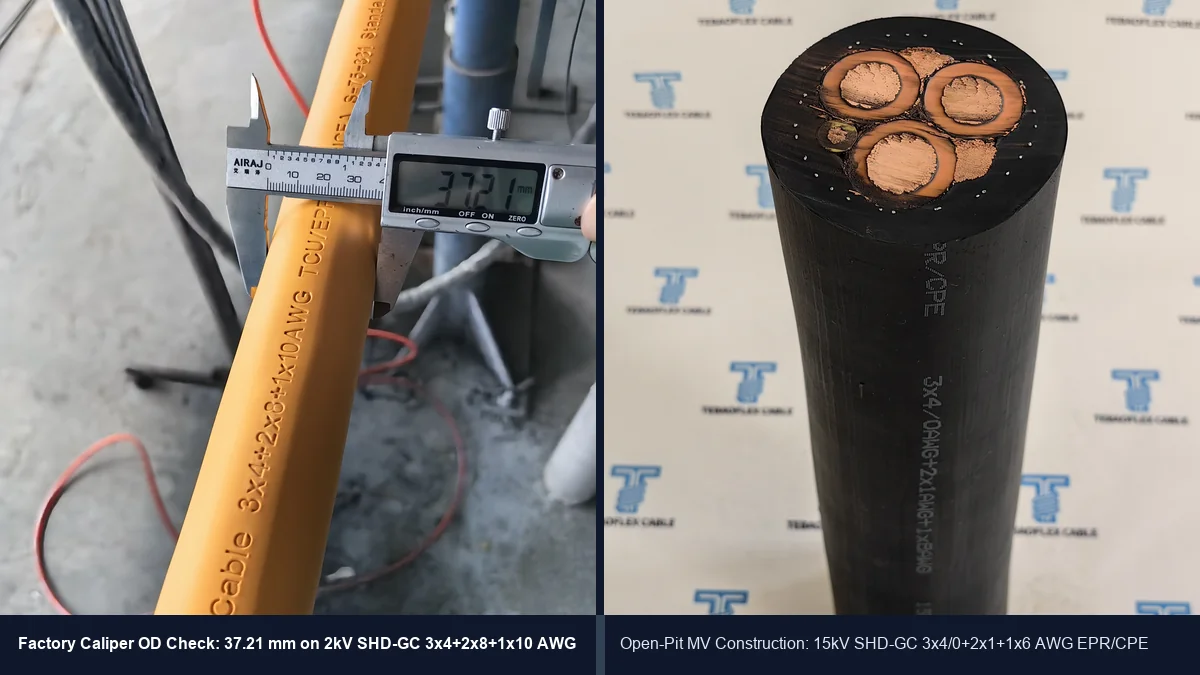
If a buyer orders a replacement cable by matching the swollen 5–6 mm oversize field caliper reading rather than the actual IEC 60228 / ICEA S-75-381 copper cross-section (mm² or AWG) and voltage class, the resulting cable will be one or two gauge sizes too large—causing the new cable to exceed drum layer capacity and jam existing fairlead rollers. Verify the conductor cross-section, core count, and nominal new-cable OD on the factory inspection caliper (for example, 37.21 mm measured on a new 2 kV Type SHD-GC 3×4+2×8+1×10 AWG cable under ICEA S-75-381) against your coupler gland ID.
2. Trailing or festoon duty vs dynamic reeling: adding an anti-torsion reinforcement braid
A common failure in both open-pit stockyards and underground declines occurs when a standard unreinforced trailing or festoon cable is wound onto a motor-driven or spring-loaded reeling drum. Without torsional stabilization, differential friction between the inner and outer jacket surfaces causes the outer sheath to creep relative to the core assembly, producing spiral corkscrewing (birdcaging) and snapping the pilot core.
When converting a cable specification from free trailing or festoon suspension to outdoor or underground drum reeling, TEBAOFLEX vulcanizes an open-weave synthetic or polyaramid anti-torsion reinforcement braid directly between the inner and outer elastomer sheath layers. Because this open-weave braid is integrated into the double-extruded sheath wall, it locks the core lay against torsional twist without increasing the cable’s nominal outside diameter.
3. Total machine installed kW vs single-feeder simultaneous load calculation
During emergency cable replacements under DIN VDE 0298-4 or ICEA S-75-381 (when the original cable print is worn off and only the machine’s main nameplate is available), buyers sometimes sum every electric motor on the rig—for example, quoting a 436 kW total installed crane or excavator rating and asking whether a medium-sized 35–95 mm² reeling cable can carry 436 kW continuously. Carrying 436 kW simultaneously at low voltage would require a massive feeder exceeding 3×400 + 1×240 mm², which cannot physically wind onto a mobile machine reel.
On mobile mining machines, drill jumbos, and cranes, individual drives (cutter/boom motors, hydraulic packs, slewing motors, and tramming drives) never run simultaneously at 100% continuous full load: tramming motors disengage during face drilling, and hoist/luffing/slewing drives operate on intermittent duty factors. Size the cable conductor cross-section from the maximum simultaneous demand current (plus drum layer derating under AS/NZS 3008 / DIN VDE 0298-4 to keep PCP sheath surface temperature below 85 °C and EPR conductor temperature below 90 °C), or match the actual conductor cross-section (mm² / AWG) terminated at the machine’s main circuit breaker.
Export drum sizing (20GP vs 40GP), split air-sea dispatch, and customs technical datasheets
International mining cable procurement involves heavy flanged wooden or steel drums, strict ocean container geometry, and detailed customs tariff inspection—especially when shipping into Latin American (Peru, Chile, Mexico), African (South Africa, Zambia, DRC), or Australian mine sites (see our dedicated mining cable drum dimensions and container loading guide for full PN 1000–PN 2200 drum tables and customs templates).
Why a 20GP container hits its volume limit at ~9.2 tons (4 reels) before its weight limit
Buyers calculating ocean freight for heavy mining cables such as Type SHD-GC, Type G-GC, AS/NZS 1802 / 2802, or (N)TSCGEWOEU often assume a standard 20GP container can load 18–20 metric tons of cable. In practice, mining cables require large-flange drums (1,600 mm to 2,200 mm flange diameter) to respect the 6 × OD to 12 × OD minimum barrel bending radius.
Because cylindrical flanged reels leave unavoidable void space inside a standard ISO 668 20GP container (5.9 m × 2.35 m × 2.39 m), a 20GP container typically reaches its physical volume ceiling at 4 large reels totaling approximately 9.0 to 9.2 metric tons gross weight—less than half of the container’s payload limit. To lower landed freight cost per meter, TEBAOFLEX engineers help buyers optimize reel loading in two ways:
- Maximize meterage per drum within flange capacity: When
4drums already fill the floor footprint of anISO 66820GPcontainer but each drum still has radial flange margin, adding~250–300 mof cable onto each reel increases total shipped meterage with almost zero change in ocean container freight. - Compare
40GP / 40HQcontainer consolidation: For multi-size mine orders exceeding4large drums, consolidating onto anISO 66840GPor40HQcontainer doubles the floor length (12.03 m) while still remaining comfortably below road-axle weight limits.
Splitting 50–100 m via air freight while shipping the balance by sea (70–85 day corridors)
When a cable fire or rock-fall sever halts an underground heading or open-pit production drill on an inland route, combined manufacturing, trans-Pacific ocean transit to ports such as Manzanillo, Callao, or Durban, customs clearance, and inland trucking can span 70–85 days. For urgent maintenance orders—such as a 1,000 m order of underground P1209 monitoring/power cable or ICEA S-75-381 2 kV Type G-GC—TEBAOFLEX can wind the first 50 m to 100 m onto a compact air-freight reel for immediate air dispatch as soon as factory spark and high-voltage testing finish, while the remaining 900 m ships economically by sea container.
Six-item customs technical datasheet (Ficha Técnica) and field Megger verification
Customs authorities in mining jurisdictions—such as Peru’s SUNAT or Mexican Pedimento Aduanal Clave A-1 clearance brokers—frequently place technical holds on imported mining cables if the commercial invoice only lists a short code like "SHD-GC 3x4 AWG" without a signed manufacturer technical datasheet (ficha técnica). To prevent port demurrage, TEBAOFLEX provides signed, stamped technical datasheets itemizing six mandatory construction disclosures:
- Conductor material and stranding: Phase, grounding, and ground-check/pilot copper purity, tinned vs bare finish, and stranding class (
AS/NZS 1125,ASTM B33 / B172, orIEC 60228Class 5/6). - Primary insulation compound: Exact thermoset or elastomer compound (
EPR,R-EP-90,XR-EP-90, orXLPE) and nominal wall thickness. - Screening and separator layers: Semi-conductive elastomer extrusion/tape and tinned copper braid shield (
pantalla trenzada) or composite copper/nylon screen percentage coverage. - Inner and outer sheath polymer: Exact inner bedding and outer jacket material (
HD-85-PCP,XHD-85-PCP,CPE, orTPU / PUR), sheath color, and optional reflective strip integration. - Central cradle, fillers, and anti-torsion reinforcement: Elastomeric center profile, polypropylene/rubber interstices, and open-weave anti-torsion reinforcement braid between jackets.
- Governing standard and rated voltage: Explicit standard reference (
ICEA S-75-381,AS/NZS 1802 / 2802,MT/T 818,DIN VDE 0250) and voltage rating ($U_0/U$).
Before dispatch, every production reel undergoes conductor DC resistance verification, high-voltage spark and AC/DC dielectric withstand testing, and dimensional caliper inspection (with production video tracking available from conductor stranding through copper braid shielding and final jacketing). Upon arrival at the mine site, maintenance electricians can verify shipping integrity under ICEA S-75-381 / AS/NZS 1802 before coupler termination using a handheld 500 V or 1000 V insulation resistance tester (such as a Fluke 1503 Megger) between phase-to-phase and phase-to-earth/shield circuits.
How to specify your underground or surface mining cable RFQ
Sending a complete operating schedule allows TEBAOFLEX engineers to recommend the exact underground coal, hard-rock heading, or surface open-pit construction and calculate optimal drum dimensions for 20GP or 40GP container loading:
For open-pit electric rope shovels, walking draglines, and rotary blast-hole drills engineered to GOST 10348-80 at 1.14 kV, 3 kV, and 6 kV in -50 °C cold-climate operations, select: KGE, KGESh and KGETSh 1.14 to 6kV GOST Mining Cable.
- Mine environment and machine type: Specify whether the cable operates in an underground coal mine (longwall shearer, continuous miner, shuttle car, roadway feeder), underground hard-rock / tunnel heading (drill jumbo, LHD scooptram, roof bolter, vertical borehole/shaft, VFD drive), or surface open-pit mine (electric shovel, dragline, blast-hole drill, bucket-wheel excavator, or submersible dewatering pump).
- Standard, voltage rating, and core configuration: State the target standard (
AS/NZS 1802 / 2802,ICEA S-75-381 SHD-GC / G-GC,MT/T 818 MCP / MYPTJ,GB/T 12972 UGF, orDIN VDE 0250 GPM-RF / (N)TSCGEWOEU), system voltage ($U_0/U$), phase cross-section (mm²orAWG), earth core size, and pilot/control core count (for example,3×35+1×16+2×6 mm²,3×50+1×25+2×10 mm², or3×4+2×8+1×10 AWG). - Reeling vs trailing kinematics and OD constraints: Confirm whether the cable trails on the ground, hangs in a festoon/Bretby chain, or winds under tension onto a reel (requiring an integrated anti-torsion braid), and state any coupler gland ID or maximum new-cable
ODlimits. - Sheath compound and visibility options: Choose between
PCP,CPE, or high-abrasionPUR / TPUouter jackets, high-visibility colors (yellow, green, orange, or black), sequential meter marking, and optional underground reflective strips. - Cut lengths, container drum plan, and destination port: Specify cut lengths per drum (
100 m,250 m,300 m, or500 m), whether split air-freight + sea-freight delivery is required, and destination customs documentation needs. Per TEBAOFLEX’s verified company profile (as of August 2026), the minimum order quantity is50 mfor standard and custom cables, with typical production lead times of7–45 working daysdepending on cable type and customization.
Request a technical datasheet and quotation for your underground or surface mining cable project to receive cross-sectional drawings, nominal OD and weight schedules, and drum-loading plans tailored to your mine site.